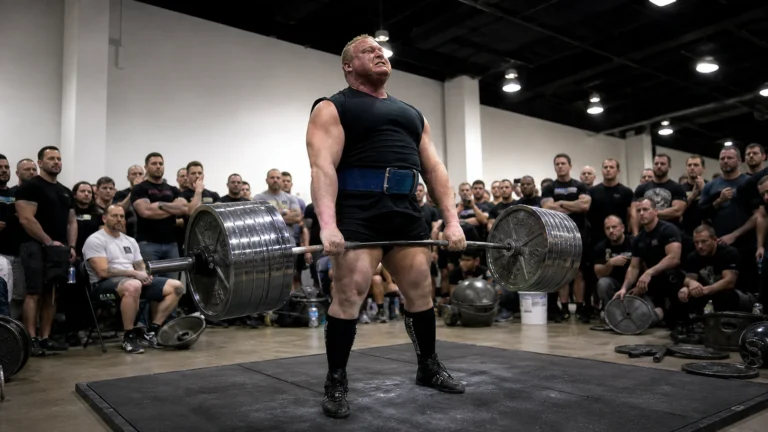

Vince Gironda was one of the most colorful coaches in bodybuilding history.
He is often credited with a method called 8×8: eight sets of eight reps on an exercise, with short rests.
A widely shared version says it was built to sharpen muscle definition.
The 8×8 label is well tied to Gironda. Some of the details around it are harder to pin down.
It is also a demanding style of training that most beginners do not need.
Who Vince Gironda Was
Gironda was born in the Bronx, New York, on November 9, 1917.
He died on October 18, 1997, in Ventura County, California, at age 79.
In 1948, he opened Vince’s Gym in North Hollywood, California.
His gym drew a long list of famous names, including Larry Scott, Frank Zane, Arnold Schwarzenegger, and Lou Ferrigno.
He was known for strong opinions and unusual methods.
We covered one of those opinions in our fact check of Vince Gironda’s anti-drug stance.
What 8×8 Actually Was
A scanned Gironda arm-specialization letter gives direct historical evidence, not just a later retelling. It prescribes eight sets of eight reps for parallel dips and long-pulley rows, six sets of eight for a paired curl sequence, and eight sets of twenty for calves. This is one person’s six-day routine, not proof that every Gironda client followed the same universal template.
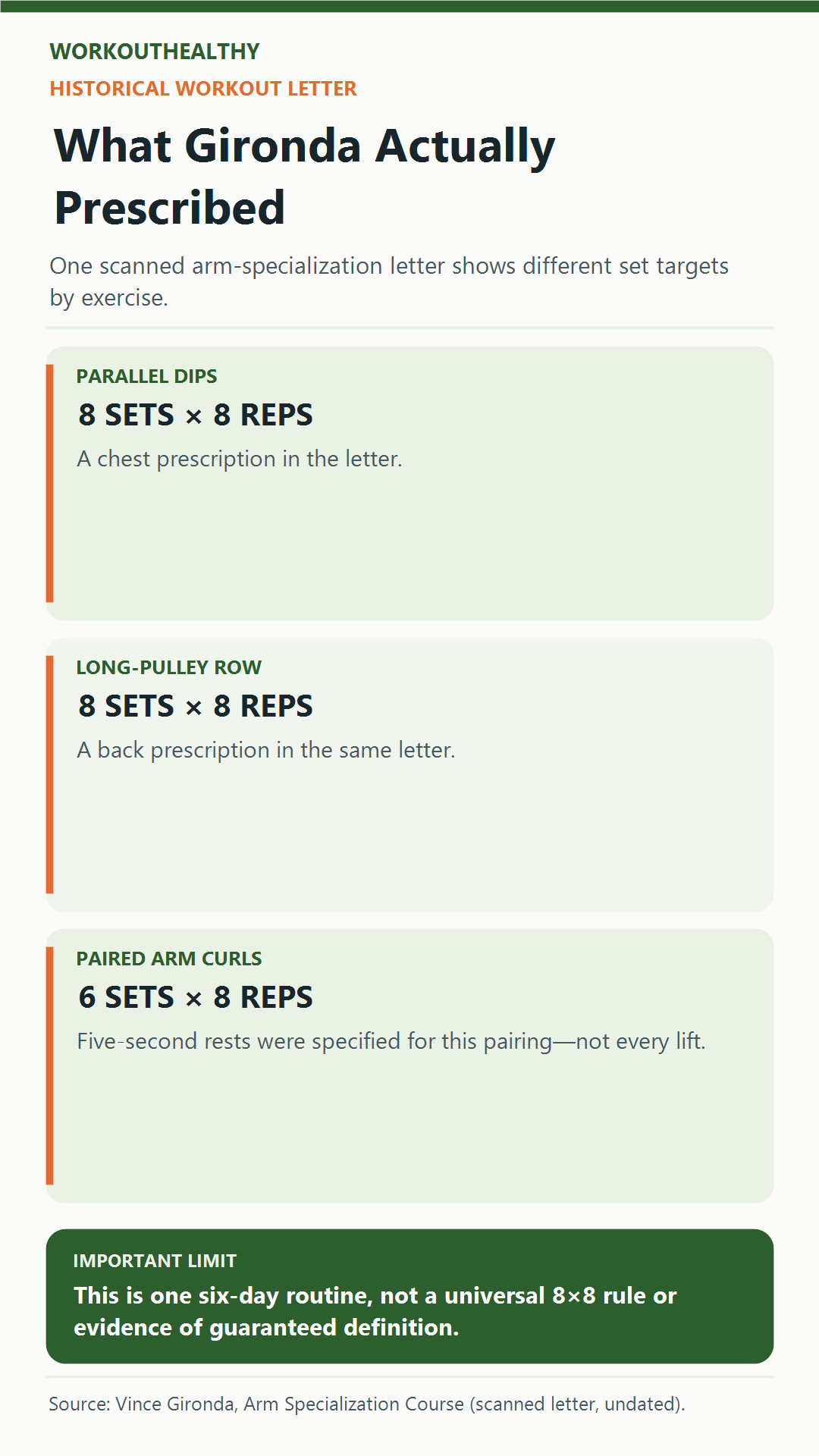
Later accounts describe an “honest” 8×8 program emphasizing controlled work and manageable loads. The scanned arm letter confirms several eight-rep prescriptions, but it does not establish that nickname, a standardized beginner ramp, or one load rule for every exercise. Treat those as separate claims rather than reading them into this document.
How Advanced Lifters Used It
The scanned arm letter describes a six-day schedule, split into three upper-body and three leg workouts. It assigns different set-and-rep targets to different exercises rather than a blanket eight sets for everything.
That is a specialized historical program, not a general fitness plan. Its volume and frequency should not be copied wholesale by a beginner, and the letter’s nutrition advice is not an evidence-based modern recommendation.
Checking the Short Rest and Definition Claims
Gironda’s scanned arm letter explicitly calls for only five seconds of rest between sets of one paired curl sequence. That is a primary-source short-rest instruction, but it does not establish a five-second rule for every exercise in the letter or for all versions of 8×8.
The letter documents high-volume set prescriptions; it does not demonstrate that any set-and-rep scheme guarantees visible “definition.” That appearance depends on muscle and overall body composition, not a special metabolic effect of 8×8.
More sets can build more muscle, but only if you can recover from them and still lift with good form.
What Research Says About Volume
Eight sets of one exercise is a lot of volume.
A 2017 meta analysis by Brad Schoenfeld, Dan Ogborn, and James Krieger looked at weekly training volume and muscle growth.
It pooled 34 treatment groups from 15 studies.
Each extra weekly set was linked with a small added gain in muscle size.
Higher volume groups gained about 3.9 percent more than lower volume groups.
The authors described a graded dose response, where more volume generally produced more growth.
Is more always better? Not necessarily within one exercise.
A 2017 study by Theban Amirthalingam and colleagues tested German Volume Training, a 10 set method.
Nineteen healthy men trained for six weeks with either 10 sets or 5 sets per exercise.
Both groups gained lean mass.
But the 5 set group gained more trunk lean mass, with a similar trend for the arms.
The authors suggested that 4 to 6 sets per exercise may be enough to optimize growth.
That cautions against assuming every added set pays off. It does not establish one universal ceiling for all lifters or exercises.
What Research Says About Short Rests
Short rests make a workout feel harder, but harder is not always better.
In a 2016 study, Brad Schoenfeld and colleagues compared 1 minute and 3 minute rests in 21 trained men.
After 8 weeks, the 3 minute group gained significantly more strength on the bench press and squat.
The authors also reported that the longer rest periods supported muscle growth in these trained lifters.
That challenges the old idea that very short rests are best for building muscle.
Why the Studies Do Not Set a Universal Eight-Set Limit
The volume meta-analysis counted sets across a week. It did not test Gironda’s exact eight-set sequence, his exercises, or his rest periods. A person doing eight sets for one muscle once a week is also not following the same plan as a competitive bodybuilder doing that sequence for several exercises and muscle groups. The number on one exercise card cannot tell you the full weekly dose.
The German Volume Training experiment compared five and ten sets per exercise in only nineteen men over six weeks. Its results challenge the assumption that doubling sets necessarily doubles growth. They do not establish that four, five, or six sets is an exact ceiling for every person, muscle, or training age. Eight well-controlled sets might be a useful temporary challenge for one experienced lifter and too much for another.
Rest duration changes what those sets mean. When breaks are very short, later sets may require a much lighter load or fewer completed repetitions. A session can feel brutally hard while providing less high-quality work than a shorter plan with enough recovery between sets. The rest-period study in trained men supports questioning a blanket short-rest rule, but it also did not directly test Gironda’s historical program.
How to Evaluate a Trial of the Method
If an experienced lifter wants to experiment with 8×8, keep the comparison fair. Use one familiar exercise, record the load and repetitions completed in every set, and write down the actual rest periods rather than estimating them afterward. Keep the rest of the week’s training reasonably stable. That makes it easier to see whether the new block is improving work capacity or simply adding fatigue.
Watch for consistent form, a manageable decline in later-set performance, and recovery by the next planned session. If the first sets are easy but the last ones collapse into shortened range, swinging, or joint pain, reducing the load, lengthening rest, or returning to fewer sets is a better decision than chasing all 64 repetitions at any cost. The point of a historical method is to learn what dose you can repeat, not to prove that one famous coach’s number is magic.
What About Definition?
Visible definition depends mostly on muscle size and body fat.
No single set and rep scheme strips fat from a specific area.
A hard, high volume session can make muscles look fuller for a short time, but that effect fades.
Lasting definition comes from building muscle over months and managing overall body fat.
Our article on whether building muscle is as simple as one coach claims covers the basics.
How to Try a Scaled Down 8×8
- Start below eight sets. Build familiarity with the exercise and a recoverable weekly plan before testing a high-volume block.
- Use one familiar movement first. Do not copy the letter’s full six-day volume as a beginner.
- Choose a manageable load. Leave room to maintain range and control across the later sets.
- Rest as needed. The letter’s five-second rest applies to one paired arm sequence, not a universal rule; lengthen breaks when performance collapses.
- Keep the trial short. Review performance and recovery after a few weeks rather than assuming more sets are always better.
- Keep reps controlled. Stop or scale back if form, range, or joint comfort deteriorates.
If you like fast paced sessions, our guide to circuit training benefits offers another way to train with short breaks.
Who Should Skip It
True beginners usually progress well on far fewer sets.
People with joint pain may find the repeated sets aggravating.
Anyone with heart or blood pressure issues should check with a doctor before very short rest, high volume training.
The Bottom Line
A scanned Gironda arm-specialization letter confirms several eight-rep set prescriptions and a five-second rest instruction for one paired arm sequence. The letter does not make that rest rule universal, establish an “honest” nickname, or show that 8×8 creates definition.
Research supports the value of enough weekly volume, but one small five-versus-ten-set trial does not establish a universal per-exercise ceiling. Longer rests can preserve strength and set quality; the best dose still depends on the rest of the program and the lifter’s recovery.
Use 8×8 as a short, advanced tool, not a starting point.
Want more stories like this? Subscribe to WorkoutHealthy Insider for practical explanations behind popular fitness claims.
References
- Amirthalingam, T., Mavros, Y., Wilson, G. C., Clarke, J. L., Mitchell, L., & Hackett, D. A. (2017). Effects of a modified German volume training program on muscular hypertrophy and strength. Journal of Strength and Conditioning Research, 31(11), 3109 to 3119. https://doi.org/10.1519/JSC.0000000000001747
- Schoenfeld, B. J., Ogborn, D., & Krieger, J. W. (2017). Dose response relationship between weekly resistance training volume and increases in muscle mass: A systematic review and meta-analysis. Journal of Sports Sciences, 35(11), 1073 to 1082. https://doi.org/10.1080/02640414.2016.1210197
- Schoenfeld, B. J., Pope, Z. K., Benik, F. M., Hester, G. M., Sellers, J., Nooner, J. L., Schnaiter, J. A., Bond-Williams, K. E., Carter, A. S., Ross, C. L., Just, B. L., Henselmans, M., & Krieger, J. W. (2016). Longer interset rest periods enhance muscle strength and hypertrophy in resistance-trained men. Journal of Strength and Conditioning Research, 30(7), 1805 to 1812. https://doi.org/10.1519/JSC.0000000000001272
- Gironda, V. Arm Specialization Course (scanned original workout letter). View the one-page scan.
This article is for general information only and is not medical advice. If you have an injury, ongoing pain, or a medical condition, talk to a doctor or physical therapist before you change how you train or eat.