
Weak glutes and knee pain can occur together without proving cause. For diagnosed patellofemoral pain, research supports hip and knee exercise as treatment.
A treatment can help without proving what caused the condition.
This article examines that claim for patellofemoral pain, a particular kneecap pain condition. Its evidence does not describe every painful knee, and the information cannot diagnose your symptoms.
Can weak glutes cause knee pain?
The broad claim is stronger than the available research supports. A prospective risk-factor review followed evidence from 18 studies involving 4,818 participants, including military recruits, adolescents and recreational runners.
Hip weakness did not predict future patellofemoral pain in the pooled findings. In the adolescent subgroup, higher hip abduction strength was associated with later pain, illustrating why a simple “weaker hip equals painful knee” rule is unreliable.
This does not mean strong hips cause knee pain or that hip strength never matters. The review found differences between populations and limitations in the available evidence, rather than a universal explanation for an individual knee.
Checking strength after pain starts answers another question: what is happening now? It cannot by itself establish what came first.
Three questions that often get mixed together
| Question | Evidence that would help answer it | What it would not establish |
|---|---|---|
| Are painful knees associated with weaker hips? | Measurements comparing people with and without the condition. | Whether weakness preceded pain, followed it or shares another explanation. |
| Does weakness predict a new case? | Strength measured before symptoms, followed by observation over time. | That changing that measurement will necessarily prevent the condition. |
| Does an exercise program improve symptoms? | A treatment trial comparing outcomes between groups. | That the program corrected the original cause, or that every component was essential. |
Read the claim before reading the exercise list. “This program helped people with a diagnosis” makes a different promise from “this muscle caused your pain.”
A useful comparison is a set of three separate folders: association, prediction and treatment. Evidence placed in one folder should not silently be moved into another.
What hip and knee exercise trials found
A 2018 review by Nascimento and colleagues included 14 trials and 673 people with patellofemoral pain. Combined hip and knee strengthening improved average pain and activity outcomes more than knee strengthening alone.
The same review found no statistically significant pooled strength changes for its interventions. That result does not prove that no participant gained strength; it means the review did not detect a significant average strength change in those analyses.
The treatment finding supports considering the hip alongside the knee. It does not establish that a weak glute caused most kneecap pain or that exercise physically repositioned everyone’s kneecap.
Adding hip work to knee work does not test replacing knee exercise. Do not discard a prescribed knee component on that basis.
Does newer research connect strength gains with recovery?
Yes, there is evidence of a connection. A 2026 review by Nunes and colleagues included 82 trials with 4,023 participants and examined whether changes in strength accompanied changes in pain and function.
Strength improvements in several hip and knee muscle groups were associated with clinical improvement. However, the authors explicitly said their analyses could not establish causality or prove that strength gains mediated recovery.
Most included trials had high risk of bias, and results varied across analyses. The review studied relationships between outcomes rather than identifying one best exercise, dose or progression.
The reviews address different questions; neither makes strength irrelevant.
Which knee pain does this evidence concern?
The 2019 patellofemoral pain clinical guideline describes pain around or behind the kneecap that is reproduced during activities such as stairs, squatting or prolonged sitting. Clinicians also exclude other explanations before making that diagnosis.
The guideline recommends combined hip- and knee-targeted exercise therapy for people with the condition. It also recognizes different presentations, including muscle performance, movement coordination and mobility issues.
A knee moving inward during a task does not automatically prove weak glutes. The guideline specifically notes that movement coordination deficits are not necessarily caused by lower-limb muscle weakness.
That makes a mirror or a phone video a record of visible movement, rather than a stand-alone cause detector. A professional assessment can put movement observations together with symptoms, measured strength, history and other findings.
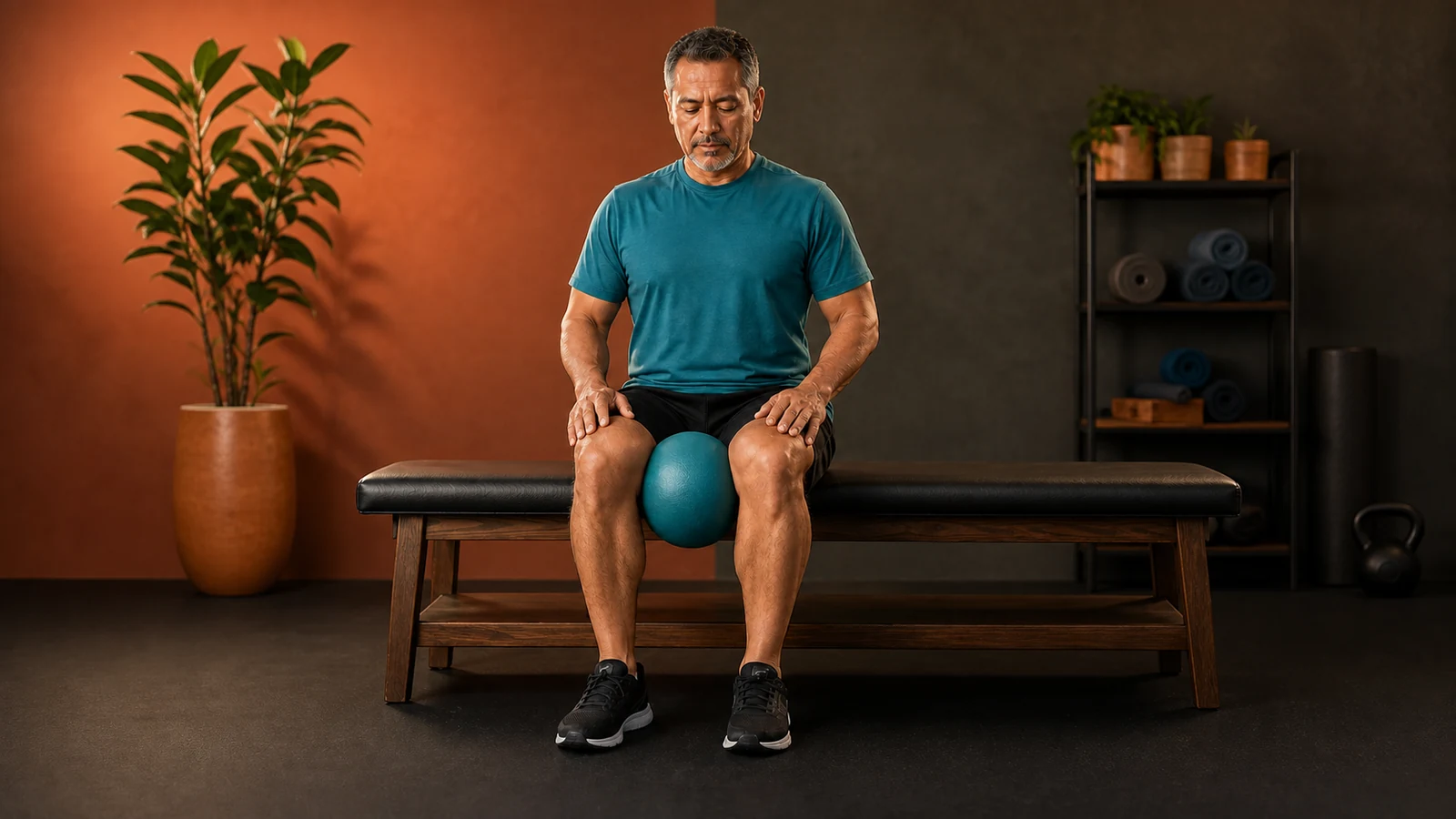
The featured illustration is general exercise imagery, not a diagnostic test or a demonstration of a treatment validated by these studies. A ball held between the knees cannot establish why a knee hurts.
A fictional example: improvement is useful, even without a cause label
Imagine Maya has been assessed for kneecap pain and follows a plan chosen with her physical therapist. At a follow-up she reports that her usual stairs are easier, and a repeated strength measurement has improved.
That is useful information about her progress. It still does not prove what originally caused her pain, whether one particular muscle explains the improvement or whether the same plan fits somebody else.
Now imagine the stairs improve but the strength measurement does not. That result deserves discussion too, rather than dismissal because it does not match a simple muscle-fix story.
This is a fictional illustration of reasoning, not a patient report or a predicted recovery timeline. There is no need to provoke pain or perform a new exercise to fill in the record below.
A practical record for your next appointment
Bring observations from ordinary life and any instructions you already received. Keeping the original wording makes the record more useful than arriving with a self-diagnosis copied from a video.
| Record | An example of useful detail | Question to ask |
|---|---|---|
| Where and when symptoms occur | “Around the kneecap on my usual stairs,” rather than “my glutes are switched off.” | What findings support the diagnosis, and what else needs consideration? |
| A change in usual activity | A different work shift, walking route, sport schedule or recent injury. | Which parts of that history affect the assessment? |
| The current plan | The actual exercise names, instructions and changes your clinician prescribed. | Why were these choices made for me? |
| The outcome being followed | A usual daily task and any clinician-administered measurements. | How will we judge progress, and when should the plan be reviewed? |
The record is a communication aid, not a scoring system. It has no cutoff that diagnoses weak glutes, proves recovery or clears someone to return to sport.
When a knee needs medical attention
Do not assume new or severe symptoms are a muscle-strength problem. NHS guidance advises urgent assessment for a very painful knee, inability to move it or bear weight, major swelling or shape change, locking or giving way, or fever with a red or hot knee.
For ongoing pain or limits in everyday activity, discuss an assessment with a qualified clinician or physical therapist. An online explanation cannot choose a rehabilitation program for your situation.
What to take from the weak-glute claim
Hip and knee exercise can help diagnosed patellofemoral pain. Its treatment value does not establish one weak muscle as the original cause.
When evaluating an explanation, ask what was measured, when it was measured and what comparison was made. Those three questions make a stronger starting point than a promise to realign or fix every knee.
Sources
- Neal et al. (2019): prospective risk factors for patellofemoral pain.
- Nascimento et al. (2018): hip and knee strengthening compared with knee strengthening alone.
- Nunes et al. (2026): associations between strength changes and clinical outcomes.
- Willy et al. (2019): patellofemoral pain clinical practice guideline.
- NHS: knee pain and when to seek help.
Medical disclaimer: This article provides general fitness and health information, not a diagnosis or an individualized rehabilitation plan. Consult a qualified clinician or physical therapist about knee pain, exercise selection and any changes to an existing treatment plan.