
How to increase walking speed: practice brief, comfortable faster sections on a familiar route, then compare your pace on the same marked stretch after several weeks. Keep your steps controlled and use breathing and comfort to set effort instead of forcing a universal stride length or steps-per-minute target.
The original Ask Your Nurse walking video prompted a question about common mistakes, but its full list of claims could not be independently verified. This guide focuses on what a walker can measure and what research can actually tell us about pace, cadence, and form.
Start with a baseline you can repeat
Choose a flat, safe stretch with two fixed landmarks and time how long it takes to walk between them at your normal, comfortable pace. Use the same shoes, direction, and approximate time of day when you repeat the check, and do not turn it into an all-out speed test.
Record the date, route, time in seconds, weather or surface conditions, and how hard it felt to talk while walking. If you use a watch, keep its GPS number as a secondary note because a short segment can be noisy.
| Check | What to do | What to record |
|---|---|---|
| Baseline | Walk your fixed segment at usual pace after a few easy minutes. | Time, route, surface, and talk-test effort. |
| Practice week 1 | On one or two usual walks, add two comfortable 30-second quicker sections with easy walking between them. | Whether the quicker pace stayed controlled and comfortable. |
| Practice weeks 2 and 3 | If week 1 felt suitable, try a third brief quicker section or make one section a little longer. | Effort, comfort, and any symptoms; hold or reduce the challenge when needed. |
| Week 4 recheck | On a separate easy day, time the same fixed segment at your usual pace. | Compare with baseline under similar conditions, not with someone else’s speed. |
This four-week card is an editorial practice example, not a studied protocol or a promise of improvement by week 4. If you are already walking briskly, you can keep a route log without adding intervals; if you have balance or cardiovascular concerns, ask a clinician or physical therapist how to practice safely.
Should you change cadence or stride length?
Walking speed reflects both step frequency and step length. Deliberately reaching far ahead to lengthen each step can feel awkward, so begin by letting your steps become a little quicker while keeping a comfortable stride and natural arm movement.
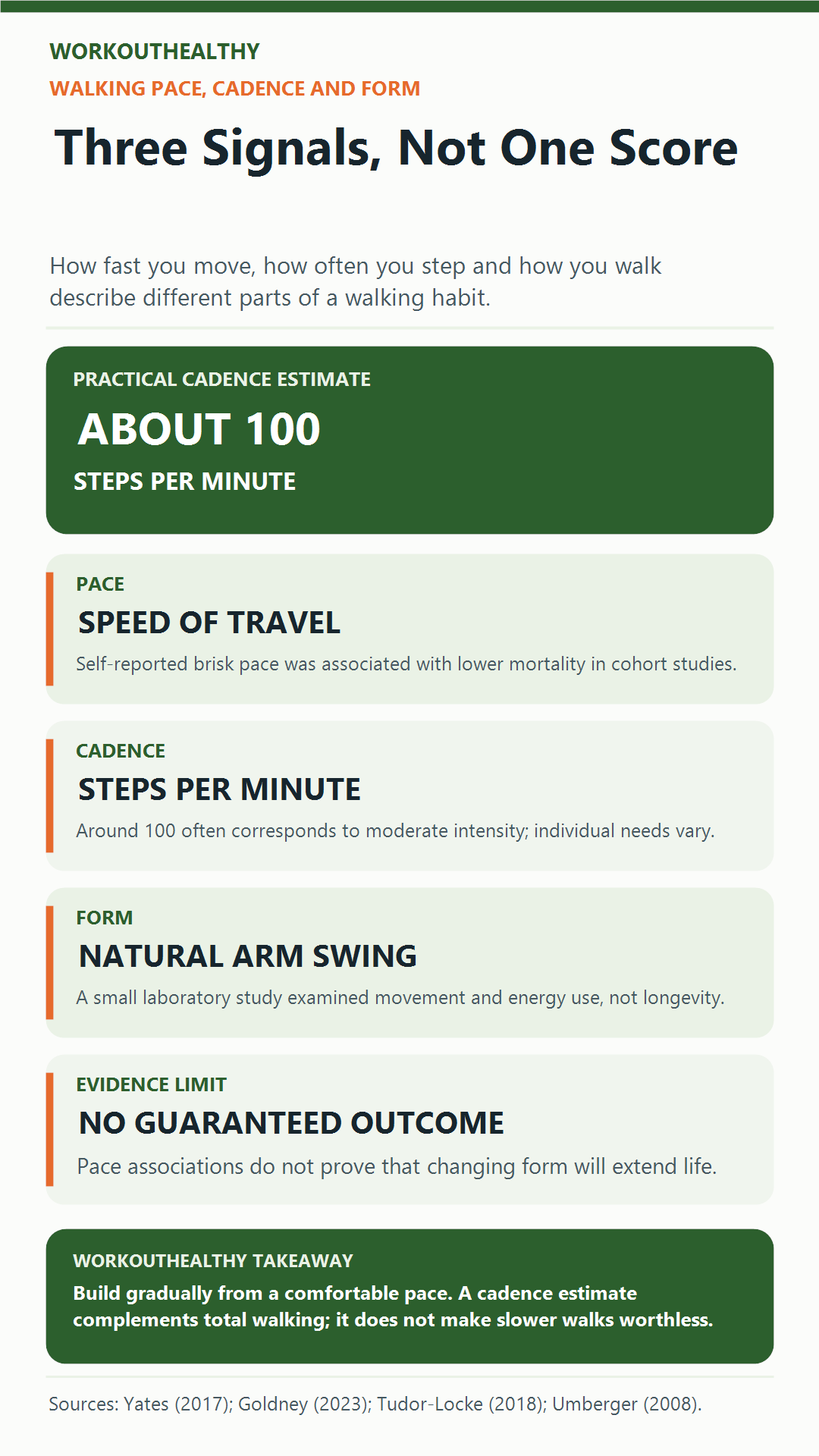
Research often cites about 100 steps per minute as a population-level marker for absolute moderate-intensity walking. In a lab treadmill study of 98 healthy older adults, the rounded threshold corresponded to about three metabolic equivalents, but the study did not test whether training at exactly 100 steps improves a person’s speed.
A related 97-person older-adult lab analysis found that thresholds differed when intensity was defined relative to a person’s own heart rate or perceived effort. Both studies are measurement studies, not four-week walking interventions, and neither makes one cadence mandatory for all walkers.
The CDC talk test offers a simpler check: at moderate personal effort you can usually talk but not sing. Count steps if you enjoy tracking them, but let comfort and any medical guidance take precedence over a fixed number.
Does walking faster mean you will live longer?
In a UK Biobank study, people who described their usual pace as brisk had lower mortality during follow-up than those who described a slow pace. A later analysis of self-reported pace found a similar pattern across causes of death.
These are observational comparisons, not experiments that assigned people a pace. Brisk pace may partly reflect existing fitness or health, so the studies cannot promise that speeding up one person’s walk will lower their mortality risk.
A faster section can still be a practical way to add personal aerobic challenge when it feels safe and sustainable. Total walking time and other activity remain useful even when you choose an easy pace, as our separate daily-steps evidence guide explains.
What about posture and arm swing?
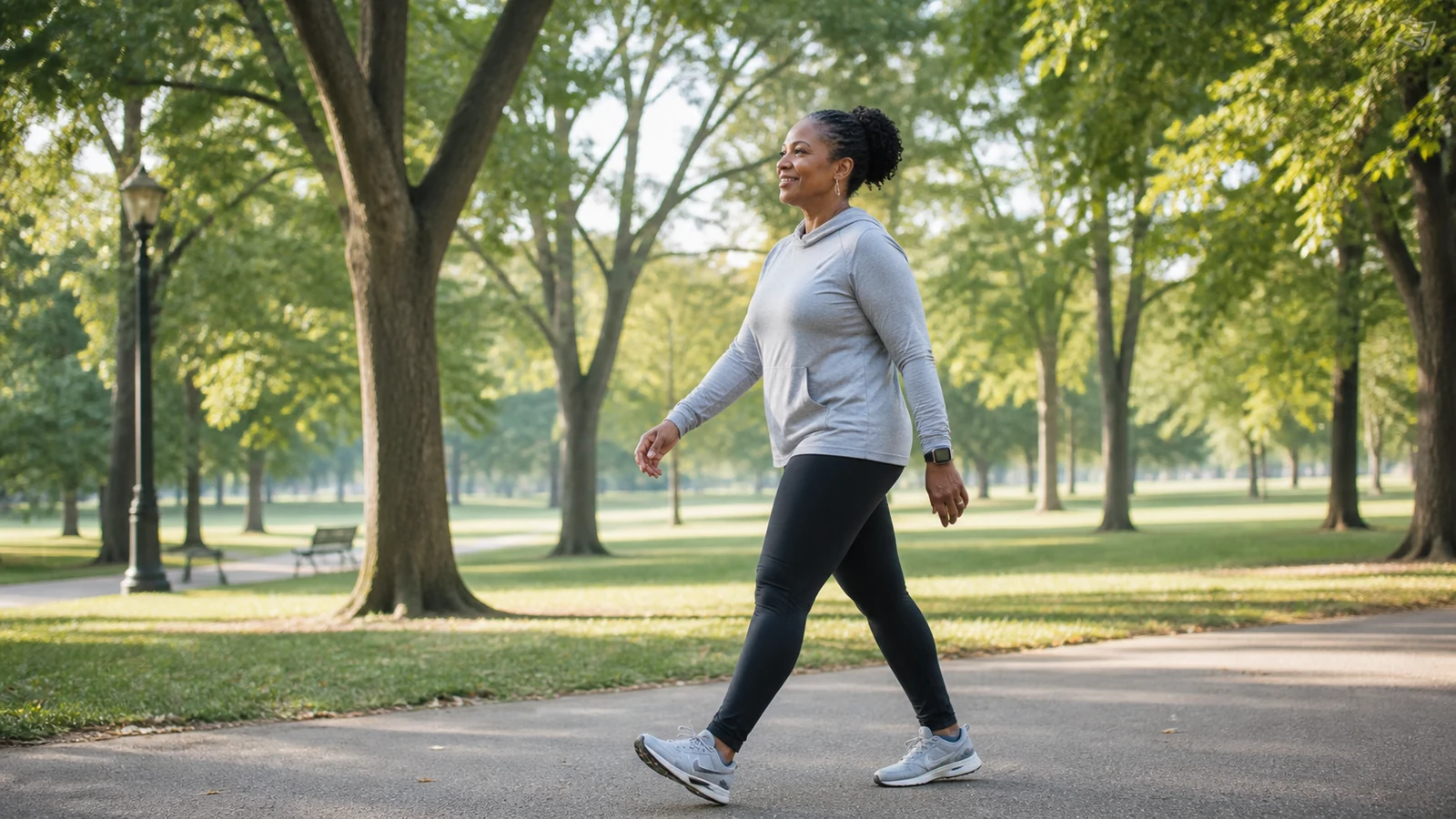
Look ahead enough to see the path, allow a comfortable arm swing, and avoid a stride that makes you brake or reach. These are comfort and awareness cues, not proven ways to prevent disease or injury.
A small biomechanics study of eight adults compared normal walking with deliberately suppressed arm swing at matched speed and stride frequency. It found some changes in mechanics and a modest rise in energy cost, but it did not test a special arm-swing style, long-term speed training, or injury prevention.
If walking faster brings pain, new instability, or worsening foot symptoms, slow down and review the cause. Shoes, terrain, balance, and an underlying condition may matter more than a generic form cue.
When to get individual help
A new limp, repeated falls, marked shortness of breath, chest symptoms, or leg pain that reliably appears with walking deserves a clinical assessment. Seek urgent care for chest pain, fainting, or severe or unusual breathlessness during activity.
If a medical condition, medication, recent surgery, or joint problem affects walking, ask a clinician or physical therapist whether and how to progress. McMaster Optimal Aging provides formal short-distance walking tests and exercise handouts, but a home route log is not a diagnostic test or substitute for a gait assessment.
Watch the original video
The Ask Your Nurse video is preserved here as the source of the walking-mistakes question. The baseline-and-retest card above is our own editorial tool and was not evaluated in the video or the cited studies.
Sources
- CDC: talk test and relative activity intensity.
- CADENCE-Adults: older-adult absolute cadence thresholds.
- CADENCE-Adults: older-adult relative-intensity cadence analysis.
- Yates and colleagues (2017): self-reported walking pace and mortality; Goldney and colleagues (2023): subsequent UK Biobank analysis.
- Umberger (2008): arm-swing biomechanics.
This is general fitness information, not medical advice or a diagnostic walking test. If you have a medical condition, new walking symptoms, or an injury, discuss pace changes with a clinician or physical therapist.