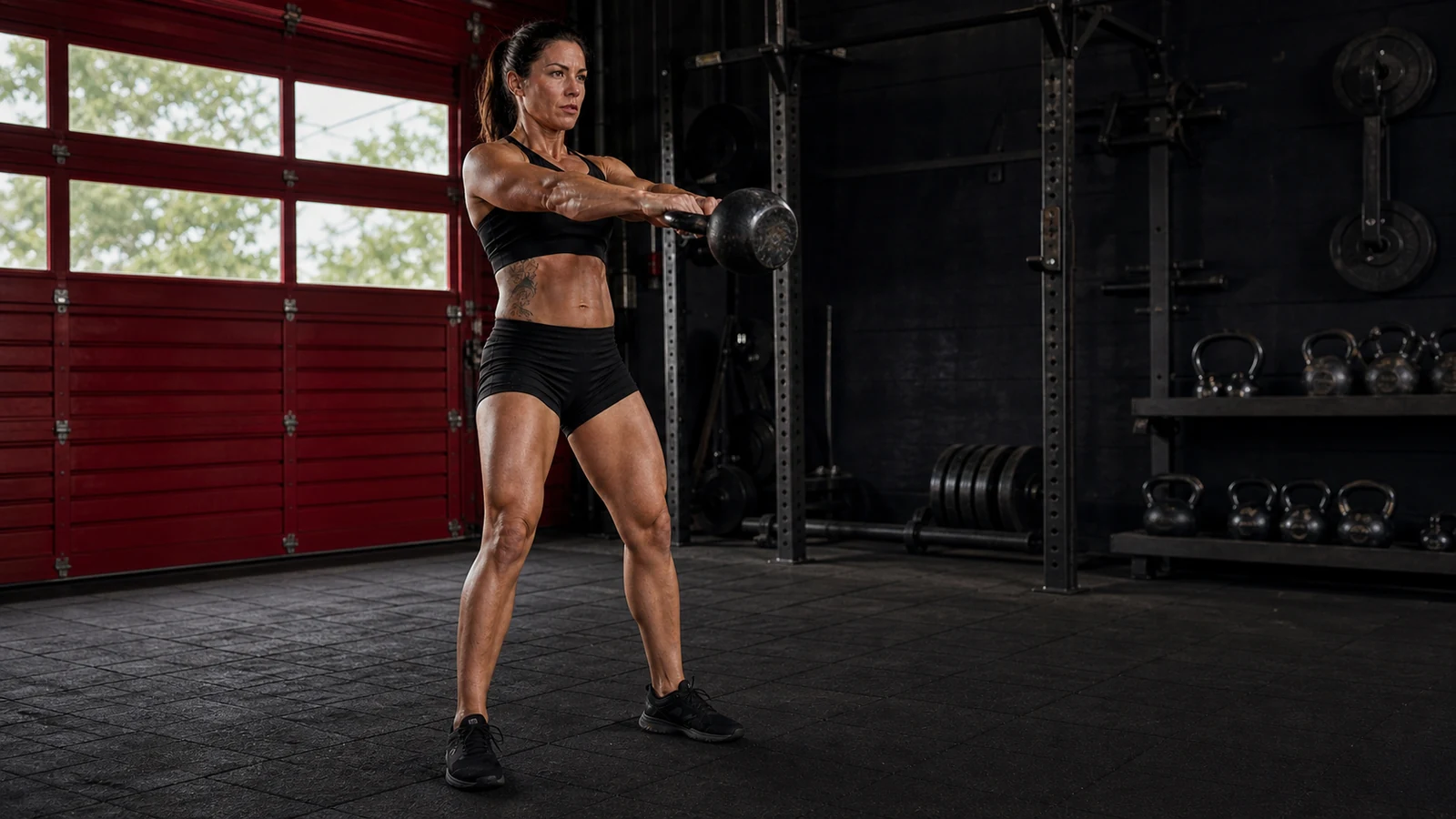

What is the Simple and Sinister program? Pavel Tsatsouline’s kettlebell approach centers on the swing and the Turkish get-up.
StrongFirst’s published challenge standard describes 100 one-arm swings and 10 get-ups total, alternating sides; it is not 10 get-ups per side.
That standard is an advanced goal to understand, not a beginner workout to copy immediately. The name is also easily confused with a separate StrongFirst article called Simply Sinister, which adds a snatch and reverse get-up to a different session.
Simple and Sinister at a glance
| Question | Accurate short answer |
|---|---|
| What are the core movements? | Kettlebell swing and Turkish get-up |
| What does the published challenge count? | 100 swings and 10 get-ups total, with sides alternating |
| Are the timed challenge standards everyday pace targets? | No. A challenge test is not a command to rush ordinary practice. |
| Is Simply Sinister the same plan? | No. That StrongFirst article describes a related variant with snatches and reverse get-ups. |
| Do two moves cover every fitness goal? | No. Goals involving aerobic endurance, maximal barbell strength or a full range of movement patterns may need more. |
The complete program includes technique, preparation, progressions and decisions about rest and loading that belong to its official materials. This page clarifies the names and evidence without presenting a substitute copy of the book.
Which Simple and Sinister source are you reading?
The official StrongFirst challenge page sets out the swing and get-up test standard, including 10 get-ups total. Some summaries say 10 per side, which would double the prescribed count.
A separate StrongFirst post, The Simply Sinister Training Plan, is an author’s compressed variant with a snatch and a reverse get-up. Its title looks similar, but the extra movement and format make it a different plan.
People comparing editions of Kettlebell Simple & Sinister may also see differences in how daily practice, rest and the timed goal are described. Use the edition you own and the official source for its details rather than stitching together a schedule from conflicting forum summaries.
What do the swing studies support?
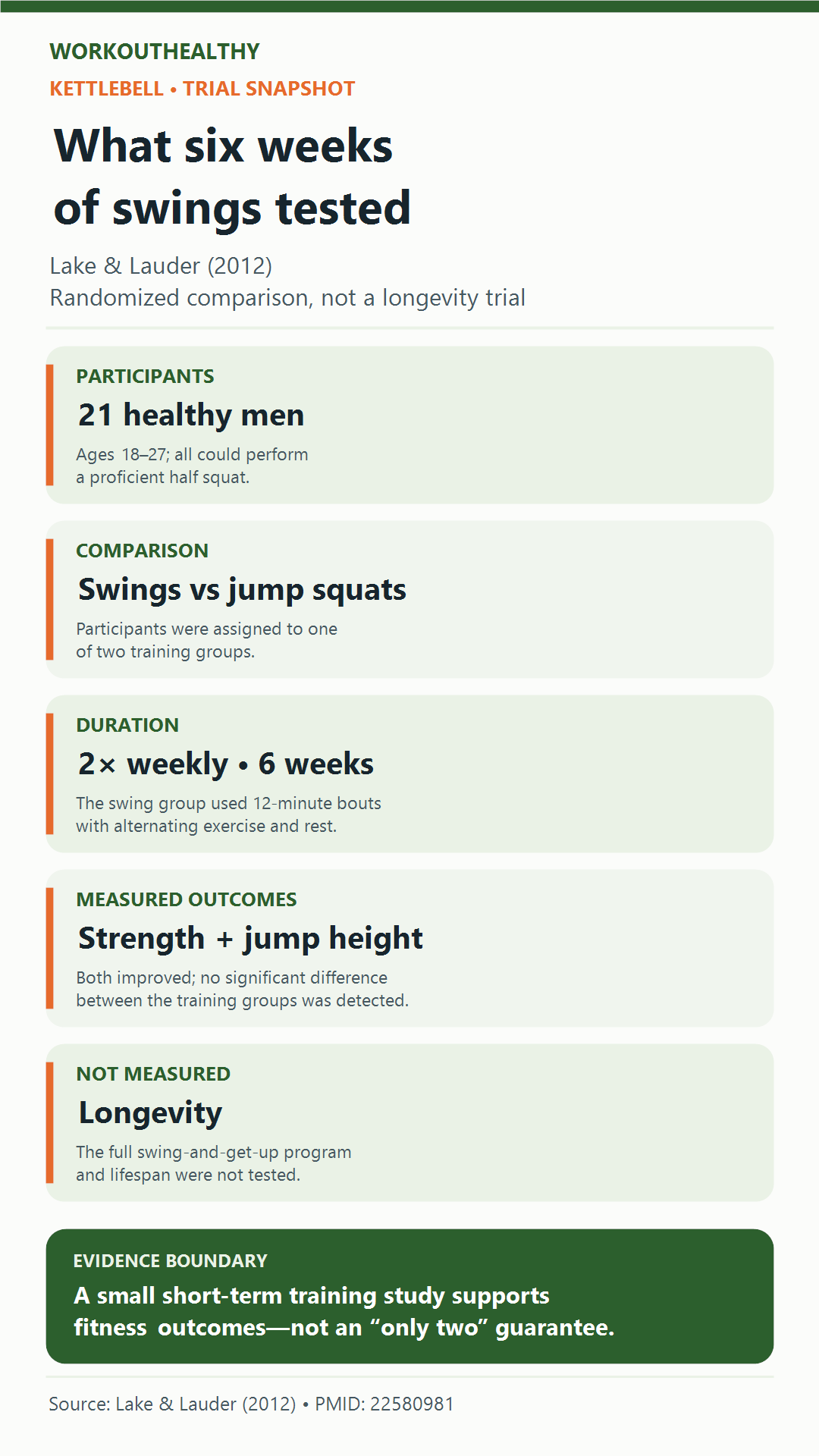
Lake and Lauder studied 21 young men for six weeks, comparing swing training with jump-squat training. Strength and vertical-jump measures improved over the intervention, and the groups did not differ significantly on the reported comparison; the study did not test get-ups or the complete branded program.
Another 2012 trial randomized 30 young men to kettlebell training or a weightlifting program for six weeks. Both groups improved selected measures, but weightlifting produced greater maximal-strength gains; neither program significantly changed the measured body-composition outcomes.
A no-difference result for body composition cannot be turned into a claim that both programs improved it. It also does not erase the measured strength differences.
What the biomechanics study cannot prove
McGill and Marshall measured muscle activation, motion and estimated spine loads during kettlebell movements in seven men, with an additional single case. The swing involved meaningful low-back loading and a distinct shear pattern, so that laboratory study does not prove swings are inherently safe for every back.
Technique and load matter, especially for a fast hip-hinge movement and an overhead get-up. If either move provokes pain or cannot be controlled, stop and seek individual coaching or clinical advice rather than trying to hit a branded count.
What two movements emphasize and what they leave out
| Goal | How the two movements contribute | Possible gap |
|---|---|---|
| Hip-hinge practice and hip power | The swing practices a loaded hip hinge | It does not directly replace a progressive plan for every maximal-strength goal. |
| Whole-body coordination | The get-up combines a floor rise with shoulder and trunk control | Its complexity requires skill and may not suit every shoulder, wrist or mobility limitation. |
| Upper-body pulling and pushing | The get-up requires stabilization; swings involve grip | Neither is a direct substitute for a goal-specific row or press program. |
| Aerobic fitness | Swings can raise exertion during sessions | A varied aerobic plan may still be needed for endurance goals. |
| Long-term health | Regular strength activity is one part of healthy movement | No trial shows this exact two-exercise program prevents disease or extends lifespan. |
Minimalist training can be useful when it helps a person practice consistently, but “only two exercises for life” is a philosophy, not a clinical finding. The small short-term studies above cannot establish an optimal lifelong program.
How to approach the program without copying an advanced goal
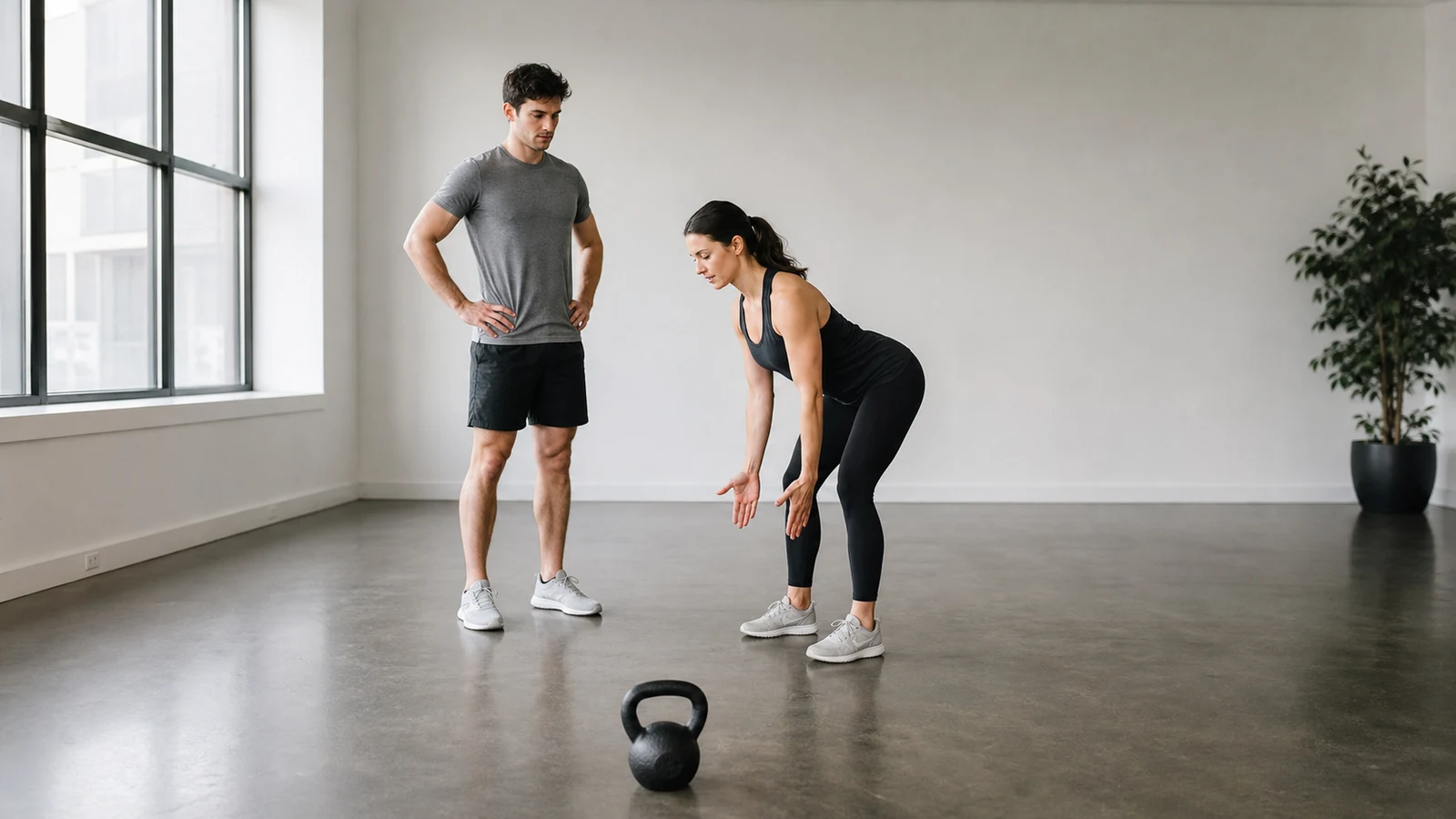
- Learn the movements first. Practice a comfortable hip hinge and the get-up’s floor-to-stand positions with a qualified kettlebell instructor when possible.
- Choose a controllable load. Use a bell and movement range that let you maintain control; a fixed starting weight based on sex does not account for individual skill or comfort.
- Rest for quality. Do not treat the timed challenge as the required tempo of every practice session.
- Match the plan to your goal. Add other strength or aerobic work when your goals require movement patterns or capacities the two exercises do not cover.
There is no need to rush toward the official total if you are learning a new movement. Follow the source program for its full progression, and ask a qualified professional to adapt it around injury, pregnancy, surgery recovery or cardiovascular concerns.
What the source video claims
The Health Reveal video frames these two exercises as all a person needs for strength and longevity. The official program is real, but the word “only” and the lifespan promise go beyond the direct research on swings and get-ups.
Medical boundary
This article is general fitness information, not a personal training or medical plan. Speak with an appropriate clinician or physical therapist when a back, shoulder, wrist or other condition makes loaded hinging or floor-to-stand movement uncertain.
References
- StrongFirst. Official Sinister challenge standard.
- StrongFirst. The Simply Sinister Training Plan, a distinct variant.
- Lake and Lauder. Kettlebell swing training trial. Journal of Strength and Conditioning Research, 2012.
- Otto et al. Weightlifting versus kettlebell training trial. Journal of Strength and Conditioning Research, 2012.
- McGill and Marshall. Kettlebell muscle activation and lumbar-load study. Journal of Strength and Conditioning Research, 2012.