
Quick answer: Exercise can improve fitness and physical function as people age, and some human studies also report changes in biological-aging biomarkers. A stronger walk, a better fitness test and a younger epigenetic-clock estimate describe different results.
Use the comparisons below to separate fitness tests, clock estimates and clinical outcomes. Each section keeps the population and comparator beside the finding.
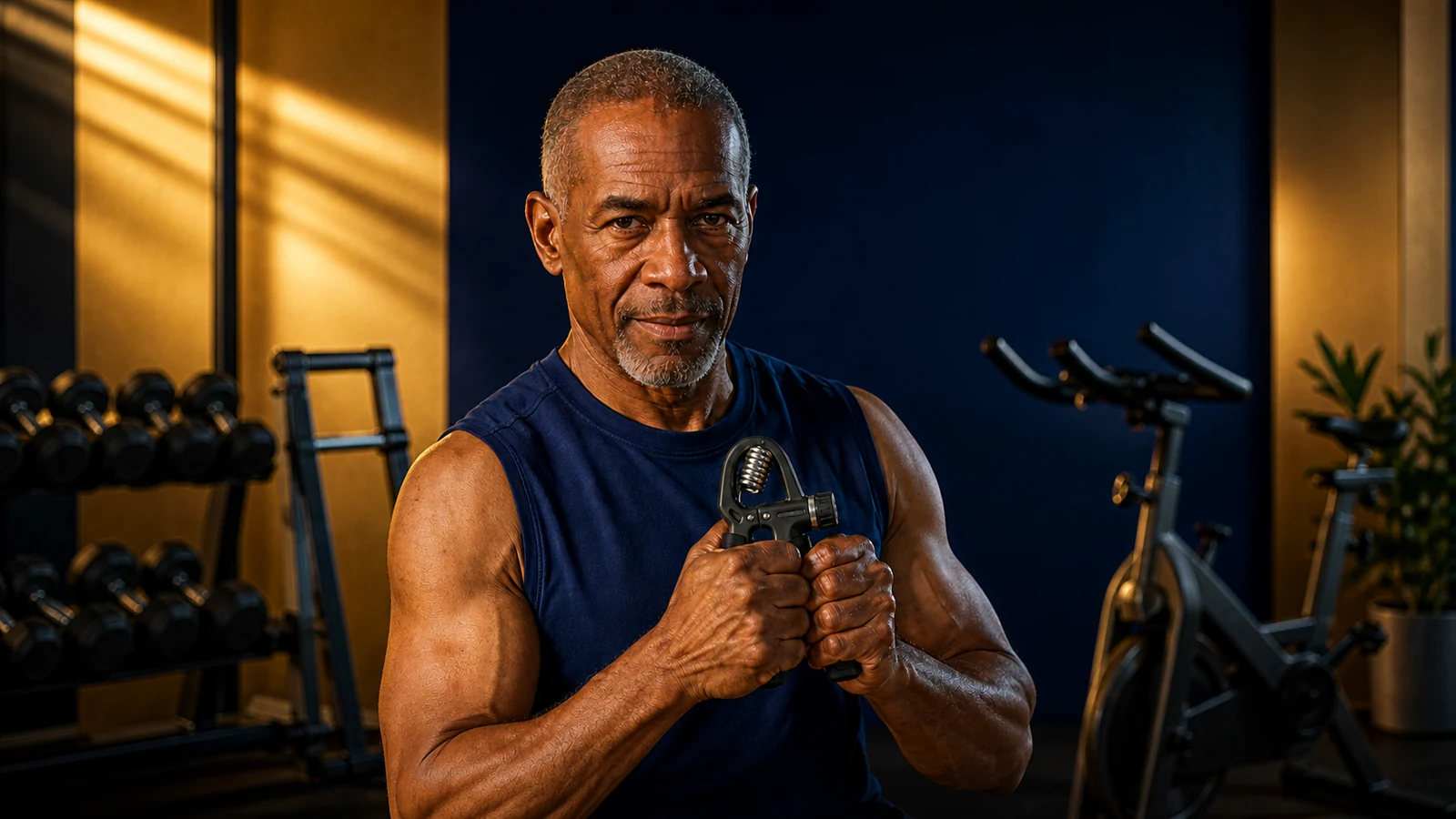
Image context: The pictured older man with a hand gripper illustrates the topic. His appearance is not a biological-age measurement, a documented study result or proof of a particular program.
What Does Exercise Change During Aging?
Start with the thing a study actually measured. Researchers may assess a walking test, oxygen uptake, strength, body composition or a blood-based molecular marker.
Those outcomes can all be relevant, but they cannot be exchanged for one another. An exercise trial does not become an age-reversal trial simply because its participants are older.
| Measurement | What it describes | What it does not establish by itself |
|---|---|---|
| Fitness or function | Performance on a defined task, such as peak oxygen uptake or a six-minute walk. | A particular number of biological years reversed. |
| Epigenetic clock | An algorithm using DNA-methylation patterns to estimate aspects of biological aging. | That every tissue became younger, or that an individual will live longer. |
| Long-term clinical outcome | Events such as disability or death followed over time. | The effect of an untested routine in a different population. |
“Biological age” is therefore more useful when the test is named. GrimAge, PhenoAge and a pace-of-aging measure are not interchangeable labels for the same calculation.
For example, DunedinPACE estimates a rate of biological change, while other clocks express an estimate like age. A rate is not a birthday.
Can Fitness Improve After 60?
Yes, and the evidence is not limited to people who exercised for decades. A review of 51 randomized trials involving 3,152 healthy older adults found better cardiorespiratory fitness with structured exercise than with control conditions.
The pooled standardized aerobic-capacity effect was 0.51 (95% CI 0.38 to 0.65); the six-minute walk difference was 36.18 meters (95% CI 26.52 to 45.84). These are trial averages, not promised personal gains or instructions for a maximal test at home.
Subgroup findings supported benefits across aerobic, resistance and combined training. That does not prove the approaches are identical or identify a universally best routine.
Trial duration and design varied; individual starting points, health and responses still matter.
A headline about lifelong exercisers answers a different question. Comparing people with different histories can reveal an association, but it cannot determine what would happen if the inactive group started training now.
What Have Human Biological-Age Studies Found?
The table separates the three intervention comparisons. Their actual populations and comparisons matter more than a dramatic number in a headline.
| Study | What was studied | Finding to retain | Boundary to retain |
|---|---|---|---|
| Combined-training pilot | Eighteen women aged 50 to 70; eight weeks of aerobic and strength training. | Age-acceleration estimates decreased in the subgroup with higher starting acceleration. | The lower-acceleration subgroup did not change; this was not a trial specifically in men over 60. |
| Cycling pilot | Six months; 42 adults aged 35 to 65 enrolled, 38 completed, 33 met the adherence threshold. | GrimAge changed relative to its expected trajectory. | Cycling alone; blood-cell composition tracked the clock change. |
| DO-HEALTH clock analysis | Three-year post hoc analysis of 777 Swiss adults aged 70 or older. | Some supplement and combination effects appeared on selected clocks. | Home exercise alone did not change the clocks. |
Read each result alongside its own boundary. The sections below explain why those boundaries matter.
Does Combined Training Make Everyone Biologically Younger?
The small women’s study is a useful example of why the result section matters. Participants were grouped by how much their clock estimate differed from the age expected: ten in the lower-acceleration group and eight in the higher group.
The higher group’s estimate decreased after training, while the lower group’s did not. Reading only the paper’s title would miss that subgroup distinction.
The indexed abstract does not describe an inactive comparison group. It cannot establish the effect in men over 60 or show that the combination was superior to aerobic or resistance training alone.
What Does the Cycling Finding Mean?
The cycling pilot reported a mean GrimAge decrease of 7.44 months relative to the expected trajectory. It also reported roughly 20% improvement in maximal oxygen uptake.
These group results do not convert training time into added life. The blood-cell finding also requires measurement context, rather than treating the clock as proof of whole-body rejuvenation.
The study did not test a strength-and-cardio combination. Keep that distinction when reading a headline about its result.
Why Is DO-HEALTH Not Proof of the Same Fitness Combo?
DO-HEALTH tested vitamin D, omega-3 and home exercise separately and together. Its exercise comparison was strength versus flexibility, without a prescribed cardio zone.
All three interventions showed an additive benefit on PhenoAge, while findings differed across clocks. That combination result cannot be credited to exercise alone.
Long-term survival implications remain unknown, and the generally healthy, active sample does not represent all adults over 70. This was a post hoc clock analysis within the larger trial.
These findings do not supply a reason to start supplements for an age score. Medication, supplement and individual exercise decisions belong in the appropriate clinical discussion.
A Better Way to Read an Aging Headline
A 2026 methods study on epigenetic clocks found that additional clocks did not confirm the examined single-clock intervention findings. The investigators proposed looking for reliable measures and several clocks responding consistently.
That is a research-interpretation framework, not a rule for diagnosing yourself from a commercial test. It also does not mean every single-clock finding is false.
Use this editorial claim-check card when a headline promises years made younger. It is a reading aid, not a validated medical checklist.
- Name the people: Older adults, younger adults, women, men or a particular clinical group?
- Name the comparison: Exercise versus inactive control, two exercise programs, or people with different past habits?
- Name the endpoint: Walking ability, oxygen uptake, one clock, several clocks or a clinical event?
- Keep the limit: Was it a small pilot, subgroup finding, observational association or post hoc analysis?
For a fictional example, a headline says a fitness combo reverses aging in men over 60. If its only cited study is the cycling pilot, the population, intervention and conclusion all need narrowing.
A defensible version would describe a pilot of adults aged 35 to 65, cycling and a GrimAge change. It would leave the untested strength combination and lifespan promise out.
What Should an Older Adult Focus On?
The CDC’s general guidance for adults 65 and older includes aerobic activity, muscle strengthening and balance work. Its weekly targets include at least 150 minutes of moderate aerobic activity, or the stated vigorous equivalent, and strengthening on at least two days.
The CDC also advises being as active as abilities and conditions allow when those targets are difficult. These are population guidelines, not a promise of clock reversal or a personalized starting dose.
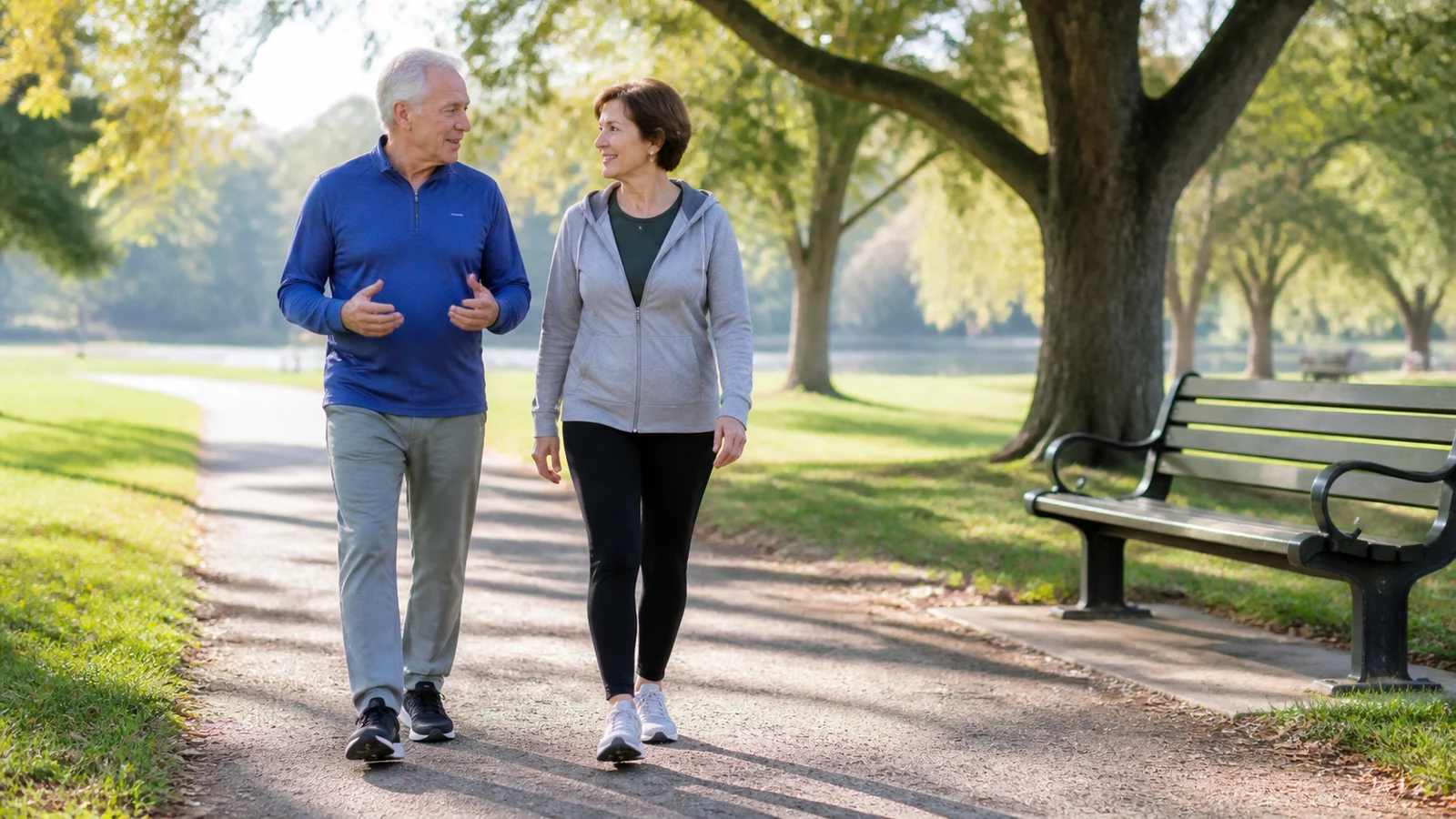
For your next review with a healthcare professional or qualified exercise professional, bring a real-life goal. That could be feeling more confident on a familiar walk or managing an ordinary household task.
Keep a brief note of the task, usual conditions and anything that changed. This is a way to communicate an observation, not a diagnostic score or a reason to push harder through symptoms.
Ask what activity is appropriate if you have a chronic condition, recent injury, falls or mobility concerns. Existing treatment advice and restrictions take priority over a general article.
The useful question is what helps your ability and health in your circumstances. You do not need to turn every improvement into a biological-age claim for it to matter.
The Takeaway
Exercise and aging research supports measurable fitness gains in older adults and offers developing evidence about molecular markers. It does not establish one universally superior age-reversing combination.
Keep the population, comparison and endpoint attached to every result. A clearer understanding of the evidence can support an appropriate activity conversation without promising a younger body or a longer life.
References
- Azimkhani, A., et al. (2026; online 2025). The effect of aerobic, resistance, and combined exercise training on cardiorespiratory fitness in healthy people aged 60 years and over. Biological Research for Nursing, 28(1), 72 to 90.
- da Silva Rodrigues, G., et al. (2024; online 2023). Eight weeks of physical training decreases 2 years of DNA methylation age of sedentary women. Research Quarterly for Exercise and Sport, 95(2), 405 to 415.
- Van Damme, M., et al. (2026). Epigenetic age deceleration reflects exercise-induced cardiorespiratory fitness improvements. GeroScience, 48, 7905 to 7921.
- Bischoff-Ferrari, H. A., et al. (2025). Individual and additive effects of vitamin D, omega-3 and exercise on DNA methylation clocks of biological aging in older adults from the DO-HEALTH trial. Nature Aging, 5, 376 to 385.
- Borrus, D. S., et al. (2026). When to trust epigenetic clocks: Avoiding false positives in aging interventions. Aging Cell, 25(10), e70756.
- Centers for Disease Control and Prevention. (2025, December 4). Older adult activity: An overview.
Medical disclaimer: This article is general fitness and health information, not medical advice or a personal exercise prescription. Discuss health conditions, symptoms, medications and activity restrictions with your treating clinician.