
Cancer related fatigue is not the same thing as being tired.
Doctors define it as a distressing, ongoing sense of exhaustion tied to cancer or its treatment.
It does not go away after a good night of sleep.
It is also one of the most common complaints among people going through cancer treatment (Berger et al., 2015).
A YouTube channel called Nowercise Cancer And Exercise recently posted a video about pacing exercise through this kind of fatigue.
The video introduces something it calls “the 60% rule.”
This article looks at what real research says about cancer related fatigue, exercise, and pacing strategies.
It also looks at where the video’s framing lines up with the evidence, and where it does not.
What the Video Claims
The video, titled “The 60% Rule: Pacing Exercise Through Cancer Fatigue,” comes from a channel called Nowercise Cancer And Exercise.
The channel’s own description identifies it as a cancer and exercise resource.
We could not confirm a named host, a specific clinical license, or a stated institutional affiliation behind the channel.
That does not automatically make the advice wrong, but it does mean viewers cannot check the presenter’s credentials the way they could with a named oncologist or exercise physiologist.
The video’s core idea is that people should exercise at around 60 percent of their normal effort during cancer treatment, then adjust from there based on how they feel.
We searched for a published study, clinical guideline, or named protocol that uses this exact “60 percent” figure as a pacing rule for cancer related fatigue.
We could not find one.
The general idea of pacing effort during cancer treatment is well supported by research.
But the specific number 60 percent appears to be this video’s own framing, not a figure drawn from a peer reviewed clinical guideline.
We are stating that plainly here so readers do not mistake the video’s shorthand for an established medical rule.
The accompanying Facebook caption calls the presenter a cancer specialist, but the channel information we could check did not verify a named clinician or license. The 60 percent rule should be understood as that video’s shorthand, not a clinician-validated threshold.
What Real Research Shows About Cancer Related Fatigue as a Real Condition
Cancer related fatigue affects a large share of people during and after treatment.
One major clinical review found it can affect most patients receiving chemotherapy or radiation (Berger et al., 2015).
That same review describes several ways it differs from ordinary tiredness.
It tends to be more severe than everyday fatigue.
It often does not improve much with rest alone.
It can interfere with basic daily tasks, including cooking, working, or even short walks (Berger et al., 2015).
This matters because it frames fatigue during cancer care as a real clinical issue, not something to simply push through.
What Real Research Shows About Exercise and Fatigue Levels
Several treatment approaches have been tested against cancer related fatigue, including medication, talk therapy, and exercise.
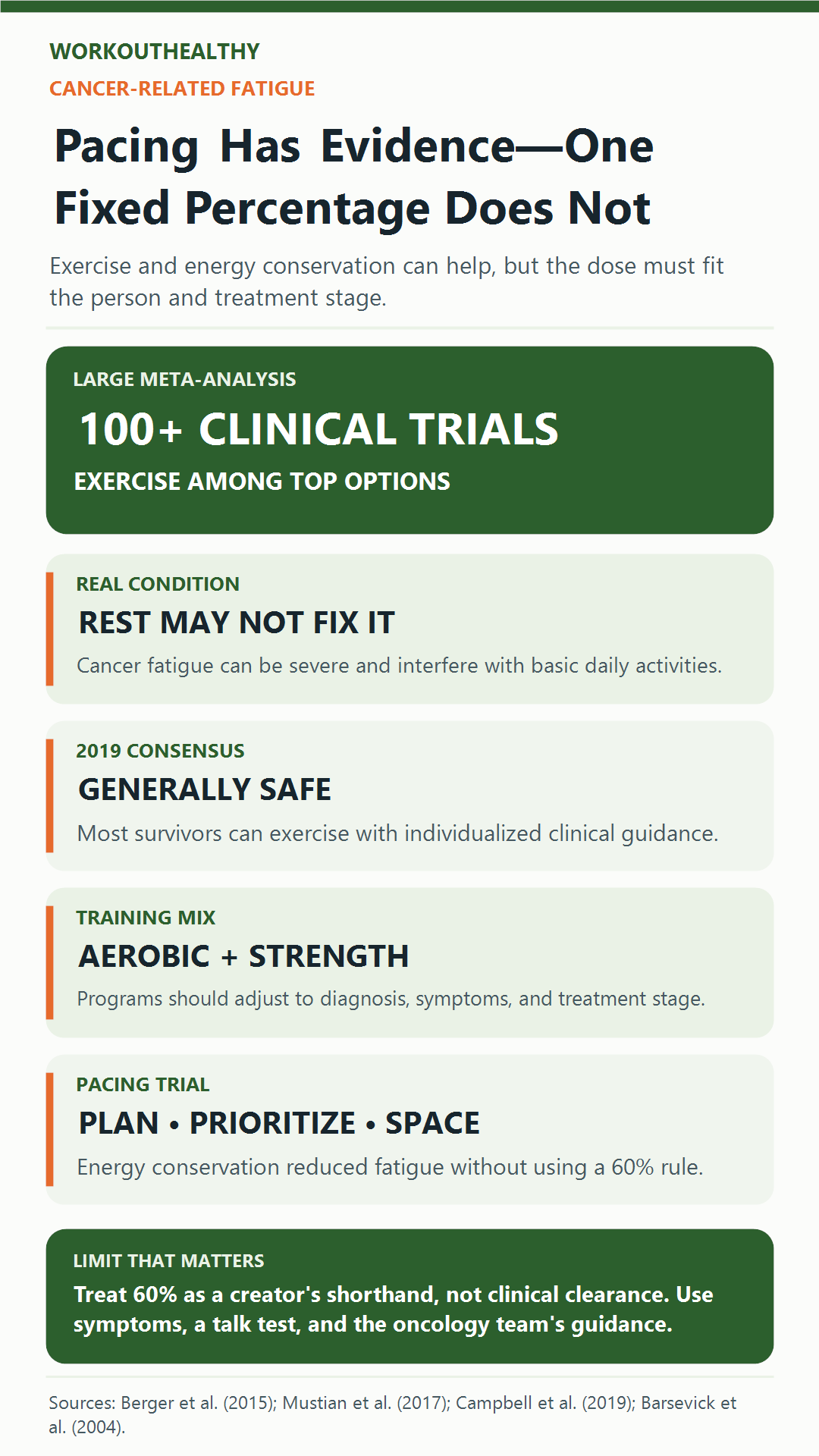
A large meta-analysis pooled data from more than 100 clinical trials to compare these approaches head to head (Mustian et al., 2017).
Exercise came out as one of the most effective options studied.
It outperformed several commonly used drug treatments for reducing fatigue during and after cancer treatment (Mustian et al., 2017).
Psychological approaches, like certain forms of therapy, also performed well in that same analysis.
The researchers reported that exercise and psychological treatments had stronger effects than the medications commonly used for this kind of fatigue (Mustian et al., 2017).
A review of more than 100 clinical trials found that exercise and psychological treatments outperformed common drug options for easing cancer related fatigue.
What Real Research Shows About Exercise Guidelines for Cancer Survivors
In 2019, an international group of exercise and oncology experts published a consensus statement on exercise for people with cancer (Campbell et al., 2019).
This roundtable statement is often cited as a foundation for modern cancer exercise guidelines.
It concluded that exercise is generally safe for most cancer survivors, both during and after treatment (Campbell et al., 2019).
It also found that exercise can improve fatigue, anxiety, depression, and physical function across several cancer types (Campbell et al., 2019).
The statement recommended a mix of aerobic and resistance exercise, adjusted to each person’s condition and treatment stage.
Resistance training in particular has a growing research base well beyond cancer care, including work on whether lifting weights helps protect brain health as people age.
The roundtable statement did not set one fixed intensity percentage that applies to every patient.
Instead, it called for individualized programming, ideally guided by a qualified exercise professional familiar with cancer care (Campbell et al., 2019).
What Real Research Shows About Pacing and Energy Conservation
Pacing is not a new idea in cancer care.
Researchers have studied a formal version of it called energy conservation and activity management.
In a randomized clinical trial, patients with cancer related fatigue were taught to plan activities, prioritize tasks, and spread effort across the day (Barsevick et al., 2004).
The group that learned this pacing approach reported a bigger drop in fatigue over time than the control group (Barsevick et al., 2004).
That trial did not use a “60 percent” number anywhere in its method.
It focused on planning, prioritizing, and spacing out demanding tasks, rather than hitting one fixed effort percentage.
That is closer to how pacing is typically taught in cancer rehabilitation today.
It is less about one number and more about a flexible, personal system.
How to Interpret the Video’s Traffic-Light Check
A traffic-light check can be a simple conversation aid: green means the activity feels manageable, yellow means symptoms or fatigue are building, and red means stop and contact the care team about concerning symptoms. These colors are not a validated cancer-exercise prescription, and they cannot replace a clinician’s individual precautions.
Fever, new dizziness, chest pain, unusual breathlessness, bleeding concerns, or a sudden unexplained decline are not a signal to merely lower the target to 60 percent. Stop the session and seek guidance from the oncology team; urgent symptoms may need urgent medical care (Campbell et al., 2019).
The Mechanism
Why does cancer related fatigue happen in the first place?
Researchers do not have one single answer, but they have identified several likely contributors (Bower, 2014).
Cancer treatment can trigger ongoing low grade inflammation throughout the body.
Certain inflammatory signals, called cytokines, are elevated in many fatigued cancer patients (Bower, 2014).
Treatment can also disrupt the body’s stress hormone system, including the pathway that regulates cortisol.
Sleep and daily activity rhythms are frequently thrown off during treatment as well (Bower, 2014).
Exercise appears to influence some of these same systems.
Regular movement is linked to lower inflammation markers over time in several populations.
That is one proposed reason exercise helps with fatigue, though researchers are still working out the exact pathways (Bower, 2014).
What This Evidence Does Not Prove
This research does not prove that any fixed percentage, including 60 percent, works for every patient.
Cancer is not one disease, and treatment plans vary enormously between patients.
A person recovering from breast cancer surgery has different needs than someone in the middle of intensive chemotherapy for leukemia.
Most of the exercise studies cited here used general fatigue and quality of life scores, not a specific pacing formula.
Study samples were often smaller for certain cancer types and certain treatment stages.
None of the research reviewed here proves that exercise pacing alone can replace medical evaluation of fatigue.
Fatigue can sometimes signal something else entirely.
That includes anemia, thyroid problems, heart strain from certain treatments, or cancer progression itself.
That is exactly why this evidence supports working with a clinical team, not skipping it.
Who Should Work With a Clinical Team
Anyone currently in cancer treatment should loop in their oncology team before starting or changing an exercise routine.
This includes people on chemotherapy, radiation, immunotherapy, or hormone therapy.
Pacing needs shift depending on cancer type, treatment phase, and how a person’s blood counts and organ function are doing.
A target like “60 percent effort” means something different for someone with normal blood counts than for someone with low platelets or a low white count.
An oncologist, oncology nurse, or physical therapist can flag whether fatigue has a medical cause that needs treatment first.
Where available, an oncology certified exercise professional can translate general research findings into a plan built for one specific patient (Campbell et al., 2019).
These professionals are trained to adjust intensity around surgical sites, medical devices, low blood counts, and treatment side effects.
That is different from working with a general fitness trainer who lacks that specific background.
Pacing needs vary by cancer type, treatment stage, and individual clinical status, which is exactly why exercise oncology guidelines call for individualized programs instead of one fixed number for every patient.
Who Should Be Extra Careful
Some situations call for extra caution before any exercise, paced or not.
This includes people with severe anemia, meaning a very low red blood cell count.
It includes people with very low platelet counts, since that raises bleeding risk.
People with bone metastases need clearance first, because certain movements can raise fracture risk.
People recovering from recent major surgery need their surgeon’s sign off before resuming activity.
Anyone with treatment related heart or lung effects should be evaluated before starting a new routine.
Fever, active infection, or a sudden unexplained drop in energy should prompt a call to the care team first, not a workout.
None of this means exercise is off the table for these situations.
It means the starting point and the pace should come from people who know the person’s full medical picture.
A Practical Takeaway
The general idea behind the video, pacing effort instead of pushing through exhaustion, lines up with real research on cancer related fatigue.
The specific number 60 percent should be treated as one creator’s simplified framing, not a clinical rule.
A more evidence based approach starts with a conversation with the oncology team about current fatigue levels and any warning signs.
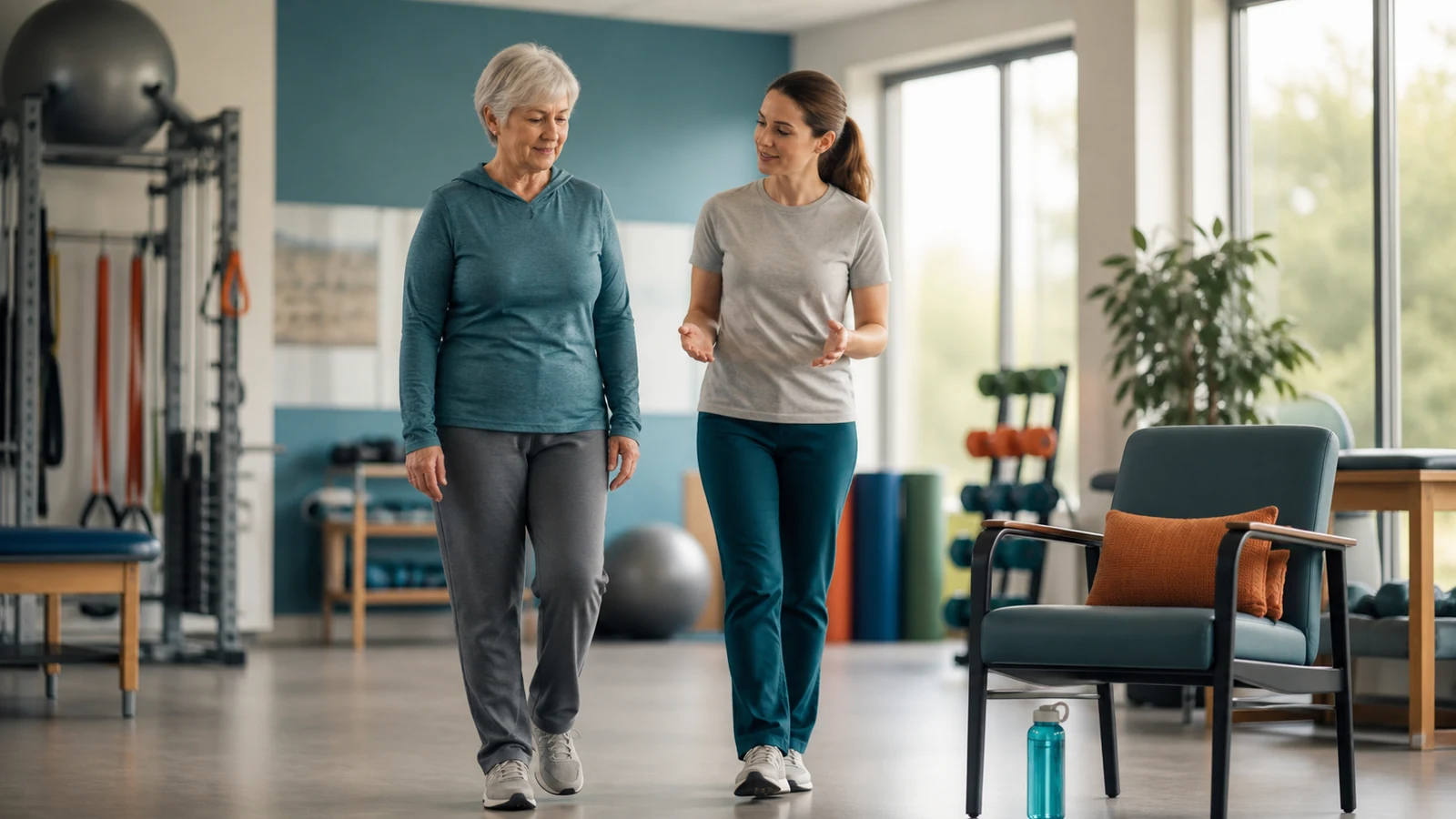
From there, many programs use tools like a perceived exertion scale or a simple talk test instead of one fixed percentage.
Short walks are often a reasonable starting point once a clinician has given the go ahead.
Research on how much walking actually moves the needle on health outcomes outside of cancer care shows real benefit from even modest amounts of movement.
Recovery from major medical treatment often works the same way in other conditions too, building capacity gradually rather than all at once.
That pattern shows up clearly in what hip replacement recovery actually takes, a very different medical situation with a similar gradual rebuilding process.
Simple recovery practices between harder sessions can also play a supporting role.
That includes looking at whether foot massage can actually help you relax, alongside sleep and stress management.
Logging energy levels, sleep, and activity across a week can help a patient and their care team spot patterns.
That kind of log is often more useful than a single fixed percentage.
It reflects how one specific person’s fatigue actually moves day to day, instead of forcing everyone into the same number.
Watch the video
Want more like this? Subscribe to WorkoutHealthy Insider for practical explanations behind popular fitness claims.
References
Barsevick, A. M., Dudley, W., Beck, S., Sweeney, C., Whitmer, K., & Nail, L. (2004). A randomized clinical trial of energy conservation for patients with cancer-related fatigue. Cancer, 100(6), 1302 to 1310. https://doi.org/10.1002/cncr.20111
Berger, A. M., Mitchell, S. A., Jacobsen, P. B., & Pirl, W. F. (2015). Screening, evaluation, and management of cancer-related fatigue: Ready for implementation to practice? CA: A Cancer Journal for Clinicians, 65(3), 190 to 211. https://doi.org/10.3322/caac.21268
Bower, J. E. (2014). Cancer-related fatigue: Mechanisms, risk factors, and treatments. Nature Reviews Clinical Oncology, 11(10), 597 to 609. https://doi.org/10.1038/nrclinonc.2014.127
Campbell, K. L., Winters-Stone, K. M., Wiskemann, J., May, A. M., Schwartz, A. L., Courneya, K. S., Zucker, D. S., Matthews, C. E., Ligibel, J. A., Gerber, L. H., Morris, G. S., Patel, A. V., Hue, T. F., Perna, F. M., & Schmitz, K. H. (2019). Exercise guidelines for cancer survivors: Consensus statement from International Multidisciplinary Roundtable. Medicine & Science in Sports & Exercise, 51(11), 2375 to 2390. https://doi.org/10.1249/mss.0000000000002116
Mustian, K. M., Alfano, C. M., Heckler, C., Kleckner, A. S., Kleckner, I. R., Leach, C. R., Mohr, D., Palesh, O. G., Peppone, L. J., Piper, B. F., Scarpato, J., Smith, T., Sprod, L. K., & Miller, S. M. (2017). Comparison of pharmaceutical, psychological, and exercise treatments for cancer-related fatigue: A meta-analysis. JAMA Oncology, 3(7), 961 to 968. https://doi.org/10.1001/jamaoncol.2016.6914
This article is for general information only and is not medical advice. If you have an injury, ongoing pain, or a medical condition, talk to a doctor or physical therapist before you change how you train or eat.