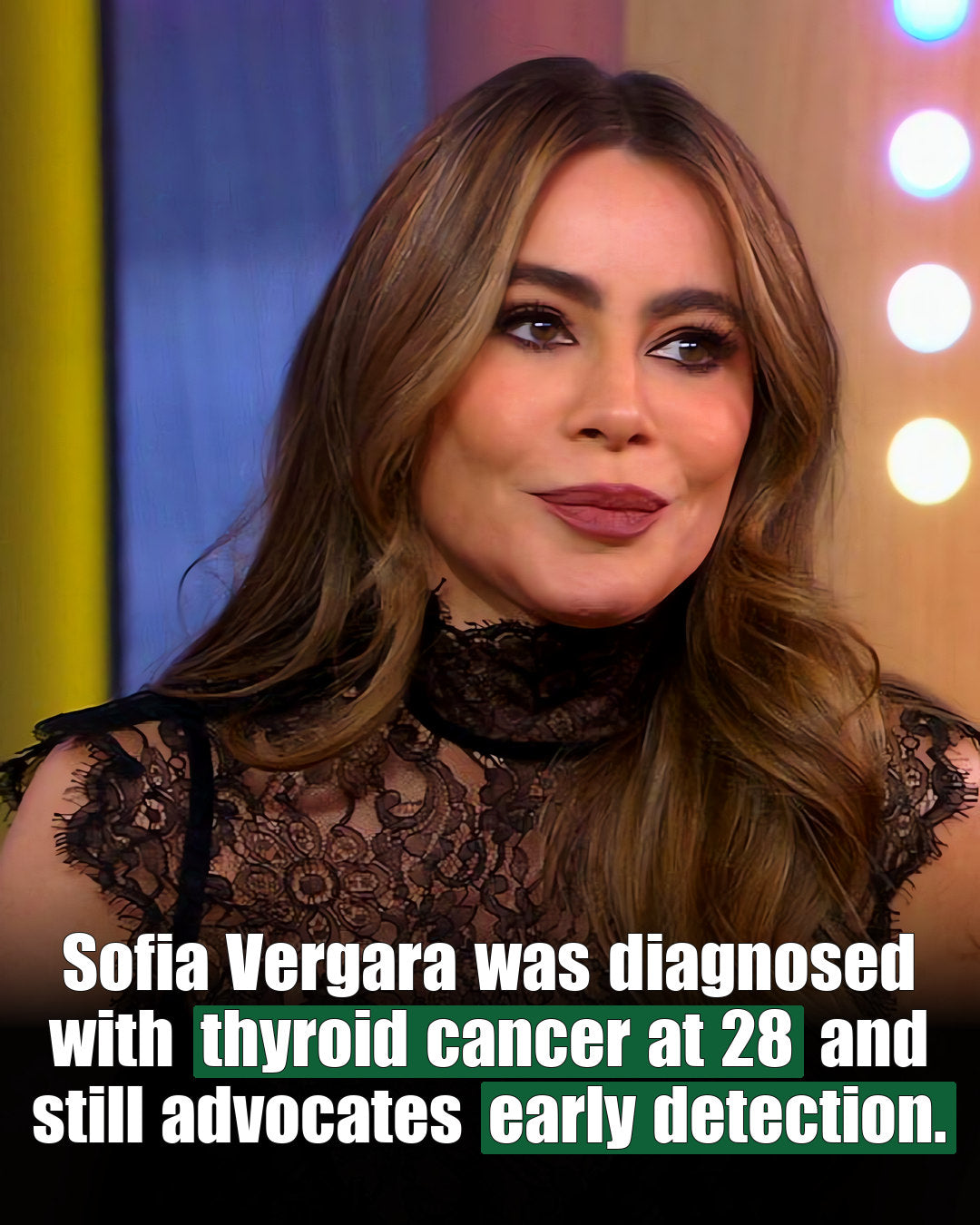

Sofia Vergara is known worldwide for her comedy work.
She has also been one of the highest paid actresses in television history. Long before any of that fame arrived, she survived something much quieter than a red carpet moment.
At 28 years old, a routine doctor’s visit turned into a cancer diagnosis. More than two decades later, Vergara is healthy, active, and still talking publicly about what that experience taught her.
Today she continues to work steadily in television, including as a judge on a major competition series, and she remains a visible public advocate for early cancer detection.
Her story is not really about a scary word. It is about a small physical change that got checked out early, and how much that single decision mattered.
What Actually Happened
Vergara was diagnosed with papillary thyroid cancer in 2000, when she was 28.
Papillary thyroid cancer is the most common type of thyroid cancer. It starts in the thyroid gland, a small butterfly-shaped gland at the base of the neck that helps control metabolism, heart rate, and body temperature.
The diagnosis came after a doctor found a lump in her neck during a checkup.
She has said she was not looking for anything unusual when it was discovered.
She underwent surgery to remove the affected tissue.
That was followed by radioactive iodine treatment, a common next step for this type of cancer.
The thyroid naturally absorbs iodine. Because of that, doctors can use a radioactive form of it to target and destroy any remaining thyroid tissue or cancer cells after surgery.
Since then, she has taken a daily thyroid hormone replacement pill. Many thyroid cancer survivors need this for life once part or all of the gland is removed, since the body can no longer produce its own supply.
Vergara has now been cancer free for more than 20 years.
She has used her platform many times since to encourage people to pay attention to changes in their own bodies, especially anything in the neck area.
In Her Own Words
Vergara has spoken about the emotional weight of hearing the word cancer at a young age.
“When you’re young and you hear that word, ‘cancer,’ your mind goes to so many places.”
She has also credited early detection and her medical team for the outcome she had.
“I was fortunate to have caught it early and to have the support of my doctors.”
Rather than describing panic, she has talked about responding to the diagnosis by learning everything she could about her condition.
That approach, understanding the disease instead of just fearing it, is a theme she has returned to in multiple interviews over the years.
She has said the experience changed how seriously she takes routine checkups. It is not just for herself either. It is something she now actively encourages in others, especially younger fans who may assume cancer is only an older person’s problem.
The Science Behind Thyroid Cancer
Thyroid cancer is not rare, though most people rarely think about it.
The American Cancer Society estimates roughly 45,000 new cases will be diagnosed in the United States this year.
The disease is almost three times more common in women than in men. Researchers have not fully settled why the gap is so large, though hormonal factors are one area of ongoing study.
The average age at diagnosis is 51, but as Vergara’s case shows, it can appear much earlier.
Papillary thyroid cancer specifically tends to grow slowly and respond well to treatment when caught before it spreads.
According to the American Cancer Society, the 5 year relative survival rate for papillary thyroid cancer that is still localized to the thyroid is above 99 percent.
Even when it has spread to nearby lymph nodes, the regional survival rate is still around 99 percent.
Survival drops to about 71 percent only in the less common cases where the cancer has spread to distant parts of the body by the time it is caught.
That gap between early and late detection is enormous. It is also exactly why doctors take neck lumps seriously, even in otherwise healthy young adults.
Treatment decisions also depend heavily on staging, meaning how far the cancer has spread by the time it is found.
A cancer contained to the thyroid is generally treated far more successfully than one that has already reached the lungs or bones.
That is part of why doctors distinguish so carefully between someone who feels a lump right away, like Vergara, and someone whose cancer goes unnoticed for years.
What This Means for Everyday Readers
Here is where the science gets a little more nuanced than a simple “get screened” message.
The United States Preventive Services Task Force is the government’s independent panel on screening recommendations.
It recommends against routine thyroid cancer screening for adults with no symptoms at all. That recommendation carries a Grade D rating, its lowest.
The reasoning is not that thyroid cancer does not matter.
Screening people with zero symptoms tends to find very slow-growing cancers that may never have caused harm.
Meanwhile, the biopsies and surgeries used to investigate those findings carry real risks of their own.
That pattern is called overdiagnosis. It is a genuine concern across modern cancer screening research, not just for thyroid cancer.
That recommendation comes with an important carve-out.
It does not apply to anyone who already has a symptom. That includes a lump, swelling, or asymmetry in the neck, hoarseness, pain, or difficulty swallowing.
For those people, seeing a doctor is exactly the right move. It is also exactly what led to Vergara’s diagnosis in the first place.
In other words, the takeaway from her story is not “everyone should get their thyroid scanned.”
It is “do not ignore a lump you can feel or see.” That is a much narrower, more useful message, and it matches what actually happened to her.
Who Should Talk to a Doctor First
Anyone who notices a new lump, swelling, or visible change in the shape of their neck should schedule an appointment with a doctor.
This applies at any age, not just after 40 or 50.
People experiencing unexplained hoarseness that lasts more than a couple of weeks should also be evaluated.
The same goes for anyone with new difficulty swallowing or persistent neck or throat pain.
These symptoms have many possible causes. A doctor is the right person to sort through them, rather than guessing at home.
Anyone with a family history of thyroid cancer or certain inherited thyroid conditions should talk to their doctor about extra monitoring.
Family history can change the calculation around screening in ways the general population guidelines do not cover.
People who have already been treated for thyroid cancer, including thyroid removal, should continue regular follow-up care.
That means ongoing bloodwork with an endocrinologist, since thyroid hormone levels need to be monitored and adjusted over time.
Anyone currently taking daily thyroid hormone medication, the way Vergara does, should keep every follow-up appointment.
This holds true even when a person feels completely well. Thyroid hormone levels can drift slowly enough that no symptoms show up until a blood test catches the change first.
Common Mistakes People Make With Neck Changes
One common mistake is assuming a neck lump is automatically nothing, especially in someone young or otherwise healthy.
Age is not protection. Vergara was 28.
Another mistake is waiting to “see if it goes away” for months before mentioning it to a doctor.
Most benign lumps do not urgently need to be checked the same week they are noticed.
Still, a lump that sticks around for weeks deserves a real talk with a doctor.
It should not turn into indefinite observation on your own.
Some people also assume that because the USPSTF recommends against general screening, thyroid cancer must not be a real concern.
That misreads the guidance. The recommendation is about screening people with no symptoms, not about ignoring a lump someone can actually feel.
Finally, people sometimes stop asking questions once they hear “cancer” and let fear take over instead of gathering information.
Vergara has described the opposite approach as something that helped her get through it. Learning everything she could about her specific diagnosis gave her a sense of control the fear alone never could.
How to Check Your Own Neck and What to Do Next
1. Look in a mirror with your neck tilted slightly back. Swallow a sip of water while watching the area just below your Adam’s apple, where the thyroid sits.
2. Gently feel the front of your neck with your fingers, checking for any lump, firmness, or asymmetry between the left and right sides.
3. Note anything unusual, including how long it has been there and whether it has changed in size.
4. Pay attention to related symptoms too, including a voice that has become persistently hoarse, trouble swallowing, or a feeling of tightness in the throat.
5. If you notice anything, call your doctor rather than searching symptoms online for reassurance. A quick physical exam and, if needed, an ultrasound can settle the question quickly.
6. If a biopsy or further testing is recommended, ask your doctor to walk you through what it will involve. Ask what the possible results would mean too, the same information-first approach Vergara has described using.
7. If you are diagnosed with thyroid cancer, ask about your specific subtype and stage. Papillary thyroid cancer caught early carries a very different outlook than more advanced disease.
8. If you have surgery or radioactive iodine treatment, plan for ongoing thyroid hormone monitoring afterward. It becomes a routine part of care, not a one time event.
References
- Today.com, “Sofia Vergara discusses thyroid cancer diagnosis at 28, urges screenings”
- NBC Insider, “Sofía Vergara Opens Up About Her Battle With Cancer”
- American Cancer Society, “Key Statistics for Thyroid Cancer”
- American Cancer Society, “Thyroid Cancer Survival Rates”
- United States Preventive Services Task Force, “Thyroid Cancer: Screening,” recommendation statement, Grade D
This article is for general information only. It is not personal medical advice. Talk with a qualified healthcare provider about any new lump, symptom, or change in your body, and about what cancer screening approach is right for your individual situation.