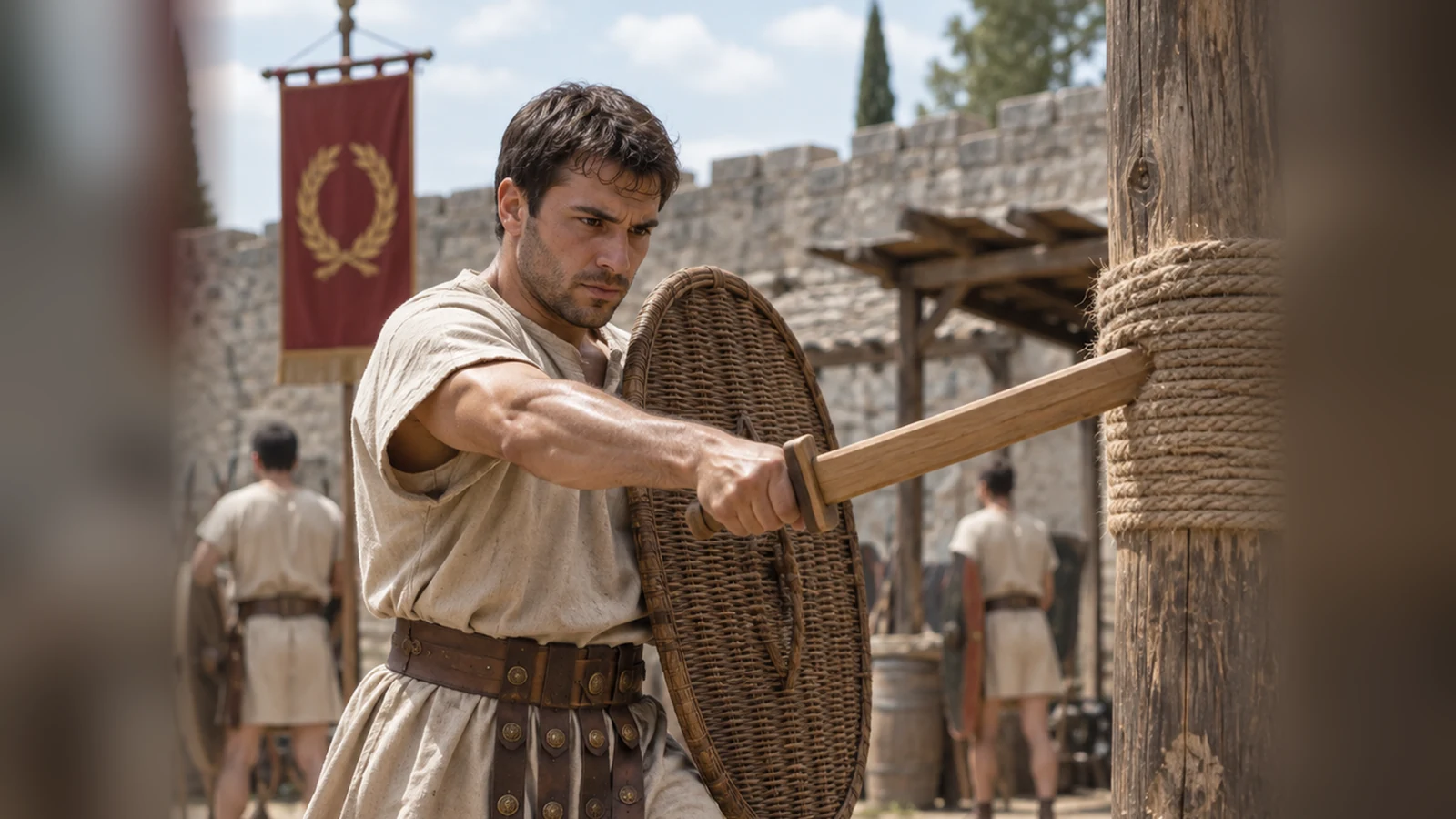

Illustration note: The opening scene is an editorial illustration. It is not an archaeological record, an authenticated equipment reconstruction or a demonstration to copy.
A training story becomes easier to evaluate when the person, equipment and claimed result remain separate. An ancient author’s explanation and a modern experiment answer different questions.
The Source
Vegetius describes recruit practice in Book I.
The passages below are read as a literary account, with an English rendering identified separately from the Latin.
Equipment and Post
| Passage | Item | Statement |
|---|---|---|
| I.11 | Practice equipment | Willow shields and wooden implements: twice usual weight. |
| I.11 | Post and timing | Fixed post, six source feet high; morning and afternoon. |
The Latin uses clauas ligneas; reproduced English uses wooden swords.
The text gives relative weights, not absolute masses.
The Gladiator Reference
I.11 addresses recruits, mentioning gladiators.
Keep the person and setting beside any claim you record.
The Author’s Rationale
I.12 expects heavier equipment to make ordinary arms feel lighter.
This rationale is not measured evidence.
A Modern Trial with Different Outcomes
Reinold and colleagues randomized 38 healthy pitchers, aged 13 to 18, to weighted-ball or regulation-ball practice. Both groups strength-trained, with performance reassessed after six weeks.
The experimental group’s reported 3.3% velocity improvement is not a net between-group estimate. Its reported injury rate was 24%: two elbow injuries during training and two the following season, versus none in controls.
The abstract does not give the final denominator behind 24%; all 38 randomized participants cannot substitute. Performance and injury outcomes cover different windows.
Different Questions
This adolescent-baseball trial cannot provide personal injury probabilities or a general overload rule for Roman fighting.
Nor does this focused source comparison establish that no other relevant study exists. Claims about the entire literature require a broader search than these passages and this one trial.
A Claim-Reading Record
Use the following record when a historical training claim is offered as modern advice. It organizes a question rather than assigning a load, drill or frequency.
- Subject: Who is being described, and in what setting?
- Change: What was heavier or otherwise different?
- Comparison: What was it compared with?
- Outcome: Is this an author’s explanation, a performance measurement or an injury record?
- Next question: What evidence would be needed for the decision I am considering?
Example: Write “relative equipment weight” and “measured performance effect” in separate fields. Finding the first does not fill in the second.
Common Mistakes
- Preserve the recruit context.
- Turning an explanation into a test result. Record which kind of evidence you have.
- Mixing time windows. Keep reassessment and later observation outcomes distinct.
- Inventing a denominator. Enrollment is not automatically the analysis population.
Care Context
An injury, ongoing pain or medical condition calls for individual guidance before changing training. An ancient description cannot provide personal clearance.
For a young athlete, discuss proposed changes with the responsible coach and healthcare team.
The Takeaway
A useful reading keeps source location, subject, comparison and outcome visible. That makes the story informative without turning a historical training account into a modern prescription.
Want more stories like this? Subscribe to WorkoutHealthy Insider for practical explanations behind popular fitness claims.
References
Vegetius. Book I.11 to 12. Latin; reproduced English.
Reinold, M. M., et al. (2018). Effect of a 6-week weighted baseball throwing program on pitch velocity, pitching arm biomechanics, passive range of motion, and injury rates. Sports Health, 10(4), 327 to 333. Published abstract.
Medical disclaimer: This article provides general historical and fitness information, not personal medical advice. If you have an injury, ongoing pain or a medical condition, consult an appropriately qualified healthcare professional before changing training.