
Novice linear progression organizes training around planned increases in the weight lifted. This guide separates a programme instruction, a measured research comparison and a decision about your next session.
Keep the source, outcome and unanswered question together. You can use the comparison record below without treating a successful workout as proof of one biological mechanism or a difficult workout as a diagnosis.
Keep each study population and outcome attached
Read each finding with its population and outcome attached. A load comparison and a personal progression rule answer different questions.
Rhea and colleagues synthesized 140 studies and 1,433 effect sizes in 2003. Their pooled dose-response estimates favored roughly 60% of one-repetition maximum, three muscle-group training days weekly and four sets for untrained participants, versus 80%, two days and four sets for trained participants; these group estimates do not determine your starting weight or next increment.
Lopez pooled 28 studies/747 healthy adults doing sets to volitional failure: low loads above 15 repetition maximum (RM), moderate 9 to 15 RM, high 8 RM or fewer. Hypertrophy and high versus moderate strength differences were nonsignificant; high/moderate loads improved strength more than low, with exploratory hypertrophy covariates favoring untrained status or more sessions in previously trained participants.
The 2022 corrigendum corrected effect sizes for Morton (2016), Jenkins (2017) and Ozaki (2018) in Figure 4, slightly changing overall and best-quality effect estimates while leaving the main findings and conclusions unchanged. Use the corrected publication alongside the original; the comparison is not an instruction to train to failure.
Name the programme version you are comparing
Write the exact title and version of the instructions you intend to follow. If two sources give different answers to a missed repetition, record both answers and their assumptions before choosing which question to take to a coach.
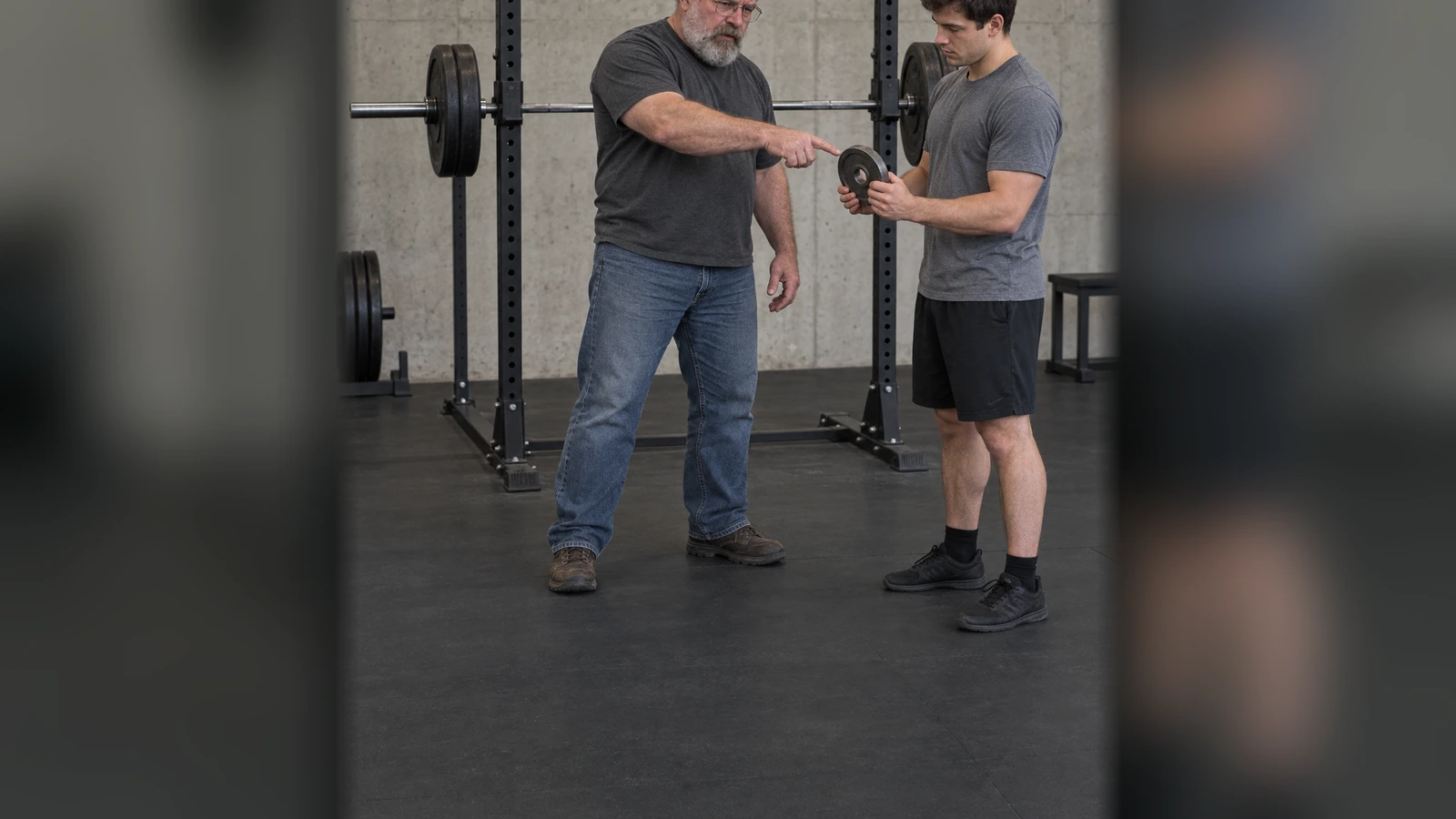
Illustration context: The featured image is a scene beside a barbell rack. It does not verify anyone’s identity, professional role, technique, completed session or progress.
How two coaching accounts define a novice
Barbell Logic defines a novice through adaptation and recovery between workouts, described as 48 to 72 hours, and explains two alternating sessions. Its example uses three sets of five for squats and presses, one set of five for deadlifts and additional weight each workout; this is that coaching explanation, not a tested personal prescription.
The r/StartingStrength wiki uses its own operational novice definition and treats lifts separately when modifying programming. Its author explicitly describes the guide as one approach rather than a definitive version, so name the source of the instructions you follow.
What neural research can and cannot explain
Škarabot and colleagues describe early force increases as thought to be primarily neural, while the precise location of adaptation remains unresolved. Variable evoked-response findings, methodological inconsistencies and limited connections to behavioral outcomes prevent firm mechanistic conclusions; preliminary nonhuman evidence cannot establish the same pathway in a person.
For your own notes, separate what you lifted, how you performed the task and what you are trying to improve. Calling every improvement muscle growth would collapse different outcomes into one label.
A training label is not a countdown
Use a record of comparable sessions rather than a countdown to an assumed expiry date. Before changing the whole programme, write down which lift or task became difficult and what changed in its execution.
Check the written instructions for that situation, including their criteria for repeating, reducing or changing the task. If the instructions do not answer your case, bring the specific record and question to a qualified coach instead of assigning yourself a new training stage.
Review the rules before changing a session
Use these six prompts to review a plan you already have. They are a decision aid, not a new weekly routine or an individualized loading prescription.
- Name the version. Record the author or organization and the instructions you are following; do not combine incompatible rules without acknowledging the change.
- Define the task. Write down the lift, setup, range of motion, repetitions and intended outcome before comparing sessions.
- Find the progression rule. Identify what counts as completion and what the plan says to do when the task is not completed.
- Keep increments conditional. A missing repetition or deteriorating execution is a reason to review the plan, not to force a predetermined increase.
- Keep care separate. Do not use a progression checklist to diagnose pain, decide medical clearance or test through worsening symptoms.
- Record the question. State what you need help deciding and which part of the written plan leaves it unresolved.
For comparable-session logging, use the existing lift log and load-comparison guide. That companion covers the recording task rather than supplying a second calendar here.
For questions about starting later in life, see our strength plan for your 40s.
For deadlift considerations later in life, see our guide to deadlifting after 50.
For a discussion of sex-related training claims, see do men and women need different workouts.
Compare an instruction with a reported outcome
Use this claim-to-decision record for a worked comparison. The entries are editorial prompts, not a validated assessment or an instruction to choose a particular programme.
Worked comparison: a load increment is a programme rule; measured strength is a study outcome.
| Record field | Programme entry | Research entry |
|---|---|---|
| Kind of claim | A rule for the next workout. | A comparison between groups or conditions. |
| Exact source | Name the author and the version of the instructions. | Name the publication and the outcome being discussed. |
| Population or task | Which lifter, lift and circumstances does the rule describe? | Who took part, and what was actually measured? |
| Unanswered decision | What should change if the task is not completed? | Did the comparison test that particular choice? |
| Worked question | Does this plan say to repeat the task, alter it or seek feedback? | Does a result about strength or muscle size answer that programming question? |
Separate comparison and care questions
- Turning an example into a requirement. Keep the example’s source and assumptions visible before borrowing its load, repetition target or timetable.
- Changing several things at once. Write down each change so you can explain what the next comparison means.
- Using pain as a progression test. Stop the provoking task when pain is new or worsening and seek appropriate assessment rather than proving readiness with another heavier attempt.
- Diagnosing a phase from one failure. Review the actual instructions and the repeated difficulty before making a wholesale programme change.
Who Should Be Careful
For an injury, ongoing pain or a medical condition, discuss relevant restrictions and the proposed activity with a clinician who knows your situation. A coach can help explain a programme and observe a task; that does not replace medical assessment.
If you have heart disease or high blood pressure, ask your doctor about the proposed activity before heavy lifting.
Choose instruction suited to your current experience and ask for a clear explanation of what to do when a task becomes difficult. Age, a training label or the appearance of a pictured lifter is not an individual clearance.
Bring the unanswered decision to the right person
Use novice linear progression as a set of instructions that you can identify, record and question. Keep the programme’s rule, the study’s measured outcome and your own next decision in separate entries.
Bring the unresolved question to the appropriate person rather than forcing a fixed increase, diagnosing an expired window or treating a named programme as a clinical guarantee.
Want more stories like this? Subscribe to WorkoutHealthy Insider for practical explanations behind popular fitness claims.
References
- Lopez, P., Radaelli, R., Taaffe, D. R., Newton, R. U., Galvão, D. A., Trajano, G. S., Teodoro, J. L., Kraemer, W. J., Häkkinen, K., & Pinto, R. S. (2021). Resistance training load effects on muscle hypertrophy and strength gain: Systematic review and network meta-analysis. Medicine & Science in Sports & Exercise, 53(6), 1206 to 1216. https://doi.org/10.1249/MSS.0000000000002585
- Resistance training load effects on muscle hypertrophy and strength gain: Systematic review and network meta-analysis: Corrigendum. (2022). Medicine & Science in Sports & Exercise, 54(2), 370. https://doi.org/10.1249/MSS.0000000000002838
- Rhea, M. R., Alvar, B. A., Burkett, L., & Ball, S. (2003). A meta-analysis to determine the dose response for strength development. Medicine & Science in Sports & Exercise, 35(3), 456 to 464. https://doi.org/10.1249/01.MSS.0000053727.63505.D4
- Škarabot, J., Brownstein, C. G., Casolo, A., Del Vecchio, A., & Ansdell, P. (2021). The knowns and unknowns of neural adaptations to resistance training. European Journal of Applied Physiology, 121(3), 675 to 685. https://doi.org/10.1007/s00421-020-04567-3
- Barbell Logic. (n.d.). Novice linear progression program explained.
- r/StartingStrength. (n.d.). The novice linear progression [Community wiki].
This article is for general information only and is not medical advice. If you have an injury, ongoing pain, or a medical condition, talk to a doctor or physical therapist before you change how you train or eat.