
On September 8, 2013, Patrik Baboumian walked onto a stage at the Toronto Vegetarian Food Festival and picked up a steel yoke loaded with more than half a ton of plates.
He carried it 10 meters across the floor.
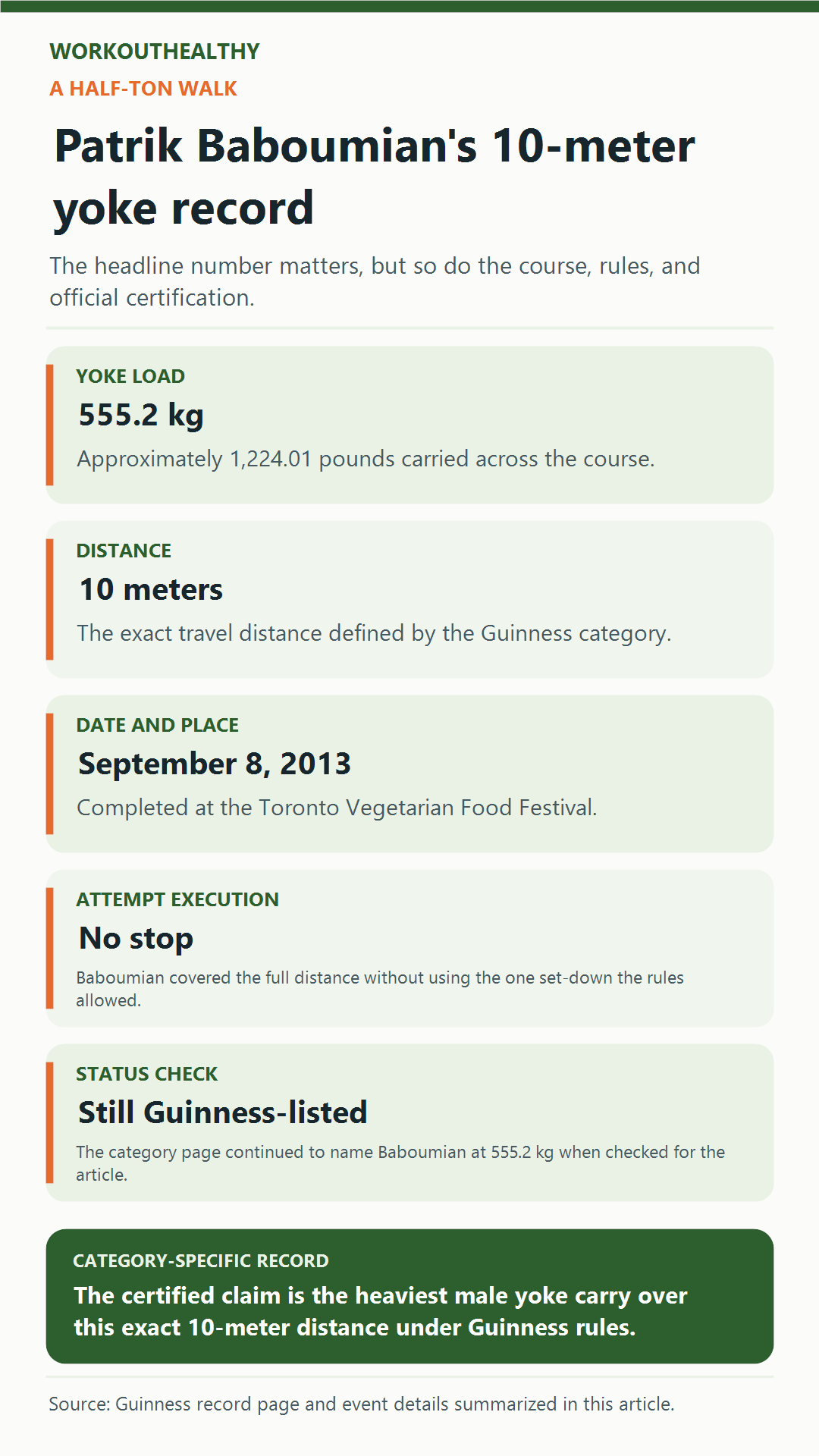
The yoke weighed 555.2 kilograms, about 1,224.01 pounds in total.
Guinness World Records still lists that walk as the heaviest yoke carry certified over a 10-meter distance by a man.
Baboumian is also a committed vegan, and the story around this record has always leaned on that fact almost as much as the number itself.
This article looks at what actually happened that day, what a yoke carry demands from the body, and what the vegan strength angle does and does not prove.
What the Record Actually Involved
A yoke carry is one of strongman’s classic loaded carry events.
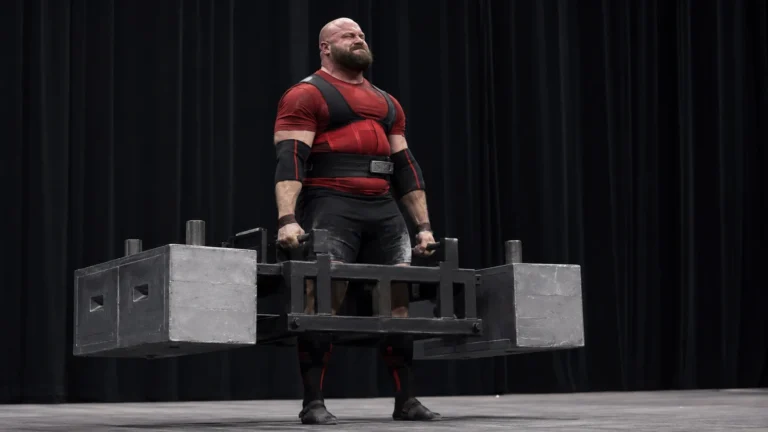
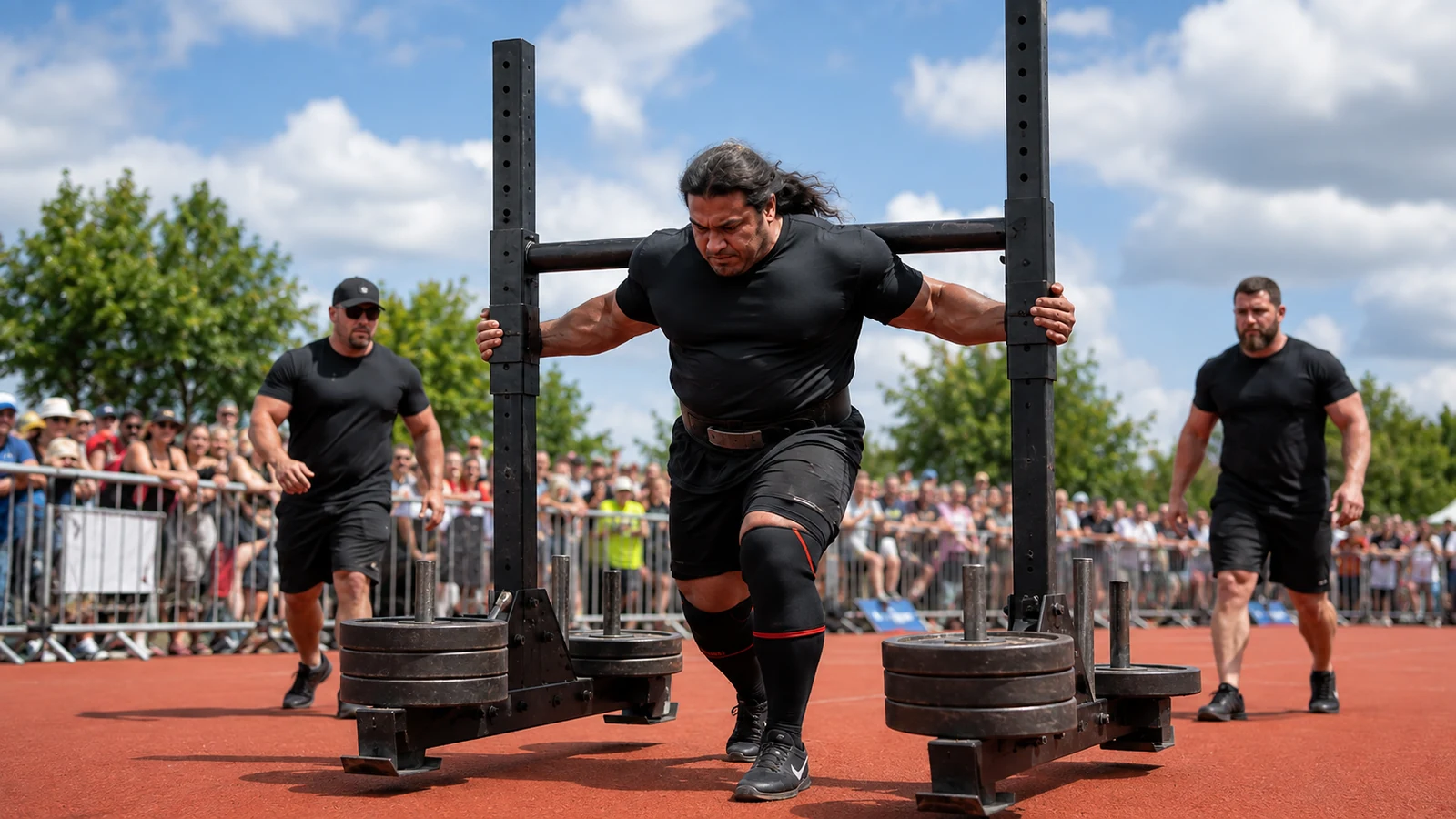
The athlete steps under a rigid steel frame, called a yoke, that rests across the upper back and shoulders.
Weight plates load onto both ends of the frame, and the lifter has to stand up, stabilize the load, and walk a set distance as fast as possible.
Guinness’s own rules for this specific record allow the yoke to be set down once during the attempt, matching common strongman competition rules.
Baboumian did not need that allowance.
He carried 555.2 kg the full 10 meters without a single stop, and Guinness credits the feat as his second official world record title.
Does the Record Still Stand in 2026?
Guinness World Records’ own page for “Heaviest Yoke Carry Travelling 10 m (Male)” lists Baboumian and this exact figure, 555.2 kg, with no note of a newer attempt replacing it.
That page is the single most reliable place to check a Guinness record’s current status, since Guinness updates it directly whenever a record changes hands.
As of this writing, no newer certified attempt appears there.
That does not mean nobody has ever put more weight on a yoke somewhere in the world.
It means no one has done it under Guinness’s specific rules for this exact distance and category and had the attempt certified.
Records like this one can also go stale between when a database entry is written and when a reader actually sees it, so it is worth checking the Guinness page directly again before treating any single number as permanent.
Why a Yoke Carry Is So Different From a Deadlift
A common question about a lift like this one is simple. What makes a heavy yoke carry so demanding compared with a straight deadlift?
A deadlift is a single effort.
You pull the bar off the floor, lock out your hips and knees, and the rep is over in a few seconds.
A yoke carry asks for something closer to the opposite.
The weight sits on your body the entire time, not just at the bottom and top of one motion.
Research on strongman events backs this up directly.
A study that measured trunk muscle activation and spine load across several strongman events, loaded carries included, found that carries produce sustained, high level muscle activity for the whole distance walked, not a brief spike the way a single rep does (McGill et al., 2009).
The lower back, hips, and core all have to stay braced step after step.
Meanwhile the legs still have to produce enough force to keep walking under a load compressing the spine.
A deadlift challenges force production for a few seconds.
A yoke carry challenges force production, endurance, and balance at the same time, while the athlete is also trying hard not to fall over.
The Grip and Core Work Nobody Sees on Camera
The legs move the load while the torso stays braced; the hands may help stabilize the yoke, but they do not carry its weight like they would hold a barbell.
The yoke rests on the shoulders and upper back, so the spine has to resist compression and any side to side sway for the entire walk.
That kind of full body bracing under load is a more extreme version of the sustained core engagement people describe building through yoga holds and other bodyweight core work, just at a completely different scale of load.
Grip matters too, even though the frame does not have to be gripped the way a deadlift bar does.
Steadying a yoke under this much weight still takes a strong, stable grip on the frame’s handles to control sway and keep the load from shifting off center.
A yoke carry does not test how much weight a person can move for one rep. It tests how long the whole body can stay rigid while carrying weight that would flatten most furniture.
Why Grip Strength Is a Bigger Deal Than It Looks
Grip strength gets tested constantly in strongman and grip sport events, but it turns out to matter well beyond the platform.
A large international study that measured grip strength in more than 140,000 adults across 17 countries found that lower grip strength was linked to a higher risk of death from any cause, and a higher risk of cardiovascular disease specifically, even after adjusting for other health factors (Leong et al., 2015).
That does not mean carrying a 555 kg yoke adds years to anyone’s life.
It means the underlying quality, whole body and grip strength built through years of hard training, tracks with real health outcomes in the general population, not just headline lifting numbers.
That link between strength and broader health also shows up in what happens when muscle mass and strength decline instead of build, which is a far more common problem than anyone ever attempting a yoke carry.
What the Vegan Framing Actually Tells Us
Baboumian has been open about being a committed vegan for years, and the story around this record leans on that fact heavily.
The point usually made is that a plant based athlete pulled off one of strongman’s heaviest loaded carries ever recorded.
That is true as a single data point, and it is a fair thing to point out.
It does not prove that a vegan diet makes anyone stronger, and it does not need to in order for the record to matter.
A review of protein and amino acid intake on vegetarian and vegan diets found that a well planned plant based diet can supply enough protein and the full range of essential amino acids to support muscle building and strength training, as long as intake and food variety stay adequate (Mariotti & Gardner, 2019).
In plain terms, a vegan athlete can absolutely build elite level strength.
The diet alone did not build this record.
Years of heavy, event specific strongman training built it.
How Strongman Athletes Actually Train for a Lift Like This
Nobody walks up to a 555 kg yoke as a first attempt at loaded carries.
A survey of competitive strongman athletes’ training practices found that most build a base of heavy compound strength work, deadlift and squat pattern lifts among them, before layering in event specific practice on the actual implements, including yokes, farmer’s handles, and stones (Winwood et al., 2011).
Event practice matters because a yoke carry is a skill, not only a strength test.
Athletes have to learn how to walk under load without losing the brace, how to breathe through a sustained isometric hold, and how to recover the frame if it starts to tip.
Pressing strength, the kind trained through movements like a floor press or a standard bench press, plays a smaller direct role here than people might assume.
A yoke carry is a hip hinge and bracing event, not a pressing one.
What This Record Does Not Prove, and Common Mistakes to Avoid
A single elite feat like this one does not prove that loaded carries are safe for anyone at any weight.
It proves what one extremely well prepared, professionally coached athlete could do after years of progressive training.
The most common mistake people make when they try loaded carries on their own is loading too much weight before their bracing technique is solid.
A yoke, trap bar, or pair of heavy dumbbells that is too heavy will pull the lifter into spinal flexion or a side lean almost immediately.
That is exactly the position that creates injury risk under load.
Another common mistake is breathing incorrectly, either holding the breath for the entire carry in a way that spikes blood pressure sharply, or losing the brace entirely and breathing shallow while the spine stays loaded.
A proper strongman style brace uses a controlled breath and a tight midsection, not breath holding for its own sake.
Who Should Be Cautious, and How to Progress Safely
Heavy loaded carries put real, sustained pressure on the abdominal wall and the cardiovascular system, so a few groups should be extra careful.
Anyone with a current or past hernia, uncontrolled high blood pressure, or an existing lower back injury should talk to a doctor or physical therapist before adding heavy carries to a program.
For most healthy lifters, the safe path in is small.
Start with a manageable trap bar or farmer’s handle carry, well under bodyweight, for short distances of 15 to 20 meters.
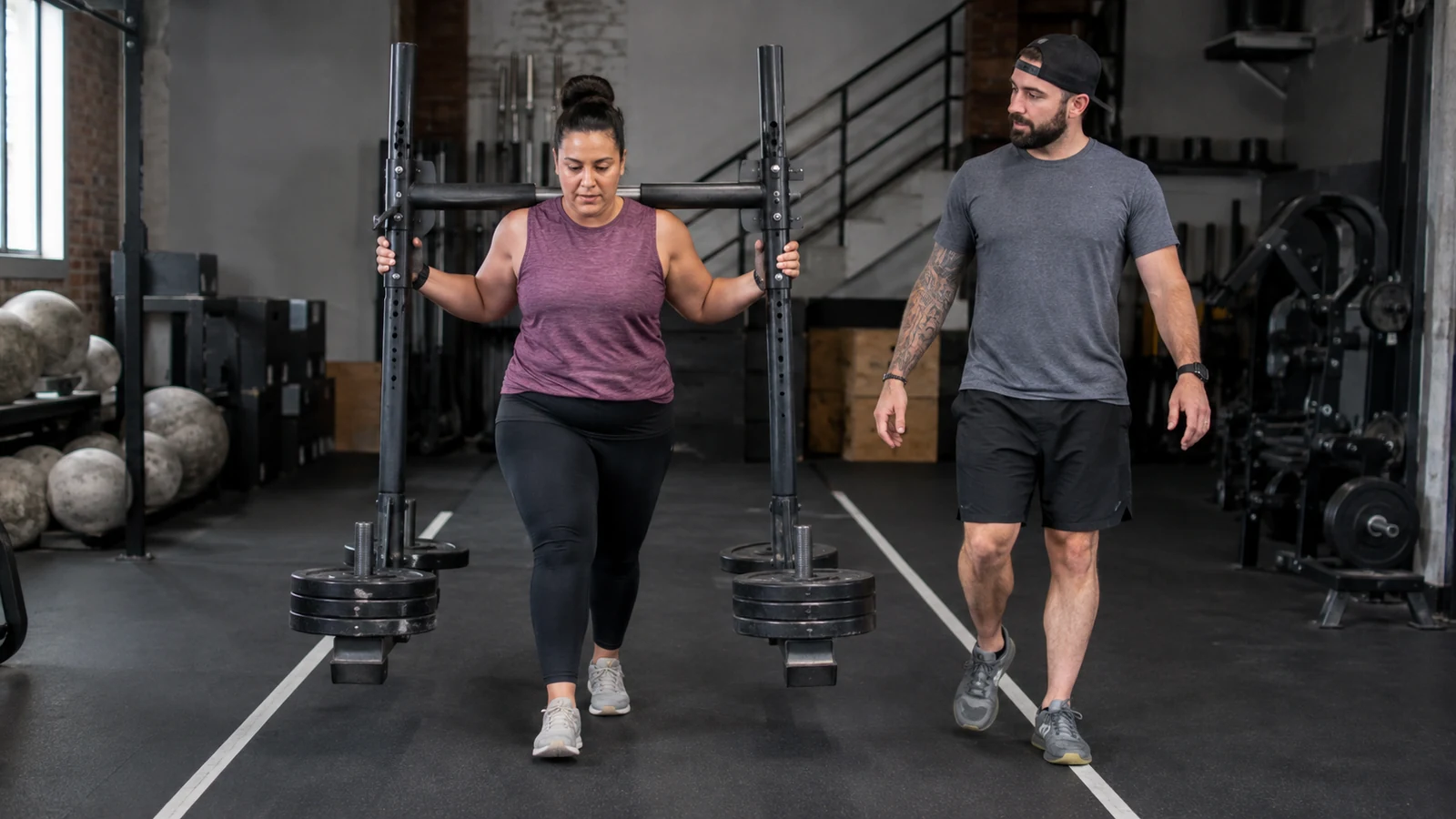
Add weight or distance in small increments only once the brace stays solid the entire walk, with no rounding through the upper back and no side lean.
Build up over months, not weeks.
The gap between a beginner’s first loaded carry and anything close to Baboumian’s record is measured in years of consistent training, not one aggressive session.
Watch the Original Video
Want more verified strength feats like this one, without the exaggeration? Subscribe to WorkoutHealthy Insider for practical explanations behind popular fitness claims.
References
Leong, D. P., Teo, K. K., Rangarajan, S., Lopez-Jaramillo, P., Avezum, A., Orlandini, A., Seron, P., Ahmed, S. H., Rosengren, A., Kelishadi, R., Rahman, O., Swaminathan, S., Iqbal, R., Gupta, R., Lear, S. A., Oguz, A., Yusoff, K., Zatonska, K., Chifamba, J., Igumbor, E., Mohan, V., Anjana, R. M., Gu, H., Li, W., & Yusuf, S. (2015). Prognostic value of grip strength: Findings from the Prospective Urban Rural Epidemiology (PURE) study. The Lancet, 386(9990), 266-273. https://doi.org/10.1016/S0140-6736(14)62000-6
Mariotti, F., & Gardner, C. D. (2019). Dietary protein and amino acids in vegetarian diets: A review. Nutrients, 11(11), 2661. https://doi.org/10.3390/nu11112661
McGill, S. M., McDermott, A., & Fenwick, C. M. J. (2009). Comparison of different strongman events: Trunk muscle activation and lumbar spine motion, load, and stiffness. Journal of Strength and Conditioning Research, 23(4), 1148-1161. https://doi.org/10.1519/JSC.0b013e318198f8f7
Winwood, P. W., Keogh, J. W. L., & Harris, N. K. (2011). The strength and conditioning practices of strongman competitors. Journal of Strength and Conditioning Research, 25(11), 3118-3128. https://doi.org/10.1519/JSC.0b013e318212daea
This article is for general information only and is not medical advice. If you have an injury, ongoing pain, or a medical condition, talk to a doctor or physical therapist before you change how you train or eat.