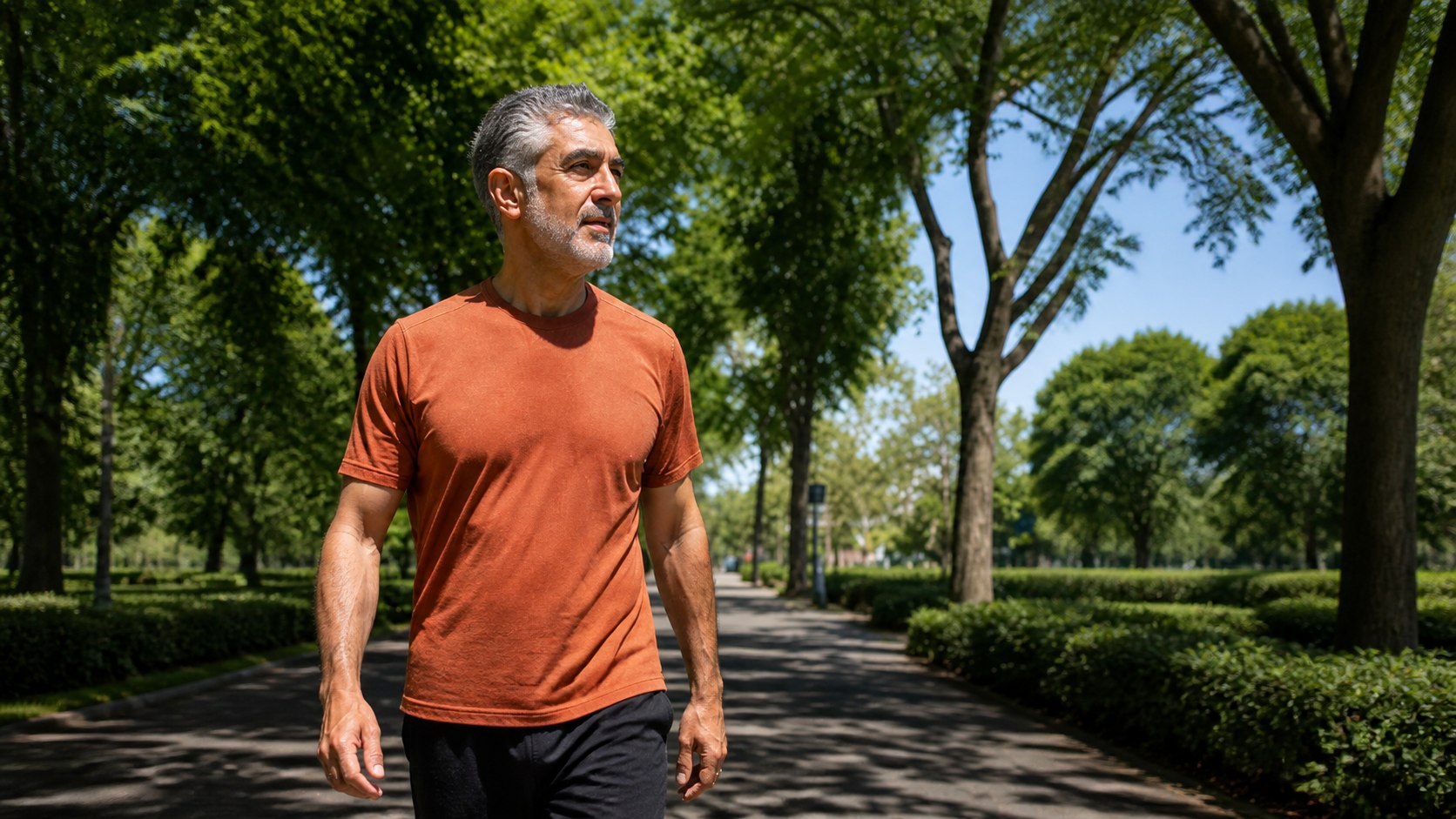

A short outdoor break around midday can feel surprisingly effective when attention is fading. Light reaches the circadian system through the eyes, and daytime exposure helps the brain distinguish active hours from the darker period that follows.
The popular claim that exactly 15 minutes will boost focus and mood is too precise for the evidence. The stronger conclusion is that brighter daytime light can support alertness, while the useful dose depends on intensity, timing, weather, season, and the individual.
A daylight break is best treated as a simple environment change, not a guaranteed fifteen minute brain hack.
What workplace research can tell us
A controlled workplace trial exposed office workers to blue enriched white light or standard white light during daytime work hours. The blue-enriched white-light condition was associated with better self-reported alertness, concentration and performance, and less reported evening fatigue and daytime sleepiness than the comparison office lighting condition (Viola et al., 2008).
The study included 94 participants in the final analysis and lasted eight weeks. The details are available through PubMed, PMID 18815716.
This was an indoor lighting intervention, not a test of a 15 minute walk outside. It supports the general role of daytime light, but it cannot prove that one exact outdoor schedule works for everyone (Viola et al., 2008).
Why light can change how the day feels
Light and darkness are the strongest environmental signals for the human circadian system. Light information reaches the brain’s master clock, which helps coordinate daily patterns in alertness, sleep, and melatonin production (National Institute of General Medical Sciences, n.d.).
That biology makes daytime light relevant, but it does not turn every bright break into a treatment. Sleep duration, stress, food, hydration, medication, illness, and workload can all affect an afternoon slump.
Outdoor daylight is often noticeably brighter than ordinary room lighting, even when the sky is overcast. The workplace trial tested a specific indoor lighting condition, however, so its results should not be rewritten as proof for an exact outdoor dose.
The WorkoutHealthy light break test
Use one practical question: do you feel more alert after moving from dim indoor light to a safe outdoor setting during the middle of your day? Test the same time for several workdays and note alertness before and after.
Keep the experiment simple. Walk, stand, or sit somewhere bright enough to feel clearly different from the room you left, while avoiding staring at the sun.
If the break helps, protect it on your calendar. If it does not, the movement and pause may still be useful, but there is no need to force a specific duration.
Make the break fit the workday
A light break can be as simple as taking a phone call outside, eating lunch near daylight, or walking once around the building. The best version is safe, repeatable, and different enough from your indoor setting to test honestly.
Track alertness on a simple one to five scale immediately before and after the break. Also note the previous night’s sleep and the time of day so a good result is not confused with extra sleep or a lighter workload.
After five similar workdays, look for a pattern instead of judging one outing. A consistently helpful break deserves a calendar slot, while inconsistent results suggest that light is only one part of the problem.
Light works well with movement
An outdoor break can also interrupt long sitting periods. Our guide to standing versus sitting explains why changing positions matters more than treating either posture as perfect.
If you prefer to walk, use our guide to daily walking mileage to scale the habit to your current activity level. A walking partner can make the break easier to keep.
The best daylight routine is one you can repeat safely without turning a useful habit into a stopwatch contest.
Remember sun and heat safety
Choose shade, clothing, and sun protection appropriate for your skin and local conditions. On very hot days, shorten the outing, move it earlier, or use bright indoor light near a window without overheating.
Get the next evidence check.
Five practical fitness stories worth your time, every Friday.
One email a week. No product pitches. Unsubscribe in one click.
References
National Institute of General Medical Sciences. (n.d.). Circadian rhythms. Retrieved August 30, 2026, from https://www.nigms.nih.gov/education/fact-sheets/Pages/circadian-rhythms
Viola, A. U., James, L. M., Schlangen, L. J. M., & Dijk, D.-J. (2008). Blue-enriched white light in the workplace improves self-reported alertness, performance and sleep quality. Scandinavian Journal of Work, Environment & Health, 34(4), 297 to 306. https://doi.org/10.5271/sjweh.1268
Medical disclaimer: This article provides general information and is not medical advice. A daylight break is not a treatment for sleepiness or any medical condition. If persistent fatigue, sleep problems, or a medical condition affects you, speak with a qualified healthcare professional.