

The finding is real, but the health conclusion is not settled. A University of Miami-led team reported plastic particles in penile tissue from men undergoing surgery. The result deserves attention. It does not show that microplastics caused their erectile dysfunction, tell us how common the finding is in the wider population, or prove that any household swap will reverse it.
The original Facebook post calls the result a warning about an invisible exposure. Here is the study behind that warning, the limits of its design, and the sensible questions to ask next.
What the Researchers Studied
The paper, Detection of microplastics in the human penis, was first published online in June 2024 by Jason Codrington and colleagues in the International Journal of Impotence Research. The authors collected tissue during inflatable penile prosthesis surgery, a treatment used for severe erectile dysfunction. This was not a random sample of healthy men. Everyone in the surgery group was already receiving a procedure related to erectile function.
The abstract describes tissue from six individuals, including a control sample that was stored in a plastic specimen container. The team took precautions to limit contamination for the main samples, including cleaned glassware. That distinction matters: when studying plastic particles, the sampling environment itself can introduce particles. A contaminated container can make a positive result harder to interpret.
The team used laser direct infrared chemical imaging to identify particles and polymers. It also used scanning electron microscopy to examine smaller particles. Those are detection tools, not tests of whether a particle changed a person’s health.
What “80%” Actually Means
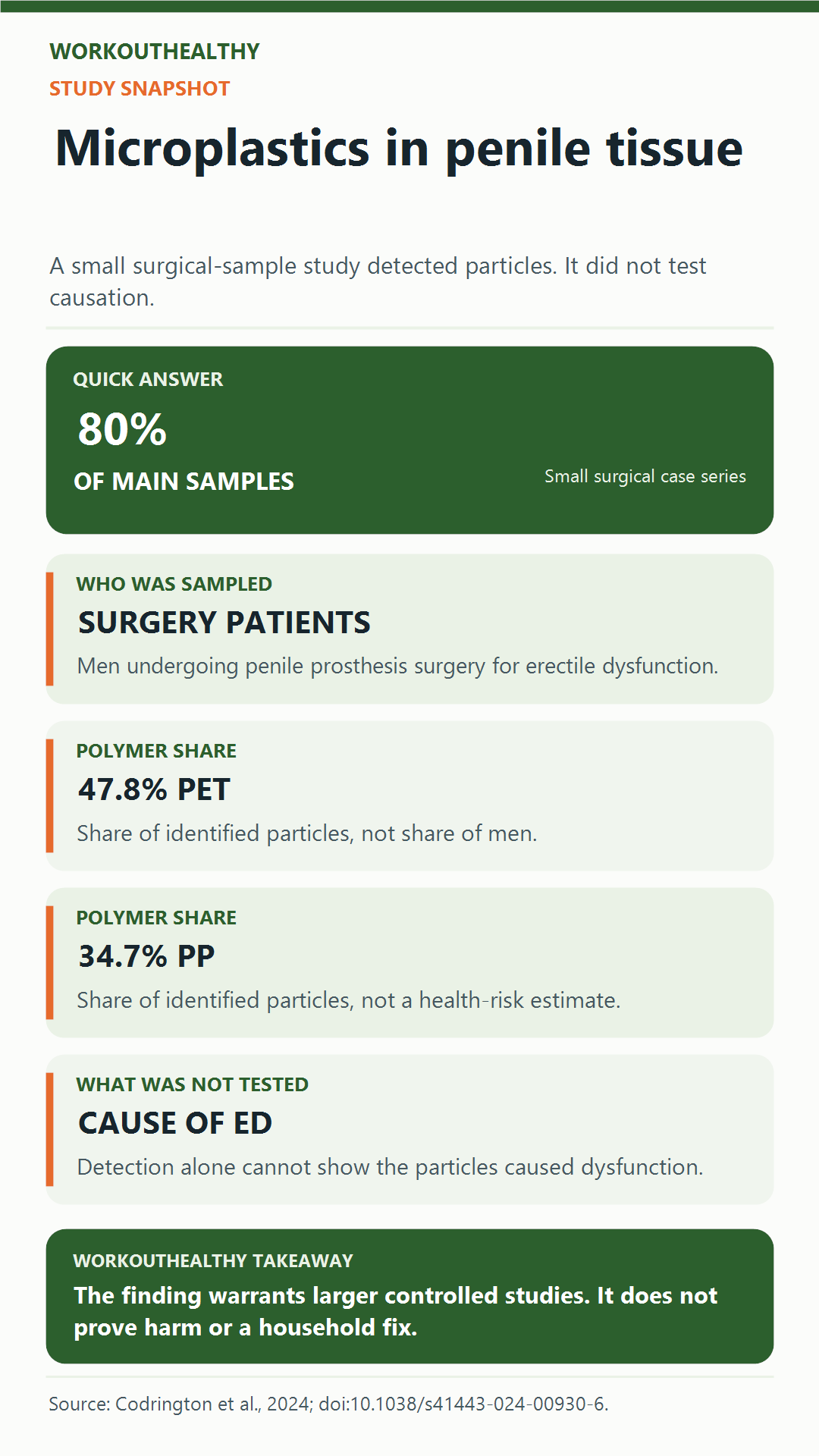
The researchers reported microplastics in 80% of the analyzed samples using their infrared method. That headline percentage comes from a very small clinical sample. It must not be read as “80% of men have microplastics in penile tissue.” Five samples can tell researchers whether a signal is worth following up; they cannot estimate a population prevalence with useful precision.
Detected particles in the infrared analysis ranged from roughly 20 to 500 micrometers. Electron microscopy also visualized smaller particles, down to around 2 micrometers. The two most common polymer types among the detected particles were polyethylene terephthalate, or PET, at 47.8%, and polypropylene, or PP, at 34.7%. Those percentages describe identified particles, not the number of men exposed and not the risk of a particular product.
PET and PP are used in many settings, so finding either polymer does not identify the exact source for an individual patient. The study did not trace a particle back to a water bottle, a food container, a shirt, or a medical product.
Did the Study Link Microplastics to Erectile Dysfunction?
No causal link was established. The participants were undergoing prosthesis surgery for erectile dysfunction, but the study did not compare enough people with and without the condition to test whether a particle burden predicts erectile function. It had no prospective exposure measurement and no intervention. Detection in tissue and an explanation for disease are different scientific claims.
Laboratory and animal studies have raised plausible questions about inflammation, oxidative stress, and endocrine effects. Plausibility is not proof that the small particles found here caused any patient’s symptoms. A later experiment or a larger human study might refine the risk picture, but this particular paper cannot settle it.
The caption’s phrase “deeply embedded” can also imply more than the study establishes. The researchers analyzed surgical tissue and identified particles within it. They did not map each person’s lifetime exposure, establish when the particles arrived, or show that those particles were doing damage at the point of detection.
Why Contamination Control Matters
Microplastics are found throughout the environment. They can enter a sample during collection, storage, preparation, or analysis if a study does not control those steps. The paper’s use of cleaned glassware for the main samples and a separately stored control addresses part of that problem; it does not make contamination impossible. Independent replication with standardized methods would increase confidence in the measured amounts and types.
The U.S. Food and Drug Administration likewise notes that microplastic studies still lack fully standardized definitions, reference materials, and sampling and detection methods. That does not mean every detection is false. It means results from different studies may not be directly comparable, and health-risk estimates remain difficult.
What About Microplastics in Other Organs?
Researchers have reported particles in other human samples and tissues, including blood, urine, stool, lungs, and placenta. Those findings show why exposure science matters. They do not mean every organ is equally exposed, that every detected particle is retained permanently, or that disease has been proven. Each tissue study has its own sampling, measurement, and contamination questions.
The strongest next study would not simply repeat a dramatic photo or headline. It would use larger and more representative groups, standardized clean sampling, blinded analysis, carefully matched comparison groups, and health outcomes measured over time. It would ask which particle sizes and polymers, if any, predict clinically important changes after accounting for other causes.
Should You Change Everyday Plastic Habits?
Reducing avoidable plastic waste is a reasonable personal or environmental choice. Reusable bottles and containers may be practical for some households. But this study did not test whether changing bottles, filtering water, or avoiding a particular package reduces particles in penile tissue or improves fertility or sexual function.
It is also important not to turn a preliminary finding into a product claim. Filter performance varies by design and by particle size. A label promising “microplastic protection” should be judged by independent testing under conditions that match the claimed use. The FDA says that current evidence does not demonstrate that the levels of microplastics found in foods pose a human-health risk, while emphasizing that major research gaps remain. That position is cautious, not a guarantee of no risk.
If you have a concern about erectile function or fertility, speak with a qualified clinician. Established medical conditions and medication effects deserve an individualized evaluation. Buying a new bottle is not a diagnostic test or a substitute for care.
How to Read the Next Headline
- Ask who was sampled. A surgical case series is not a population survey.
- Ask what was measured. Detecting polymer particles is not the same as measuring harm.
- Check the denominator. “80%” sounds broad, but here it comes from a handful of samples.
- Separate mechanism from outcome. A laboratory pathway can justify research without proving a human clinical effect.
- Look for an intervention test. A proposed household action needs its own evidence of benefit.
That evidence-first approach also guides our editorial standards. For another example of why a biological detection does not automatically become a clinical conclusion, see our urine-cancer-test explainer. Our health disclaimer explains the limits of general articles like this one.
The Bottom Line
The Codrington team found microplastics in most of a very small set of penile-tissue samples from men undergoing erectile-dysfunction surgery. The detection warrants careful follow-up. It cannot tell us how common those particles are in all men, where each particle came from, or whether they caused sexual-health problems. Curiosity and caution belong together here.
References
- Codrington J, et al. Detection of microplastics in the human penis. International Journal of Impotence Research. Published online June 19, 2024. doi:10.1038/s41443-024-00930-6.
- U.S. Food and Drug Administration. Microplastics and Nanoplastics in Foods. Accessed September 2026.
This article is for general information, not medical advice, diagnosis, or treatment. Consult a qualified clinician about sexual-health or fertility concerns.