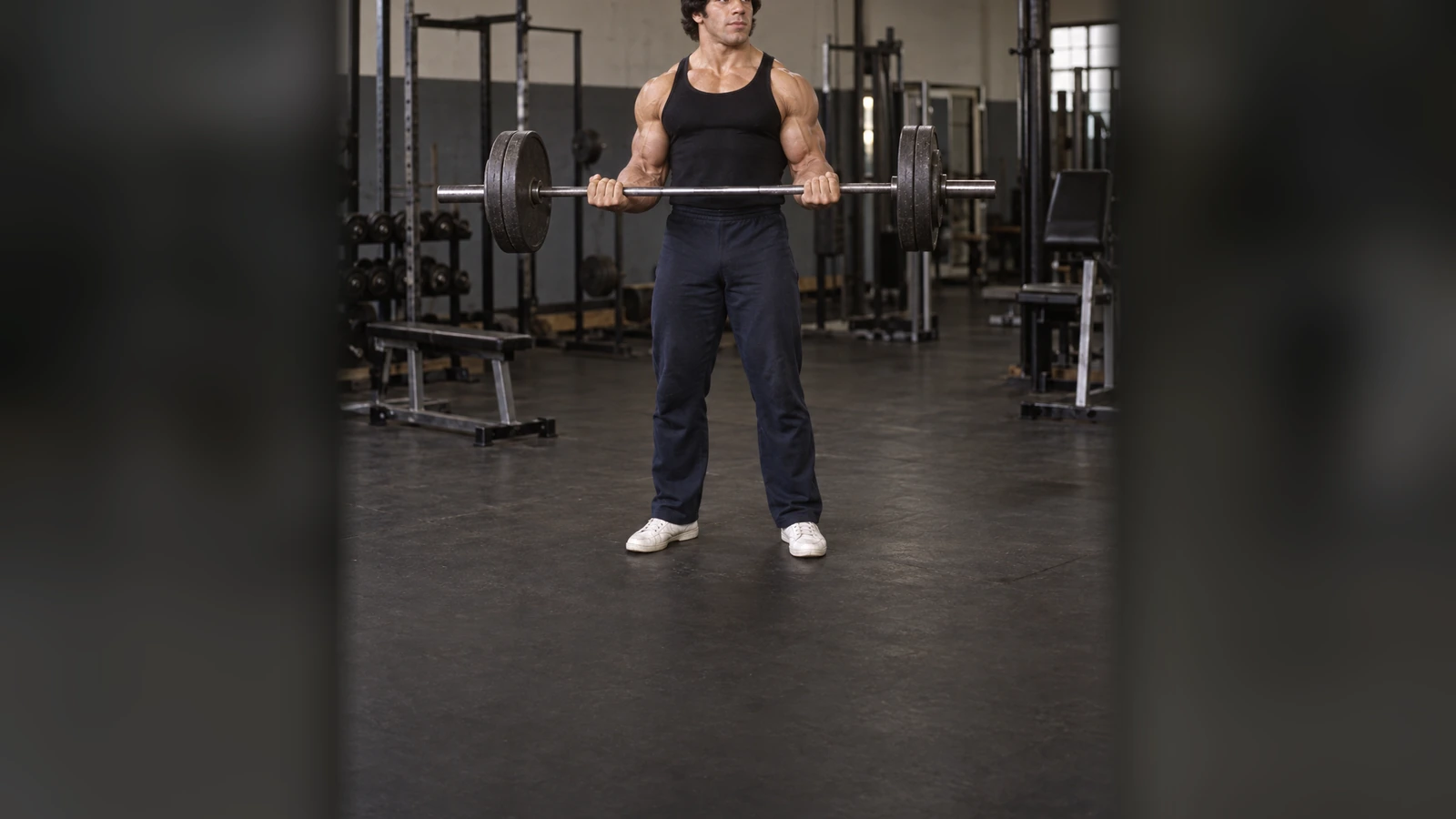

Lou Ferrigno was one of the largest bodybuilders of the 1970s.
At 6 feet 5 inches, he competed at around 275 to 285 pounds.
A widely shared post says he built that size on heavy compound lifts like the bench press, squat, and deadlift.
The heavy lifting part fits what is known about him. The claim that it was nearly all he did is harder to back up.
Here is what the record shows, what the science says about heavy lifting, and how to use the lesson without copying a 285 pound champion.
Who Lou Ferrigno Is
Ferrigno was born in Brooklyn, New York, in 1951.
He started lifting at 13, inspired by the actor and bodybuilder Steve Reeves.
Money was tight, so early on he made his own weights from a broomstick and pails partly filled with cement.
He won the IFBB Mr. America title in 1973 and the IFBB Mr. Universe title in 1973 and 1974.
He placed second at the 1974 Mr. Olympia and third in 1975.
The 1977 film Pumping Iron showed him chasing Arnold Schwarzenegger, and it made him famous.
He went on to play the Hulk on television, and he is still living today.
What We Can Confirm About His Training
A BarBend review of his strength history says Ferrigno preferred heavy weights to build the mass needed at the elite level.
The same review says he pushed for the heaviest weight he could handle for about 8 to 12 reps.
Ferrigno has claimed a bench press of about 560 to 600 pounds, a 640 pound squat, and a deadlift near 900 pounds.
Strength journalist Greg Merritt has pointed out that there is no evidence to support those numbers.
So treat them as personal claims, not recorded lifts.
There is one more real test of his strength.
He competed in the first World’s Strongest Man contest in 1977. He finished fourth of eight and won two events.
What We Could Not Confirm
We could not find a reliable source saying Ferrigno built his size almost entirely on the bench press, squat, and deadlift.
We also could not confirm that he added isolation work only after building a base with those three lifts.
Like most bodybuilders of his time, he trained every muscle group for a physique contest.
The fair summary is that heavy multi-joint lifting was a big part of his approach, not the only part.
Heavy basics build the engine. The finishing work shapes the car. Most people need far more engine than they think.
What Research Says About Heavy Loads
A 2021 network meta-analysis by Lopez and colleagues compared light, moderate, and heavy resistance training.
It pooled 28 studies with 747 healthy adults, and all sets were taken to failure.
Heavy loads were defined as 8 reps or fewer, or at least 80 percent of a one rep max.
For muscle growth, the load did not seem to matter much.
For strength, the story changed.
Both heavy and moderate loads beat light loads, and the authors concluded strength gains are superior with high load programs.
A 2021 review by Schoenfeld and colleagues reached a similar view.
It found similar muscle growth across a wide range of loads, from about 30 percent of a one rep max and up.
Heavy loads were still better for building one rep max strength.
What This Means for Ferrigno’s Approach
Ferrigno’s 8 to 12 rep range falls mostly in the moderate zone of the Lopez review.
That range builds muscle well and still lets you use a lot of weight.
Big multi-joint lifts also let you load many muscles at once, which saves time.
But the research does not say heavy barbell lifts are the only path to size.
Muscle can grow with lighter loads when sets are pushed hard enough.
His extreme size also came with rare height, years of training, and elite genetics that no program can copy.
How to Apply the Lesson
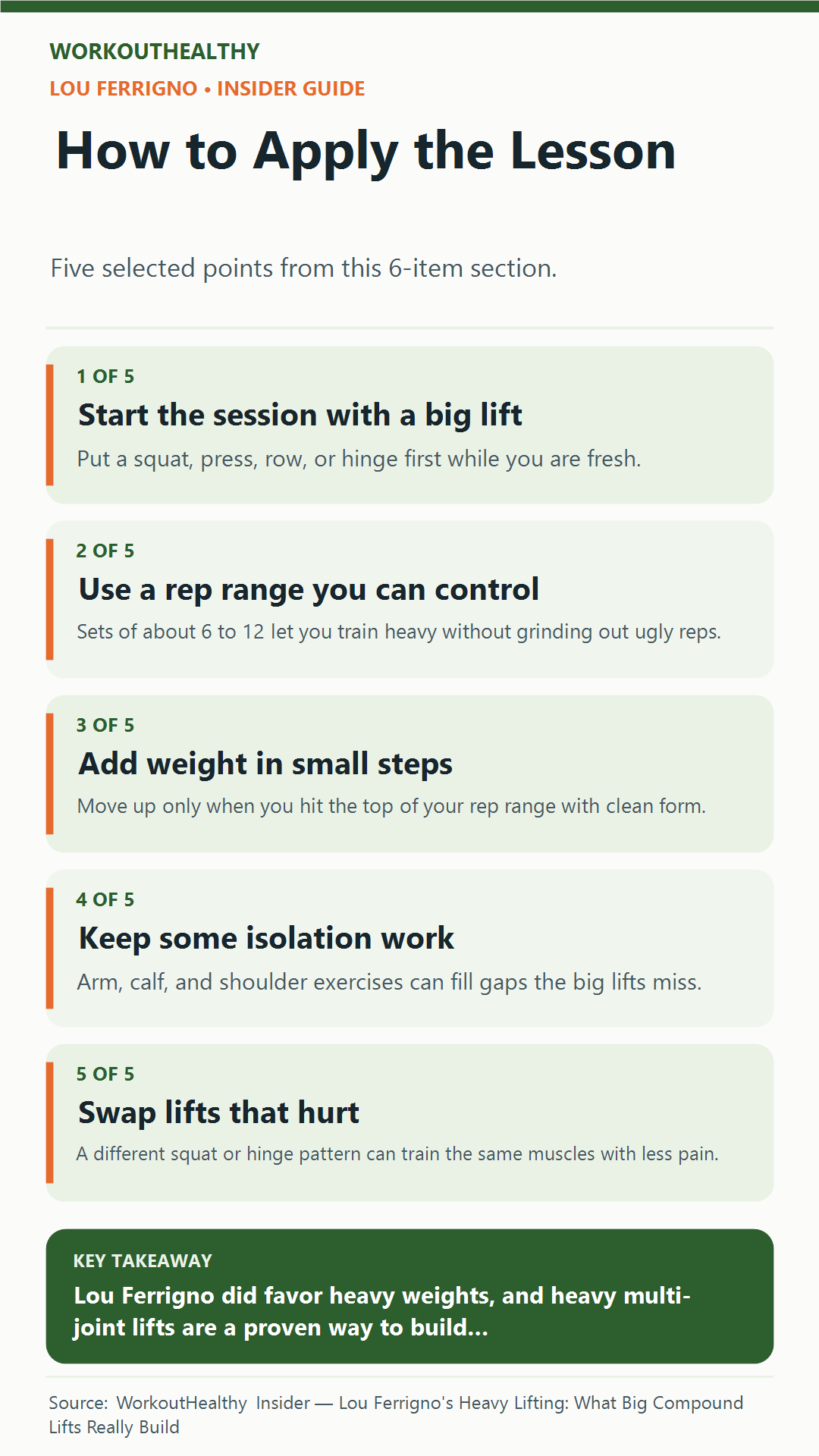
- Start the session with a big lift. Put a squat, press, row, or hinge first while you are fresh.
- Use a rep range you can control. Sets of about 6 to 12 let you train heavy without grinding out ugly reps.
- Add weight in small steps. Move up only when you hit the top of your rep range with clean form.
- Keep some isolation work. Arm, calf, and shoulder exercises can fill gaps the big lifts miss.
- Swap lifts that hurt. A different squat or hinge pattern can train the same muscles with less pain.
- Eat enough to grow. Size takes enough total food and protein, not just hard sets.
If a barbell squat does not suit you, see our guide to squat alternatives by goal.
Lean lifters who struggle to add size can start with our article on how to gain muscle when you are skinny.
For a reality check on simple mass building advice, read whether building muscle is as simple as one coach claims.
Mistakes to Avoid
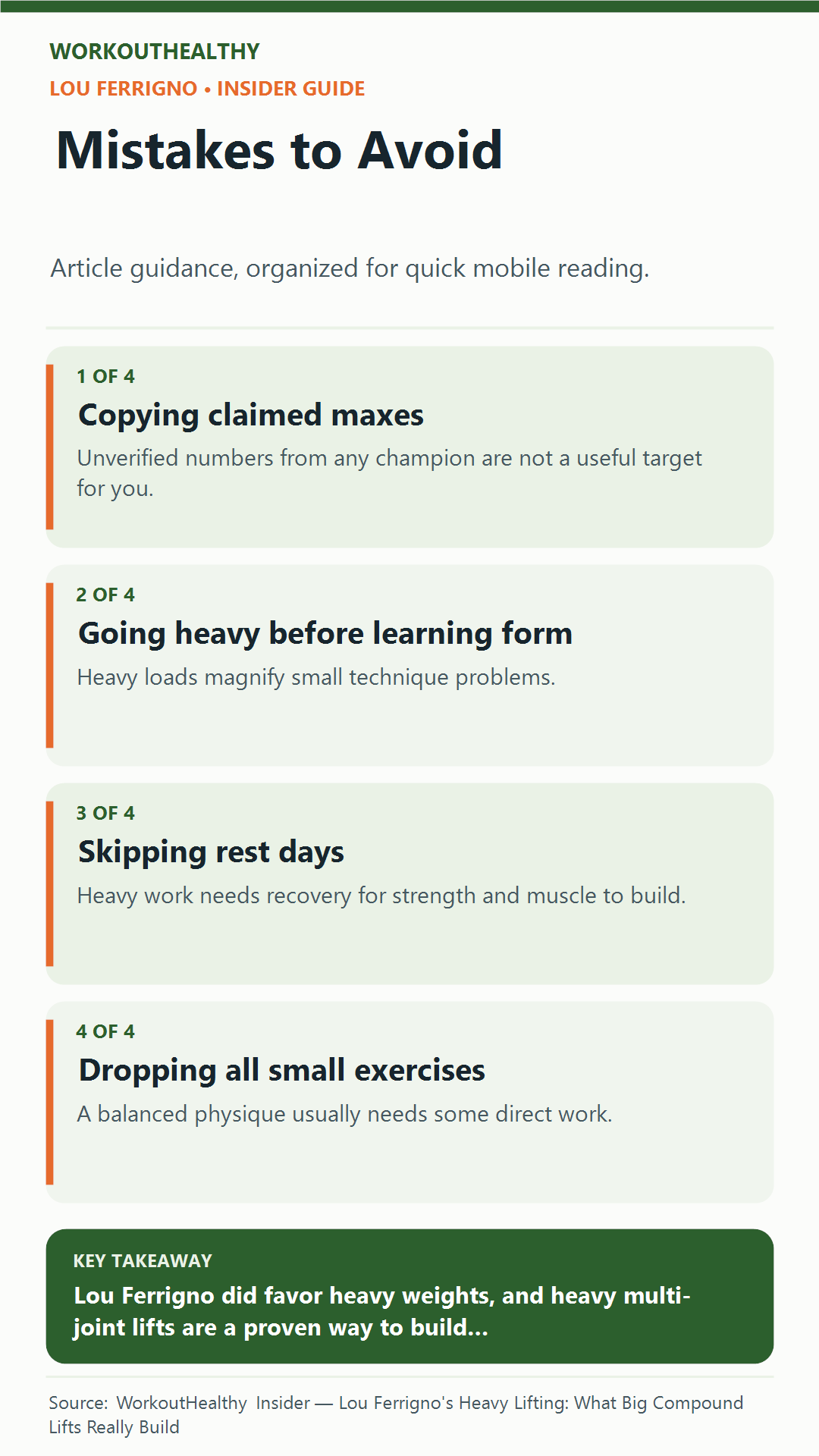
- Copying claimed maxes. Unverified numbers from any champion are not a useful target for you.
- Going heavy before learning form. Heavy loads magnify small technique problems.
- Skipping rest days. Heavy work needs recovery for strength and muscle to build.
- Dropping all small exercises. A balanced physique usually needs some direct work.
Who Should Be Careful
People with back, knee, or shoulder problems should get guidance before loading heavy barbell lifts.
The same goes for anyone with high blood pressure or heart disease, since heavy straining raises blood pressure during a set.
Beginners should learn each lift with lighter weights first, ideally with a qualified coach.
The Bottom Line
Lou Ferrigno did favor heavy weights, and heavy multi-joint lifts are a proven way to build strength.
His famous lift numbers are unverified, and it is not clear that three lifts were almost all he did.
Research shows heavy loads matter most for strength, while muscle can grow across many loads.
Build around big lifts, progress slowly, and keep the extra work that fills your gaps.
Want more stories like this? Subscribe to WorkoutHealthy Insider for practical explanations behind popular fitness claims.
References
- BarBend. (n.d.). How strong was Lou Ferrigno? Looking back at the bodybuilder’s hulking feats.
- Pumping Iron [Documentary film]. (1977).
- Lopez, P., Radaelli, R., Taaffe, D. R., Newton, R. U., Galvão, D. A., Trajano, G. S., Teodoro, J. L., Kraemer, W. J., Häkkinen, K., & Pinto, R. S. (2021). Resistance training load effects on muscle hypertrophy and strength gain: Systematic review and network meta-analysis. Medicine & Science in Sports & Exercise, 53(6), 1206 to 1216. https://doi.org/10.1249/MSS.0000000000002585
- Schoenfeld, B. J., Grgic, J., Van Every, D. W., & Plotkin, D. L. (2021). Loading recommendations for muscle strength, hypertrophy, and local endurance: A re-examination of the repetition continuum. Sports, 9(2), 32. https://doi.org/10.3390/sports9020032
This article is for general information only and is not medical advice. If you have an injury, ongoing pain, or a medical condition, talk to a doctor or physical therapist before you change how you train or eat.