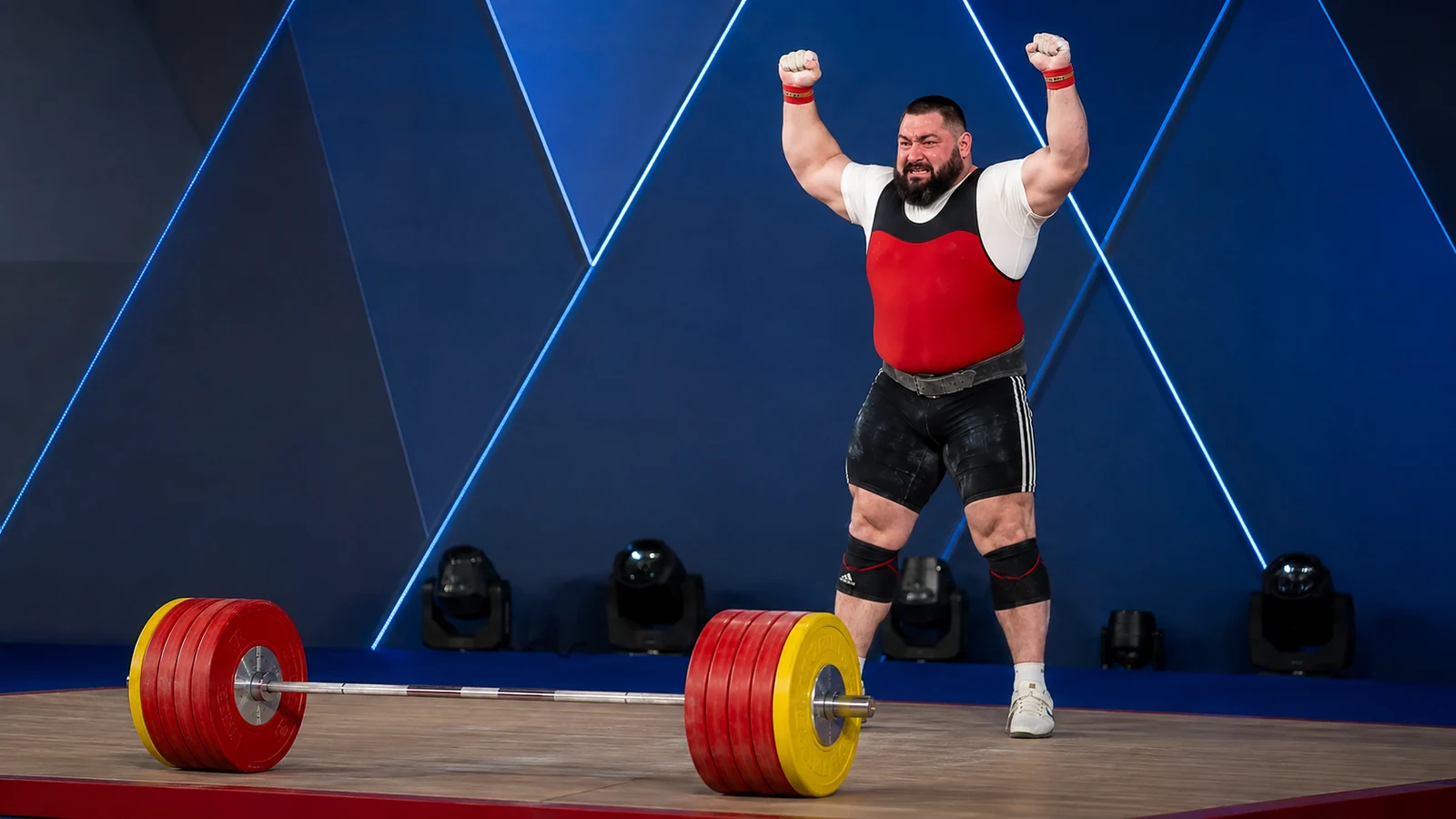

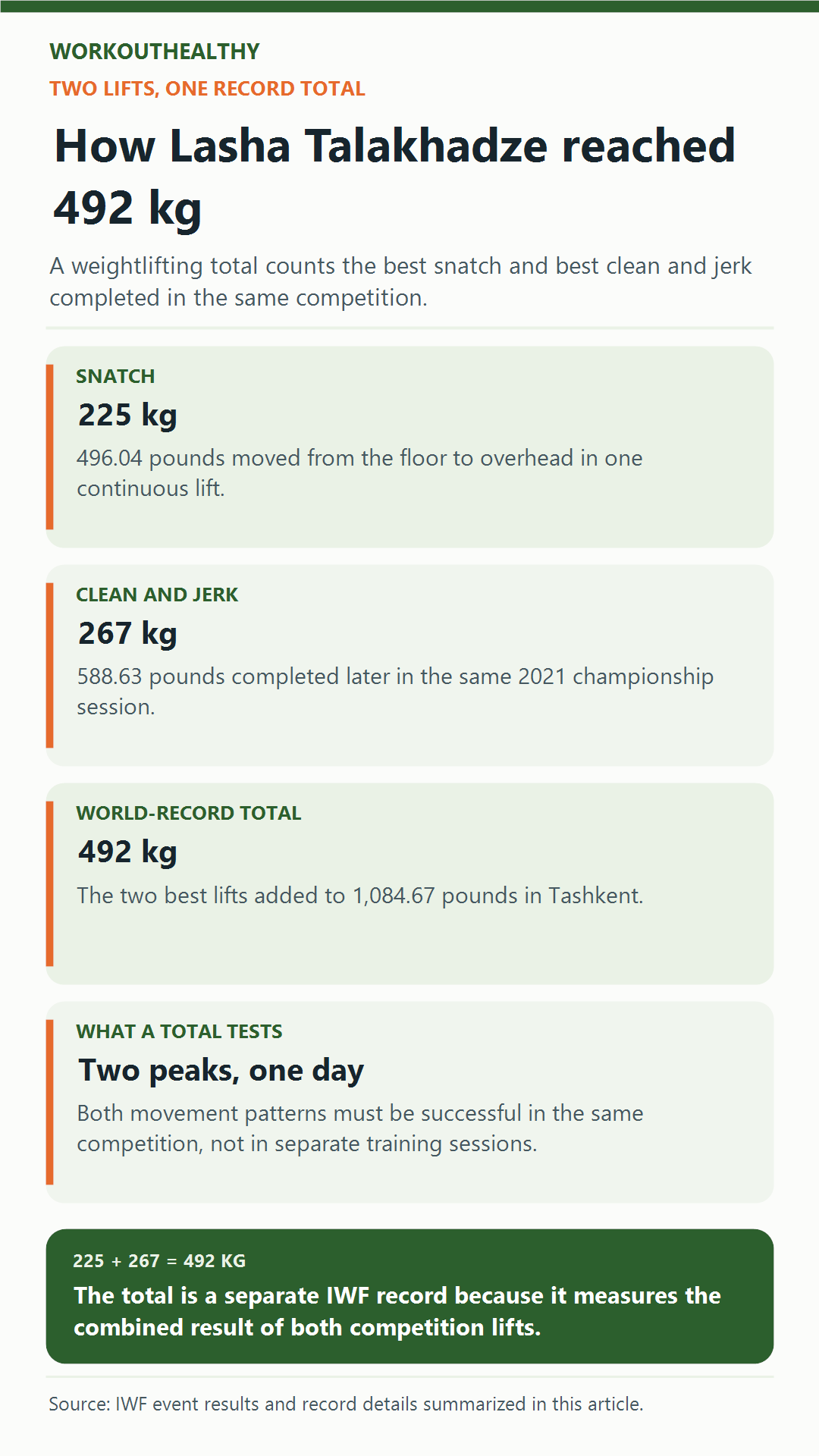
Four hundred ninety two kilograms is 1,084.67 pounds.
That number by itself does not say much until you know what produced it.
On December 17, 2021, at the IWF World Championships in Tashkent, Uzbekistan, Lasha Talakhadze added a 225 kilogram snatch to a 267 kilogram clean and jerk in the same session.
The sum of those two lifts became a world record of its own, separate from either lift individually.
Nearly five years later, no one has beaten it.
A Total Is Its Own World Record, Not Just Math
Olympic weightlifting recognizes three separate world records in every weight class: the snatch, the clean and jerk, and the total.
A lifter can hold one of the three, two of the three, or all three at once, and the sport’s governing body, the International Weightlifting Federation, tracks and certifies each one separately.
Talakhadze holds all three in the men’s +109 kilogram category, the sport’s unlimited superheavyweight class.
His 267 kilogram clean and jerk from that same night is itself a separate, individually recognized world record, one WorkoutHealthy has covered in its own detail elsewhere.
This article is about the total specifically, the number that only exists because he produced something exceptional twice in one competition, not once.
That distinction matters because a total is not simply the bigger of two impressive lifts added together for a headline.
It is the sport’s actual measure of who the best all-around lifter in a weight class is on a given day.
It is worth pausing on a common mix-up here.
Olympic weightlifting and powerlifting are different sports, even though this article sits in a website category called Powerlifting Records.
Powerlifting tests the squat, the bench press, and the deadlift, three separate maximal lifts usually contested across a single meet.
Olympic weightlifting tests only the snatch and the clean and jerk, both performed explosively and both requiring the bar to finish locked out overhead.
A powerlifting total adds three lifts together.
A weightlifting total, like Talakhadze’s, adds exactly two.
The Snatch Half of the Story: 225 Kilograms in One Motion
Most retellings of this session focus on the clean and jerk, since 267 kilograms is the single heaviest number involved.
The snatch deserves its own attention, because without it there is no total record at all.
A snatch is a single continuous pull.
The bar starts on the floor and has to reach a full overhead lockout in one motion, with no pause at the shoulders and no second lift to finish the job.
A lifter grips the bar wide, pulls it upward and slightly back along the body, then drops underneath it into a full squat, catching it directly overhead with straight arms.
Standing back up from that squat, still holding the bar locked out above the head, completes the lift.
Any bend in the elbows at the catch, or any stumble forward or back, and the lift is disqualified no matter how much weight was on the bar.
On his final attempt that night, Talakhadze loaded 225 kilograms, or 496.04 pounds, onto the bar.
That broke his own previous world record of 223 kilograms.
Two hundred twenty five kilograms is close to the weight of a baby grand piano, moved from the floor to arms-length overhead in well under two seconds, without a single break in the motion.
He caught it, held the overhead position, and stood.
That lift alone secured him first place in the snatch portion of the competition before the clean and jerk even began.
A snatch has to be caught overhead in one unbroken motion. A clean and jerk gets to pause at the shoulders first. Excelling at only one of those two very different tasks has never been enough to set a total record.
Why the Total Demands Two Different Kinds of Strength
The snatch and the clean and jerk look related from a distance, since both start with a barbell on the floor and end with it overhead.
Up close, they ask the body to do different things.
Researchers who directly compared the two lifts in elite weightlifters found real biomechanical and neuromuscular differences between them, not just a difference in how much weight gets used (Arauz et al., 2026).
The snatch demands a wider grip, a longer first pull, and one uninterrupted catch far overhead.
The clean and jerk allows a narrower grip and a shorter first pull, because the bar only needs to reach the shoulders before the lifter resets and drives it up a second time.
A separate study using wearable motion sensors on competitive lifters found measurable differences in bar path, joint angles, and timing between the two lifts, even within the same athletes on the same day (Khuyagbaatar et al., 2024).
That is a meaningful finding for anyone chasing a total rather than a single lift.
Being strong is necessary for both lifts.
It is not sufficient for either one on its own.
The specific technical skill built for a fast, overhead-catching snatch does not automatically transfer into the slower, heavier, two-stage grind of a clean and jerk.
A lifter who only trains one pattern will plateau on the other, and a total record requires both patterns to peak in the same competition, on the same day, sometimes within the same hour.
What This Evidence Does Not Prove
None of this means every strong athlete could learn both lifts equally well with enough practice.
Genuine differences in mobility, limb length, and coordination shape how far any individual lifter can push either movement.
It also does not mean the two lifts are unrelated.
Strength built through one still supports the other to a real degree, which is exactly why elite lifters train both in the same programs instead of specializing entirely.
The kinematic studies cited above measured a relatively small number of elite athletes under lab conditions, not a broad population of recreational lifters.
Their exact numbers should not be treated as universal rules for every gym.
A total record also does not prove a lifter can repeat either half of it on command.
Talakhadze’s own results at major competitions since 2021, including a lower total at the 2024 Paris Olympics where he still won gold, show how rarely even a world record holder lines up a personal-best snatch and a personal-best clean and jerk on the same day.
Common Mistakes Lifters Make Chasing a Bigger Total
Most lifters who want to raise their total make one of a few predictable errors.
The most common is training the lift they already enjoy, or are already good at, far more than the other one, which widens the gap between the two instead of closing it.
A second is treating competition day like two separate events instead of one combined test, without ever practicing how fatigue from a heavy snatch affects the clean and jerk that follows less than an hour later.
A third is picking overly aggressive opening attempts, chasing a personal record on the very first lift and missing it, which eats into recovery time and working attempts for the lift that follows.
A fourth is neglecting the specific mobility each lift needs.
The snatch depends heavily on shoulder and hip mobility for a very deep, very wide catch position.
The clean and jerk depends more on ankle and thoracic mobility for the front rack and the split or squat under the jerk.
Skipping either one quietly caps a lifter’s total long before their raw strength does.
Who Should Be Cautious Training Toward a Heavier Total
Training both lifts in the same session, the way a real total requires, adds up to real cumulative demand on the body.
Anyone with a history of shoulder instability should get cleared by a doctor or physical therapist before catching heavy weight overhead in either lift.
Anyone with uncontrolled high blood pressure should be cautious with near-maximal barbell work in general, since both lifts produce sharp, brief spikes in pressure during the pull and the catch.
Lower back and knee issues deserve real attention too, since both lifts load the spine and the knees repeatedly, lift after lift, set after set.
Total-focused training is not the place to start learning either lift from scratch.
A qualified weightlifting coach matters even more once a program is stacking both lifts together, not less.
Anyone building general barbell strength before attempting either Olympic lift can start with more familiar patterns, the way our look at floor press versus bench press mechanics breaks down how small setup changes shift which joints and muscles do the work.
How Lifters Actually Train to Raise Their Total
Programs built around raising a total look different from programs built around a single lift.
Most competitive weightlifting coaches split training weeks so that snatch technique work, clean and jerk technique work, and general strength work for both all get dedicated time, rather than rotating through whichever lift feels easiest that day.
Lifters typically train both competition lifts, along with technical variations of each, several times a week rather than isolating just one for long stretches.
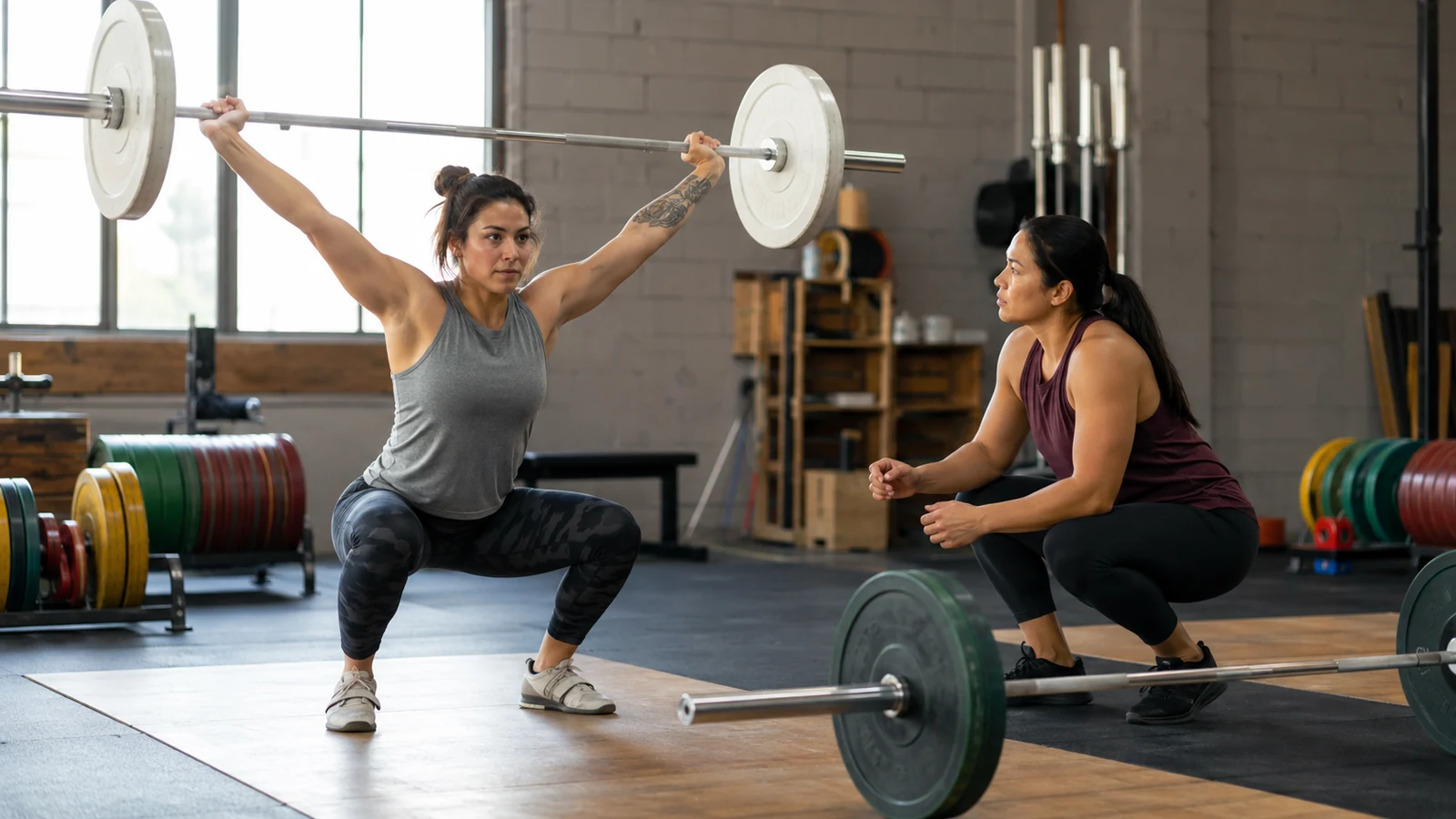
Overhead squats and snatch balances build the specific mobility and catch confidence the snatch requires.
Front squats and jerk drives build the strength the clean and jerk leans on most heavily.
As a total-focused competition approaches, coaches often run mock meets, testing a full snatch, a short rest, then a full clean and jerk, exactly as it will happen on the actual platform.
That rehearsal is where lifters learn how their body actually handles the two-lift sequence, not just how each lift feels in isolation.
Fueling and rest between lifts on competition day get planned in advance too, since even a few unplanned extra minutes between a snatch attempt and the first clean and jerk attempt can change how a lifter’s body responds.
That kind of week-to-week balancing act is not unique to weightlifting, either.
A similar tension between chasing a single number and building broad, well-rounded capacity shows up in how WorkoutHealthy readers themselves weigh weightlifting against other training, where the appeal of a clear, measurable number keeps pulling people toward barbell sports in the first place.
Does the 492 Kilogram Total Still Stand?
Based on the International Weightlifting Federation’s own December 2021 report and Talakhadze’s competitive results since then, yes, the record still stands.
He has not matched his own 492 kilogram total in any competition since setting it, including at the 2024 Paris Olympics, where he won gold with a lower total.
No other lifter in the men’s +109 kilogram category has come close either.
The International Weightlifting Federation, not Guinness World Records, is the sport’s official record-keeping body for this mark, and its original report from that night remains the primary documentation of it.
Building a total this large is also a long-term project, not a single lucky night, the same way strength training research on long-term barbell work keeps finding that consistent lifting pays off over years, not weeks.
Watch the Original Video
Want more verified strength records broken down clearly? Subscribe to WorkoutHealthy Insider for practical explanations behind popular fitness claims.
References
Arauz, P. G., Garcia, G., Llerena, J., & Kao, I. (2026). Biomechanical and neuromuscular differences between the snatch and clean in elite weightlifters. Journal of Biomechanics, 195, Article 113106. https://doi.org/10.1016/j.jbiomech.2025.113106
International Weightlifting Federation. (2021, December 17). 4 new world records: Last day at the 2021 IWF World Championships and Commonwealth Championships. https://iwf.sport/2021/12/17/4-new-world-records-last-day-at-the-2021-iwf-world-championships-and-commonwealth-championships/
Khuyagbaatar, B., Tumurbaatar, M., Tsenkherjav, K., Purevsuren, T., Shambaljamts, T., Kim, K., Danjkhuu, T., Danaa, G., & Kim, Y. H. (2024). Kinematic comparison of snatch and clean lifts in weightlifters using wearable inertial measurement unit sensors. Physical Activity and Health, 8(1), 1–9. https://doi.org/10.5334/paah.306
This article is for general information only and is not medical advice. If you have an injury, ongoing pain, or a medical condition, talk to a doctor or physical therapist before you change how you train or eat.