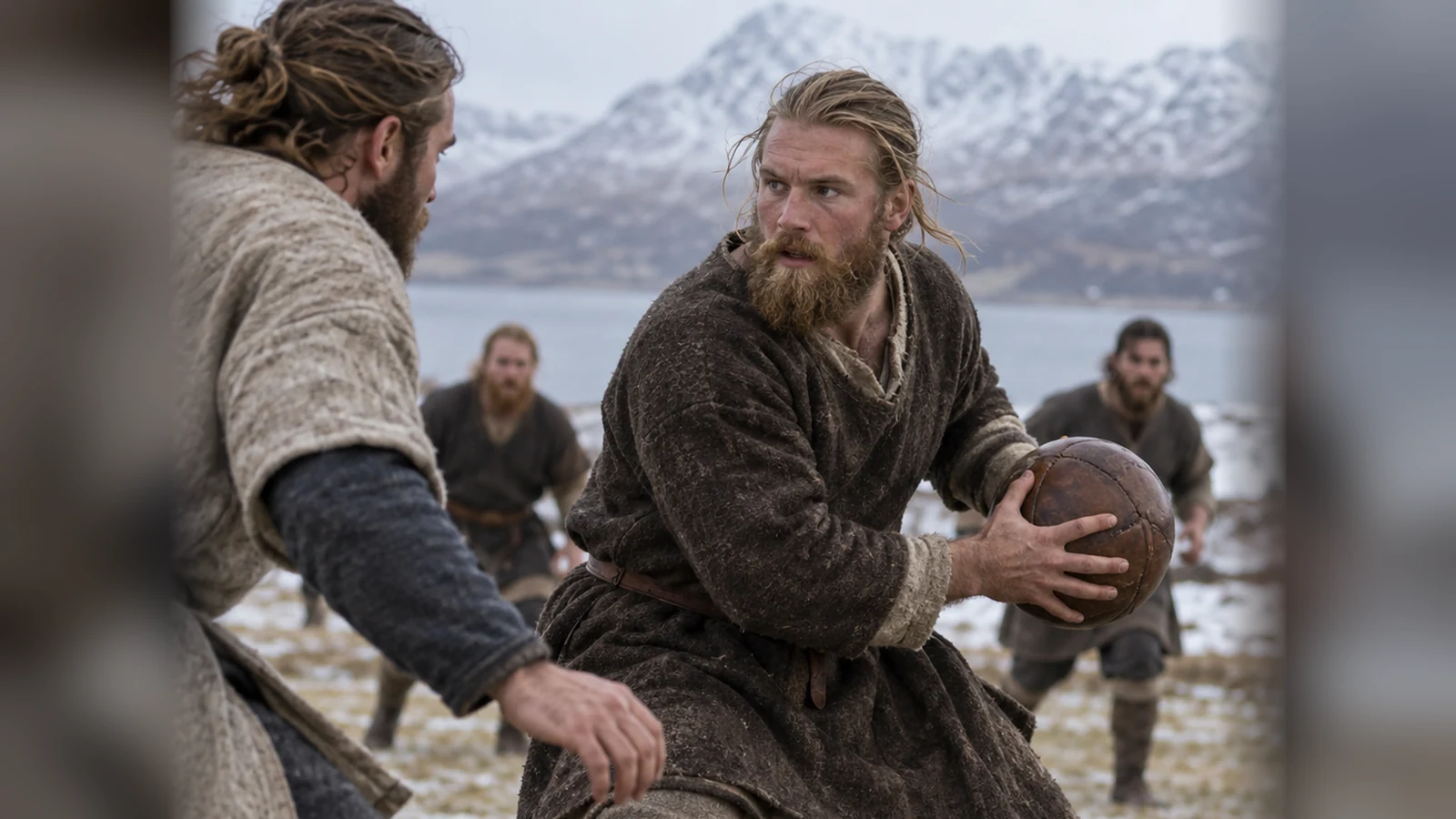

Long before hockey or lacrosse, people in Viking Age Iceland played a rough team ball game called knattleikr.
It shows up again and again in the Icelandic sagas, often in scenes that end badly.
A popular post says Icelanders played this full contact game to build strength, speed, and toughness.
The game was real and physical. The idea that it was designed as fitness training is a modern reading.
What the Sagas Tell Us
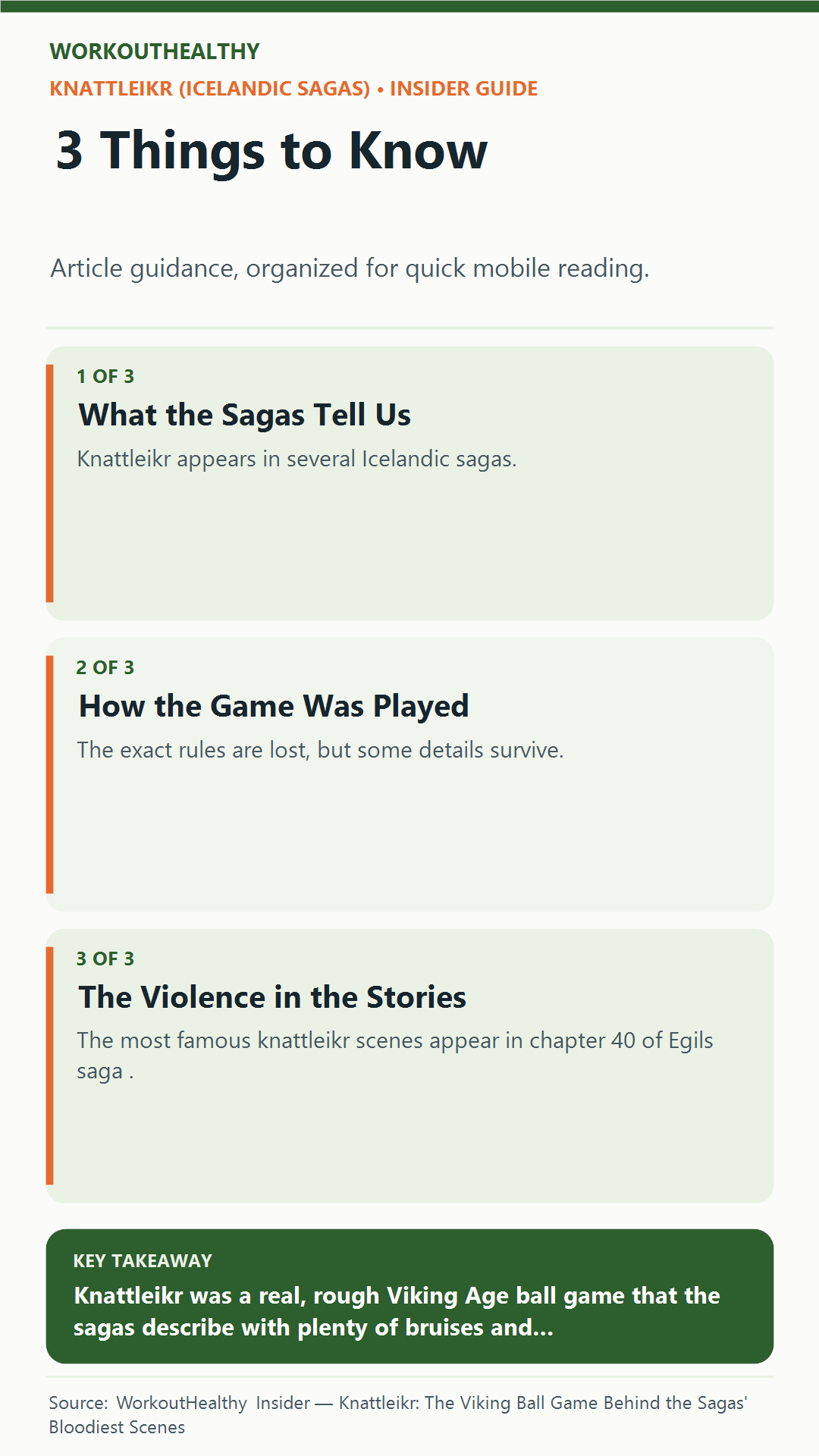
Knattleikr appears in several Icelandic sagas.
These include Egils saga, Gísla saga, Grettis saga, Eyrbyggja saga, and Vápnfirðinga saga.
The sagas are stories as much as records, so they mix history with drama.
They are best read as a window into how later Icelanders remembered the game, not as rule books.
How the Game Was Played
The exact rules are lost, but some details survive.
Players struck a hard ball with a stick, and they could also use their hands.
Teams had captains.
Body contact was allowed in the fight for the ball, so the strongest players had an advantage.
There appear to have been penalties, and trash talk was part of the contest.
Some historians think it was often played on a flat, frozen surface such as an iced over pond.
That part is a conjecture, not a firm fact.
The game could run from morning until night, and big tournaments drew crowds from across Iceland.
It is often compared with early forms of the Irish sport of hurling.
The Violence in the Stories
The most famous knattleikr scenes appear in chapter 40 of Egils saga.
There, the saga’s hero, Egil Skallagrimsson, plays as a boy in his seventh winter.
His opponent, Grim, is ten or eleven and stronger.
Egil loses his temper and hits Grim with his bat. Grim throws him down hard.
Egil then comes back with an axe and kills the older boy.
Later in the same chapter, when Egil is twelve, a game against his father Skallagrim turns deadly as evening falls.
Skallagrim throws Egil’s teammate Thord down so violently that he dies.
These scenes show that the sagas treated the game as a place where tempers and strength could boil over.
They do not show a planned training method.
They also come from a literary source written to entertain, so the details may be exaggerated for effect.
Even so, the fact that storytellers kept returning to the game suggests it held a big place in community life.
A hard game can build a tough athlete, but only rules and self control keep that game from breaking the players.
What the Popular Claim Gets Right and Wrong
The post is right that knattleikr was rough, physical, and demanding.
A game with sticks, a hard ball, and open body contact would reward strength, speed, and quick reactions.
It is less accurate to say the game was played “specifically” or “just” to build fitness.
The sagas present it as a social event and a competition.
Any fitness benefit was likely a side effect, not the stated goal.
What Research Says About Team Sports and Health
Modern science has looked at which sports offer clear health benefits.
A 2015 systematic review by Pekka Oja and colleagues examined 69 studies covering 26 sport disciplines.
It found moderately strong evidence that running and football, meaning soccer, improve aerobic fitness and heart function at rest.
Football also reduced body fat.
There was weaker, conditional evidence that football improves metabolic fitness, muscle performance, and heart function.
Evidence for many other sports was inconclusive or thin.
That supports the idea that running based team games can build real fitness. It does not mean every contact sport does.
The Cost of Full Contact
Heavy contact also brings injuries.
A 2013 meta analysis by Sean Williams and colleagues pooled data from 15 studies of professional men’s rugby union.
Match injuries occurred at about 81 per 1,000 player hours.
Training injuries were far less common, at about 3 per 1,000 player hours.
Injuries most often happened to the player being tackled.
The lower limbs were hurt most often, while upper limb injuries tended to be the most severe.
These are elite players, but the pattern is a useful warning for anyone drawn to rough games.
How to Get the Benefits Without the Saga Ending
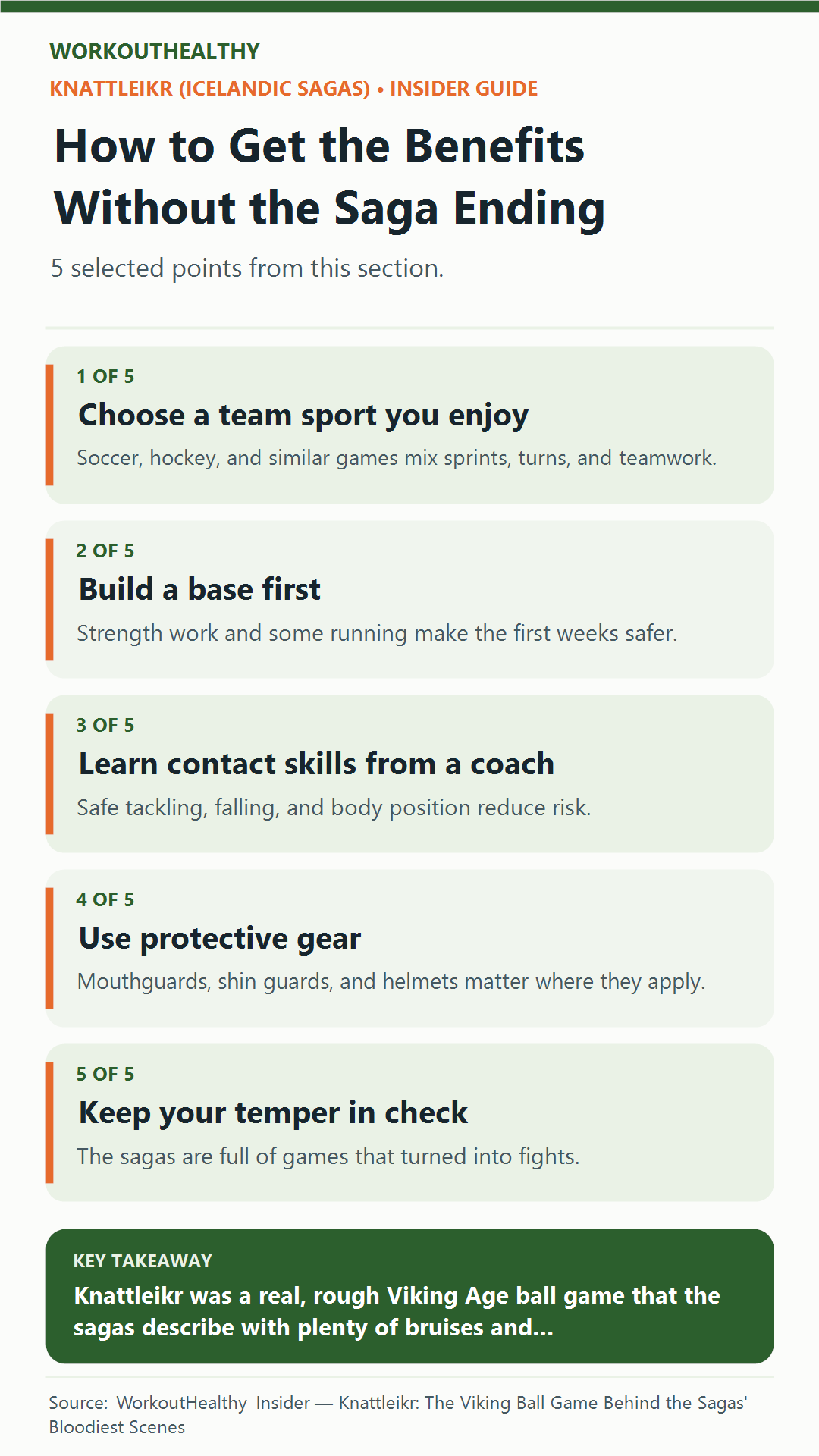
- Choose a team sport you enjoy. Soccer, hockey, and similar games mix sprints, turns, and teamwork.
- Build a base first. Strength work and some running make the first weeks safer.
- Learn contact skills from a coach. Safe tackling, falling, and body position reduce risk.
- Use protective gear. Mouthguards, shin guards, and helmets matter where they apply.
- Keep your temper in check. The sagas are full of games that turned into fights.
- Train your legs and ankles. Lower limb injuries were the most common type in the rugby research.
For a modern stick and ice example, see how François Arnaud trained like a real hockey player.
Small daily habits can protect joints during quick cuts, as in the ankle routine behind Stephen Curry’s long career.
Who Should Be Careful
Contact sports are not a good fit for everyone.
People with past concussions, joint replacements, bone density problems, or heart conditions should get medical advice first.
Adults returning to sport after many years should start with non contact versions and build up.
Modern Knattleikr
The game has not vanished completely.
Versions have been played at several American universities, including Brandeis, Clark, Providence, and Yale.
The first intercollegiate match was held in April 2007.
The Bottom Line
Knattleikr was a real, rough Viking Age ball game that the sagas describe with plenty of bruises and bloodshed.
The sagas do not say it was played mainly to build fitness, and its exact rules are lost.
Modern research shows team sports like soccer can improve health, while heavy contact raises injury risk.
Play hard, learn the skills, and leave the saga style violence in the stories.
Want more stories like this? Subscribe to WorkoutHealthy Insider for practical explanations behind popular fitness claims.
References
- Egil’s saga, chapter 40. (n.d.). Voluspa.org. https://www.voluspa.org/egil40.htm
- Oja, P., Titze, S., Kokko, S., Kujala, U. M., Heinonen, A., Kelly, P., Koski, P., & Foster, C. (2015). Health benefits of different sport disciplines for adults: Systematic review of observational and intervention studies with meta-analysis. British Journal of Sports Medicine, 49(7), 434 to 440. https://doi.org/10.1136/bjsports-2014-093885
- Williams, S., Trewartha, G., Kemp, S., & Stokes, K. (2013). A meta-analysis of injuries in senior men’s professional rugby union. Sports Medicine, 43(10), 1043 to 1055. https://doi.org/10.1007/s40279-013-0078-1
- Wikipedia contributors. (n.d.). Knattleikr. In Wikipedia. Retrieved September 16, 2026, from https://en.wikipedia.org/wiki/Knattleikr
This article is for general information only and is not medical advice. If you have an injury, ongoing pain, or a medical condition, talk to a doctor or physical therapist before you change how you train or eat.