

A video called “Dr. Jason Fung Reveals the Fastest Way to Reverse Insulin Resistance” has been getting attention from the channel Quick Fit Zone.
Dr. Jason Fung is a nephrologist known for speaking about fasting and low-carbohydrate eating.
The hosting channel is not itself a medical study.
The video title should be checked against primary research rather than treated as a clinical recommendation.
That matters, because the title makes a very big promise.
“Fastest way to reverse” is the kind of phrase that sells clicks.
It is not the kind of phrase that shows up in peer reviewed research.
This article looks at what real studies actually say about insulin resistance.
It covers exercise, fasting, and low carb eating, and it is honest about where the evidence is strong and where it is shaky.
Insulin resistance means the body’s cells stop responding well to insulin.
Insulin is the hormone that normally tells cells to pull glucose out of the blood.
When cells respond less well, the pancreas may compensate by releasing more insulin, so glucose can remain normal for years before it rises. Progression to type 2 diabetes is not inevitable. A single normal glucose reading therefore cannot settle a concern about insulin resistance (NIDDK).
When compensation no longer keeps pace, blood sugar can rise into the prediabetes or diabetes range, with associated cardiovascular risk.
It rarely happens overnight, and improvement usually reflects sustained care rather than a quick reversal.
What the Video Claims
The video’s framing suggests one clear method can reverse insulin resistance quickly.
That framing leans on Dr. Fung’s public reputation as a fasting advocate.
He has argued publicly that fasting can help improve blood sugar control for many people.
He has not published a single study claiming a fast, universal reversal for everyone.
No credible researcher has, because insulin resistance responds differently in different people.
Age, genetics, muscle mass, and how long someone has had it all play a role.
A clickbait title compresses that complexity into one dramatic promise.
The real research paints a slower, more individual picture instead.
What Real Research Shows About Exercise and Insulin Sensitivity
Physical activity is a well-supported part of preventing type 2 diabetes, but a trial of combined lifestyle changes should not be presented as a test of exercise alone.
The Diabetes Prevention Program is one of the most cited trials in this field.
Researchers followed more than 3,000 adults with prediabetes for about three years (Knowler et al., 2002).
One group joined an intensive lifestyle program built around exercise and modest weight loss.
That group cut their risk of developing type 2 diabetes by 58 percent.
A second group took the drug metformin instead, and cut their risk by 31 percent.
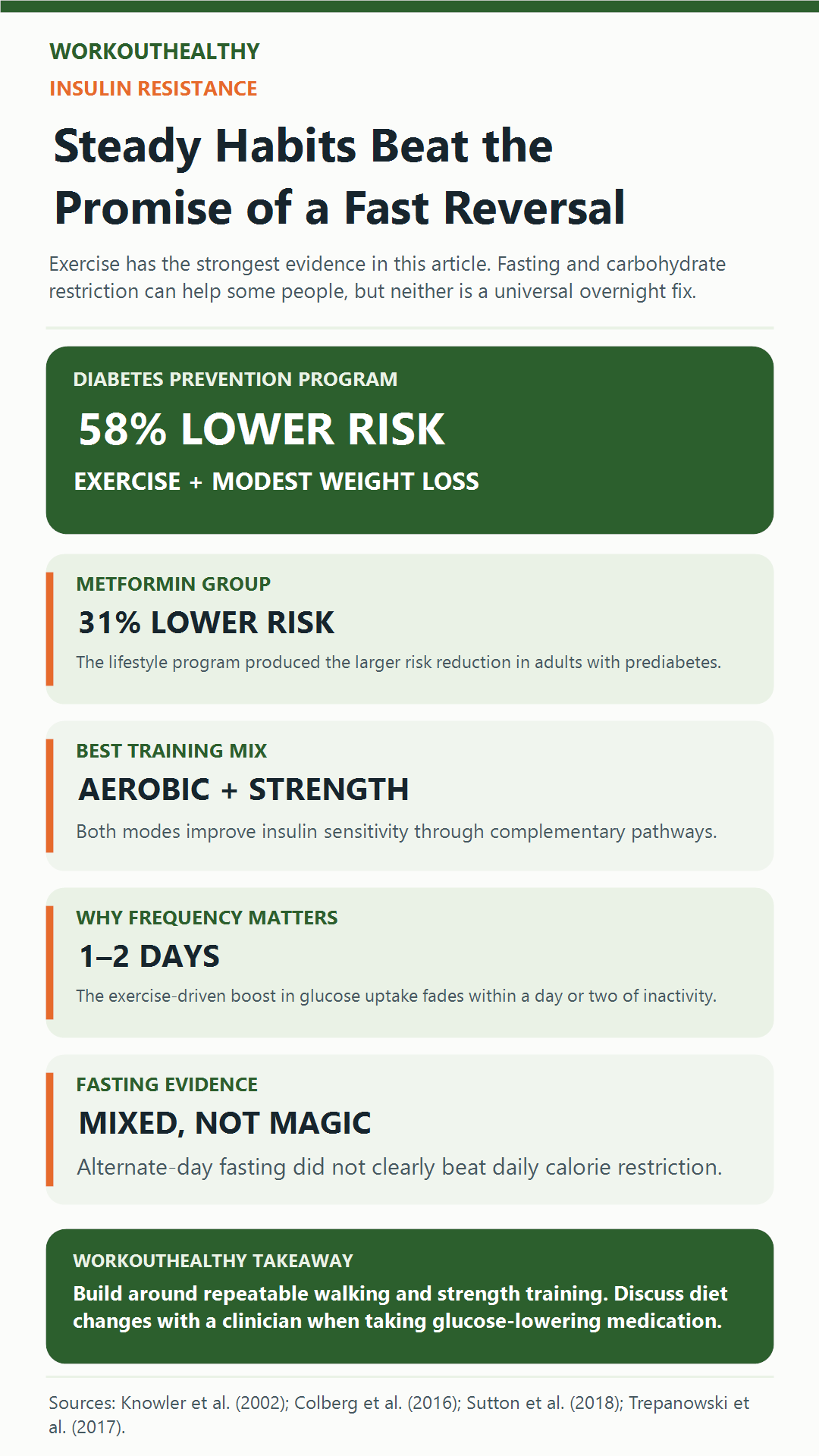
In that high-risk study population, the combined lifestyle program reduced diabetes incidence more than metformin did; this does not mean people should stop prescribed medication.
It remains a landmark result more than two decades later.
More recent guidance points the same direction.
A major position statement reviewed exercise research across many kinds of trials (Colberg et al., 2016).
It found that both aerobic exercise and resistance training improve insulin sensitivity.
Using both types of exercise can add benefits, but the best mix depends on the person and the outcome being measured.
Muscle tissue handles a large share of glucose disposal after a meal.
More muscle generally means more capacity to clear glucose from the blood.
That is one reason losing muscle along with fat can quietly work against insulin sensitivity.
Walking counts as real, useful exercise for this purpose too.
Simple daily walking shows up again and again as protective in large population studies.
If you want a sense of how much is enough, the research on daily walking distance is a good starting point.
Resistance training adds a separate benefit on top of walking.
Lifting weights has research behind it for far more than muscle size or brain health.
It also trains muscle to pull glucose out of the blood more efficiently.
Intensity seems to matter too, though total volume still counts for something.
Shorter, harder sessions and longer, easier sessions both showed benefits across the trials the ADA reviewed.
The most consistent finding was frequency, not any single workout style.
Regular activity is recommended because some of exercise’s effects on glucose handling are short-lived.
That lines up with how the body’s glucose uptake pathway behaves.
The exercise driven boost in glucose uptake fades within a day or two of inactivity.
Regular sessions keep that pathway switched on more of the time.
What Real Research Shows About Fasting and Low Carb Eating
Fasting research is real, but it is smaller and more mixed than the exercise research.
One well known trial studied early time restricted eating in men with prediabetes (Sutton et al., 2018).
Participants ate all their food inside an early six hour window each day.
Insulin sensitivity improved without weight loss among the eight men who completed the five-week crossover study. Its small size and narrow population make it a promising signal, not a general fasting prescription.
Insulin sensitivity improved before any weight was lost, which suggests timing itself matters, not just calories.
That is a genuinely interesting finding, and it suggests meal timing itself might matter.
Not every fasting protocol produces a clean win, though.
A large trial compared alternate day fasting against simple daily calorie cutting (Trepanowski et al., 2017).
Both groups lost weight over the year long study.
Neither approach clearly beat the other for weight loss or heart health markers.
Alternate day fasting was also harder for people to stick with over time.
That is an important caution against treating any single fasting protocol as magic.
Low carb eating has its own research base, separate from fasting schedules.
A systematic review pooled multiple trials on carb restriction and glycemic control (Sainsbury et al., 2018).
It found that cutting carbs improved blood sugar control in adults with diabetes.
The effect was strongest in the first three to six months.
It tended to fade somewhat over longer follow up periods.
That fade matters, since a headline claim of permanent reversal ignores it.
This particular review assessed carbohydrate restriction in adults with diabetes; it did not establish a general ranking of carbohydrate quality across the pooled trials.
Food quality still matters to a balanced diet, but that conclusion should not be attributed to these carbohydrate-restriction trials.
The evidence is more nuanced than a video title suggests.
No single carbohydrate target suits everyone.
The Mechanism: Why Movement and Eating Patterns Change Insulin Sensitivity
Insulin resistance means cells stop responding well to insulin’s signal.
The pancreas then pumps out more insulin to compensate for that weaker signal.
For some people, insulin-producing beta cells eventually cannot sustain enough compensation, and glucose levels rise. This outcome is not inevitable.
A detailed review in a major endocrinology journal mapped out how exercise interrupts this cycle (Sylow et al., 2017).
During and right after exercise, muscle can pull in glucose without needing much insulin at all.
That happens through a separate pathway that exercise itself switches on.
Regular training also increases the number of glucose transporters inside muscle cells.
Fasting and carb restriction work through a related but different route.
Both lower the amount of glucose and insulin circulating in the blood at any moment.
Changes in body weight, energy intake, food composition, and activity can affect insulin sensitivity through different pathways; a lower insulin reading alone does not prove that cells have become more responsive.
Weight loss, when it happens, adds a third mechanism on top of the other two.
Losing fat around the liver and abdomen tends to improve insulin signaling directly.
Chronic low grade inflammation is part of this picture as well.
Excess fat tissue, especially around organs, releases signals that interfere with insulin’s normal effect.
Exercise and weight loss both tend to lower that inflammatory signaling over time.
That is a slower process than a single workout or a single fast.
What This Evidence Does Not Prove
None of these studies prove that insulin resistance reverses the same way for everyone.
Response varies by genetics, age, sex, and how long someone has had the condition.
Some people with long standing type 2 diabetes see modest improvement, not full reversal.
Most of these trials also ran for months, not years.
Long term durability is still an open question in this research.
No single study, no matter how well designed, proves a fast universal reversal for every person reading this.
The alternate day fasting trial is a direct reminder of this problem.
It showed real limits, not a clean universal win, for one specific fasting method.
No study cited in this article supports the idea of one fastest method for everyone.
That framing belongs to marketing, not to the data.
Common Mistakes and Who Should Check With a Doctor First
A common mistake is jumping into an extreme fasting schedule with no medical guidance.
Anyone taking insulin or a sulfonylurea medication faces real risk from fasting.
Skipping meals while on those drugs can cause dangerously low blood sugar.
Another common mistake is treating carbs as the enemy and ignoring protein and fiber.
Low carb diets still need enough protein to protect muscle mass during weight loss.
A third mistake is expecting fast results and quitting after two or three weeks.
Most of the studies above ran for eight weeks or longer before showing real change.
People with a history of eating disorders should be especially cautious with any fasting plan.
Pregnant women, people who are underweight, and frail older adults need medical guidance too.
A doctor can check kidney function, medications, and overall health before any of this starts.
A simple fitness or health check is also worth doing before starting anything intense.
People with kidney disease need extra caution around both fasting and very low carb eating.
Dr. Fung’s own medical background is in kidney care, which is worth knowing given that overlap.
That background does not make his general fasting advice universally safe for every kidney patient.
It still means a real conversation with your own doctor matters more than a video.
A Practical Takeaway
Start with movement, since it has the deepest and most consistent evidence behind it.
Aim for both walking and resistance training across most weeks of the year.

Add fasting or carb changes only after talking with a doctor, especially on medication.
If you are considering time-restricted eating, discuss the approach with a clinician first if you have diabetes, take glucose-lowering medication, are pregnant, or have a history of disordered eating.
Track blood sugar or A1C with your doctor rather than guessing from how you feel.
Agree on an appropriate follow-up interval with your clinician; it depends on the measure being tracked and your treatment plan.
Consistency across months matters more than any single dramatic protocol.
Our own reader survey found people lean toward weightlifting over running, and either one beats staying sedentary for insulin health.
Whatever you choose, the evidence points to steady habits, not a single fast fix.
A realistic first month looks small on paper.
For a practical first step, choose movement you can repeat, review your eating pattern without a crash diet, and discuss personalized targets with a clinician if you have a diagnosis or take medication.
Add a consistent sleep schedule, since poor sleep also worsens insulin sensitivity on its own.
None of that is dramatic enough for a video title.
It is still what the research actually supports.
Watch the video
Want more like this? Subscribe to WorkoutHealthy Insider for practical explanations behind popular fitness claims.
References
National Institute of Diabetes and Digestive and Kidney Diseases. (n.d.). Insulin resistance and prediabetes. https://www.niddk.nih.gov/health-information/diabetes/overview/what-is-diabetes/prediabetes-insulin-resistance
Colberg, S. R., Sigal, R. J., Yardley, J. E., Riddell, M. C., Dunstan, D. W., Dempsey, P. C., Horton, E. S., Castorino, K., & Tate, D. F. (2016). Physical activity/exercise and diabetes: A position statement of the American Diabetes Association. Diabetes Care, 39(11), 2065 to 2079. https://doi.org/10.2337/dc16-1728
Knowler, W. C., Barrett-Connor, E., Fowler, S. E., Hamman, R. F., Lachin, J. M., Walker, E. A., Nathan, D. M., & Diabetes Prevention Program Research Group. (2002). Reduction in the incidence of type 2 diabetes with lifestyle intervention or metformin. New England Journal of Medicine, 346(6), 393 to 403. https://doi.org/10.1056/NEJMoa012512
Sainsbury, E., Kizirian, N. V., Partridge, S. R., Gill, T., Colagiuri, S., & Gibson, A. A. (2018). Effect of dietary carbohydrate restriction on glycemic control in adults with diabetes: A systematic review and meta-analysis. Diabetes Research and Clinical Practice, 139, 239 to 252. https://doi.org/10.1016/j.diabres.2018.02.026
Sutton, E. F., Beyl, R., Early, K. S., Cefalu, W. T., Ravussin, E., & Peterson, C. M. (2018). Early time-restricted feeding improves insulin sensitivity, blood pressure, and oxidative stress even without weight loss in men with prediabetes. Cell Metabolism, 27(6), 1212 to 1221.e3. https://doi.org/10.1016/j.cmet.2018.04.010
Sylow, L., Kleinert, M., Richter, E. A., & Jensen, T. E. (2017). Exercise-stimulated glucose uptake: Regulation and implications for glycaemic control. Nature Reviews Endocrinology, 13(3), 133 to 148. https://doi.org/10.1038/nrendo.2016.162
Trepanowski, J. F., Kroeger, C. M., Barnosky, A., Klempel, M. C., Bhutani, S., Hoddy, K. K., Gabel, K., Freels, S., Rigdon, J., Rood, J., Ravussin, E., & Varady, K. A. (2017). Effect of alternate-day fasting on weight loss, weight maintenance, and cardioprotection among metabolically healthy obese adults: A randomized clinical trial. JAMA Internal Medicine, 177(7), 930 to 938. https://doi.org/10.1001/jamainternmed.2017.0936
This article is for general information only and is not medical advice. If you have an injury, ongoing pain, or a medical condition, talk to a doctor or physical therapist before you change how you train or eat.