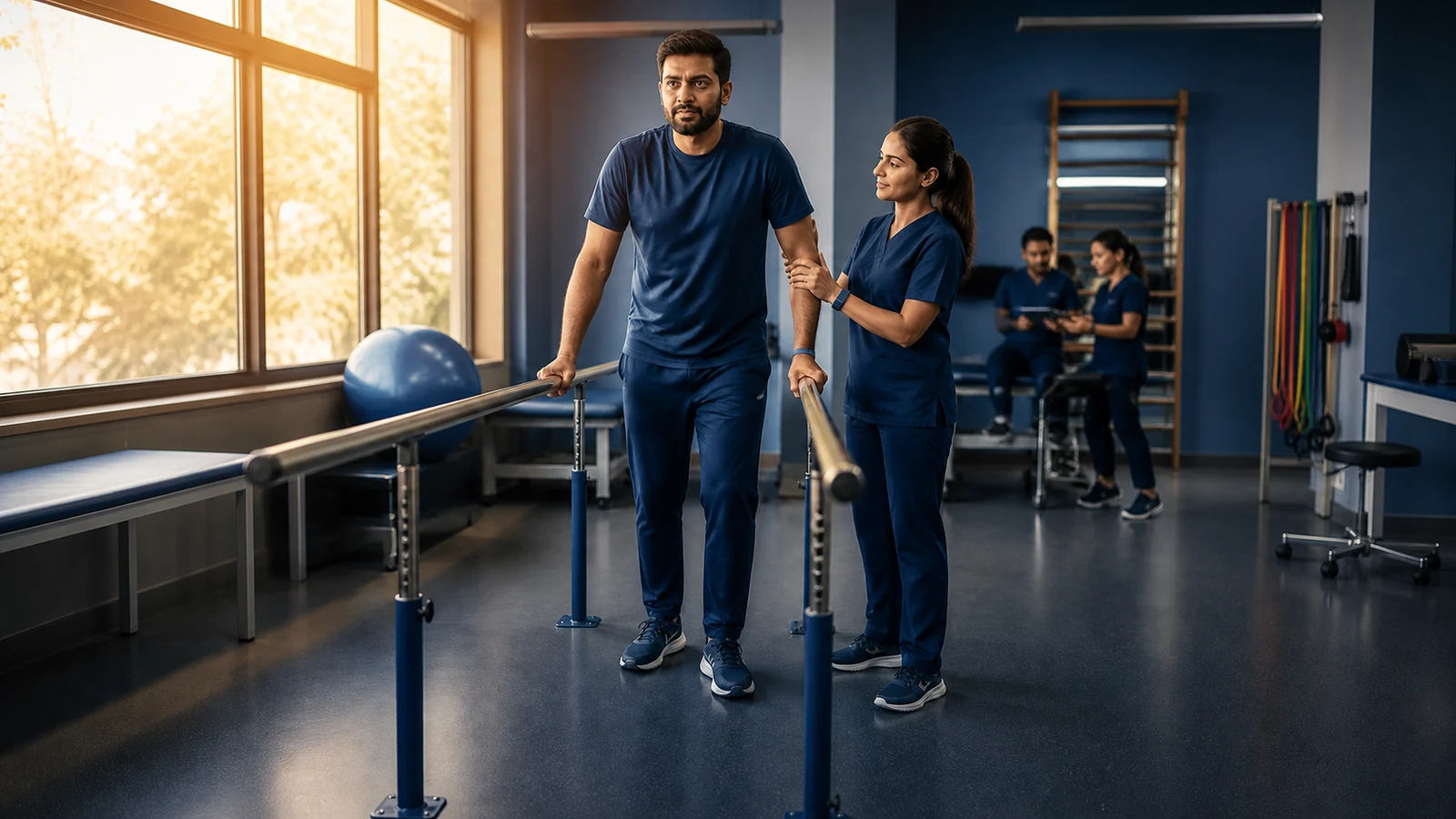

Locomotor training is supervised practice of standing and stepping after spinal cord injury, using assistance selected for the person’s abilities and goals. It can involve a treadmill, overground walking, body-weight support, robotic assistance or functional electrical stimulation, but it does not guarantee independent walking or repair of the spinal cord.
The useful question is which approach fits a particular injury and what improvement it is intended to measure. A walking-speed gain, a change in muscle activity and greater independence at home are different results.
What locomotor training can involve
Ask which upright tasks the proposed service includes and what assistance you would receive. Record the answer alongside your goal so the next discussion concerns a specific activity.
Mayo Clinic’s procedure overview describes these options and requires medical assessment first.
| Approach | What the person may encounter | Useful clarification |
|---|---|---|
| Body-weight-supported treadmill practice | A harness supports part of body weight while stepping is practiced on a moving belt. | How much movement is voluntary, and what assistance is provided? |
| Overground training | Standing or walking practice off a treadmill, with appropriate support or assistance. | Which home or community task is the practice preparing for? |
| Robot-assisted training | A device helps guide stepping or supports walking practice. | What does the person actively contribute, and how is progress assessed off the device? |
| FES-assisted walking | Electrical stimulation helps activate selected muscles during assisted movement. | Is the goal useful assistance while stimulation is on, improvement afterward, or both? |
These descriptions explain a clinical service, not instructions for setting up equipment or choosing stimulation settings. The treating team determines whether an approach is appropriate and how it is delivered.
First ask who the studies included
Spinal cord injury is not one uniform condition. Injury level, retained movement and sensation, time since injury, current walking ability and other health issues affect how a study relates to an individual.
The 2024 trial enrolled people with motor-incomplete injuries, classified as AIS C or D, who could walk without physical assistance. Those findings do not establish results for motor-complete injury or every assistance level.
Minimum injury duration: one year in 2011, six months in 2024.
Ask the rehabilitation team to explain your classification and current functional assessment rather than trying to assign an AIS grade from an online description. A study’s eligibility rules describe its participants, not a checklist for deciding your own treatment.
What controlled walking trials found
Comparative trials help answer whether one program produces different results from another. Improvement during treatment alone cannot establish that a particular machine or technique caused the change.
| Study | Who and what was compared | Finding and limit |
|---|---|---|
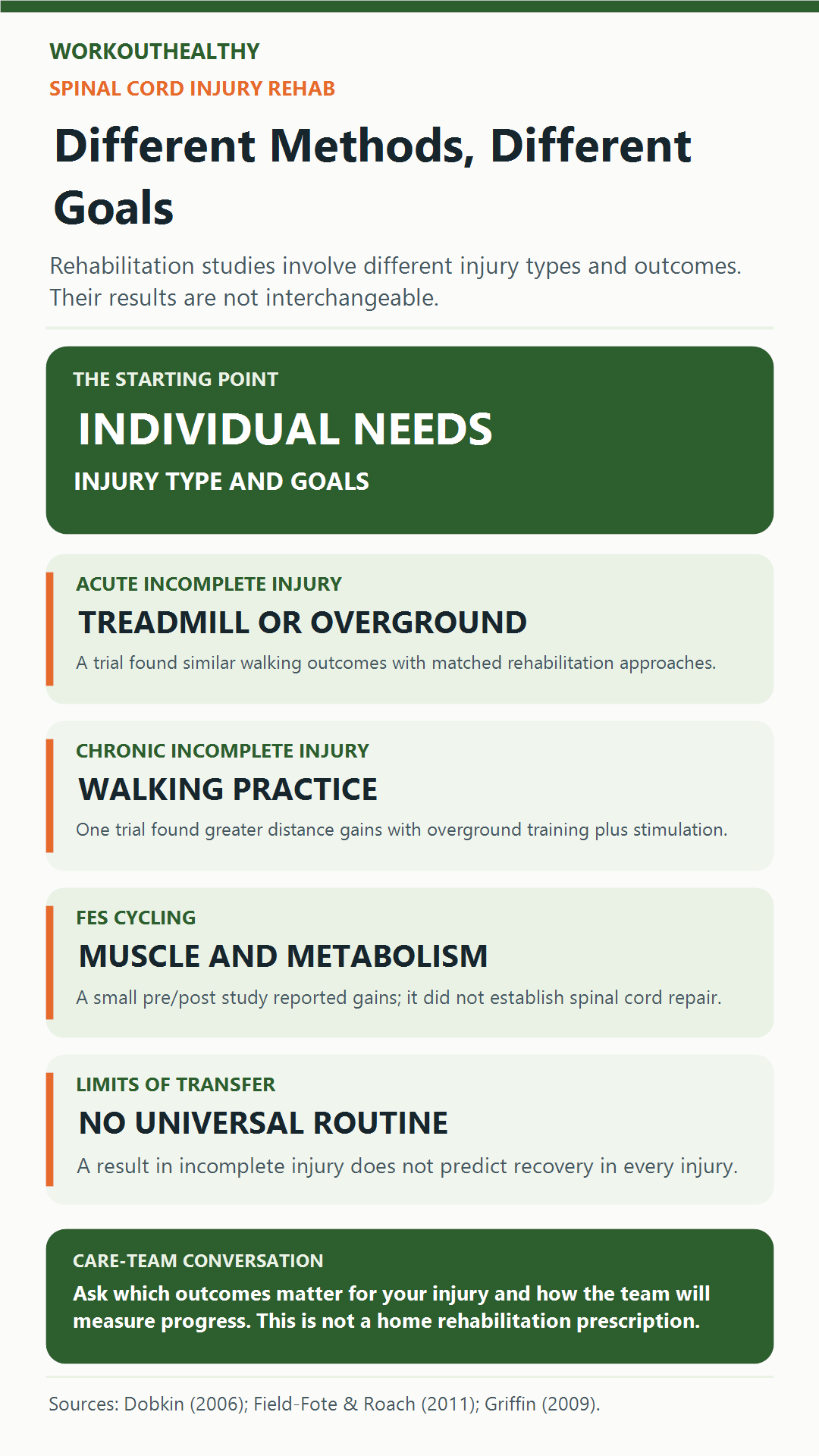
| Dobkin and colleagues, 2006 | 146 people entered within eight weeks of incomplete injury; supported treadmill plus overground practice versus a defined overground mobility program. | No significant between-group differences in the principal walking outcomes at six months. Both groups received active rehabilitation. |
| Field-Fote and Roach, 2011 | 74 people with chronic motor-incomplete injury entered four assisted training approaches; 64 completed training. | Walking-speed gains did not differ significantly between groups; overground training with stimulation produced greater distance gains. |
| Lotter and colleagues, 2020 | Ambulatory people more than one year after incomplete injury; 17 randomized and 16 included in analyses of a crossover trial. | Task-specific stepping favored fastest walking speed over impairment-based exercise, with more minor adverse events. Practice amount and achieved cardiovascular intensity also differed. |
| Zwijgers and colleagues, 2024 | 41 ambulatory people with motor-incomplete injury randomized; walking adaptability in a virtual environment versus conventional locomotor and strength training. | No significant advantage for adaptability training in the primary speed outcome or secondary outcomes at follow-up; 35 participants contributed follow-up group data. |
The 2006 trial compared rehabilitation strategies during early recovery, not treatment against no treatment. It therefore cannot tell a reader how much recovery would have occurred without either program.
The 2011 trial required at least one step and standing with limited assistance; maximal robotic assistance limits generalization to active protocols.
The 2020 trial reported 11 falls outside task-specific training versus three outside impairment-based training, without significant injury. These were event counts in a small study, not percentages of patients or proof that the falls occurred during supervised sessions.
The 2024 trial compared programs designed to have similar doses. Both groups improved on some measures over time, but that does not establish that the more elaborate virtual environment added a benefit.
What newer FES and robotic reviews add
A 2026 review of FES-assisted locomotor training identified 13 studies in motor-incomplete injury, including four randomized trials. Three trials contributed to its meta-analyses, with 76 participants for walking speed and 71 for endurance.
It found no significant added benefit over comparison conditions for these walking outcomes. The review assessed performance when stimulation was not active, which asks a different question from whether stimulation helps a person complete a movement while it is on.
Small samples, risk of bias, different training doses and incomplete reporting limit that conclusion. It does not establish that FES is useless, identify a universal stimulation dose or answer every question about FES-supported activity.
A separate 2026 robotic-training review included 25 randomized trials and 905 participants. Its published abstract reported favorable results for selected outcomes in different injury stages, but evidence quality ranged from very low to moderate and long-term effects needed stronger evidence.
Those findings support asking about the particular device, population, comparator and outcome rather than declaring a winner across all spinal cord injuries. They also differ from an older Cochrane review whose search ended in November 2011, so that review should not be presented as a summary of every later trial.
Walking, muscle activation and health are different outcomes
Neuroplasticity describes changes in nervous-system function with experience and activity. Detecting a change in a reflex or muscle-activation pattern does not, by itself, show that someone can walk farther or needs less help at home.
The 2016 review of spinal circuits illustrates that distinction. In research it discussed, some physiological and assisted-stepping changes did not transfer to better overground six-minute walking performance, although other studies reported functional improvements.
FES cycling also needs its own evidence. A small 2009 before-and-after study followed 18 people through FES cycling and reported changes in lean mass and metabolic measures, but it had no comparison group and did not establish restored independent walking.
The SCI Model Systems FES factsheet explains that stimulation can support different tasks, including cycling, grasping and walking. A finding for one task should not be used as proof of an identical benefit for another.
| Reported result | Question it helps answer | Question still open |
|---|---|---|
| Faster walking during a test | Did measured speed change under the test conditions? | Does everyday walking require less assistance? |
| More distance in a timed walk | Did walking capacity change during that test? | Does the gain persist and transfer to the person’s environment? |
| Changed reflex or muscle signal | Did a measured physiological response change? | Did meaningful daily function improve? |
| More muscle or a metabolic change | Did that body or health measure change? | Was walking measured, and was there a comparison group? |
Why assessment and monitoring matter
The SCI Model Systems exercise factsheet identifies blood-pressure changes, autonomic dysreflexia, skin breakdown, temperature regulation and fracture risk as relevant considerations. These are reasons to plan activity with professionals familiar with spinal cord injury, not reasons to assume all activity is off limits.
Before upright practice, ask how blood pressure and tolerance of position changes will be checked. Before loading the legs, ask how the team will consider bone health, fracture risk, joint movement and skin protection.
For FES, ask about eligibility, electrode placement, skin monitoring and the response expected from the muscles being stimulated. The FES factsheet specifically advises telling the therapist immediately about signs of autonomic dysreflexia, such as a pounding headache or unusual flushing and sweating.
If symptoms occur during treatment, stop and alert the treating professional immediately, following your established SCI emergency plan. The exercise factsheet advises seeking medical help quickly if autonomic dysreflexia symptoms do not go away.
Ask who will supervise, how assistance will be adjusted and what findings would change the plan.
A practical record for the rehabilitation conversation
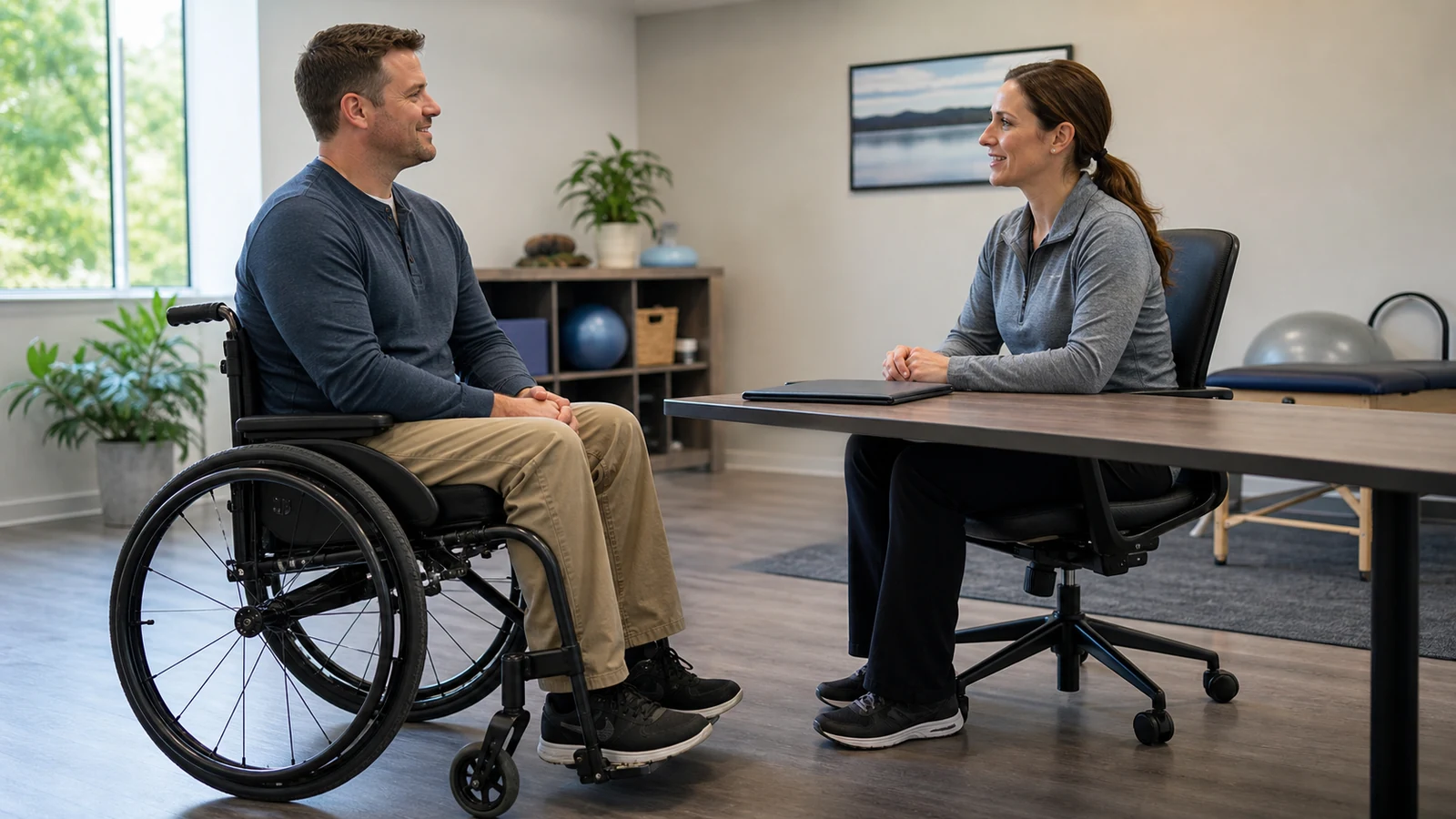
Bring a specific goal rather than a demand for a particular machine. “I want to discuss walking to my bathroom with less help” gives the team a task to assess without predicting that training will achieve it.
- My current task: What can I do now, with which walking aid and how much assistance?
- My intended outcome: Is the goal speed, distance, transfers, standing tolerance, participation or something else?
- The proposed approach: Why does this method fit my assessment, and which study population is relevant?
- The comparison: What are the reasonable alternatives within my rehabilitation plan?
- The measurement: How will the same outcome be checked again, and will assistance or device use be recorded?
- The safety plan: What should I report during and between sessions, and whom should I contact?
- The practical commitment: What supervision, travel, caregiver support and follow-up will the program require?
These prompts are a discussion record, not a validated screening tool or a home exercise prescription. Useful rehabilitation goals can include daily function and participation alongside walking measures.
Common questions
Can locomotor training help years after injury?
Selected chronic motor-incomplete groups improved; individual walking recovery is not guaranteed.
Is a robotic program better than conventional therapy?
There is no single answer across injury stages, devices and outcomes. Ask which comparison supports the proposed approach for your circumstances and what meaningful change will be measured.
Does FES cycling prove that FES-assisted walking works?
No, cycling and walking are different tasks, and muscle or metabolic outcomes are not interchangeable with walking outcomes. The clinical team should explain the specific goal of the proposed FES application.
Can I copy locomotor training from an online video?
A generic video cannot determine your assistance needs or medical risks. Use it as a topic to discuss with your rehabilitation team rather than as a substitute for an assessed program.
Sources
- Mayo Clinic. Locomotor training for spinal cord injury.
- Dobkin and colleagues. Weight-supported treadmill versus overground training after acute incomplete SCI. Neurology, 2006.
- Field-Fote and Roach. Four locomotor approaches in chronic SCI. Physical Therapy, 2011.
- Lotter and colleagues. Task-specific versus impairment-based training. Neurorehabilitation and Neural Repair, 2020.
- Zwijgers and colleagues. Walking adaptability versus conventional locomotor and strength training. Neurorehabilitation and Neural Repair, 2024.
- Unger and colleagues. FES-assisted locomotor training systematic review. Neurorehabilitation and Neural Repair, 2026.
- Robotic and conventional walking-recovery training systematic review and network meta-analysis. American Journal of Physical Medicine and Rehabilitation, 2026. Published abstract.
- Mehrholz, Kugler and Pohl. Locomotor training for walking after spinal cord injury. Cochrane, 2012; search through November 2011.
- Smith and Knikou. Locomotor training, spinal circuits and motor function. Neural Plasticity, 2016.
- Griffin and colleagues. FES cycling, body composition and metabolic measures. Journal of Electromyography and Kinesiology, 2009. Published abstract.
- Model Systems Knowledge Translation Center. Exercise after spinal cord injury and FES for spinal cord injury.
Medical disclaimer: This article is general health and rehabilitation information, not medical advice or an individualized treatment plan. If you have a spinal cord injury, discuss exercise, rehabilitation methods and changes in symptoms with your treating rehabilitation team.