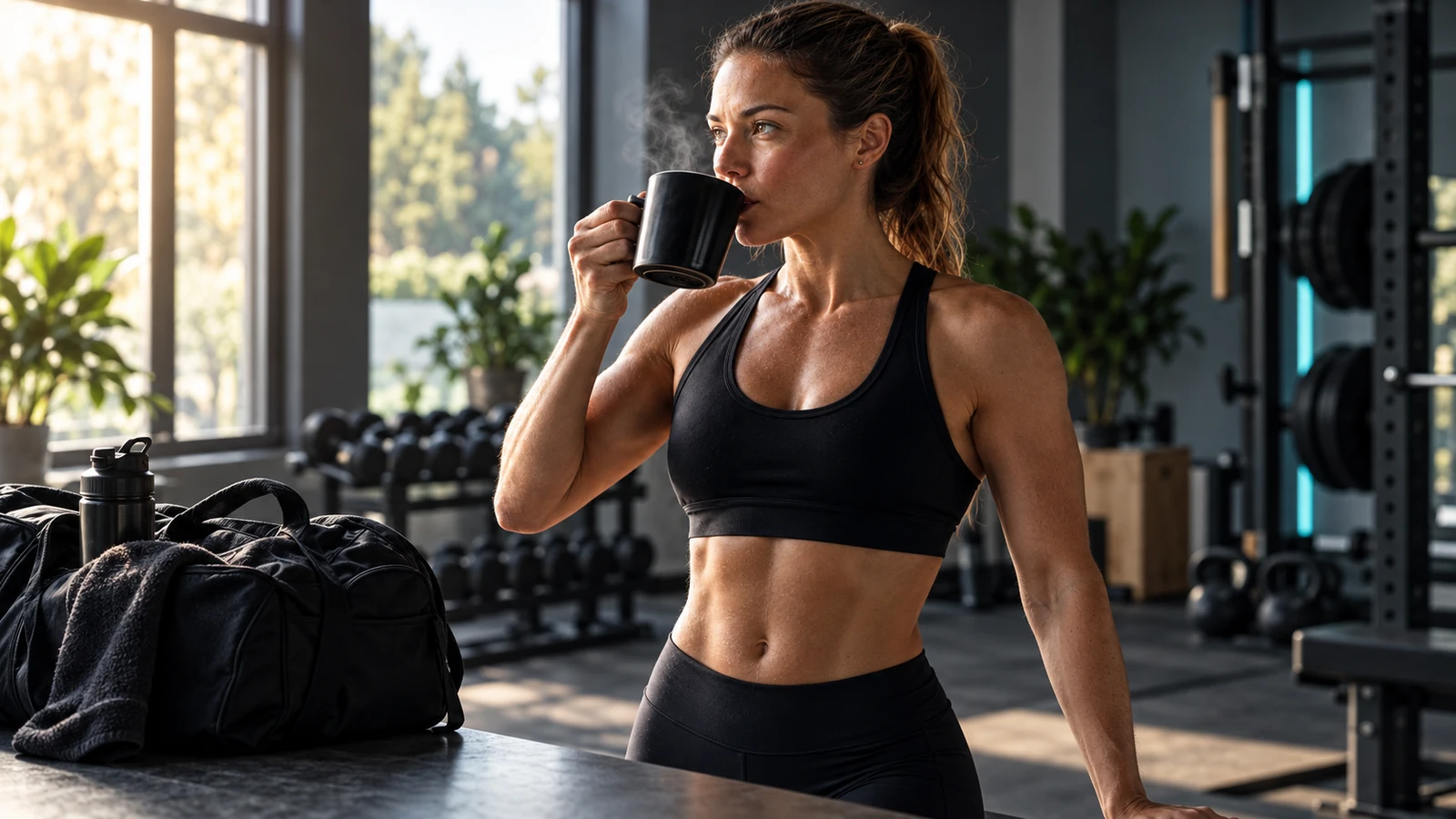

Image context: The woman and mug illustrate the topic. The image does not establish fasting, caffeine content or study participation.
Separate reports evaluate acute fuel use, not long-term body-fat change.
Fuel Use
Fat oxidation is fat used as fuel, estimated here from breathing gases.
No personal-performance prediction follows.
Comparisons
| Evidence | Compared | Observed | Not established |
|---|---|---|---|
| 2020 review: 19 crossover studies; fasting protocols; 2 to 7 mg/kg. | Caffeine versus placebo at matched exercise intensity. | Higher acute fat oxidation overall. | Greater long-term body-fat loss. |
| 2021: 15 active, caffeine-naïve men; 3 mg/kg. | Caffeine/placebo, 8 am and 5 pm. | Higher maximal fat oxidation at both times. | Not assigned: fed versus fasted. |
| 2024: 18 trials, 20 comparisons, 228 participants; meal within 5 hours. | Caffeine/placebo after food. | Higher acute fat oxidation. | No personal optimum or body-fat-loss finding. |
After Food
Effects were not confined to fasting.
Subgroups do not establish personal dose optima.
Amounts
The calculation below explains the units in a research claim. It does not say that these amounts were equally effective, tested together or appropriate for the reader.
| Listed amount | Multiplication | Calculated amount |
|---|---|---|
| 3 mg/kg | 3 × 68 | 204 mg |
| 6 mg/kg | 6 × 68 | 408 mg |
| 9 mg/kg | 9 × 68 | 612 mg |
FDA: 400 mg/day is not generally associated with negative effects for most adults.
These calculated amounts are not personal caffeine recommendations.
Labels
Typical 12-fluid-ounce brewed coffee contains 113 to 247 mg.
Packaged caffeine quantities can be undisclosed; cafés need not disclose them.
For a claim about a particular drink, note the actual serving and available amount information. Leave an unknown amount unknown instead of converting a mug into a capsule dose by appearance.
Body Fat
Our published fasted-training and fat-loss guide covers the wider meal-timing question. Here the question is what adding caffeine changes.
Care
Discuss conditions, medicines, sensitivity, pregnancy, attempts to conceive or breastfeeding with a healthcare professional.
Excess caffeine can cause palpitations, disrupted sleep, anxiety, jitters or digestive symptoms. Discuss symptoms with a healthcare professional.
Study amounts establish neither personal doses nor exercise safety.
Reading Card
Before acting on a coffee-and-cardio headline, record four fields: the actual comparison, the measured outcome, the interval and the unanswered question. That is a claim-reading task, not a personal trial.
- Was the comparison caffeine versus placebo, a clock-time difference, or eating versus fasting?
- Was the outcome fuel use during exercise, completed performance or body-fat change?
- How long was the observation, and was the drink’s caffeine amount known?
- Which desired outcome still needs different evidence or individual advice?
For example, “Would this help my usual morning session?” remains a reader question, not an answer supplied by a different population’s laboratory measurement.
Sources
Collado-Mateo, D., et al. (2020). Effect of Acute Caffeine Intake on the Fat Oxidation Rate during Exercise: A Systematic Review and Meta-Analysis. Nutrients, 12(12), 3603.
Ramírez-Maldonado, M., et al. (2021). Caffeine increases maximal fat oxidation during a graded exercise test: is there a diurnal variation?
Fernández-Sánchez, J., et al. (2024). Effect of Acute Caffeine Intake on Fat Oxidation Rate during Fed-State Exercise: A Systematic Review and Meta-Analysis.
FDA. Spilling the Beans: How Much Caffeine is Too Much?
Source scope: Public abstracts reviewed, not full manuscripts.
Medical disclaimer: This article provides general research and fitness information, not individualized medical or nutrition advice. A qualified healthcare professional can assess questions about caffeine, symptoms, medication or exercise in your circumstances.