

What happens if you walk 30 minutes a day? You add a repeatable block of movement that may help your mood and daily activity immediately, while possible changes in cardiovascular fitness and other health measures depend on your effort, starting point, and consistency over time.
The research below supports walking, but its studies used different schedules and populations, so none promises every benefit after exactly 30 minutes each day.
Thirty minutes on five days is 150 minutes a week; seven days is 210 minutes. Those minutes count toward moderate aerobic activity when the effort is moderate for you, rather than merely because a timer ran.
What does a 30 minute walk actually change?
A walk can interrupt a long sitting period and may change how you feel that day. Changes in blood pressure, fitness, bone measures, or long-term disease risk require a different kind of evidence and usually a longer timeframe.
| Question | What was studied | What it can tell you about 30 minutes daily |
|---|---|---|
| Heart health | Manson and colleagues followed 72,488 women for eight years. Higher walking activity, including a brisk-walking category of at least three hours weekly, was associated with lower coronary-event risk. | This is a long-term association, not a trial establishing a three-hour threshold or a guaranteed result from a daily walk. |
| Glucose after meals | DiPietro and colleagues tested ten inactive adults aged 60 or older with elevated fasting glucose. They compared three 15-minute postmeal walks, totaling 45 minutes, with one 45-minute morning or afternoon walk on separate laboratory days. | Both the postmeal and morning formats improved 24-hour glucose relative to control; postmeal bouts did better on the three-hour postdinner measure. This small acute study did not test a 30-minute daily routine or diabetes prevention. |
| Mood and energy | Bergouignan and colleagues compared a single 30-minute walk with six five-minute walking breaks during one sedentary laboratory day in 30 adults. | The interrupted-sitting format improved some self-reported mood, energy, and craving measures. It does not show that a month of walking has the same effect, and cognition did not significantly improve. |
| Brain structure | Erickson and colleagues randomized 120 older adults to about 40 minutes of walking three days a week or stretching and toning for one year. The walking arm had a favorable anterior-hippocampus volume change. | The spatial-memory task did not show a significant walking-versus-control change over time. This study does not prove that a 30-minute daily walk improves memory or prevents dementia. |
| Bone density | Martyn-St James and Carroll pooled walking programs lasting roughly six to 24 months in postmenopausal women. The femoral-neck result was modest; lumbar-spine results were not significant, and total-hip data were insufficient for pooling. | Bone effects are site-specific and slow. The review did not establish that 30 minutes daily prevents fractures. |
| Respiratory illness | Nieman and colleagues observed 1,002 adults for 12 weeks. More frequent reported aerobic activity and greater fitness correlated with fewer upper-respiratory-illness days. | The observational comparison cannot isolate walking, assign a 30-minute dose, or prove that walking prevents an infection. |
The large cardiovascular study is useful for understanding a habit over years, while the glucose and sitting-break studies measured responses over a day. Mixing their timelines into a single promise is where a simple walking headline can become misleading.
How hard should the 30 minutes feel?
The CDC talk test gives a practical check: at moderate effort, you can talk but cannot sing comfortably. That test adapts better to individual fitness than a universal speed, step count, or distance.
A gentle walk still moves you and may be the right starting point, even if some minutes do not meet moderate intensity. For a separate discussion of distance, see our daily walking mileage guide; you do not need to hit a fixed mileage for this 30-minute plan.
A practical 30 minute walking card
This is an editorial example for a comfortable walking session, not the protocol from any one study above. Adjust effort and duration to your ability, and choose a flat, familiar route if balance or footing is a concern.
| Time | What to do | Check |
|---|---|---|
| 0:00 to 5:00 | Begin at an easy conversational pace. | Settle into a comfortable stride. |
| 5:00 to 25:00 | Walk at a steady effort if it feels appropriate today. | For moderate effort, you can talk but not sing. |
| 25:00 to 30:00 | Ease down to a comfortable finish. | Use the route home as part of the clock. |
If a continuous 30 minutes is awkward, three ten-minute walks are an easier way to schedule the same elapsed time. The DiPietro trial used three 15-minute postmeal walks, so its precise glucose result should not be transferred to a three-by-ten version.
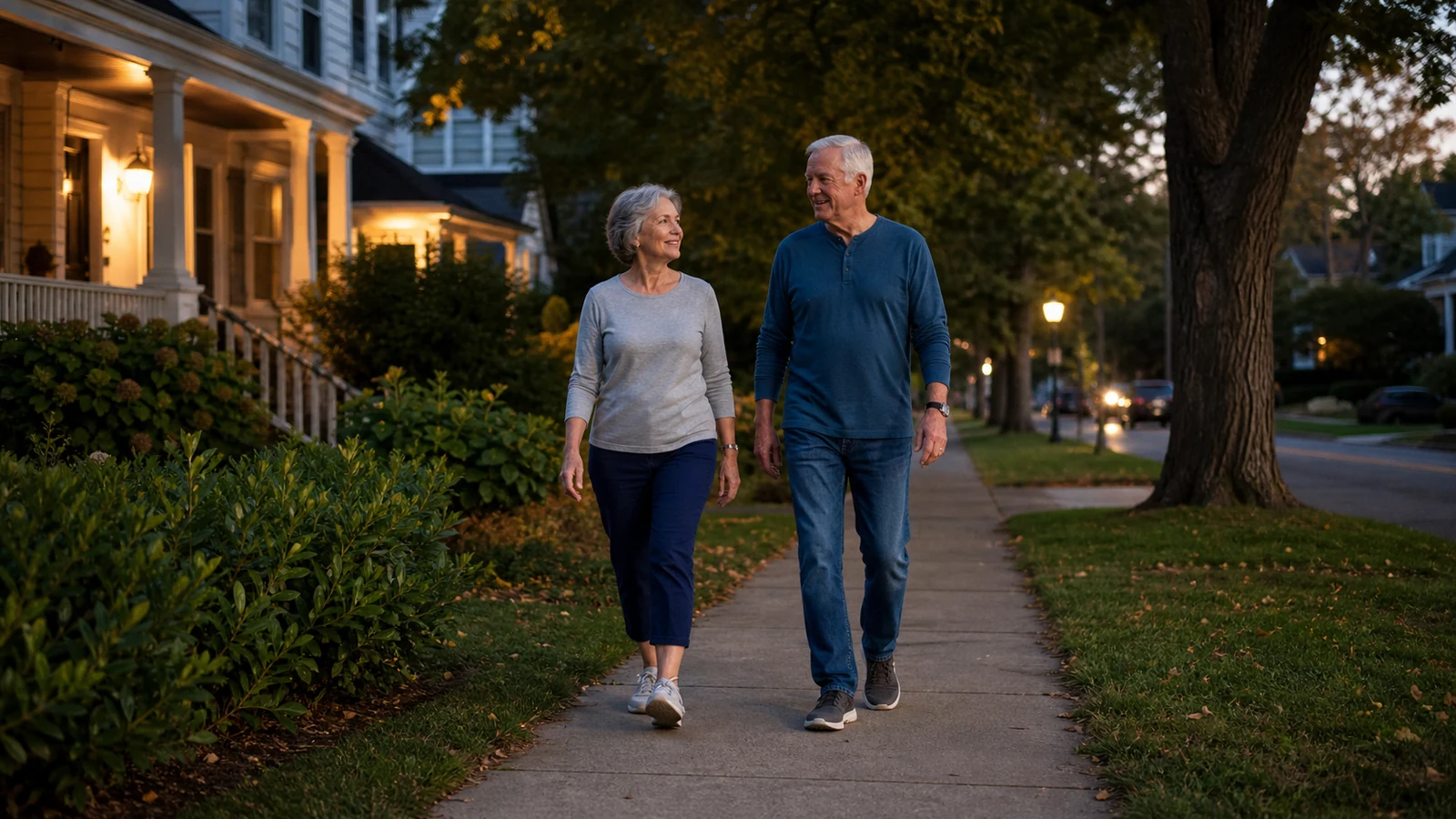
Will walking 30 minutes a day cause weight loss?
Not necessarily. Walking contributes activity, but a particular body-weight change cannot be predicted from walking time alone, and the research table does not test a universal weight-loss outcome.
Judge the habit first by whether it fits your life and whether your walking feels more comfortable over time. If weight management is a personal medical goal, a qualified clinician or dietitian can help place walking within an overall plan without guessing from a daily timer.
What about creativity, joints, and other claims?
Oppezzo and Schwartz tested brief walks of roughly five to 16 minutes in acute creativity experiments and found a benefit on divergent idea generation, not every thinking task. That is a useful reason to try a walk when you are stuck on an idea, but it is not evidence of long-term brain remodeling from 30 minutes daily.
An observational knee-cartilage study looked at overall activity, with walking common among participants. It cannot establish that a daily walk grows cartilage or treats knee disease.
Walking comfort matters more than forcing a schedule through pain. If you have a heart condition, frequent falls, persistent joint symptoms, or take medication that can lower blood glucose, ask your care team how to adapt activity.
If you develop chest pain or severe unusual breathlessness during a walk, stop and seek emergency medical help. Fainting during exercise also needs emergency help.
Watch the original video
The video is a starting point for the claims reviewed here. The study table gives the actual walking schedules and outcomes so you can separate a useful habit from a promise that a specific daily dose was proven.
Sources
- CDC: How to Measure Physical Activity Intensity.
- Manson et al. 1999: Walking and coronary heart disease in women.
- DiPietro et al. 2013: Postmeal walking and 24-hour glucose in ten older adults.
- Bergouignan et al. 2016: Walking breaks, mood, and energy.
- Erickson et al. 2011: One-year walking trial and hippocampal volume.
- Martyn-St James and Carroll 2008: Walking and bone density review.
- Nieman et al. 2011: Activity, fitness, and respiratory illness days.
- Oppezzo and Schwartz 2014: Walking and creative thinking.
- Racunica et al. 2007: Physical activity and knee-joint structure.
This article is for general information and is not medical advice. If you have an injury, ongoing pain, or a medical condition, ask a qualified professional for guidance before changing your activity.