
Image context: The featured image illustrates the frightening claim being examined, using a glowing CGI brain in a kitchen bin. It does not depict an established consequence of choosing egg whites or discarding a yolk.
Egg yolks supply choline, an essential nutrient involved in brain and nervous-system function. That does not establish that discarding a yolk damages your brain, or that eating more yolks prevents Alzheimer’s disease.
The useful distinction is between a nutrient’s role, changes on a memory test, and a diagnosis recorded years later. Studies of egg yolks, choline, and brain health have examined those questions in very different ways.
Essential choline is not a prevention promise
Your body uses choline in cell membranes and to make acetylcholine, a neurotransmitter involved in memory and other functions. The NIH consumer fact sheet explains why food sources matter even though the liver makes some choline.
A nutrient being necessary does not mean that increasing it indefinitely improves the function it supports. Nor does a food lacking much of that nutrient become harmful simply because another food supplies more.
For an egg-white breakfast, the relevant food question is what the rest of the diet supplies. For an Alzheimer’s-prevention claim, the relevant research question is whether an intervention actually reduced new disease in people.
Those questions can inform each other without becoming interchangeable. A biochemical explanation is a reason to investigate an outcome, not evidence that the outcome has already been demonstrated.
What the different studies actually measured
This comparison keeps the exposure and outcome together. A result about tissue changes in mice cannot be swapped for a result about human memory, and a death record is not the same endpoint as a new diagnosis.
| Study and exposure | Measured result | Inference limit |
|---|---|---|
| Dave and colleagues, 2023: female mice receiving control or choline-deficient chow | Organ and selected brain-pathology changes; no detected diet effect on water-maze learning or memory | No whole-egg, egg-white, or human breakfast comparison |
| Yamashita and colleagues, 2023: 12-week randomized capsule trial | Selected verbal-memory changes favored the test preparation; results were not uniformly better | Not a whole-egg meal trial or dementia-prevention study |
| Niu and colleagues, 2025: reported dietary choline in UK Biobank | Associations with coded diagnoses and cognitive performance | Observational intake categories do not define an individual treatment dose |
| Zhuang and colleagues, 2021: reported egg and egg-white/substitute intake in NIH-AARP | Cause-specific mortality associations, including Alzheimer’s mortality | Whites and substitutes grouped together; mortality is not disease onset |
| Oh and colleagues, 2026: reported egg frequency in Adventist Health Study-2 | Association with new Alzheimer’s diagnoses identified in Medicare claims | Not randomized; not a yolk-versus-white or choline-isolation experiment |
These are selected studies addressing the claim, not a complete systematic review. The primary references below identify the methods and outcomes behind each row.
The mouse study did not test an omelet
The 2023 mouse experiment used female nontransgenic mice and an engineered Alzheimer’s model, starting the diets at three months of age. Behavioral testing occurred at ten months, after months of exposure.
Choline deprivation affected motor performance, metabolism, organs, and selected amyloid and tau measures. However, the authors reported no significant diet main effect or interaction for water-maze learning, and no diet effect on its memory probe outcomes.
That null result belongs beside the pathology findings. It does not erase them, but it prevents a blanket statement that every measured brain outcome deteriorated.
There was no experiment in which people replaced whole eggs with whites while otherwise eating normally. Removing choline from experimental chow for months is not equivalent to removing one ingredient from one meal.
The capsule trial has an important quantity distinction
The Japanese trial randomized 60 adults aged 60 to 80 without dementia; 41 entered its cognitive analysis. Post-randomization exclusions included clinical-measurement changes.
It tested capsules against a comparison preparation, not eggs against whites. Verbal-memory changes favored the test preparation; processing speed favored placebo at six weeks, and many other measures did not differ.
The paper calls its condition 300 milligrams of egg-yolk choline, but Table 1 distinguishes 289.6 milligrams in theoretical phosphatidylcholine equivalent from 38.8 milligrams of calculated choline. Those labels cannot be treated as identical nutrient quantities or converted into a recommended number of eggs.
Kewpie funded the trial, and seven authors were company employees. Its small selected analysis and multiple outcomes warrant caution; it did not establish dementia prevention.
Why the newer egg study does not settle the question
The 2026 Adventist Health Study-2 analysis included 39,498 Medicare-linked participants and 2,858 Alzheimer’s diagnoses. Egg frequency came from a food questionnaire; the outcome came from Medicare diagnostic claims.
The adjusted hazard ratio for eating eggs five or more times weekly, compared with never or rarely, was 0.73, with a 95% confidence interval of 0.60 to 0.89. These are observed categories, not a recommended schedule.
The authors specify that the model concerns the rate of diagnosis among people still alive and diagnosis-free. It does not demonstrate a 27-percentage-point reduction in absolute risk, and it cannot isolate choline or the yolk from other food and lifestyle differences.
The American Egg Board funded the analyses; initial cohort support came from the National Cancer Institute. The paper reports no funder role in the research or publication and no author conflicts.
Older evidence asks a different question. The 2021 NIH-AARP study followed 521,120 adults and assessed deaths, with causes drawn from death records.
Both whole-egg intake and egg-white/substitute consumption were associated with lower Alzheimer’s mortality in their respective analyses. Egg whites and commercial substitutes were grouped together, and the study did not randomly assign either food.
This does not prove that whites protect the brain or that yolks do not matter. It does show why one observational result cannot establish that avoiding yolks is harmful, especially when the outcomes and comparison groups differ.
The 2025 UK Biobank choline analysis adds another distinction: it studied reported nutrient intake, not an assigned egg intervention. Its abstract reports U-shaped associations, so its middle intake category should not become a universal target or a reason to assume that more is always better.
Below an intake reference is not a diagnosis
The NIH health-professional fact sheet distinguishes an Adequate Intake, or AI, from a diagnosed deficiency. The AI is used when evidence is insufficient to establish a Recommended Dietary Allowance.
For choline, the reference values were based largely on preventing liver damage, not on identifying a dementia-prevention dose. NIH also notes that frank deficiency is very rare in healthy men and nonpregnant women, despite many people consuming less than the AI.
Consequently, an estimate that many people fall below an intake reference does not mean that those people have Alzheimer’s disease or a clinical deficiency. A food diary can prompt a useful nutrition discussion without becoming a diagnostic test.
Compare portions and the whole eating pattern
The existing food graphic uses approximate NIH values for specified portions, including 147 milligrams in a large hard-boiled egg, 107 in half a cup of roasted soybeans, and 45 in half a cup of canned kidney beans. These are food-composition values, not measured improvements in memory.
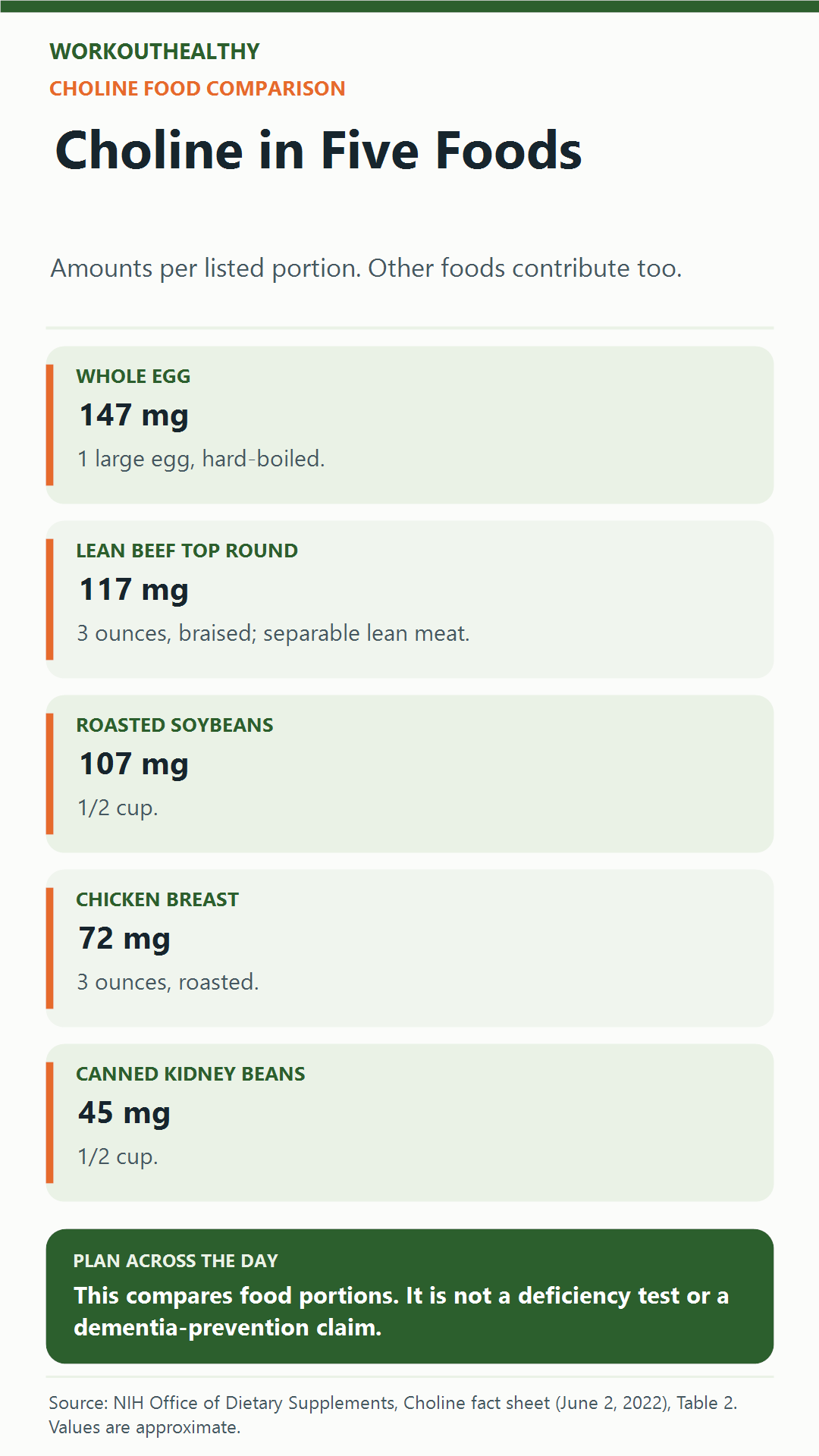
For a simple arithmetic example, the listed soybean and kidney-bean portions total about 152 milligrams. That is close to the egg’s choline amount, but it does not make those foods nutritionally identical or establish a complete meal or day’s intake.
The example demonstrates why the omitted food and its replacement both matter. It is possible to ask what supplies choline without requiring everyone to eat the same breakfast.
If you keep a food record, note the actual serving and preparation rather than copying a number beside a food name. A value for a large hard-boiled whole egg is not automatically the value for an arbitrary serving of whites or a processed egg product.
A five-question card for the next headline
Before turning a brain-health headline into a food rule, fill in these five lines. This is an editorial reading aid, not a validated screening tool.
- What was compared? A depleted diet, a capsule preparation, reported egg frequency, or a real food replacement?
- Who was studied? Mice, selected trial volunteers, or a particular human cohort?
- What counted as improvement? A tissue marker, a test score, a diagnosis, or a cause of death?
- What does the quantity mean? Nutrient choline, phosphatidylcholine equivalent, an egg serving, or a study intake category?
- What remains untested? Write the missing step between the reported result and the advice being offered.
For the claim that an egg-white omelet causes Alzheimer’s disease, the missing step is a suitable human comparison establishing that outcome. Neither a plausible mechanism nor a dramatic illustration supplies it.
For the opposite claim that extra yolks prevent the disease, the same discipline applies. An association or selective short-term test benefit is not a demonstrated preventive treatment.
Keep personal diet and supplement decisions in context
A brain-health hypothesis does not override a cardiovascular care plan. The American Heart Association advisory emphasizes the overall dietary pattern and distinguishes observational cardiovascular findings from intervention effects on blood cholesterol.
Someone advised to alter egg or cholesterol intake should discuss nutrient replacements within that existing plan. This article does not set an egg allowance or prescribe a supplement to resolve that decision.
NIH notes that supplement findings for cognition are mixed and that excessive choline can cause harm. A trial preparation, an intake reference, and an upper limit have different purposes; none is a personal dose derived from a viral claim.
During pregnancy, with a restricted diet, or while receiving medical care, bring the actual food pattern and supplement labels to a clinician or registered dietitian. The useful conversation is about nutritional needs and the whole diet, rather than treating one ingredient as either compulsory or dangerous.
Egg yolks can contribute choline, and other foods can contribute too. The evidence supports taking nutritional adequacy seriously while keeping mouse pathology, memory tests, and human disease outcomes in their proper places.
References
Dave, N., and colleagues. (2023). Dietary choline intake is necessary to prevent systems-wide organ pathology and reduce Alzheimer’s disease hallmarks. Aging Cell, 22, e13775. Primary mouse study. DOI: 10.1111/acel.13775.
Yamashita, S., and colleagues. (2023). Effects of egg yolk choline intake on cognitive functions and plasma choline levels in healthy middle-aged and older Japanese. Lipids in Health and Disease, 22, 75. Primary randomized trial, including Table 1. DOI: 10.1186/s12944-023-01844-w.
Oh, J., and colleagues. (2026). Egg intake and the incidence of Alzheimer’s disease in the Adventist Health Study-2 cohort linked with Medicare data. The Journal of Nutrition, 156(6), 101541. Primary cohort study. DOI: 10.1016/j.tjnut.2026.101541.
Zhuang, P., and colleagues. (2021). Egg and cholesterol consumption and mortality from cardiovascular and different causes in the United States. PLOS Medicine, 18(2), e1003508. Primary NIH-AARP cohort study. DOI: 10.1371/journal.pmed.1003508.
Niu, Y.-Y., and colleagues. (2025). Association of dietary choline intake with incidence of dementia, Alzheimer disease, and mild cognitive impairment. The American Journal of Clinical Nutrition, 121(1), 5 to 13. PubMed abstract and bibliographic record. DOI: 10.1016/j.ajcnut.2024.11.001.
NIH Office of Dietary Supplements. Choline. Health-professional fact sheet and food table; consumer fact sheet.
Carson, J. A. S., and colleagues. (2020). Dietary cholesterol and cardiovascular risk: A science advisory from the American Heart Association. Circulation, 141(3), e39 to e53. PubMed abstract and bibliographic record. DOI: 10.1161/CIR.0000000000000743.
Medical disclaimer: This article provides general fitness and nutrition information, not medical advice or a treatment plan. If you have a medical condition or concerning symptoms, discuss suitable diet and supplement choices with a qualified healthcare professional before making changes.