
A 24 minute home workout mixes running in place with jumping moves.
That combination is more than a way to get sweaty.
Jumping can provide a faster, higher-impact loading pattern than walking. Jogging in place also has impact; the amount of loading depends on how the movement is performed.
This article separates three questions that often get blurred together: how hard the session is, what repeated landings may do to bone, and how to manage impact safely.
What the Video Claims
ByBlondie’s 24-minute Run & Jump Cardio Workout at Home blends running and jumping in a follow-along session framed for different fitness levels.
The creator’s video description specifies 20 seconds of work followed by 10 seconds of rest and lists two dumbbell options: 3 kg (6 lb) and 5 kg (11 lb) in each hand. It also recommends a five- to ten-minute warm-up, water nearby, and exercise modifications as needed.
So it would be inaccurate to call the original session strictly no-equipment. A bodyweight-only adaptation may be possible for some moves, but it is a modification, not the equipment list supplied by the creator.
Twenty-four minutes of intervals can be a real cardio session. The separate question is how its benefits and impact compare with a lower-impact steady session.
But it raises three separate questions worth checking against actual evidence.
Does the jumping component burn meaningfully more calories than low impact cardio would in the same time?
Does the impact of landing repeatedly do anything useful for the body, beyond burning calories?
And is a session this short, even at a vigorous pace, actually long enough to matter?
The video itself does not cite research to answer these questions. It is a workout, not a science lecture.
So this article did the digging instead.
What Real Research Shows About Impact and Calorie Burn
Vigorous movements often use more energy per minute than easier ones, whether or not they involve landing impact. The workout’s pace and effort matter more to calorie burn than the impact label alone.
A useful reference is the updated 2024 Adult Compendium of Physical Activities, a catalog of standardized energy-cost estimates for many activities. Its entries describe activity categories, not this particular workout.
The 2024 Compendium lists jogging in place at 4.8 METs and vigorous calisthenics including jumping jacks at 7.5 METs. Those are estimates for activity categories, not a measurement of this particular video.
A MET, or metabolic equivalent, is a multiple of your resting energy use.
The Compendium’s walking values vary by speed and terrain; brisk level walking at 3.5 to 3.9 mph is listed at 4.8 METs. Vigorous cycling and other low-impact exercise can also have high MET values.
The difference between those example categories illustrates how intensity changes energy use; it does not establish a fixed multiplier for this video.
A vigorous jumping-based interval can use more energy per minute than a brisk walk, but the comparison depends on actual effort and time spent working.
The Compendium does not prove that landing impact itself causes extra calorie burn, nor that this full 24-minute video burns a specific multiple of walking.
Our breakdown of jump-rope energy estimates also emphasizes how much pace and effort change the result.
Jumping rope and jump-based bodyweight cardio both involve repeated landings, but their energy costs also depend on pace, effort, and how much of the session is spent moving.
Duration matters here too, and this is where a second line of research is useful.
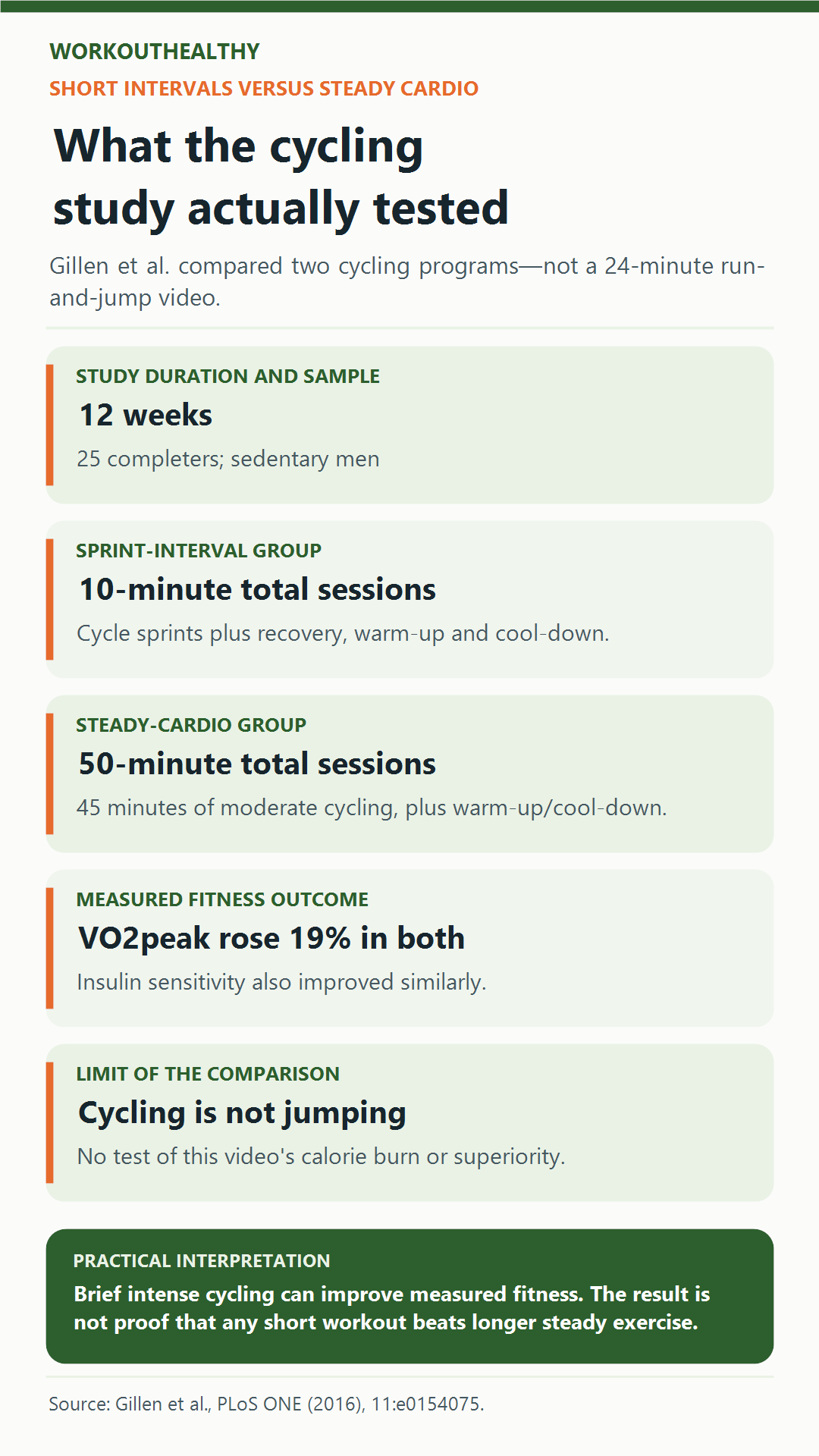
A frequently cited trial found that twelve weeks of short, vigorous interval sessions produced cardiometabolic improvements similar to much longer traditional endurance training (Gillen et al., 2016).
The interval group in that trial did just three short, all out sprints per session.
The whole session, warm up and cool down included, took about ten minutes.
That does not mean 24 minutes is a magic number.
It does mean the idea that “short but vigorous” can be physiologically meaningful is grounded in real trial data, not just marketing language.
Twelve weeks of low volume sprint interval training produced cardiometabolic health improvements similar to traditional endurance training, despite a fivefold lower total exercise volume and time commitment.
What Real Research Shows About Bone Loading From Jumping
Calorie burn is only half the impact story.
The other half is what happens to your skeleton.
Bone is living tissue. It responds to mechanical stress by getting stronger, within limits.
In a 1994 randomized study, healthy premenopausal women were assigned to either a high-impact or a low-impact exercise program, with weekly classes and home exercise (Bassey & Ramsdale, 1994).
At six months, the high-impact group of 14 women had a 3.4 percent increase in bone density at the femoral trochanter, a change that differed significantly from the low-impact control group. The study compared groups of women, not a jumping leg with a non-jumping leg.
The sample was small, and the result does not establish what this 24-minute home workout would do to bone density.
This lines up with a broader body of work on bone adaptation.
Researchers reviewing how bone responds to exercise have concluded that bone cells respond strongly to dynamic, high strain rate loading, and respond weakly or not at all to slow, steady loading of the same total force (Turner & Robling, 2003).
In plain terms, higher-rate loading can stimulate bone differently from lower-impact walking. The response depends on the person, loading dose, and time; a single jump session is not a guaranteed bone-building treatment.
This is one reason resistance and plyometric movements get grouped together for bone health, a theme our piece on whether box jumps build muscle also touches from the strength side.
Walking still matters for cardiovascular health and for daily activity totals, and our guide on how many miles you should walk a day covers that ground well.
But walking alone is not an efficient bone building stimulus, based on the mechanism above.
That makes jumping a potential bone-loading option for suitable people, while the exact response to this video has not been studied.
What Real Research Shows About Injury Risk
Impact cuts both ways.
The same repeated landings that stimulate bone also load joints, tendons, and connective tissue.
This is not a new observation.
A widely cited study tracking injuries among aerobic dance participants and instructors found that lower leg and foot injuries were common, with impact identified as a contributing factor in a meaningful share of cases (Garrick et al., 1986).
Aerobic dance in that era leaned heavily on jumping and hopping choreography, not unlike a modern run and jump cardio routine.
The lesson from that research is not that jumping is dangerous.
It is that repeated, high frequency impact has a real injury cost when volume and recovery are not managed.
Shin splints, plantar fasciitis, and knee irritation are the most commonly reported issues tied to high impact cardio in the sports medicine literature.
None of that means a 24 minute session is reckless.
It means the same load that builds bone can also accumulate stress if it is done every day without variation.
The Mechanism
Here is the short version of why impact behaves this way in the body.
Every time your foot strikes the ground during a jump or a hard landing, your body absorbs a force several times your body weight.
Muscles, tendons, and bone all share that load.
Muscles get a strength and power stimulus from the eccentric, or lengthening, phase of absorbing the landing.
Bone gets a mechanical strain signal that triggers bone forming cells called osteoblasts to lay down new tissue.
Your heart and lungs get a demand signal, because moving your body weight against gravity repeatedly requires more oxygen delivery than a low impact movement of similar speed.
That is the whole trade in one sentence.
Appropriate loading can support adaptation, but excessive loading can outpace recovery. More force is not automatically better.
Low impact cardio, like cycling or incline walking, skips most of that landing force.
You still get a cardiovascular workout, just without the bone and joint loading component.
Watch the video
What This Evidence Does Not Prove
It is worth being precise about the limits here.
The Bassey and Ramsdale study compared high-impact and low-impact exercise programs in young women, not this home video or an isolated one-leg hopping protocol.
It does not directly prove that a 24 minute run and jump video produces the same bone benefit.
The interval training research showing short sessions can work used structured, measured intervals in a lab setting.
A home workout video is not a controlled trial, and results will vary by how hard a person actually pushes during it.
The injury research describes aerobic dance from the 1980s, a different population doing different choreography.
It shows that impact carries real risk in general. It does not measure the injury rate of this specific video.
No study in this article followed people doing this exact workout for weeks or months.
That kind of direct, video specific outcome data essentially does not exist for any home fitness video, from any creator.
What exists is solid mechanistic and comparative research on the ingredients, running, jumping, and short vigorous sessions, that this workout is built from.
Common Mistakes
Doing high impact cardio every single day without a lower impact day mixed in is the most common mistake.
Bone and connective tissue need time to remodel after a loading session, not just muscles.
Landing flat footed or stiff legged is another frequent issue.
A stiff landing sends more shock straight up through the shin and knee instead of letting the calf and ankle absorb it.
Skipping a warm up before jumping straight into impact work raises injury risk unnecessarily.
A few minutes of easy marching or light bouncing lets tendons and joints prepare for the load ahead.
Doing the workout on a hard tile or concrete floor instead of a mat or carpeted surface also adds avoidable impact.
None of these mistakes ruin the value of the workout.
They just shift the risk to benefit ratio in the wrong direction.
Who Should Be Extra Careful
Anyone with a current knee, ankle, hip, or lower back injury should check with a doctor or physical therapist before adding jumping cardio.
People managing osteoporosis or a recent stress fracture need individualized guidance, since the same loading that helps healthy bone can be excessive for compromised bone.
Anyone recovering from a joint replacement is in a similar position, and needs a program built around their specific healing timeline rather than a generic home video.
The recovery story behind Misty Copeland’s hip replacement is a useful reminder of how carefully impact has to be reintroduced after major joint surgery.
People who are new to exercise altogether should also ease in.
Starting with the running in place portions and adding jumping intervals gradually is a reasonable, evidence aligned approach.
Pregnant individuals, people with balance issues, and anyone with uncontrolled high blood pressure should get clearance first as well.
None of this means avoid the workout. It means match the dose to your own joints and history.
A Practical Takeaway
Run and jump style cardio is a legitimate, evidence supported way to get more out of a short session.
Vigorous intervals can raise energy use per minute compared with easier activity, but intensity and work duration—not impact alone—drive that comparison. Vigorous low-impact cycling can also be demanding.
It also adds a bone loading stimulus that walking and cycling generally do not provide.
A sensible approach is two to three sessions like this per week, not seven.
Pair it with lower impact days for active recovery, the kind of steady daily movement covered in research on daily step counts and long term health.

Before starting the 20-second-work, 10-second-rest intervals, use the creator’s suggested five- to ten-minute warm-up. Begin with easier movement and add intensity gradually rather than treating the first interval as a sprint.
The video lists light dumbbells for some work; choose a load you can control or adapt those movements without weights if needed. A bodyweight modification is not proof that every filmed movement is identical without dumbbells.
Keep water available and drink according to thirst and conditions; a 24-minute session does not require a special hydration formula. Land with control, and if joint pain develops, reduce or replace the jumping rather than pushing through it.
Used this way, a 24 minute session is a reasonable, time efficient piece of a broader routine, not a replacement for strength training or every other form of cardio you do.
Want more like this? Subscribe to WorkoutHealthy Insider for practical explanations behind popular fitness claims.
References
ByBlondie. (2026, August 2). 24 Min RUN & JUMP Cardio Workout at Home – All Levels [Video and creator description]. YouTube. Original video.
Compendium of Physical Activities. (2024). 2024 Adult Compendium of Physical Activities. Activity codes and MET values.
Bassey, E. J., & Ramsdale, S. J. (1994). Increase in femoral bone density in young women following high-impact exercise. Osteoporosis International, 4(2), 72 to 75. https://doi.org/10.1007/bf01623226
Garrick, J. G., Gillien, D. M., & Whiteside, P. (1986). The epidemiology of aerobic dance injuries. The American Journal of Sports Medicine, 14(1), 67 to 72. https://doi.org/10.1177/036354658601400111
Gillen, J. B., Martin, B. J., MacInnis, M. J., Skelly, L. E., Tarnopolsky, M. A., & Gibala, M. J. (2016). Twelve weeks of sprint interval training improves indices of cardiometabolic health similar to traditional endurance training despite a five-fold lower exercise volume and time commitment. PLOS ONE, 11(4), e0154075. https://doi.org/10.1371/journal.pone.0154075
Turner, C. H., & Robling, A. G. (2003). Designing exercise regimens to increase bone strength. Exercise and Sport Sciences Reviews, 31(1), 45 to 50. https://doi.org/10.1097/00003677-200301000-00009
U.S. Department of Health and Human Services. (2018). Physical activity guidelines for Americans (2nd ed.). https://health.gov/sites/default/files/2019-09/Physical_Activity_Guidelines_2nd_edition.pdf
This article is for general information only and is not medical advice. If you have an injury, ongoing pain, or a medical condition, talk to a doctor or physical therapist before you change how you train or eat.