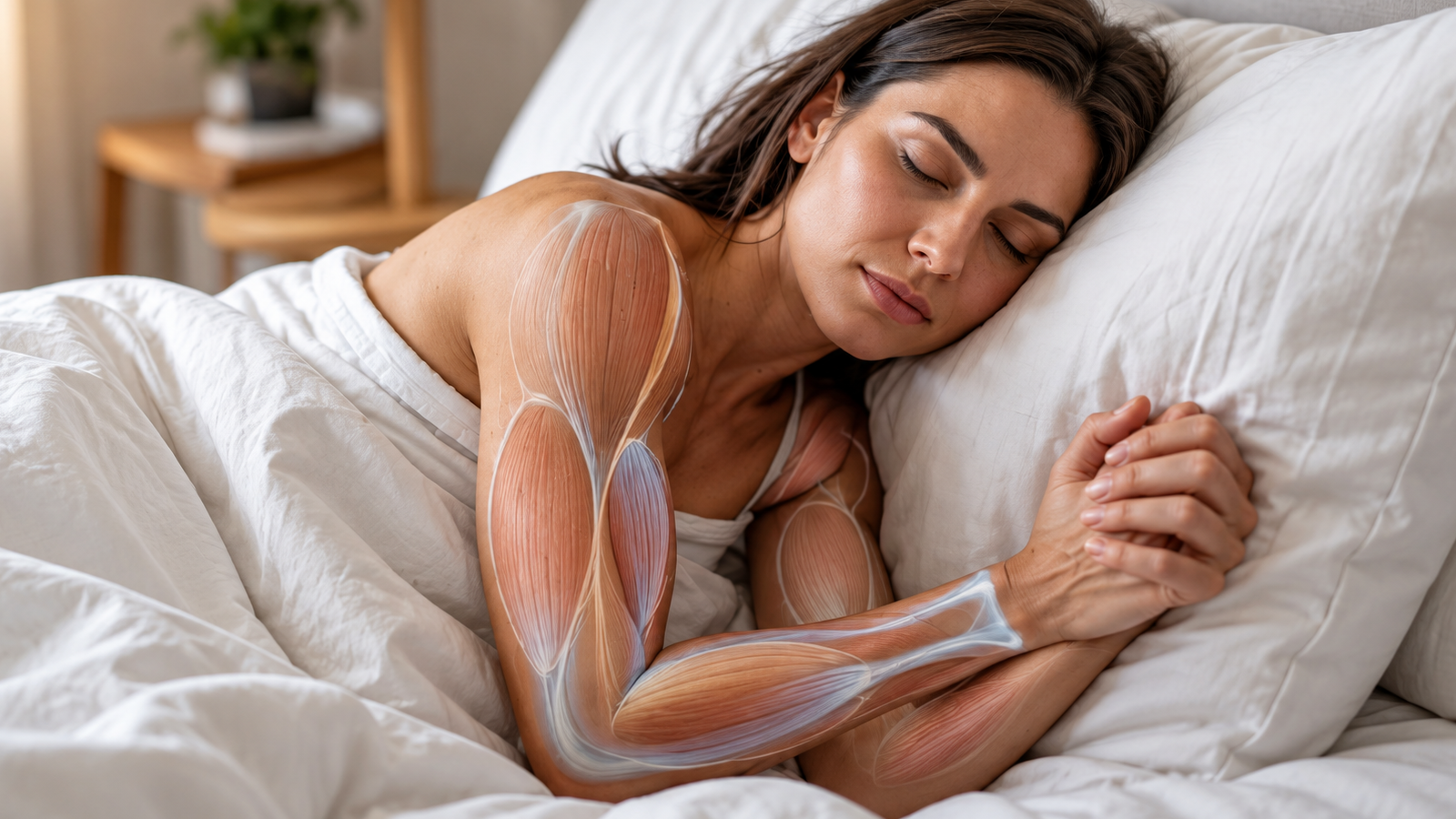

Cynthia Thurlow, a nurse practitioner who discusses fitness and recovery, is right to draw attention to sleep as part of a training plan. But a viral caption that says one bad night “blocks” muscle growth or that GABA and magnesium reliably trigger deep sleep goes beyond what the evidence can show. The stronger, more useful message is simpler: resistance training, adequate food, and consistent sleep work together. None can be replaced by a supplement.
What actually happens when muscle recovers?
Exercise creates a training stimulus. Your body then repairs and remodels tissue over time, with muscle protein synthesis contributing to adaptation. The process is influenced by the type of exercise, protein and energy intake, previous training, age, and rest. It does not switch on only after a person falls asleep. Muscle protein turnover continues around the clock, including after meals and during waking hours.
Sleep matters because it is a recurring period of recovery and because persistent sleep loss can disrupt appetite, mood, training quality, and physiological processes involved in adaptation. It is not accurate to say that every missed hour of deep sleep cancels a workout. The research is more nuanced—and in some ways more interesting—than that.
The study behind the “one bad night” claim
A 2021 randomized crossover study tested 13 healthy young adults after one night of total sleep deprivation and after a normal night. The researchers measured post-meal muscle protein synthesis during the following afternoon. It was about 18% lower in the sleep-deprived condition. Cortisol was higher and testosterone was lower in that acute setting. This is a real laboratory finding, but it is not a direct measurement of how much muscle those participants gained or lost over weeks.
There are important limits. Thirteen participants is a small sample. A full night with no sleep is much more extreme than a merely short night. The outcome was a short-term physiological rate, not a long-term strength or hypertrophy result. The study supports taking sleep seriously; it does not justify telling a person that one poor night has permanently blocked progress.
A separate 2020 trial investigated five nights with only four hours in bed per night in healthy young men. The sleep-restricted group showed lower myofibrillar protein synthesis than a normal-sleep group. Intriguingly, a third group that performed high-intensity interval exercise during the restriction period maintained synthesis closer to control levels. That does not mean exercise can “fix” inadequate sleep. It shows that activity, sleep, and muscle adaptation interact in ways a one-line caption cannot capture.
Why “deep sleep equals muscle growth” is too simple
Deep non-REM sleep is associated with changes in hormone secretion, including pulses of growth hormone. That fact often gets translated into a promise that more deep sleep automatically means more muscle, or that any product increasing a sleep-stage metric increases hypertrophy. Neither conclusion follows directly. A hormone pulse is not the same outcome as a measured training gain.
Consumer wearables can offer a rough look at sleep patterns, but their estimates of specific stages are imperfect. Obsessing over a nightly “deep sleep” number can make sleep anxiety worse. A more reliable approach is to look at broad patterns: regular bed and wake times, enough total sleep opportunity, daytime alertness, and whether persistent symptoms warrant a clinical conversation.
Adult sleep needs vary. Many adults should plan for at least seven hours on a regular basis, though individual circumstances and medical conditions matter. Athletes with demanding training schedules may need more opportunity for sleep, but there is no universal number that guarantees recovery. The quality of a week or month matters more than one isolated graph.
Where lifting and protein fit
Thurlow’s three-pillar framing—train, eat enough protein, and sleep—works as a practical reminder if none of the pillars is treated as a magic switch. Progressive resistance training gives muscle a reason to adapt. Protein supplies amino acids. Sufficient overall food supports training and normal health. Sleep supports the recovery environment and the ability to perform consistently.
Doing only one of those exceptionally well will not necessarily compensate for neglecting the others. A person who sleeps eight hours but never trains will not build significant muscle because of sleep alone. Someone who lifts regularly but routinely gets very little sleep may struggle to train well and recover. Someone who buys a supplement while undereating protein still has a basic nutrition problem to solve first.
There is also no need to make every meal or night perfect. Training gains accrue over many sessions. Occasional poor sleep is common, and one study’s acute percentage should not be turned into a frightening prediction about any individual workout.
Do magnesium and GABA supplements deliver deeper sleep?
Magnesium is an essential nutrient, and correcting an inadequate intake can matter for health. But the U.S. National Center for Complementary and Integrative Health says the research on magnesium for insomnia is limited and inconsistent. Small studies in older adults have suggested possible improvements in falling asleep, but the evidence is not strong enough to promise that a magnesium supplement will reliably create deeper, muscle-building sleep.
Supplemental magnesium also has a dose ceiling and potential side effects. High intakes can cause gastrointestinal problems and may be risky for people with certain health conditions or medications. Food sources, such as nuts, beans, and leafy greens, can be a sensible starting point; personal supplementation decisions belong in a conversation with a qualified clinician when medical issues are involved.
GABA is a neurotransmitter involved in the nervous system. That does not establish that an oral GABA supplement will consistently reach the brain, alter sleep stages, or improve strength gains. The published evidence is far weaker than the marketing language around it. There is no good reason to describe a GABA product as a proven trigger for the muscle-repair stage of sleep.
Better sleep habits for people who train
Start with an attainable sleep schedule. A consistent wake time helps anchor the day; a bedtime that allows enough sleep opportunity follows from it. Keep the bedroom reasonably dark, quiet, and comfortable. If late caffeine interferes with your sleep, move it earlier. Alcohol may make someone drowsy while disrupting the later part of the night, so it is not a dependable recovery aid.
Consider the timing of hard workouts. Some people sleep well after evening training; others feel too activated when a very intense session ends close to bedtime. The right adjustment is personal. Keep regular exercise in the week, but change the session time or wind-down routine if a clear pattern of poor sleep follows late training.
When sleep is persistently difficult despite reasonable habits, seek a medical assessment rather than stacking products. Loud snoring, breathing pauses, significant daytime sleepiness, or chronic insomnia deserve attention. Sleep disorders can affect health and performance, and a qualified clinician can distinguish them from ordinary schedule problems.
What the research cannot yet tell us
The muscle studies are valuable because they measure biological changes directly, but their results should not be treated as a precise forecast for every gym-goer. Short trials cannot establish how many kilograms of lean mass a person will gain over a year. Different ages, training histories, diets, and medical conditions may change the response. The two studies also used different sleep-loss protocols. One involved a whole night without sleep; the other used several nights of severely shortened time in bed. Neither is identical to a parent having one interrupted night or a lifter occasionally staying up late.
Longer studies that combine carefully tracked sleep, strength training, diet, and body-composition outcomes would help answer the practical questions athletes ask. Until then, the fairest conclusion is directional: chronic inadequate sleep is a plausible obstacle to recovery and performance, while the size of any individual’s muscle effect remains uncertain.
Recovery is broader than muscle protein synthesis
Even if a person could preserve one laboratory measure during poor sleep, they might still feel less alert, make worse training decisions, or struggle to complete a session safely. Coordination, mood, motivation, and the ability to follow a program all influence results. That is why sleep belongs in a fitness discussion even when an exact “muscle growth percentage” is unavailable.
Rest days and lighter sessions are part of the same picture. Recovery is not a single event that occurs only at night. It is the accumulated effect of appropriately dosed training, adequate food, and enough time between hard efforts. Someone increasing lifting volume rapidly while sleeping poorly may need to adjust the program, not hunt for an “anabolic” pill.
A calmer way to measure progress
Instead of checking a sleep-stage score every morning, track a few broad signals across several weeks: whether you can complete planned sessions with good technique, whether loads or repetitions gradually improve, whether soreness resolves, and whether you feel functional during the day. If a stretch of poor sleep coincides with worse performance, use that as a prompt to review your schedule and recovery habits.
These signals are imperfect, but they keep attention on the outcome you actually care about. A single percentage from a laboratory study cannot diagnose your personal recovery, and a consumer app cannot tell you exactly how much muscle you synthesized overnight.
What should a tired athlete do tomorrow?
After a bad night, do not assume the week’s training is ruined. Check how you feel, consider a lighter session if coordination or alertness is poor, and keep the next night as normal as possible. Avoid turning recovery into a punishment cycle of extreme workouts, excessive caffeine, and anxiety about an app’s sleep score.
The evidence supports protecting sleep as a repeatable habit. It does not support claiming that one imperfect night erases muscle growth, or that magnesium and GABA are shortcuts to a deeper anabolic stage. Train consistently, eat adequately, make room for sleep, and ask for medical help if sleep remains a problem.
Sources: 2021 crossover study on one night of sleep deprivation and muscle protein synthesis; 2020 trial of five nights of sleep restriction and myofibrillar protein synthesis; NIH NCCIH review of sleep supplements and safety.