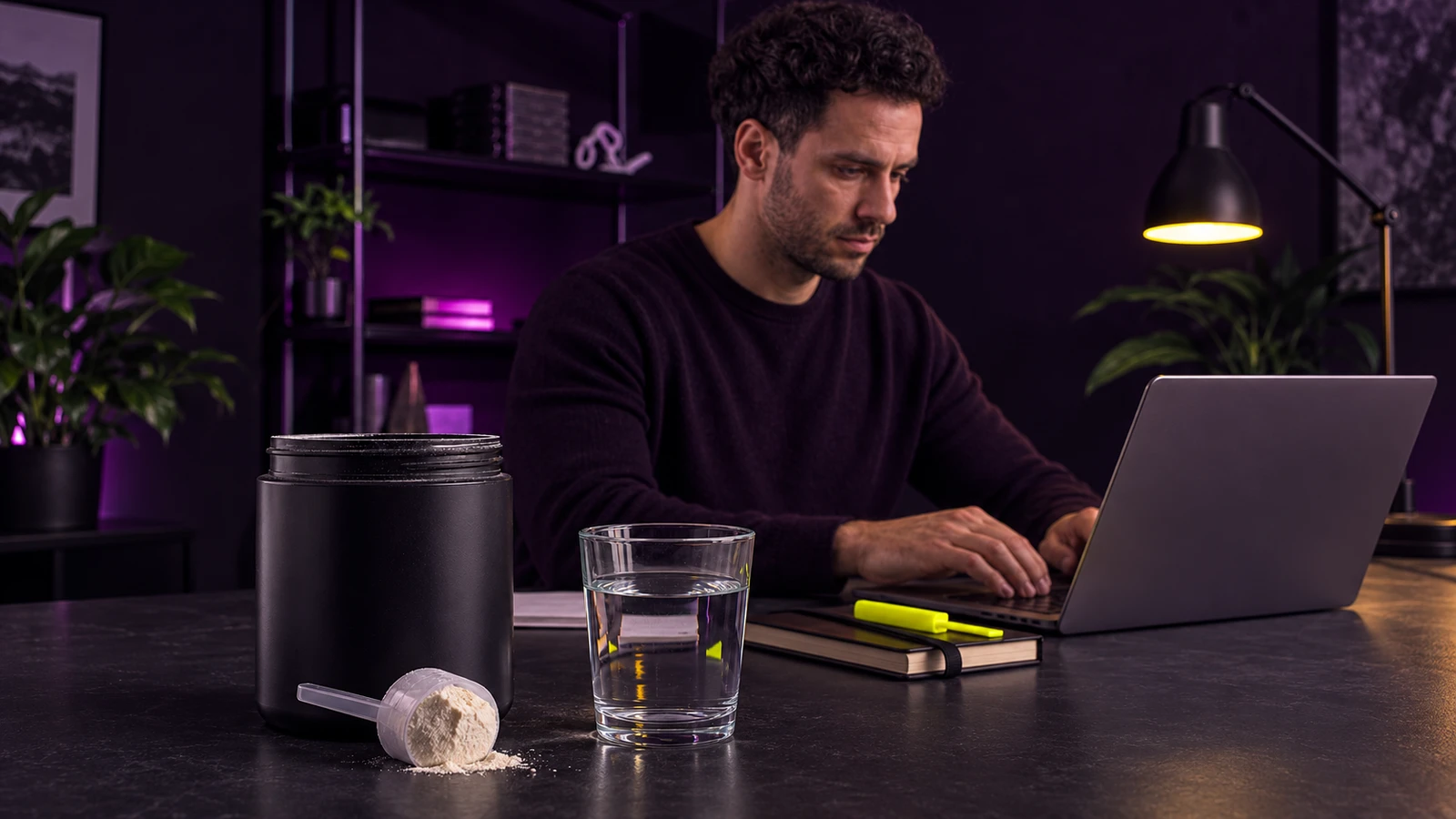

Creatine built its reputation in weight rooms, where it can help people repeat short, high-intensity efforts and gain more from resistance training. Now it is being marketed as something bigger: a daily fuel that can keep the brain sharp, resist mental fatigue, and compensate for lost sleep.
There is real science behind the interest. Brain cells use creatine and phosphocreatine to help buffer the energy needed to regenerate adenosine triphosphate, or ATP.
That mechanism does not make creatine a stimulant, and it does not guarantee a noticeable lift in focus. The human trials show a more modest and inconsistent picture, with stronger signals for memory and for people under metabolic stress than for a universal cognitive upgrade.
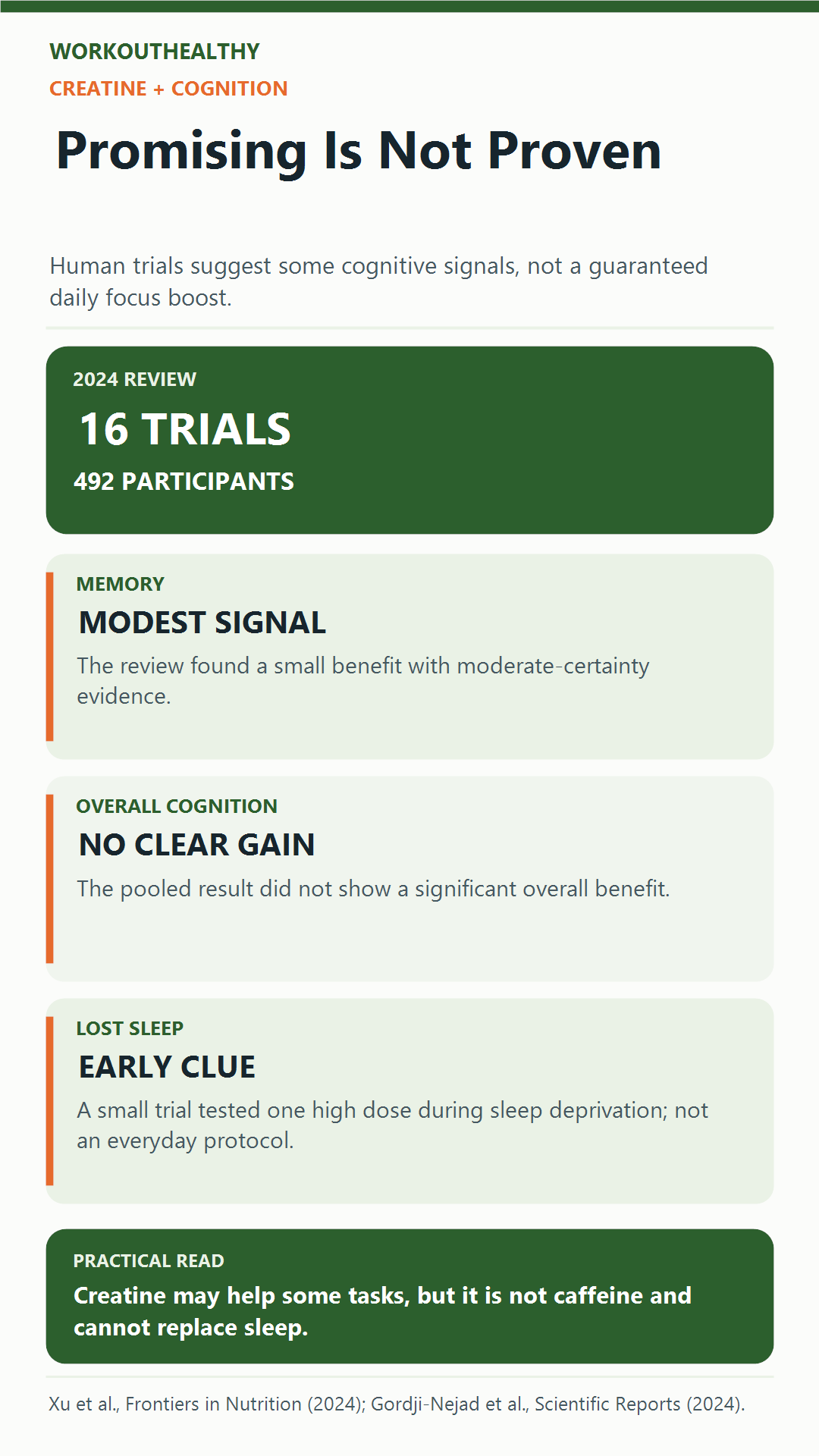
The useful verdict is promising, not proven. Creatine monohydrate may support some aspects of cognition, but it should not be sold as caffeine without the jitters or as a substitute for sleep.
Creatine helps buffer cellular energy, but a plausible mechanism is not the same as a guaranteed mental-performance benefit.
What Creatine Does in the Brain
ATP is the immediate energy currency used by cells. Because cells store only a limited amount, ATP must be regenerated continuously from adenosine diphosphate, or ADP.
Creatine can accept a phosphate group to form phosphocreatine. The creatine kinase system then helps donate that phosphate back to ADP when energy demand rises, buffering ATP availability across time and inside different parts of a cell.
This system operates in skeletal muscle and in the nervous system. The brain has a high and continuous energy demand, so researchers have asked whether increasing creatine availability can help when cognitive work, sleep loss, aging, diet, or illness strains energy metabolism.
Oral creatine reliably increases muscle creatine, but brain uptake is slower and less predictable. A supplement can support the raw material for the system without acting like an instant switch that forces neurons to work faster.
The common claim that people have only two seconds of ATP is also too literal. Stored ATP is limited, but the phosphagen, glycolytic, and oxidative systems overlap continuously to regenerate it rather than waiting in a simple sequence.
What the Best Cognitive Review Found
A 2024 systematic review and meta-analysis pooled 16 randomized trials involving 492 adults. Creatine monohydrate produced a small benefit for memory and improvements in the time needed for some attention and processing-speed tasks.
The same analysis found no significant improvement in overall cognitive function or executive function. Certainty was rated moderate for memory but low for processing speed, attention, executive function, and overall cognition.
That distinction matters because “cognition” is not one ability. Memory recall, sustained attention, reaction time, reasoning, and executive control use different tests, and a positive result on one task cannot be generalized to every kind of mental work.
The studies also differed in age, health status, dose, duration, and baseline diet. A pooled average can identify a signal while still leaving uncertainty about who will feel a practical benefit.
This is why the evidence does not support calling cognitive stamina creatine’s biggest benefit. The strength and power evidence is older, larger, and more consistent, while the cognitive literature remains relatively small.
Why One Famous Vegetarian Study Is Not the Whole Story
A 2003 double-blind crossover trial gave 45 young adult vegetarians 5 grams of creatine per day for six weeks. Participants improved on backward digit span and a reasoning test while taking creatine compared with placebo.
The result made biological sense because creatine is found mainly in animal foods and vegetarians often begin with lower muscle creatine stores. However, a small, selected study cannot tell us that every healthy omnivore will gain the same cognitive effect.
A 2011 trial in 128 young women found better memory in vegetarians but not meat eaters after five days of high-dose supplementation. Vigilance and verbal fluency did not improve, which again points to task-specific rather than global effects.
The largest preregistered cognitive trial to date tested 123 vegetarians and omnivores with 5 grams per day for six weeks. It found evidence consistent with a small benefit, but the primary effects were borderline or nonsignificant and vegetarians did not clearly benefit more.
Taken together, diet may influence baseline stores and response, but it is not a dependable screening test. A vegetarian diet does not guarantee a brain boost, and eating meat does not prove supplementation will do nothing.
Can Creatine Help During Sleep Deprivation?
A 2024 laboratory study gave participants a single dose of 0.35 grams per kilogram while they underwent 21 hours of sleep deprivation. Magnetic resonance measurements showed changes in brain high-energy phosphate metabolism, and several cognitive measures improved compared with placebo.
That is an intriguing proof-of-concept, not a routine dosing recommendation. For a 176-pound person, the experimental dose would be about 28 grams at once, far above the usual daily maintenance amount and more likely to cause gastrointestinal distress.
The study also tested a very specific state of acute sleep loss under controlled conditions. It does not show that a scoop of creatine can restore judgment, reaction time, mood, or safety after an all-nighter.
Sleep deprivation affects far more than the phosphocreatine system. If a bad night is unavoidable, creatine might eventually prove useful as one countermeasure, but sleep remains the intervention that addresses the cause.
Exercise can also change alertness after lost sleep, although it is not a replacement for recovery. Our look at whether a short HIIT session can undo a bad night explains the same limitation.
A sleep-deprivation experiment is a research clue, not a reason to replace rest with a scoop of powder.
Creatine Is Not a Stimulant
Caffeine blocks adenosine receptors and can acutely reduce the sensation of sleepiness. Creatine does not produce that nervous-system effect, so people should not expect a buzz, rapid alertness, or a reliable same-day change in concentration.
Standard creatine supplementation works by gradually increasing tissue creatine availability. A daily dose without a loading phase can take several weeks to approach the same muscle saturation reached more quickly with loading.
This difference also means creatine and caffeine should not be judged by the same feeling. A lack of immediate sensation does not prove creatine is ineffective, while feeling stimulated does not prove cognition or judgment has improved.
If you use caffeine, dose and timing create their own tradeoffs. Our guides to timing caffeine before a workout and how late caffeine can disrupt sleep cover those effects directly.
Who Might Be More Likely to Benefit?
The strongest hypothesis involves people whose brain energy demands are high or whose baseline creatine availability may be lower. That can include sleep-deprived people, some vegetarians or vegans, older adults, and certain clinical populations.
Hypothesis is the key word. The 2024 meta-analysis suggested different effects across age, sex, and health subgroups, but most subgroup estimates came from a small number of trials and should not be treated as personalized predictions.
Healthy, rested young adults may have less room to improve. A 2026 randomized trial in physically active young adults found better Wingate cycling power after creatine loading but no improvement on the cognitive tests used.
Research into neurological and psychiatric conditions is a separate clinical question. A supplement that modestly changes one laboratory task in healthy adults should not be presented as a treatment for dementia, depression, concussion, or another medical condition.
Lifestyle still carries more evidence for long-term brain health than any one powder. Our review of whether lifting weights helps keep the brain young puts resistance training in that broader context.
What Dose and Form Make Sense?
Creatine monohydrate is the form used in the cognitive meta-analysis and the standard form supported by the largest safety and performance literature. More expensive buffered, esterified, or branded alternatives have not established a cognitive advantage.
For healthy adults who choose to use it, 3 to 5 grams daily is a common maintenance dose. A loading phase of about 20 grams per day divided into four smaller servings for five to seven days can saturate muscle faster, but loading is not required.
The ideal cognitive dose is not settled. Brain creatine may respond differently from muscle creatine, and the high acute dose used during sleep deprivation should not be copied as a general focus strategy.
Consistency matters more than clock timing. Taking creatine with food or splitting the dose can make it easier on the stomach, while weighing powder with the scoop supplied by a reputable product reduces guesswork.
Choose a product that lists creatine monohydrate as the only active ingredient and has independent testing for identity and contaminants. Supplements are not preapproved for effectiveness before they reach the market, so label quality matters.
Safety, Water Weight, and Kidney Tests
Creatine is well tolerated by most healthy adults at standard doses. The most predictable effect is a small increase in body weight as water is retained inside tissues, and some users report stomach upset, especially with large single doses.
Creatine can also raise blood creatinine because creatinine is a breakdown product of creatine. A 2025 meta-analysis found a small increase in serum creatinine without a significant decline in measured glomerular filtration rate, suggesting the lab change does not automatically mean kidney damage.
That does not make kidney history irrelevant. People with kidney disease, abnormal kidney tests, pregnancy, or medications that affect kidney function should discuss supplementation with a clinician who can interpret the full context.
Tell a clinician that you take creatine before laboratory testing. Creatinine-based estimates can look worse even when other kidney markers do not indicate injury, and a clinician may choose additional testing when appropriate.
The National Institutes of Health Office of Dietary Supplements describes creatine as safe for healthy adults at typical performance doses and notes that several years of use appears safe. It also lists possible weight gain and uncommon gastrointestinal or muscle complaints.
What a Realistic Trial Looks Like
Decide what outcome you are testing before you start. If the goal is gym performance, track repetitions, load, and recovery across several weeks rather than looking for a sensation.
If the goal is cognition, expectations should be modest. Choose one repeatable measure such as errors on a demanding work task, a standardized memory exercise, or afternoon mental fatigue, while recognizing that practice effects can look like improvement.
Use one product and a standard daily dose for at least four to six weeks unless a clinician recommends otherwise. Keep sleep, caffeine, hydration, and major diet changes as stable as practical so they do not overwhelm the signal.
Stop if adverse effects persist, and do not escalate to a large acute dose because a sleep-deprivation experiment looked exciting. Research protocols are designed with screening and monitoring that a self-experiment does not have.
The absence of a noticeable mental change is a valid result. Creatine can still support high-intensity training without producing a subjective cognitive effect.
The Bottom Line
Creatine is not only relevant to muscle, because the brain also uses the creatine kinase system to buffer cellular energy. That mechanism gives researchers a credible reason to test memory, attention, processing speed, and mental fatigue.
The current evidence suggests a small benefit for memory and possibly certain timed tasks, with greater potential under stress or in people with lower baseline stores. It does not show a reliable improvement in overall cognition or executive function for everyone.
Creatine monohydrate at 3 to 5 grams per day is the practical, well-studied option for healthy adults who already want its training benefits. Treat any cognitive effect as a possible bonus, not a guaranteed transformation.
Most importantly, creatine does not replace sleep, a balanced diet, exercise, or medical care. It can support an energy-buffering system, but it cannot turn that system into unlimited mental fuel.
Get the next evidence check.
Five practical fitness stories worth your time, every Friday.
One email a week. No product pitches. Unsubscribe in one click.
References
- Xu, C., et al. (2024). The effects of creatine supplementation on cognitive function in adults: A systematic review and meta-analysis. Frontiers in Nutrition, 11, 1424972.
- Rae, C., et al. (2003). Oral creatine monohydrate supplementation improves brain performance: A double-blind, placebo-controlled, cross-over trial. Proceedings of the Royal Society B, 270(1529), 2147 to 2150.
- Benton, D., & Donohoe, R. (2011). The influence of creatine supplementation on the cognitive functioning of vegetarians and omnivores. British Journal of Nutrition, 105(7), 1100 to 1105.
- Sandkühler, J. F., et al. (2023). The effects of creatine supplementation on cognitive performance: A randomised controlled study. BMC Medicine, 21, 440.
- Gordji-Nejad, A., et al. (2024). Single dose creatine improves cognitive performance and induces changes in cerebral high energy phosphates during sleep deprivation. Scientific Reports, 14, 4937.
- Avgerinos, K. I., et al. (2018). Effects of creatine supplementation on cognitive function of healthy individuals: A systematic review of randomized controlled trials. Experimental Gerontology, 108, 166 to 173.
- Antonio, J., et al. (2021). Common questions and misconceptions about creatine supplementation: What does the scientific evidence really show? Journal of the International Society of Sports Nutrition, 18, 13.
- Kabiri Naeini, E., et al. (2025). Effect of creatine supplementation on kidney function: A systematic review and meta-analysis. BMC Nephrology, 26, 622.
- National Institutes of Health Office of Dietary Supplements. Dietary supplements for exercise and athletic performance: Health professional fact sheet.
Medical disclaimer: This article is for general information only and is not medical advice. If you have kidney disease, are pregnant, take medications that affect kidney function, or have other medical concerns, discuss supplementation with a qualified clinician.