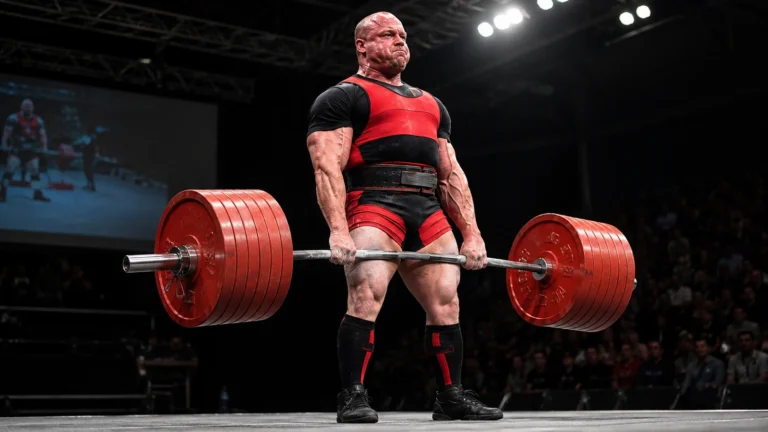

A video from DD News asks a serious question.
Can an intense workout actually trigger a stroke?
DD News is a general news broadcaster.
It is not a hospital, a university, or a stroke research center.
That does not automatically make the question wrong to ask.
Stroke is a serious topic, and it deserves a real answer.
We already looked at a related myth in our piece on sauna use and heart health.
The same approach applies here.
We went straight to the peer reviewed research on exercise and stroke.
Here is what large studies actually found, and what they do not prove.
What the Video Claims
The video is titled “Workout and Stroke, Fitness Myths Explained.”
It comes from DD News, a general public broadcaster.
DD News covers many topics, not just health or medicine.
It is not affiliated with a hospital, medical school, or stroke research institute that we could confirm.
The video frames its topic around common fitness myths.
One of those myths is whether an intense workout can trigger a stroke.
We were not able to independently verify every detail of the broadcast’s script.
So we are not going to repeat its specific framing as settled fact.
Instead, this article treats the question as worth checking, not already answered.
What we can do is look directly at what real stroke research says.
That research draws a clear, important line.
It separates two very different kinds of stroke.
What Real Research Shows About Exercise and Long Term Stroke Risk
Before looking at any trigger effect, the bigger picture matters first.
Regular exercise is strongly linked to a lower lifetime risk of stroke.
A major review pooled the results of 23 separate studies (Lee et al., 2003).
It was published in the journal Stroke.
Researchers combined data on physical activity and stroke outcomes across those studies.
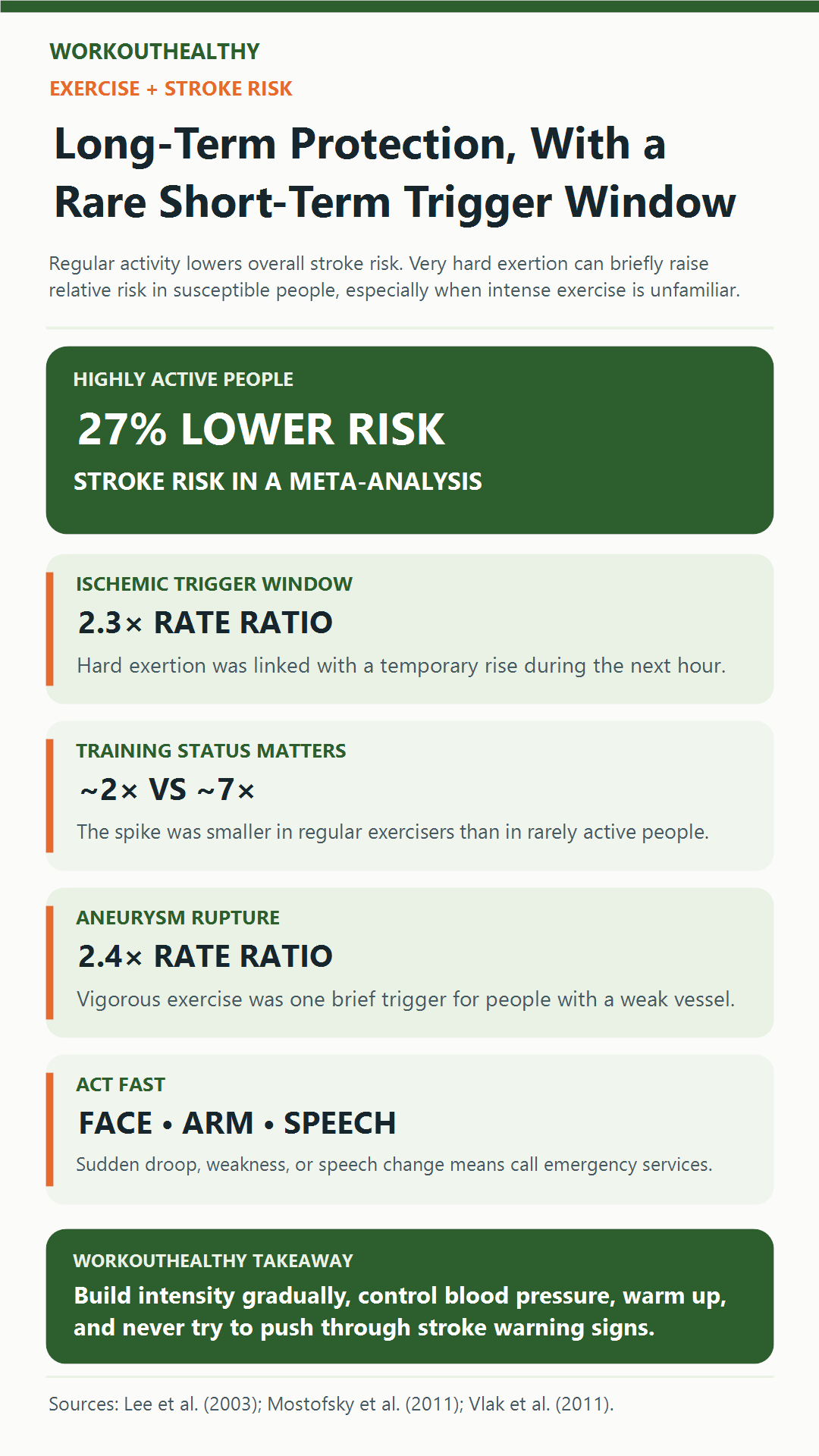
People who were highly active had a 27 percent lower risk of stroke.
That is compared to people who were the least active.
Moderately active people also had a lower risk, just a smaller one.
This pattern held for both men and women.
It also held across different countries and different study designs.
The protective effect showed up for stroke risk overall, not just one subtype.
That is a strong, consistent signal across a large body of evidence.
Across these observational studies, regular activity is associated with lower long-term stroke risk. They do not prove that exercise alone caused the entire difference.
Our review of daily steps and mortality covers a similar pattern for overall death risk.
What Real Research Shows About Exercise and Ischemic Stroke Risk
Long term benefit is one question.
A different question is whether a single hard workout can act as a short term trigger.
Ischemic stroke happens when a clot blocks blood flow to part of the brain.
It is the most common type of stroke.
A study called the Stroke Onset Study looked at this directly (Mostofsky et al., 2011).
Researchers interviewed 390 people shortly after an ischemic stroke.
They asked about physical activity in the hour right before symptoms started.
They compared that hour to the person’s usual activity patterns.
Moderate or vigorous exertion in that hour was linked to a higher short term risk.
The rate ratio was 2.3, meaning risk was roughly doubled in that hour.
Heavy lifting showed a similar pattern, with a rate ratio of 2.6.
But the size of that jump depended heavily on the person’s normal habits.
People who exercised three or more times a week had about double the risk during exertion.
People who rarely exercised had nearly seven times the risk during that same kind of exertion.
The relative short-term increase was smaller among people who reported exercising regularly. This suggests a role for habitual activity, but the case-crossover study cannot prove that fitness alone caused the difference.
What Real Research Shows About Exercise and Hemorrhagic Stroke Risk
Hemorrhagic stroke is different from ischemic stroke.
It happens when a blood vessel in or around the brain actually bleeds.
One common cause is a ruptured aneurysm, a weak bulge in a vessel wall.
A large study looked at what triggers that kind of rupture (Vlak et al., 2011).
Researchers studied 250 patients with a bleed called aneurysmal subarachnoid hemorrhage.
Patients reported their exposure to 30 possible triggers right before the bleed.
Vigorous physical exercise was one of eight triggers linked to a higher rupture risk.
The rate ratio for vigorous exercise was 2.4.
Several other everyday moments carried an even higher relative risk.
A sudden startle, like a loud noise, had a rate ratio over 23.
Straining during a bowel movement had a rate ratio of 7.3.
Sexual intercourse had a rate ratio of 11.2.
Coffee had the highest attributable risk of any trigger studied, at 10.6 percent.
The authors estimated a 7.9 percent population-attributable fraction for vigorous exercise among people with aneurysmal subarachnoid hemorrhage. That is a modeled estimate under the study assumptions, not a count of observed ruptures during workouts or the risk to a typical exerciser.
That number sounds concerning at first glance.
But it needs context most headlines skip.
In people who already had an intracranial aneurysm, vigorous exercise was associated with a temporary rise in rupture risk. That narrow finding does not mean exercise is generally dangerous.
Aneurysms are rare to begin with.
Most people never develop one, and most who do never have it rupture.
The aneurysm-rupture study concerns people who already had an intracranial aneurysm. Its estimated trigger risk should not be generalized to people without one. The separate ischemic-stroke study examined a different mechanism and population.
The Mechanism: Why Exertion Can Act as a Trigger
It helps to understand why exertion could matter at all.
Intense effort causes a fast rise in heart rate and blood pressure.
It also triggers a surge of stress hormones like adrenaline.
For ischemic stroke, possible pathways include changes in blood pressure, vessel tone, and clotting during exertion. The Stroke Onset Study measured activity before stroke onset; it did not directly test which biological pathway, if any, caused an individual event.
For hemorrhagic stroke, the mechanism is more mechanical.
Straining and heavy lifting both raise pressure inside blood vessels sharply.
In a vessel wall that is already weak, like an aneurysm, that spike matters more.
A sudden pressure increase is one plausible mechanism for rupture in a vessel that is already vulnerable. The trigger study supports an association; it cannot predict whether any given effort will cause a rupture.
Regular training changes this picture over time.
Consistent exercise improves how blood vessels dilate and handle pressure changes.
It also helps regulate blood pressure and clotting factors at rest.
Building that adaptation slowly appears to matter for the brain’s blood vessels too.
Our look at whether lifting weights keeps your brain young covers a related piece of this puzzle.
What This Evidence Does Not Prove
It is worth being precise about what these studies actually show.
In the hour after exertion, the case-crossover studies found temporary relative increases in ischemic stroke or aneurysm-rupture rates in their studied populations. The ischemic analysis included moderate as well as vigorous activity. Those short windows must be distinguished from the lower long-term stroke risk associated with habitual activity.
The absolute risk of a stroke during any single workout remains very low for most people.
These studies also do not identify one universal workout mistake that applies to everyone.
Personal risk depends heavily on underlying vascular health.
Some intracranial aneurysms cause no symptoms and never rupture. An individual risk assessment depends on medical history and the aneurysm’s characteristics, not on this trigger study alone.
These studies are observational, so they show patterns, not a guarantee for any one person.
They cannot tell an individual reader exactly how much risk their next workout carries.
They also do not mean every healthy adult needs brain imaging before starting to exercise.
We should also note a limit in the video’s own framing.
DD News is a general broadcaster, and it did not cite specific studies we could independently trace.
A broadcast reducing this topic to a single myth or fact answer leaves out most of this nuance.
Common Mistakes That Actually Fit the Research
A few real patterns show up again and again in this research.
The first is jumping from a sedentary lifestyle straight into a hard event.
The body has not built the base fitness that protects regular exercisers.
Starting a hard session without a gradual build-up may feel abrupt, so a warm-up is sensible exercise practice. The stroke-trigger studies cited here did not test whether warming up prevents stroke, and it should not be sold as a guarantee.
Another concern is heavy straining, like maxing out a lift while holding the breath.
Holding your breath while straining hard can spike pressure sharply for a moment.
The fourth is ignoring early warning symptoms and pushing through them anyway.
The fifth is returning from a long break at the same intensity used before the break.
Fitness fades faster than people expect, and blood vessels need time to catch back up too.
Building a base gradually, the way our guide on how many miles to walk each day describes, is a reasonable starting point.
Who Should Be Extra Careful
Some people carry a higher baseline risk and should be more careful before ramping up intensity.
That includes anyone with a personal history of stroke or a mini-stroke, also called a TIA.
It includes anyone with a known aneurysm or a family history of one.
It includes people with high blood pressure that is not well controlled.
It includes people with an irregular heartbeat, like atrial fibrillation.
It includes people with diabetes, high cholesterol, or a long smoking history.
It includes older adults who are starting vigorous exercise for the first time in years.
Anyone in these groups should talk to a doctor before starting an intense new program.

A simple check on current fitness, like our four flight stair test, can be a useful starting conversation.
Knowing stroke warning signs matters just as much as knowing your risk factors.
Remember B.E. F.A.S.T.:
- B — Balance: sudden trouble walking, dizziness, or loss of balance.
- E — Eyes: sudden trouble seeing.
- F — Face: one side droops.
- A — Arms: sudden weakness, especially on one side.
- S — Speech: slurred speech or trouble speaking or understanding.
- T — Time: call emergency services immediately and note when symptoms began.
A sudden, severe headache with no known cause is another warning sign. Any one of these symptoms warrants urgent help, whether or not a workout preceded it.
These signs can appear during exercise or shortly after it.
They can also appear with no exercise involved at all.
Do not wait to see if symptoms pass on their own.
Do not try to drive yourself to a hospital.
Call emergency services immediately if you or someone near you shows any of these signs.
Stroke treatment works best when it starts within the first few hours.
FAST is not a suggestion. Face drooping, arm weakness, or slurred speech during or after a workout means calling emergency services right away, not waiting to see if it passes.
A Practical Takeaway
None of this research is a reason to avoid exercise.
Regular activity is one of the most protective things you can do for your brain’s blood vessels.
The goal is to build intensity in a way that respects how the body actually adapts.
Start with a real base of moderate activity before adding intense sessions.
Increase intensity and duration in small steps over weeks, not in one dramatic jump.
Warm up before hard effort, use appropriate breathing during heavy lifts, and avoid unnecessary prolonged straining. These are sensible training practices, but the cited stroke studies did not show that warm-up, breathing, or hydration can eliminate exercise-associated stroke risk.
If you have any risk factors listed above, get cleared by a doctor before starting anything intense.
Learn the FAST warning signs, and treat them as a reason to stop and call for help.
Most of all, the strongest long-term evidence favors a consistent activity habit, while individual stroke risk still depends on medical factors. Hydration is appropriate exercise care, but it has not been shown here to prevent a stroke during an intense workout.
Watch the video
Want more like this? Subscribe to WorkoutHealthy Insider for practical explanations behind popular fitness claims.
References
Centers for Disease Control and Prevention. Signs and symptoms of stroke. CDC stroke warning-sign guide.
Lee, C. D., Folsom, A. R., & Blair, S. N. (2003). Physical activity and stroke risk: A meta-analysis. Stroke, 34(10), 2475 to 2481. https://doi.org/10.1161/01.STR.0000091843.02517.9D
Mostofsky, E., Laier, E., Levitan, E. B., Rosamond, W. D., Schlaug, G., & Mittleman, M. A. (2011). Physical activity and onset of acute ischemic stroke: The Stroke Onset Study. American Journal of Epidemiology, 173(3), 330 to 336. https://doi.org/10.1093/aje/kwq369
Vlak, M. H. M., Rinkel, G. J. E., Greebe, P., van der Bom, J. G., & Algra, A. (2011). Trigger factors and their attributable risk for rupture of intracranial aneurysms: A case-crossover study. Stroke, 42(7), 1878 to 1882. https://doi.org/10.1161/STROKEAHA.110.606558
This article is for general information only and is not medical advice. If you have an injury, ongoing pain, or a medical condition, talk to a doctor or physical therapist before you change how you train or eat.