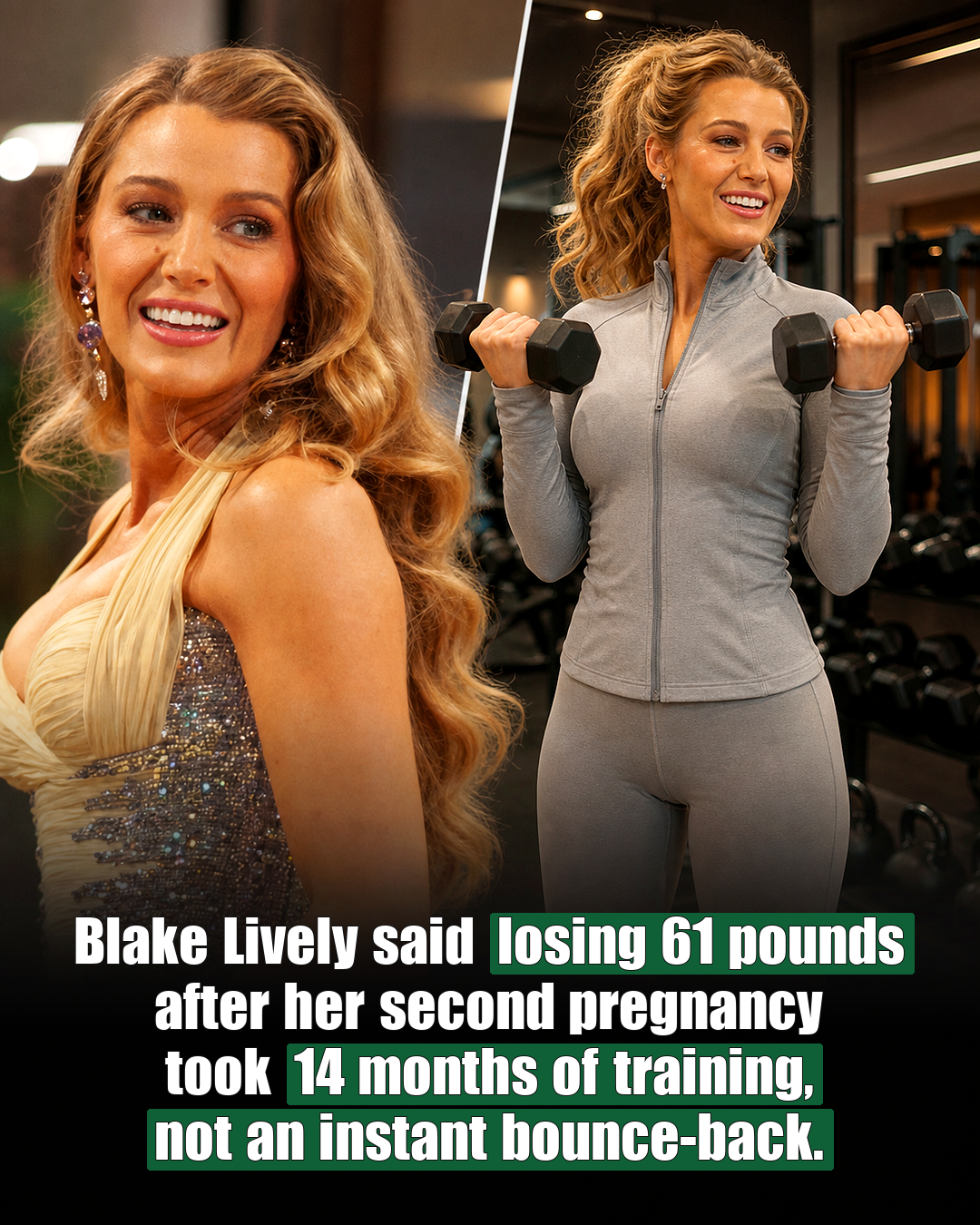

Blake Lively is an actress and mother of four.
She first became widely known for “Gossip Girl,” and later starred in films including “The Shallows” and “A Simple Favor.”
She has also been open about a subject most new parents face but few celebrities discuss honestly.
That subject is how long it actually takes to physically recover from having a baby.
In a 2018 Instagram post, Lively wrote about her second pregnancy. She said it took her “10 months to gain, 14 months to lose,” referring to the weight and physical changes of pregnancy.
That number surprised a lot of people.
Celebrity culture often sells the idea that new mothers should look “back to normal” within weeks.
Lively’s timeline pushed back on that idea directly, using her own body as the example.
What Blake Lively Has Actually Said About Postpartum Recovery
Lively has talked about postpartum recovery multiple times over the years, across different pregnancies.
In 2016, while promoting the film “The Shallows,” she discussed filming a bikini scene.
That scene was shot about eight months after she gave birth to her first daughter.
She told an interviewer, “The struggle is that I am doing a movie in a bikini eight months after having a baby and there is a level of insecurity and vanity that comes with that.”
She also pushed back on how the media treats postpartum bodies.
“You don’t want to be the person in magazines that they are saying, ‘Ugh, look at her’ rather than ‘Wow, look at her,'” she said.
“There shouldn’t be that negative ‘ugh’ after someone has a baby,” she added.
By 2018, after her second pregnancy, she was more direct about the timeline itself.
Speaking with E! News, she said body comparison is a common trap for new mothers.
“You compare yourself to other moms,” she said.
She also made clear that a fast recovery isn’t required for everyone.
“It’s also OK if you don’t,” she said. “If that’s not a priority or a goal of yours, then that’s fine, too.”
Why the “14 Months, Not Weeks” Message Matters
Most images of celebrity moms are taken at carefully chosen moments.
A red carpet appearance six weeks after birth can look like a full recovery. It usually is not.
Hair and makeup, lighting, clothing, and a single flattering angle can all hide a body that is still healing.
Lively’s own numbers show a real gap between the common assumption and what actually happened for her.
She said pregnancy weight gain took about 10 months. Losing it took about 14 months.
That process reportedly involved consistent training with a coach and steady, balanced eating, not a crash diet or an extreme plan.
That gap matters for a simple reason. It lines up with what research on postpartum recovery actually shows, not the version sold in magazine headlines.
Lively isn’t the only actress whose public fitness story has needed a closer, more honest look.
Our fact check on Gabrielle Union’s actual training routine found a similar gap between the viral version of a celebrity’s fitness story and what she has actually confirmed herself.
What the Research Says About Postpartum Weight and Recovery Timelines
A 2024 review published in Current Obstetrics and Gynecology Reports looked at postpartum weight retention across multiple studies.
The researchers, Gabriela Dellapiana, Quy Tu Nguyen, and Mariam Naqvi, found something striking.
Between 50 and 75 percent of patients weigh more than their pre-pregnancy weight a full year after giving birth.
Half of those patients retained at least 10 pounds at the one year mark.
A quarter retained at least 20 pounds.
The same review found that people with weight retention at two years out weighed about 15 pounds more, on average, than before pregnancy.
The review also looked at when weight loss actually happens.
Most of the fast, early weight loss occurs in the first six weeks after birth.
That early drop, usually 5 to 15 pounds, comes mostly from fluid loss and the uterus shrinking back down.
It is not fat loss, and it is not a preview of how the rest of the process will go.
The body that just built a placenta, carried a baby to term, and delivered it does not reset on a magazine’s timeline. It resets on its own.
The same research found that delivery method matters too.
A cesarean delivery raises the odds of longer term weight retention.
Patients who had a C-section were about 30 percent more likely to retain 10 or more pounds at the one year mark, compared to patients who delivered vaginally.
Other factors can slow the timeline as well.
Lower activity levels during pregnancy, gaining more weight than recommended, and getting less sleep can all extend recovery.
Losing sleep is nearly universal with a newborn in the house, which makes this factor almost impossible to avoid entirely.
Lively has credited working with trainer Don Saladino during parts of her recovery process.
That kind of professional guidance is a real advantage that most new parents don’t have access to.
It doesn’t change the underlying biology, though.
Even with expert coaching, her own numbers still landed at 14 months, not six weeks or three months.
That detail is worth sitting with. Professional support speeds up consistency and technique, but it does not override how long tissue actually takes to heal and rebuild.
How This Compares to General Medical Guidance
Doctors do not frame postpartum recovery as a race with a finish line.
The body needs time to heal on the inside as well as the outside.
The uterus itself takes about six weeks to shrink back to its pre-pregnancy size.
Many people also deal with diastasis recti, a separation of the abdominal muscles along the midline of the stomach.
That separation can take months of targeted core and pelvic floor work to fully close, if it closes completely at all.
Most obstetricians recommend a general checkup within two to three weeks after delivery.
A more complete postpartum exam usually follows somewhere between six and twelve weeks out.
That later exam is often the point where a doctor actually clears a patient to resume more structured exercise, not week one or two.
Lively’s 14 month figure fits comfortably inside what the data shows is normal.
The bigger problem is not her timeline. It is how few public examples show that normal range honestly.
Who Should Talk to a Doctor First
Every postpartum body is different, and a few situations call for a direct conversation with a doctor before starting or resuming exercise.
Anyone who had a C-section needs clearance for their incision to heal before doing core work or anything involving heavy lifting.
Anyone with ongoing pelvic pain should be evaluated before adding intense training.
Leaking urine during exercise or a visible bulge along the midline of the stomach are also signs to get checked for diastasis recti or pelvic floor dysfunction.
Anyone who experienced significant blood loss, high blood pressure, or other complications during delivery should get direct guidance from their OB before ramping up activity.
Postpartum depression and anxiety are medical concerns too, not just a passing mood.
A doctor or therapist can help if the emotional side of recovery feels heavier than expected, at any point in the first year.
Common Mistakes People Make With Postpartum Fitness
The most common mistake is comparing week six to someone else’s month twelve.
Recovery timelines vary by delivery type, body, and how much rest a person is actually getting.
Another mistake is jumping straight into high intensity workouts or heavy ab training too soon.
Doing this before the core and pelvic floor have rebuilt basic support can worsen diastasis recti instead of healing it.
Some new parents also chase weight loss numbers while ignoring strength and function.
Being able to lift a car seat, bend without pain, or sleep through discomfort matters more early on than a number on a scale.
Finally, many people quietly skip the six week or twelve week postpartum checkup, or treat it as optional.
That visit is where real, individual clearance actually happens, not a guess based on how strong someone feels.
A Realistic Way to Approach Postpartum Fitness
Recovery does not need a celebrity’s schedule or budget to work. It needs patience and a plan that respects the body’s actual timeline.
Start with walking. Short, easy walks are usually safe within the first couple of weeks for an uncomplicated vaginal delivery, and our guide to how many miles to walk a day covers how to build that habit gradually.
Walking supports circulation and mood without stressing the core the way more intense training would.
Wait for a real clearance before returning to structured exercise. That means the six to twelve week postpartum visit, not a personal guess.
Rebuild the core from the inside out.
Gentle breathing work and pelvic floor engagement come before planks, crunches, or heavy lifting.
A pelvic floor physical therapist can check for diastasis recti and guide this stage directly.
Add strength training gradually once cleared.
Bodyweight movements and light resistance work come first, building toward heavier loads over weeks and months, not days.
Track how things feel, not just how things look.
Less pain, better sleep, and more energy are real markers of progress, even before the scale or mirror shows a change.
Expect a full year, possibly more.
Treating 12 to 14 months as a normal, even fast, recovery window removes the pressure that makes early postpartum life harder than it needs to be.
Ask for support.
A trainer with postpartum experience, a pelvic floor specialist, or simply a partner who takes on more at home can make consistent movement realistic during an exhausting stretch of life.
Give yourself permission to move slower than you expected.
Lively’s own message, repeated across several interviews and several pregnancies, keeps landing on the same point.
A body that grew and delivered a baby is allowed to take real time to recover, and that timeline is not a measure of discipline or willpower.
References
- Dellapiana, G., Nguyen, Q. T., & Naqvi, M. (2024). Navigating Postpartum Weight Loss: Evidence and Interventions. Current Obstetrics and Gynecology Reports.
- Mayo Clinic. Postpartum care: What to expect after a vaginal delivery.
- E! News. “Blake Lively on the Challenges of Losing Pregnancy Weight: ‘You Compare Yourself to Other Moms.'”
- Herald Sun / Yahoo Lifestyle. “Blake Lively on the Pressure to Lose Weight After Giving Birth: ‘It’s Unfair.'”
This article is for general information only and is not medical advice. Postpartum recovery varies widely from person to person, and anyone with questions about their own healing, exercise readiness, or emotional wellbeing after childbirth should talk with their OB-GYN, midwife, or another qualified healthcare provider.