
Latoya Shauntay Snell does not describe movement as a debt owed to a smaller future body. The runner, chef, and founder of Running Fat Chef has argued that people deserve room to move for joy, connection, and curiosity, regardless of size.
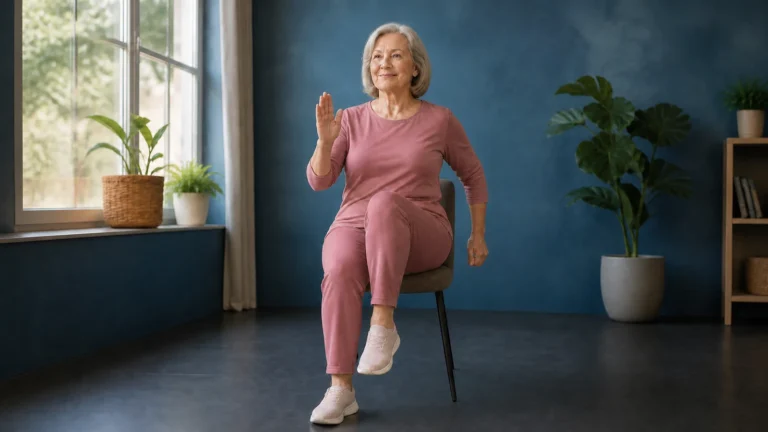
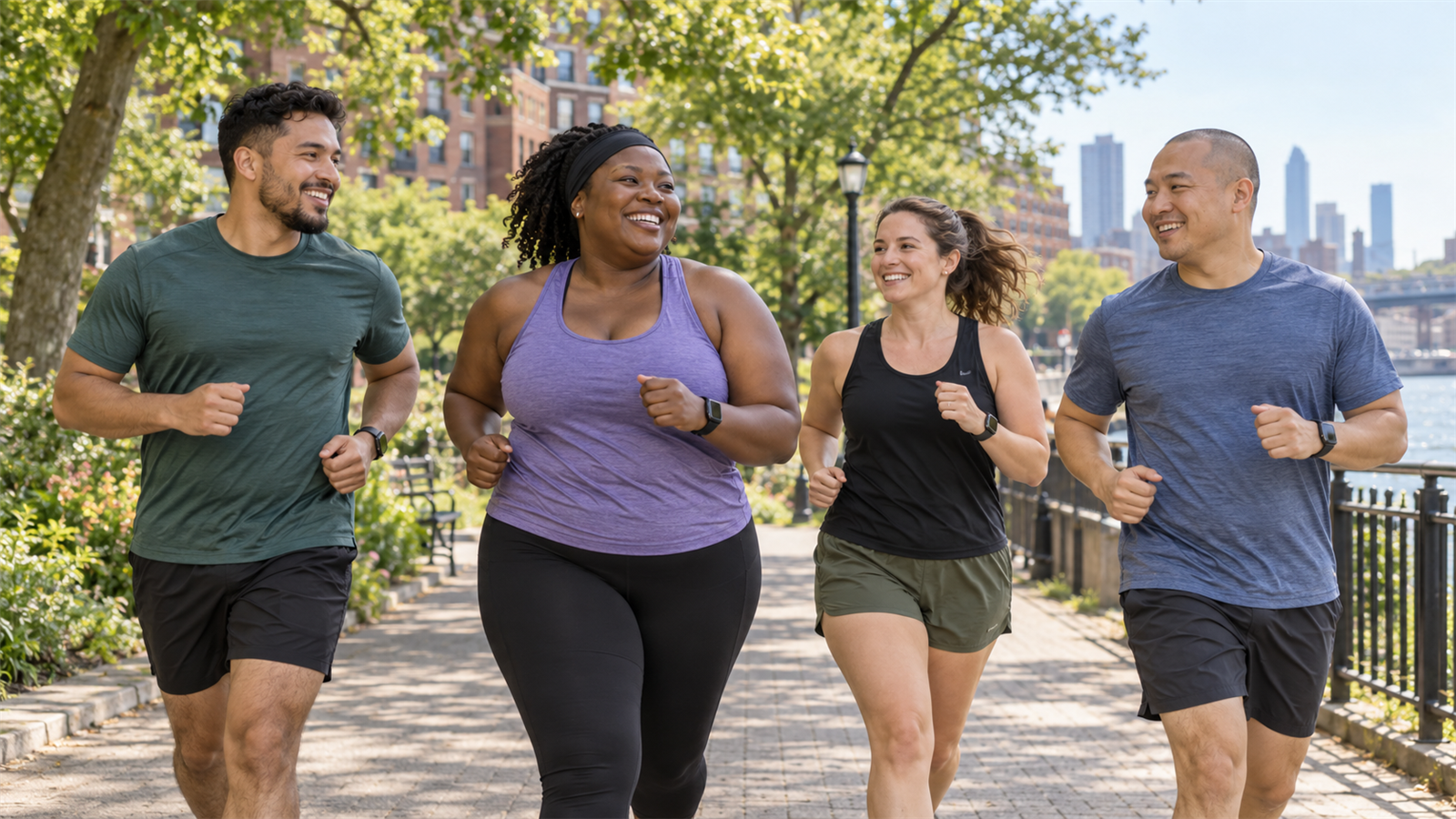
Image note: The hero is an editorial illustration of recreational runners, not a depiction of Snell.
A 2022 Shape interview explored that approach. The interview supports the central message, but Snell’s story is more complicated than a slogan about loving every workout.
She spoke openly about pain, a difficult relationship with food and body image, and the work of claiming an athletic identity. Those details matter because a joy-first approach is not a promise that exercise is always fun or that medical needs disappear.
Who is Latoya Shauntay Snell?
Snell founded Running Fat Chef in 2016. Her own account describes the project as a place for stories about food, fitness, travel, and people who have not always felt welcome in wellness spaces.
Her current team biography identifies her as an endurance athlete, writer, influencer, and advocate for inclusion beyond body size alone. It describes a community project rather than a single weight-loss journey.
In its 2019 profile, REI Co-op reported that Snell had completed races from short road events to a 100K trail race. The point is not that everyone should try an ultramarathon; it is that a runner’s appearance cannot tell you what distances they have covered.
Her public story has also changed over time. The Running Fat Chef site says the project slowed while she dealt with chronic illness and loss during the pandemic, then grew into a broader community platform.
What Shape actually reported about joy
Shape’s interview centered on Snell’s wish to make fitness more inclusive and less tied to shame. She encouraged people who are beginning to choose movement that brings joy, purpose, or fun, and to restart as often as needed.
That is not a claim that every mile must feel easy. It is a statement about who controls the reason for moving and whether a person is allowed to value the experience itself.
Snell also challenged the idea that a person must look a certain way to call themselves an athlete. In the interview, she connected that realization to respecting boundaries, eating enough, resting when needed, and noticing what her body can do.
She did not provide a universal running plan, a target pace, or a diet for readers to copy. Turning her experience into a guaranteed formula would miss the very flexibility she described.
Her history makes the message more than a slogan
Snell told Shape that exercise initially helped her respond to a difficult period involving back pain and other health issues. She also described weight loss followed by disordered eating and a painful reassessment of what she thought an athlete should look like.
Those are personal disclosures, not a diagnosis this article can make on her behalf. They show why a simple before-and-after account would be incomplete and potentially harmful.
In REI’s earlier interview, Snell described a finish at the Javelina Jundred 100K that mattered to her despite being last. She treated showing up and finishing within the cutoff as achievements rather than using rank as the only measure of success.
The two interviews took place years apart. They should not be blended into a single quote or treated as evidence that one mindset change solved all of her difficulties.
Her own site later described chronic illness and a period of reduced athletic activity. That update is an important reminder that exercise capacity, motivation, and health can vary across seasons of life.
What body-inclusive running asks us to change
Body-inclusive running starts with a simple idea: a person’s size is not an entry requirement for walking, jogging, racing, or calling themselves a runner. It does not deny differences in comfort, pace, health, or training history.
Snell’s advocacy challenges the habit of treating a runner’s body as public evidence of success or failure. A race result records a time and distance; it does not authorize strangers to grade the athlete’s appearance or food choices.
REI reported that Snell had faced harassment during races. That context explains why visibility can matter, especially for people who rarely see someone like themselves in running media or event photographs.
It also explains why support should be offered with care. The Shape interview notes that a person may be finding confidence privately and may not want unsolicited advice, a compliment about weight, or a public conversation about their body.
Inclusion is practical as well as rhetorical. Clubs can make room for varied paces, publish realistic course cutoffs, welcome run-walk participants, and use images that show more than one body type without making any one person a mascot.

Does enjoyment help people keep moving?
Snell’s approach aligns with a useful but limited research finding. A systematic review of 66 studies on exercise motivation found a consistent positive association between more self-directed motivation and physical activity.
The review reported a tendency for personally valued reasons to matter when people start and for enjoyment itself to matter more for longer-term adherence. It does not prove that simply telling someone to have fun will produce a lasting habit.
A later systematic review of variety in activity settings found that variety can be related to interest, enjoyment, participation, and adherence. The studies differed in design and setting, so the finding is best used as a planning clue rather than a guarantee.
Enjoyment is not the only factor. Cost, safe places to move, disability access, time, pain, childcare, and social support may determine whether a person can return to an activity they like.
The evidence therefore supports a modest reading of Snell’s message: giving people meaningful choice and a tolerable experience may help them build a routine. It does not make a joyful activity a substitute for medical care or remove structural barriers.
A practical way to try a joy-first routine
Start by naming one form of movement you are curious about, not a body measurement you want to change. It might be a park walk, dancing, a gentle cycling route, a beginner lifting session, or a run-walk with a friend.
Keep the first session small enough to finish with some interest left. Ten comfortable minutes can be a useful experiment if the alternative is a punishing hour that makes a second session unlikely.
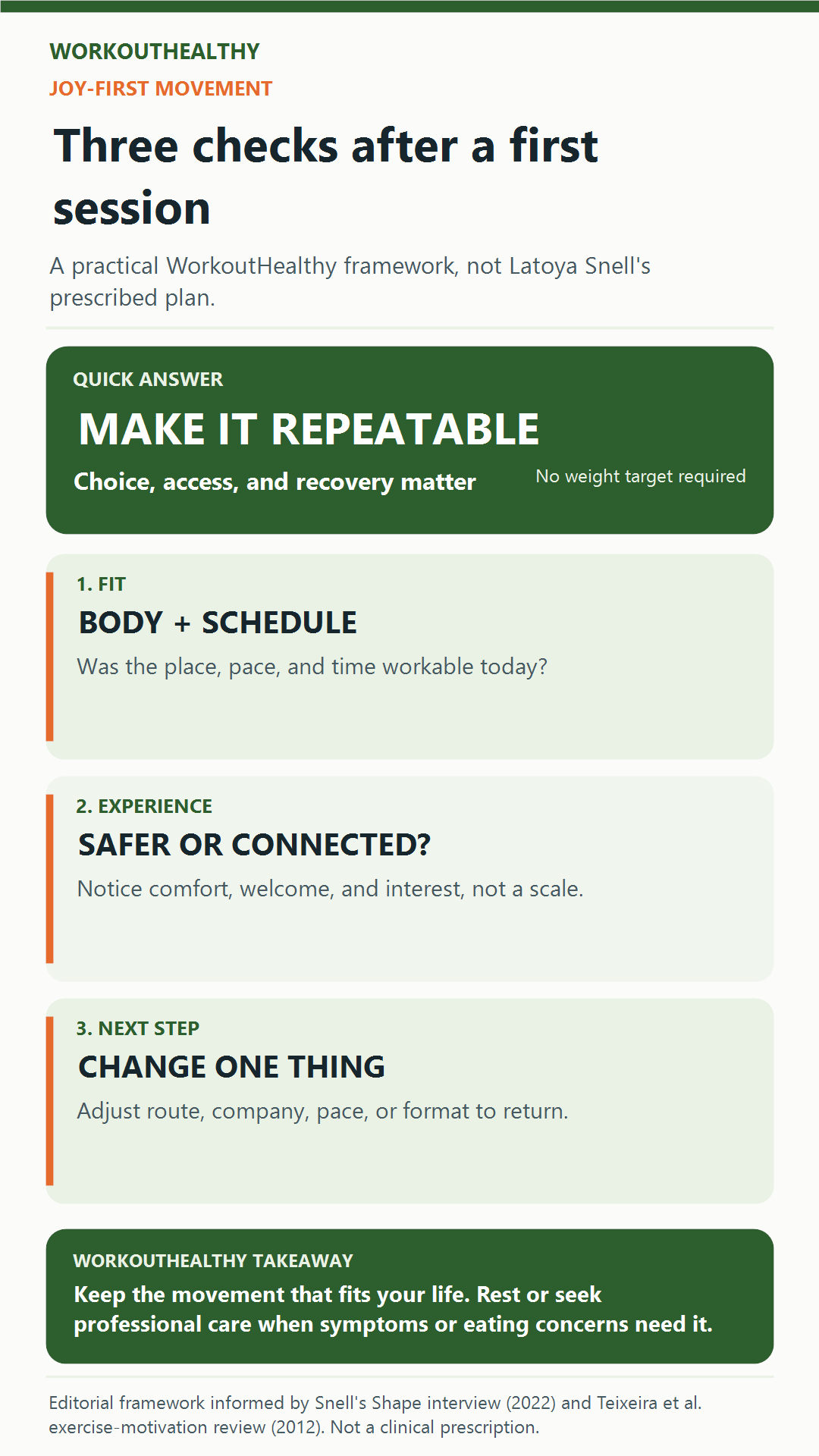
Afterward, use three simple questions to decide what to keep and what to change:
- Did the activity fit my current body, access needs, and schedule?
- Did I feel safer or more connected than I expected?
- What would make the next attempt easier to repeat?
A question about access matters as much as a question about motivation. A nearby route can still be unusable if sidewalks are uneven, a facility lacks an accessible restroom, or a class treats a slower participant as an inconvenience.
Try changing the setting before deciding the activity itself is wrong for you. A different group, shorter loop, seated version, or lower-noise space can turn a frustrating first attempt into one worth repeating.
Use the answers to change the route, pace, company, music, equipment, or time of day. This is an editorial framework inspired by Snell’s emphasis on choice, not a training prescription she published.
If running appeals to you, alternating brief jogs with walking is a legitimate way to begin. You can shorten the jogging interval, repeat the same route, or stay with walking while you build comfort.
Track signals that have meaning beyond weight: how often you returned, whether the route felt less intimidating, whether recovery was manageable, and whether you want to do it again. A scale cannot tell you whether a community welcomed you.
Some people enjoy logging distance or pace, and there is nothing wrong with that. The distinction is whether the number serves your chosen goal or becomes a verdict on your worth after every session.
Joy does not mean ignoring pain or treatment needs
Some movement will feel challenging, and some people live with symptoms that make the word joy complicated. Snell’s own public account includes difficult health periods, not a promise of permanent ease.
Do not treat pain as a test of commitment or imitate an endurance athlete’s mileage when you are starting from a different baseline. New or worsening symptoms, dizziness, chest pain, or major changes in exercise tolerance deserve professional evaluation.
People recovering from an eating disorder may also find fitness advice that focuses on calories, weight, or compensation triggering. A qualified clinician or dietitian can help tailor movement and fueling to the person’s needs; a social post cannot do that work.
Body-inclusive language should leave room for rest. Skipping a run during illness, choosing a lower-impact option, or taking a long break does not cancel an athletic identity.
The bottom line
Latoya Shauntay Snell’s Running Fat Chef project and Shape interview support the scheduled post’s central point: she wants movement to be open to more people and valued for more than weight control. Her own story also includes setbacks, health concerns, and a deliberate rejection of narrow ideas about what an athlete looks like.
The useful takeaway is not that exercise must feel magical every day. It is that people can choose a form, pace, and community that make returning possible, while respecting medical needs and refusing to judge the worth of their movement by body size alone.
References
- Konstantinovsky, M. How Latoya Snell, aka the Running Fat Chef, Finds Joy and Liberation in Movement. Shape, February 8, 2022.
- Running Fat Chef. Our Story and Our Crew. Accessed October 2026.
- Daddio, J. Latoya Shauntay Snell Is a Force to Be Reckoned With. REI Co-op, October 24, 2019.
- Teixeira, P. J., et al. Exercise, physical activity, and self-determination theory: A systematic review. International Journal of Behavioral Nutrition and Physical Activity, 2012.
- Juvancic-Heltzel, J. A., et al. The Provision and Experience of Variety in Physical Activity Settings: A Systematic Review. 2023.
This article is for general information only and is not medical or mental-health advice. If you have pain, an injury, a medical condition, or concerns about eating or exercise behaviors, seek guidance from a qualified clinician.