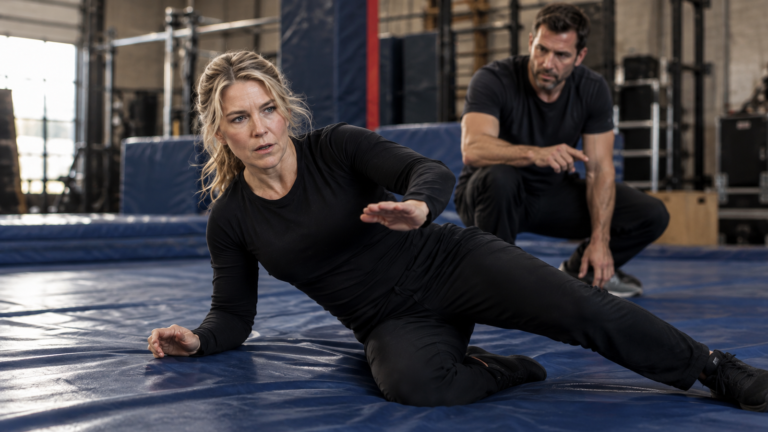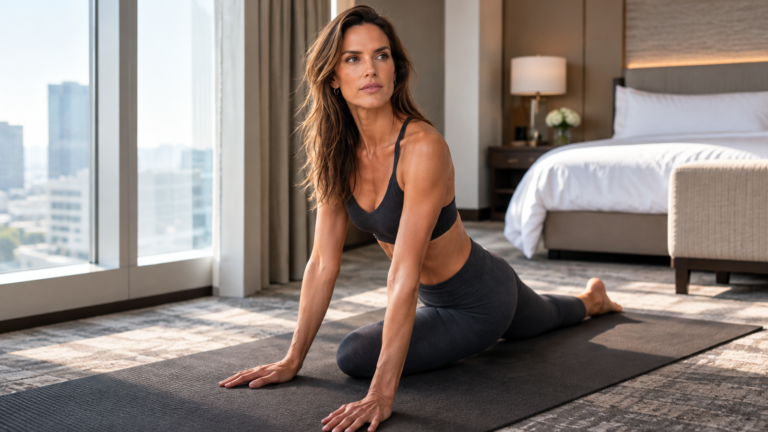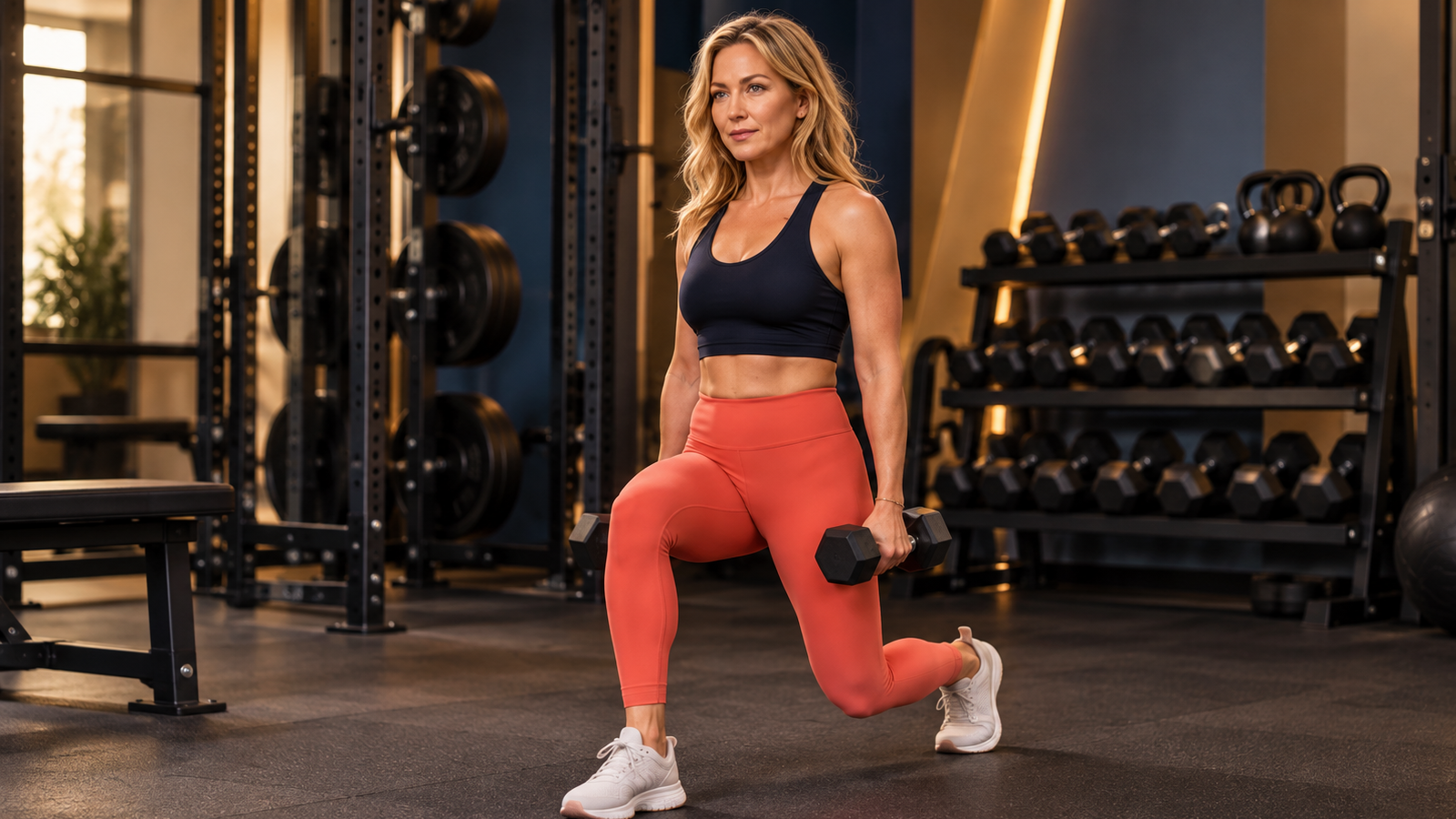

Kate Hudson’s lower-body strength work is more varied than a two-exercise celebrity headline suggests. In a 2022 Shape interview, her trainer and strength coach Brian Nguyen described a program built around squats, lunges, deadlifts, single-leg balance, sled work, and other athletic basics. He also shared a six-move lower-body circuit. The useful lesson is not that everyone should copy Hudson’s volume or weights; it is that a few fundamental movement patterns can be adapted to different levels.
The scheduled Facebook post highlights compound moves such as squats and lunges. That is a fair entry point, but the source deserves fuller context. The featured routine also includes a single-leg hinge, a balance-and-reach drill, a plank variation, and a glute bridge. Those choices cover several movement demands rather than asking one exercise to train every muscle equally. The article was published in 2022, so it should not be presented as a verified account of Hudson’s exact routine today.
What the trainer actually shared
Nguyen told Shape that he and Hudson rely on technical, strong basic movements, and he described using squats, lunges, deadlifts, balance work, sprints, and sled pushes or pulls. For the specific lower-body circuit in that feature, he listed six exercises: single-leg Romanian deadlift, toe touch, bodyweight squat, plank variation, glute bridge, and classic lunge. The published format suggested 30-second work intervals, short transitions, and several rounds with rest between rounds.
That is a trainer-designed example for Hudson, not a universal prescription. An experienced performer training with professional supervision may handle a volume or intensity that a beginner should not attempt. The article said the routine can be done with body weight and that resistance can be added. Those options matter more than any impression that a heavy dumbbell is required from day one.
Hudson has also been associated with Pilates, yoga, and dance. The 2022 interview describes strength work as one part of a broader activity mix. Reducing her routine to “squats and lunges” misses both the other exercises in the circuit and the fact that individuals can train for different goals in different sessions.
Why squats and lunges are useful
A squat asks the hips, knees, and ankles to work together while the trunk remains organized. Depending on depth, stance, and load, it can challenge the quadriceps and glutes substantially. A lunge shifts weight between the legs and adds a balance demand. The front leg usually does much of the work, while the rear leg supports the position. Both are multi-joint movements, which makes them practical ways to train several muscles in one exercise.
Multi-joint does not mean perfectly comprehensive. Hamstrings contribute to lower-body movement, but a squat is not automatically an ideal hamstring-building exercise. A hip hinge, such as the single-leg Romanian deadlift in Nguyen’s circuit, emphasizes a different pattern. Glute bridges add another way to train hip extension. That is why the six-move example makes more sense as a collection than as a promise that one compound lift covers the whole lower body.
These patterns can also relate to everyday tasks: sitting and standing, stepping, carrying, and controlling balance. But “functional” is not a magic label. A movement is functional when it helps a person do something they value and is appropriate for their body. A supported sit-to-stand may be more useful than a deep loaded squat for one reader; another may benefit from a heavier progressive lift.
A closer look at the six moves
Single-leg Romanian deadlift: This hip-hinge pattern challenges the glutes and hamstrings while asking the standing leg and trunk to control balance. A beginner can hold a wall or keep the back foot lightly down. Move only as far as the spine and hips can stay controlled; touching the floor is not a requirement.
Toe touch or balance reach: The feature describes a standing balance-and-reach movement rather than a maximum stretch. Its main value in a general program is controlled coordination and single-leg stability. It may need a simpler variation for someone with balance concerns, and it is not a substitute for progressive strength work by itself.
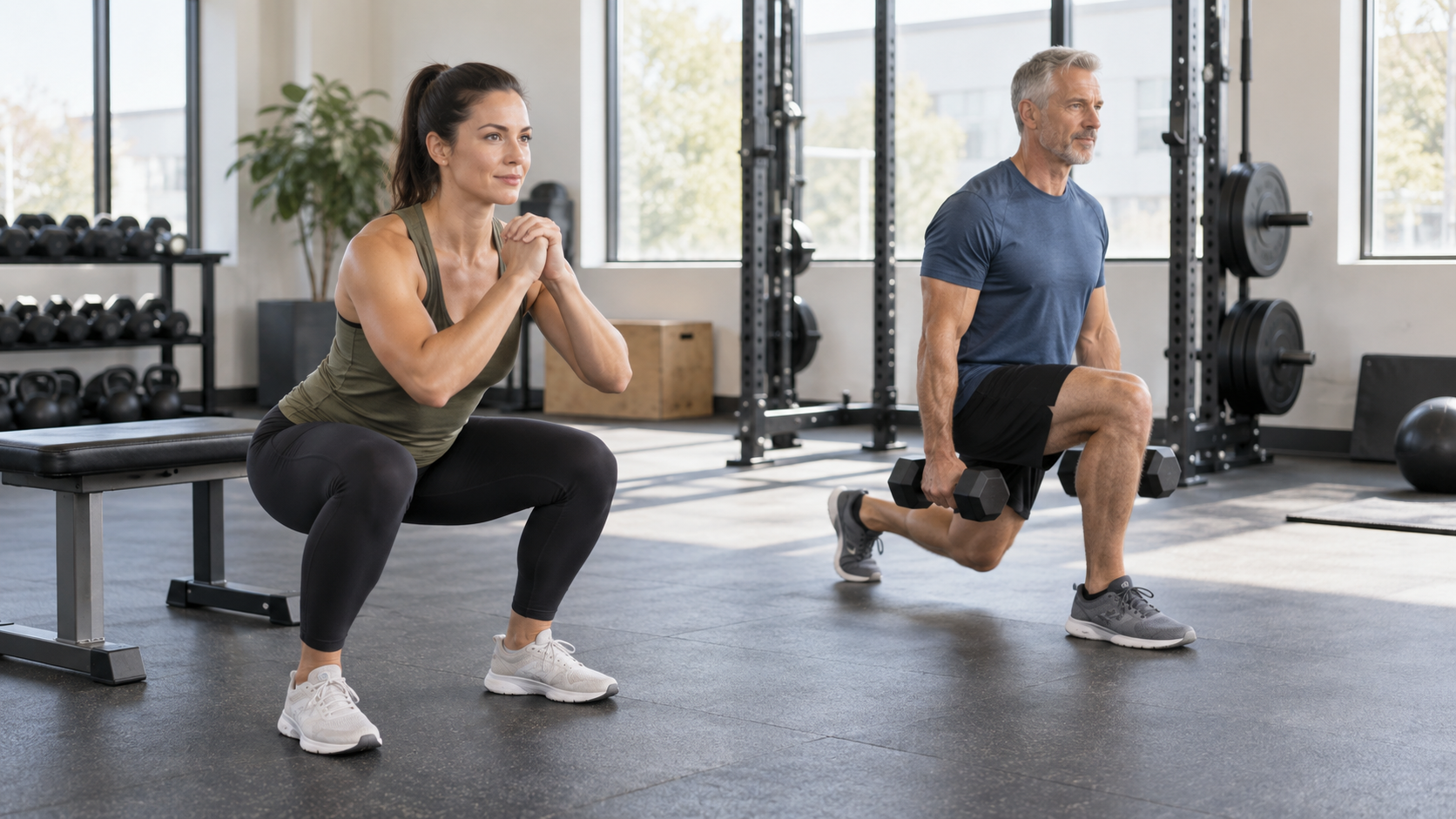
Bodyweight squat: A chair or bench can establish a comfortable target and help a new lifter learn the pattern. Keep the motion controlled and choose a depth that is comfortable. An individual’s knees, hips, and ankles will influence stance and range. There is no single visually perfect squat for every body.
Plank variation: Nguyen’s circuit uses a core challenge that can involve shoulder taps and knee movement. The intent is controlled trunk stability, not simply moving as fast as possible. A high plank can be modified with hands on a bench or wall when floor work is too demanding.
Glute bridge: This floor exercise emphasizes hip extension. It can be a useful introduction to feeling the glutes work without standing load. Start with controlled repetitions and avoid forcing the lower back into an exaggerated arch at the top.
Classic lunge: A lunge can be scaled with support, a shorter range, or a static split stance before adding walking or dumbbells. Choose a version that allows balance and control. If one direction aggravates a joint, a coach or clinician may suggest a different step length or pattern.
How to adapt the idea without copying the circuit
The simplest version might include a supported squat, a supported split squat or step-up, a light hip hinge, and a bridge. Choose a number of controlled repetitions that leaves room for good form. Rest as needed. A person who is new to strength training could do one or two rounds and focus on learning; a more experienced trainee might use more sets, load, or complexity according to a plan.
Nguyen’s published circuit used timed intervals and multiple rounds, but “as many reps as possible” should not be read as permission to rush through poor technique. In a public article for varied readers, quality and a sustainable dose matter more than matching a celebrity’s session. A qualified trainer can help choose appropriate loads and progressions. Anyone with current pain, recent injury, or a medical condition may need individualized advice before trying a demanding circuit.
Progression can be modest. When a bodyweight squat becomes comfortable, one might add repetitions, a little depth, a pause, or a light load—not all at once. A lunge can progress from a supported static stance to a controlled step and eventually to resistance. The aim is to increase the challenge while keeping the movement tolerable, not to chase a dramatic clip for social media.
How often should lower-body strength be trained?
The U.S. Physical Activity Guidelines recommend muscle-strengthening activity for adults on at least two days a week, alongside aerobic activity. That is a population-level target, not a command to repeat the exact same hard leg workout every day. Muscles and connective tissues need recovery as training becomes more challenging. The amount of rest depends on the session, the person, and the rest of the week.
ACSM’s updated resistance-training guidance also emphasizes that bodyweight, bands, and home-based routines can build strength and physical function. A gym is useful but not mandatory. The program that works is one that is challenging enough, repeatable, and gradually adjusted. The glamorous setting of a celebrity workout is irrelevant to those basic principles.
For someone starting from very little activity, even one sensible session can be a bridge toward a two-day habit. For a well-trained person, two days may be a minimum rather than an upper limit. Neither group benefits from treating a 2022 trainer feature as a one-size-fits-all prescription.
A sample beginner-friendly week
A reader might put a short strength session on Monday and Thursday, leaving easier movement or rest between them. Each session could begin with five minutes of comfortable walking and a few unloaded practice repetitions. One or two sets of chair squats, supported split squats, and light hip hinges may be enough to learn the patterns. Finish before balance or technique deteriorates. The next week, repeat the same plan and make only one small change if it feels appropriate. This is an illustration, not Hudson’s actual schedule, and it should be adapted for individual health and goals.
What the caption should—and should not—promise
It is reasonable to say Hudson’s trainer featured squats and lunges in a broader lower-body strength approach. It is not supported to claim that a single circuit guarantees injury prevention, that it precisely describes her current week, or that every exercise trains glutes, quadriceps, and hamstrings equally. Injury risk depends on many factors, and strength training is only one part of preparation.
Hudson’s example can make ordinary basics feel appealing. A squat, a lunge, and a hinge are not flashy, yet together they train useful patterns. The worthwhile question is how to make those movements appropriate and progressive for the reader, not how to reproduce a celebrity’s body or a coach’s advanced numbers.
Practical takeaway
Use the trainer feature as a menu. Select a squat pattern, a single-leg pattern, and a hip-hinge or bridge that you can do with control. Start with a manageable dose, repeat it consistently, and increase the challenge only when technique and recovery support it. If pain or uncertainty appears, choose a modification or seek qualified guidance. That is a more durable takeaway from Hudson’s lower-body training than a claim that compound moves alone solve every goal.