

Egg yolks and brain health are linked through choline, a nutrient needed for cell membranes and acetylcholine production. A large hard-boiled egg contains about 147 milligrams (National Institutes of Health Office of Dietary Supplements [ODS], 2022).
That makes a whole egg one useful food choice. It does not establish that an egg-white omelet damages the brain.
The viral claim comes from a severe deprivation experiment in mice, rather than a comparison of whole eggs and egg whites in people (Dave et al., 2023). Here is what that distinction means for an ordinary breakfast.
The short answer
Choline is essential, but no single food is compulsory. Eggs, soybeans, poultry, fish and other foods can contribute to intake (ODS, 2022).
The Arizona State University experiment tested what happens when mice receive food with no added choline for months. It cannot tell us whether choosing whites at breakfast causes human deficiency or Alzheimer’s disease (Dave et al., 2023).
Human research offers reasons to investigate choline further. Observational associations and a small trial with mixed findings do not establish that adding yolks prevents dementia (Niu et al., 2025; Yamashita et al., 2023).
The useful next step is to review your overall food pattern. There is no need to make a breakfast decision from a frightening image or a single mouse experiment.
A nutrient can be essential without every food that lacks it becoming dangerous.
What choline does
Choline supplies methyl groups and helps form phospholipids and the neurotransmitter acetylcholine. The liver makes some, but dietary intake is still needed (ODS, 2022).
Those functions explain why researchers study choline. They do not imply that adding more to an already adequate diet will keep improving memory.
Think of the difference between maintaining a necessary supply and using a substance as a treatment. The first question concerns nutritional adequacy; the second needs clinical evidence for a particular outcome.
That distinction matters when a headline moves directly from a biochemical role to a disease-prevention promise. A plausible mechanism is a reason to test the promise, not the result of that test.
What the mouse study tested
The 2023 Aging Cell experiment used female nontransgenic mice and 3xTg-AD mice, an engineered Alzheimer’s model (Dave et al., 2023).
From three to 12 months of age, their diets contained either 2.0 or 0.0 grams of choline bitartrate per kilogram of food (Dave et al., 2023).
The deprived animals had reduced circulating and brain choline, greater weight gain, impaired glucose handling and motor performance, and liver and cardiac pathology. Several effects were greater in the engineered model (Dave et al., 2023).
The units describe the concentration of an ingredient in mouse food. They are not a human daily dose, and a direct conversion into a breakfast prescription would be misleading.
This was prolonged, severe deprivation across much of mouse adulthood. The experiment did not compare omelets, ask whether people replaced yolks with other foods, or test an ordinary diet that occasionally includes whites.
Its design is useful for investigating what deprivation can do. It leaves a separate question unanswered: what happens when humans with different starting diets make a realistic food change?
What happened to plaques and tangles
The plaque-related analyses concerned 3xTg-AD mice. Nontransgenic mice were excluded from amyloid-beta analyses because they did not display that pathology. The deprived engineered mice showed increased amyloid-beta measures and tau phosphorylation (Dave et al., 2023).
The study also found no main effect of diet on its water-maze learning or memory outcomes, despite the other reported abnormalities (Dave et al., 2023). A broad claim about every aspect of brain function would miss that result.
An engineered mouse model is not a person developing sporadic Alzheimer’s disease. Species, mutations, life span and the severity of exposure all affect how a result might translate.
For a human prevention claim, we would want direct evidence that a realistic intervention changes clinically meaningful outcomes over an appropriate period. This experiment cannot provide that answer.
Our review of whether lifting weights keeps the brain young uses the same distinction between promising signals and demonstrated benefits.
The source image is a conceptual illustration of discarding a yolk. Its glowing brain is a visual metaphor, not a depiction of what happens inside a person’s body.
Are 90 percent of Americans deficient?
The often-repeated figure refers to intake below an Adequate Intake, or AI. It does not identify people diagnosed with deficiency. The mouse paper itself described approximately 90 percent as below recommended intake (Dave et al., 2023).
An AI is established when evidence is insufficient for an Estimated Average Requirement and a Recommended Dietary Allowance (ODS, 2022).
For choline, it was based largely on preventing liver damage (ODS, 2022).
NIH reports that frank deficiency is very rare in healthy men and nonpregnant women (ODS, 2022).
That leaves two different statements: an intake record may fall below a planning value, and a person may have a demonstrated deficiency. The first does not establish the second.
The adult AI is 550 milligrams daily for men and 425 for women; pregnancy and lactation values are 450 and 550 milligrams respectively (ODS, 2022).
Use those values to inform food planning, rather than to diagnose yourself from one day’s meals. If a record looks consistently low, discussing the pattern is more useful than assigning yourself a disease label.
The reasonable response to uncertain adequacy is to examine the diet. Calling almost everyone deficient makes the finding sound more conclusive than it is.
An intake target is a planning tool. Falling below it is not a diagnosis.
What human brain research shows
A 2025 UK Biobank analysis included 125,594 adults aged 40 to 70 at baseline, followed for a median 11.8 years (Niu et al., 2025).
Moderate reported choline intake, roughly 333 to 354 milligrams daily, was associated with lower dementia incidence and better performance on several cognitive measures (Niu et al., 2025).
The relationship was U-shaped. Dietary recalls and observational analysis cannot establish causation or remove every difference between people with different diets (Niu et al., 2025).
That range is a finding from one population and analysis. It is not a treatment dose, a replacement for the AI, or a reason to cut someone’s intake to an exact number.
A 12-week Japanese trial randomized 60 adults aged 60 to 80 without dementia to egg-yolk choline, 300 milligrams daily, or placebo (Yamashita et al., 2023).
Its cognitive analysis included 41 after 19 exclusions for compliance or discontinuation criteria (Yamashita et al., 2023).
Verbal-memory changes favored choline, but processing speed and physical quality of life favored placebo at six weeks (Yamashita et al., 2023).
Many measures were not significantly different between groups (Yamashita et al., 2023).
Seven of ten authors were Kewpie Corporation employees. The small analysis, exclusions, multiple outcomes and company involvement are relevant limitations, rather than proof that the findings are invalid (Yamashita et al., 2023).
The trial did not test dementia prevention. Its selective memory result should not become a promise that eating a particular number of eggs protects every person’s brain.
Reading both studies together leaves a sensible research question, not a settled prescription. Larger independent trials would help establish which people, interventions and outcomes might benefit.
Do you need egg yolks?
An egg is a convenient choline source, but it is one option among several (ODS, 2022). The important planning question is what the rest of the diet provides when you keep or remove a food.
The cited mouse study supplies no evidence that egg whites themselves are toxic to the brain (Dave et al., 2023). Treating them as dangerous would confuse the absence of one nutrient with evidence of harm.
The extreme 140-egg-white bodybuilding story is not a useful template for judging an ordinary omelet.
For someone who enjoys eggs, a whole egg plus extra whites is one possible meal choice. Someone who avoids eggs can review other foods instead; the choice need not become a verdict on character or discipline.
Consider substitutions explicitly. If you remove a food because of preference, allergy or medical advice, ask which foods will supply the nutrients you were relying on it for.
That question travels beyond eggs. A restrictive routine deserves an occasional review even when it was originally designed around a reasonable training goal.
What about cholesterol and heart health?
Choline content does not settle the separate cholesterol question. The American Heart Association advisory emphasized dietary patterns and noted that intervention studies often associate higher dietary cholesterol with higher blood cholesterol (Carson et al., 2020).
The advisory was published online in December 2019 and in the 2020 journal issue. AHA’s accompanying summary says healthy individuals can include up to one whole egg daily, with caveats for dyslipidemia, diabetes and heart-failure risk (American Heart Association [AHA], 2019).
Its preferred patterns include vegetables, fruit, whole grains, lean protein, nuts, seeds and liquid vegetable oils, with less saturated fat (Carson et al., 2020).
That is guidance about a pattern, not permission for unlimited yolks or a requirement that everyone discard them. Anyone already following clinical nutrition advice should use that advice when considering a change.
The choline mouse experiment does not override a cardiovascular care plan. Bring the food question to the clinician or dietitian who knows the relevant history if the two concerns seem to conflict.
A practical way to meet choline needs
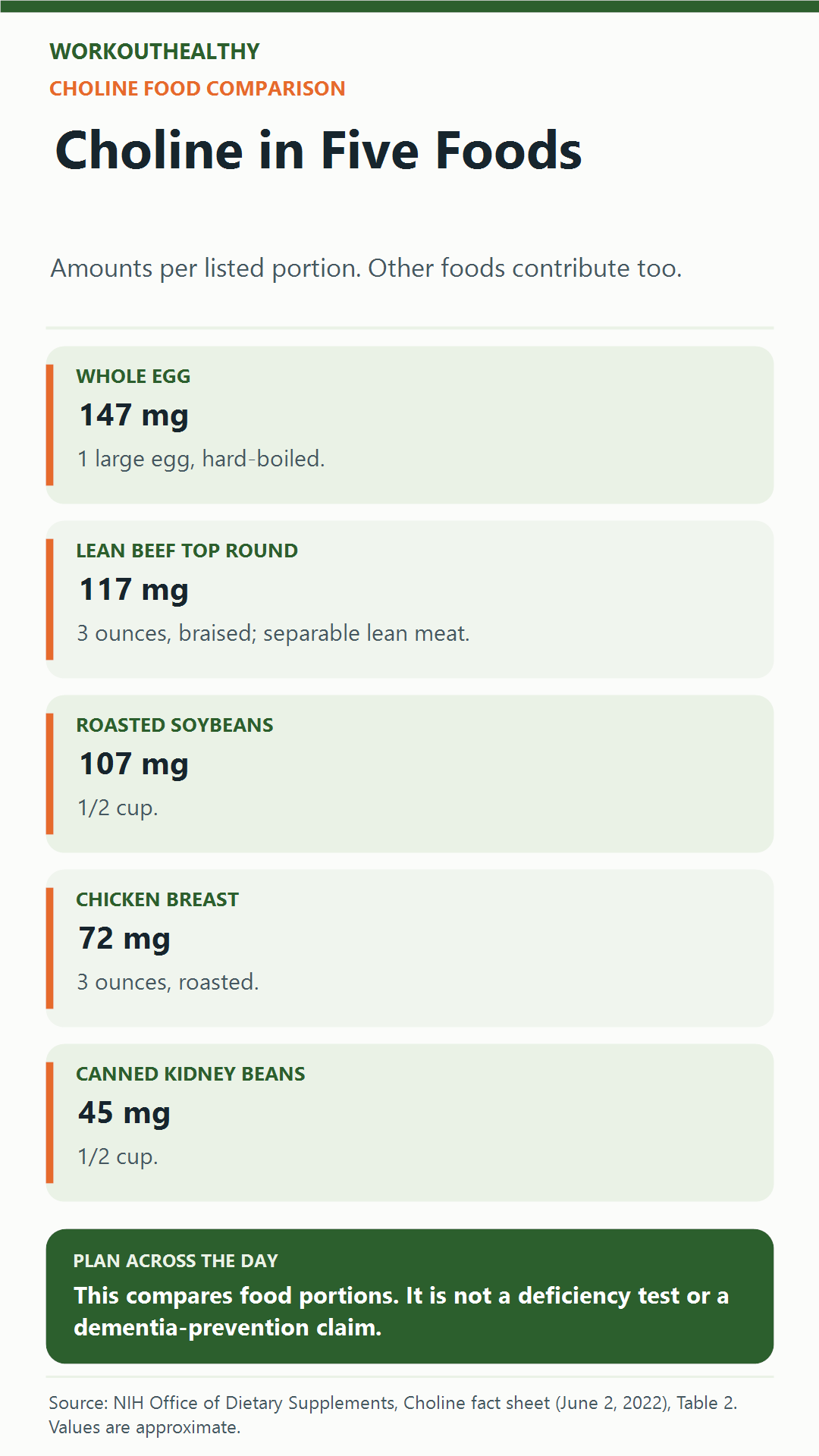
NIH’s food table provides these approximate examples (ODS, 2022):
- Large hard-boiled egg: 147 milligrams.
- Braised lean beef top round, three ounces: 117 milligrams.
- Roasted soybeans, half a cup: 107 milligrams.
- Roasted chicken breast, three ounces: 72 milligrams.
- Canned kidney beans, half a cup: 45 milligrams.
The exact serving and preparation matter when comparing those numbers. They are examples for planning, not interchangeable portions or a ranking of overall food quality.
Here is a simple food-review worksheet we use as an editorial framework. It is not a validated diagnostic tool:
- Record the pattern. Write down two or three typical days, including portions and drinks. A single unusually sparse or elaborate day may give a misleading impression.
- Mark the sources. Identify which meals actually include foods you are counting toward choline. Avoid assuming a food contributes a large amount without checking the serving.
- Review substitutions. If you repeatedly omit a usual source, decide what replaces it within your preferences and any clinical restrictions.
- Bring the record when needed. A dietitian can interpret the overall pattern and help with a practical gap. A food tally alone cannot diagnose deficiency.
One whole egg with extra whites, vegetables and toast is an illustrative breakfast option. It is not a complete-day choline plan, and the mouse study did not test it.
Likewise, choosing soybeans or beans does not require proving that they are superior to eggs. The purpose is to build a pattern you can repeat, rather than win a debate about one ingredient.
Our guide to breakfast protein after 60 offers another way to think about a morning meal within a broader eating and activity routine.
During pregnancy, review actual food and supplement labels with the obstetric team or a registered dietitian. Do not assume the name of a prenatal product tells you how much choline it contains.
Should you take a supplement?
A supplement should address an identified need. Neither the mouse experiment nor the human studies reviewed here establishes choline supplementation as a dementia-prevention treatment (Dave et al., 2023; Niu et al., 2025; Yamashita et al., 2023).
The adult upper limit is 3,500 milligrams daily from food and supplements. Excess can cause fishy body odor, vomiting, sweating, salivation, low blood pressure and liver toxicity (ODS, 2022).
An upper limit is not an intake goal. A product offering a large dose does not thereby offer a larger benefit.
If you are considering a supplement during pregnancy or while receiving care for a medical condition, discuss it with your clinician or dietitian. Take the food record and product label so the conversation concerns the actual intake and proposed change.
Buying a bottle is easy; defining why it belongs in the routine is the useful part. The evidence here does not support choosing a dose from a viral caption.
The bottom line
Egg yolks can contribute choline. The severe mouse-deprivation study shows biological consequences under its experimental conditions; it does not establish that an egg-white breakfast causes Alzheimer’s disease (Dave et al., 2023).
The human research remains limited for a prevention claim. Association in a large cohort and selective benefits in a small trial cannot justify promising protection from dementia (Niu et al., 2025; Yamashita et al., 2023).
Keep the yolk when it suits your preferences and medical context, or plan other sources when it does not. Review adequacy across the whole diet before turning one breakfast choice into a health scare.
Get the next evidence check.
Five practical fitness stories worth your time, every Friday.
One email a week. No product pitches. Unsubscribe in one click.
References
American Heart Association. (2019, December 16). Top things to know: Dietary cholesterol and cardiovascular risk. https://professional.heart.org/en/science-news/dietary-cholesterol-and-cardiovascular-risk/top-things-to-know
Carson, J. A. S., Lichtenstein, A. H., Anderson, C. A. M., Appel, L. J., Kris-Etherton, P. M., Meyer, K. A., Petersen, K., Polonsky, T., & Van Horn, L. (2020). Dietary cholesterol and cardiovascular risk: A science advisory from the American Heart Association. Circulation, 141(3), e39-e53. https://doi.org/10.1161/CIR.0000000000000743
Dave, N., Judd, J. M., Decker, A., Winslow, W., Sarette, P., Villarreal Espinosa, O., Tallino, S., Bartholomew, S. K., Bilal, A., Sandler, J., McDonough, I., Winstone, J. K., Blackwood, E. A., Glembotski, C., Karr, T., & Velazquez, R. (2023). Dietary choline intake is necessary to prevent systems-wide organ pathology and reduce Alzheimer’s disease hallmarks. Aging Cell, 22(2), Article e13775. https://doi.org/10.1111/acel.13775
National Institutes of Health Office of Dietary Supplements. (2022, June 2). Choline: Fact sheet for health professionals. https://ods.od.nih.gov/factsheets/Choline-HealthProfessional/
Niu, Y.-Y., Yan, H.-Y., Zhong, J.-F., Diao, Z.-Q., Li, J., Li, C.-P., Chen, L.-H., Huang, W.-Q., Xu, M., Xu, Z.-T., Liang, X.-F., Li, Z.-H., & Liu, D. (2025). Association of dietary choline intake with incidence of dementia, Alzheimer disease, and mild cognitive impairment: A large population-based prospective cohort study. The American Journal of Clinical Nutrition, 121(1), 5-13. https://doi.org/10.1016/j.ajcnut.2024.11.001
Yamashita, S., Kawada, N., Wang, W., Susaki, K., Takeda, Y., Kimura, M., Iwama, Y., Miura, Y., Sugano, M., & Matsuoka, R. (2023). Effects of egg yolk choline intake on cognitive functions and plasma choline levels in healthy middle-aged and older Japanese: A randomized double-blinded placebo-controlled parallel-group study. Lipids in Health and Disease, 22, Article 75. https://doi.org/10.1186/s12944-023-01844-w
Medical disclaimer: This article provides general fitness and nutrition information, not medical advice. If you have a medical condition, an injury or concerning symptoms, discuss suitable training, diet and supplement choices with a qualified healthcare professional before making changes.