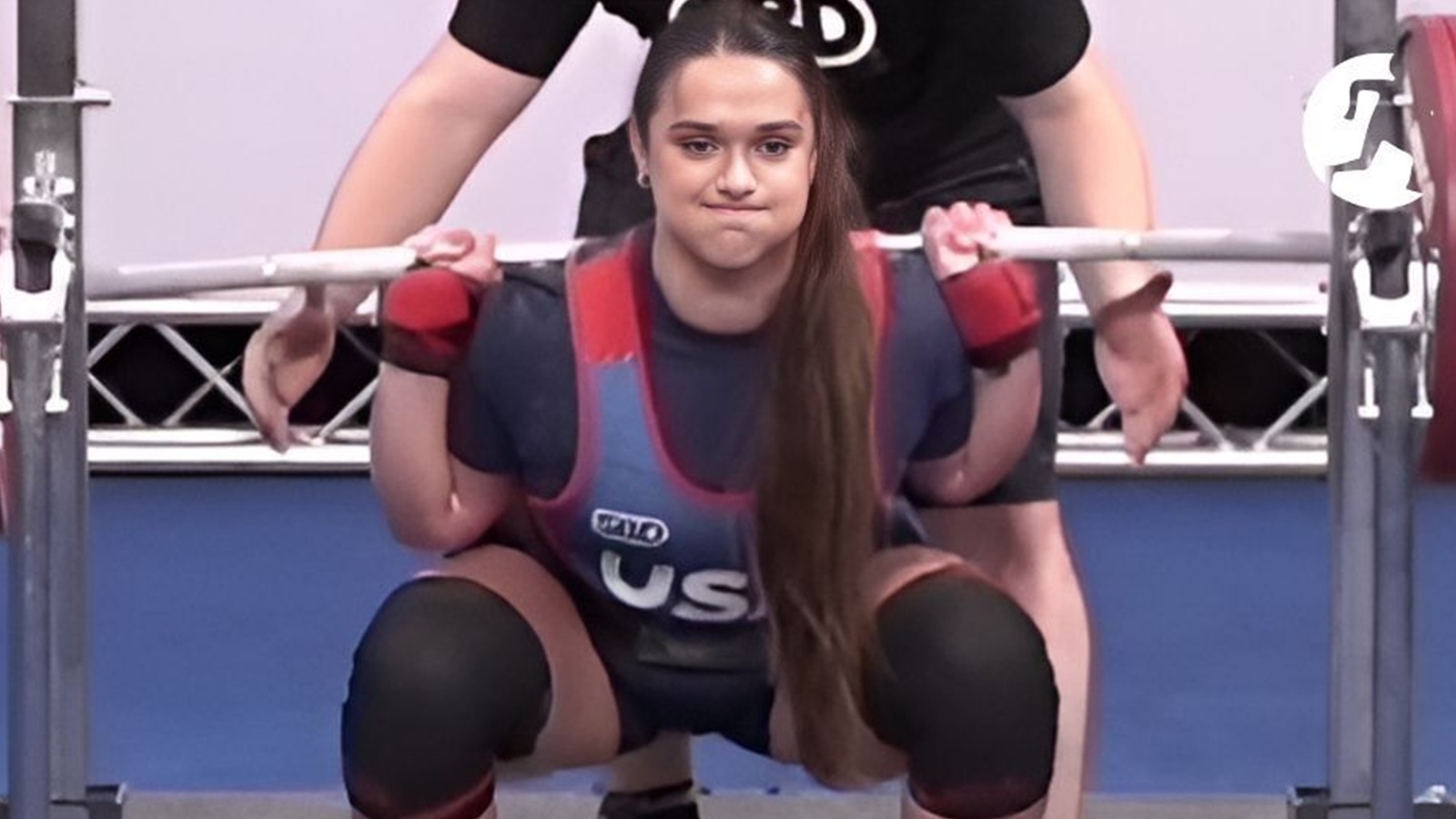
Amanda Lawrence squatted 250.5 kilograms and totaled 648 kilograms at the 2026 Sheffield Powerlifting Championships.
Both numbers were recognized as IPF world records in the women’s 84-kilogram class at the meet. Lawrence weighed 83.9 kilograms, benched 135, and deadlifted 262.5 to complete the total.
She did not win Sheffield. The official results place her seventh in the overall women’s standings. The viral caption combines genuine class records with a false overall victory.
Record Snapshot
| Athlete | Amanda Lawrence, United States |
|---|---|
| Meet | 2026 Sheffield Powerlifting Championships |
| Date and place | 31 January 2026, Sheffield, United Kingdom |
| Body weight | 83.9 kg, about 184.9 lb |
| Class context | 84 kg |
| Squat | 250.5 kg, about 552.3 lb |
| Bench press | 135 kg, about 297.6 lb |
| Deadlift | 262.5 kg, about 578.7 lb |
| Total | 648 kg, about 1,428.6 lb |
| Records set at the meet | 84 kg IPF squat and total |
| Overall placing | Seventh among women |
Watch Lawrence’s Full Sheffield Performance
The Official Result Confirms Every Best Lift
OpenIPF lists Lawrence at 83.9 kilograms with a 250.5-kilogram squat, 135-kilogram bench press, 262.5-kilogram deadlift, and 648-kilogram total. OpenPowerlifting shows the same attempt sequence and result.
That agreement matters because Sheffield video edits can emphasize successful lifts without displaying the full scorecard. The database supplies body weight, missed attempts, placing, and total in one record.
She Made All Three Squats
Lawrence opened the squat at 230 kilograms, moved to 242.5, and completed 250.5 on her third attempt. The final lift received the result needed to enter the IPF record line.
A successful three-attempt progression is not the same as making the weights look easy. It shows that her attempt selection preserved a legal total while creating room for a record on the final squat.
The 250.5-Kilogram Squat Was an IPF Record
Record reporting identified 250.5 kilograms as the women’s 84-kilogram IPF classic squat world record at Sheffield. A certificate database also lists the lift as confirmed on 31 January 2026.
Lawrence had squatted 256 kilograms in a USAPL meet in 2020, but federation and record-book context determine which performance counts as the IPF international mark. A personal best and a governing body’s record are not always the same number.
Bench Press Required a Repeat Attempt
Lawrence opened bench at 127.5 kilograms. She missed 135 on her second attempt, then returned to the same weight and completed it on her third.
Repeating the weight protected the total. Jumping higher after a miss would have added risk without first proving that the planned number was available. The decision gave her ten more kilograms over the opener and kept the record total within reach.
Her Second Deadlift Secured 648 Kilograms
Lawrence opened the deadlift at 240 kilograms and completed 262.5 on her second attempt. With the earlier 250.5 squat and 135 bench, that pull produced the final 648-kilogram total.
The total improved the 647-kilogram IPF mark she had established at Sheffield in 2024. One kilogram is enough to move a record when every lift passes under the applicable rules.
The 272.5-Kilogram Deadlift Did Not Count
Lawrence attempted 272.5 kilograms on her third deadlift and missed it. The bar moved, but an incomplete attempt does not add to a competition total.
The number would have taken her total to 658 kilograms and challenged the deadlift record as well. It remains an attempted weight, not part of the official result. A responsible recap separates ambition from accepted performance.
The 648-Kilogram Total Was the Second Record
Contemporary reports identify 648 kilograms as a new 84-kilogram IPF classic total record. Lawrence had owned the previous 647-kilogram mark, so the 2026 result advanced her own record.
This is why the performance can be historic without an overall win. Weight-class records compare an athlete with others in that division, while Sheffield’s final ranking compares athletes of many sizes through a scoring method.
Record language also depends on the governing organization. An IPF world record must be accepted under IPF rules at an eligible event. A heavier lift from another federation can remain an impressive all-time result without replacing the IPF mark. Naming the organization prevents those different lists from being blended into one imaginary leaderboard.
Lawrence Finished Seventh, Not First
The official Sheffield table lists Lawrence seventh among the women. Tiffany Chapon won, followed by Alba Boström and Sara Naldi in the top three.
The caption’s statement that Lawrence dominated the stage by winning is therefore false. Her record total translated to a lower cross-class score than six other performances. The standings and the 84-kilogram records can both be correct.
That distinction is central to Sheffield. An athlete can improve a class world record and still lose ground if another athlete exceeds a different class benchmark by a larger percentage. The event rewards record-relative performance, not the greatest number of records collected during the day.
How Sheffield Compares Different Weight Classes
A superheavyweight will usually total more absolute weight than a lighter athlete. Sheffield addresses that problem by comparing performance with the world-record standard for each athlete’s class.
The method rewards how far a lifter reaches beyond or approaches the class benchmark. It is not identical to simply ranking totals, DOTS scores, or medals at a normal weight-class championship. That special format explains why records do not guarantee first place.
Her Total Was About 7.72 Times Body Weight
Dividing 648 by 83.9 gives approximately 7.72. The ratio gives useful perspective on the amount of weight Lawrence moved across squat, bench, and deadlift.
It is not an official fourth lift or a new record category. Body-weight multiples are descriptive. The official claims remain the accepted lifts, the 84-kilogram class total, and the competition placing.
The Performance Was Seven for Nine
Lawrence completed all three squats, two of three bench presses, and two of three deadlifts. Seven successful attempts produced two records.
That is a useful reminder that elite competition does not demand perfection. A well-managed opener and second attempt can secure a total before a lifter uses later attempts to pursue records.
Her Career Is Bigger Than One Sheffield Placing
Lawrence’s public meet history begins in 2016 and shows repeated national and international wins. She had already accumulated multiple world championship titles before the 2026 event.
Calling seventh place a failure would ignore the event’s unusually strong invited field and the records she set. Calling it a win would ignore the actual ranking. The accurate middle is more interesting: a champion advanced her class records and still finished outside the top six.
Consistency Is Not Literally Showing Up Every Day
The caption turns the performance into a lesson about training every single day. Lawrence’s career supports years of consistent practice, but it does not prove that daily heavy lifting is the secret.
Strength programs alternate stress and recovery. Training days, lighter sessions, and rest all contribute to adaptation. Consistency means following an appropriate plan over time, not refusing every day off.
What Lifters Can Copy From the Attempt Card
The useful model is strategic rather than numerical. Choose an opener that is highly likely to pass, use the second attempt to build the total, and make the third attempt fit the day’s evidence.
Lawrence also showed the value of repeating a missed weight. Our guide to low reps and high reps for strength explains why heavy attempts work best when supported by broader training volume.
Most lifters should spend more time practicing submaximal repetitions than testing limits. Technical consistency under manageable load creates the confidence to select sensible attempts when competition day arrives.
A competition plan should also include responses to misses. Lawrence’s bench sequence shows one option: keep the same weight, review the technical error, and try again. That decision is often more valuable than making an emotional jump that risks losing kilograms already needed for the total.
Do Not Turn a Record Into a Weekly Target
Maximal lifts are snapshots of readiness after a planned training cycle. They are not an appropriate default for every gym visit.
Steve Shaw’s PR-Zero rule offers a practical alternative to constant testing. A lifter can build strength through good repetitions, progressive loading, and recovery without forcing a personal record on demand.
Verified Sources
- OpenIPF Sheffield 2026 results
- Amanda Lawrence competition history
- Contemporary record report and attempt list
- Confirmed squat record certificate listing
- Powerlifting America Sheffield video
The Bottom Line
Amanda Lawrence’s Sheffield performance was genuine and record setting. She weighed 83.9 kilograms, squatted 250.5, benched 135, deadlifted 262.5, and totaled 648 kilograms.
The squat and total entered the 84-kilogram IPF record book, but Lawrence placed seventh overall. That distinction does not weaken the achievement. It simply tells the complete story of a class-record day inside an unusually competitive cross-class event.
Get the next evidence check.
Five practical fitness stories worth your time, every Friday.
One email a week. No product pitches. Unsubscribe in one click.
Medical disclaimer: This article is for general information only and is not medical advice. If you have an injury, ongoing pain, or a medical condition, talk to a doctor or physical therapist before you change how you train or eat.