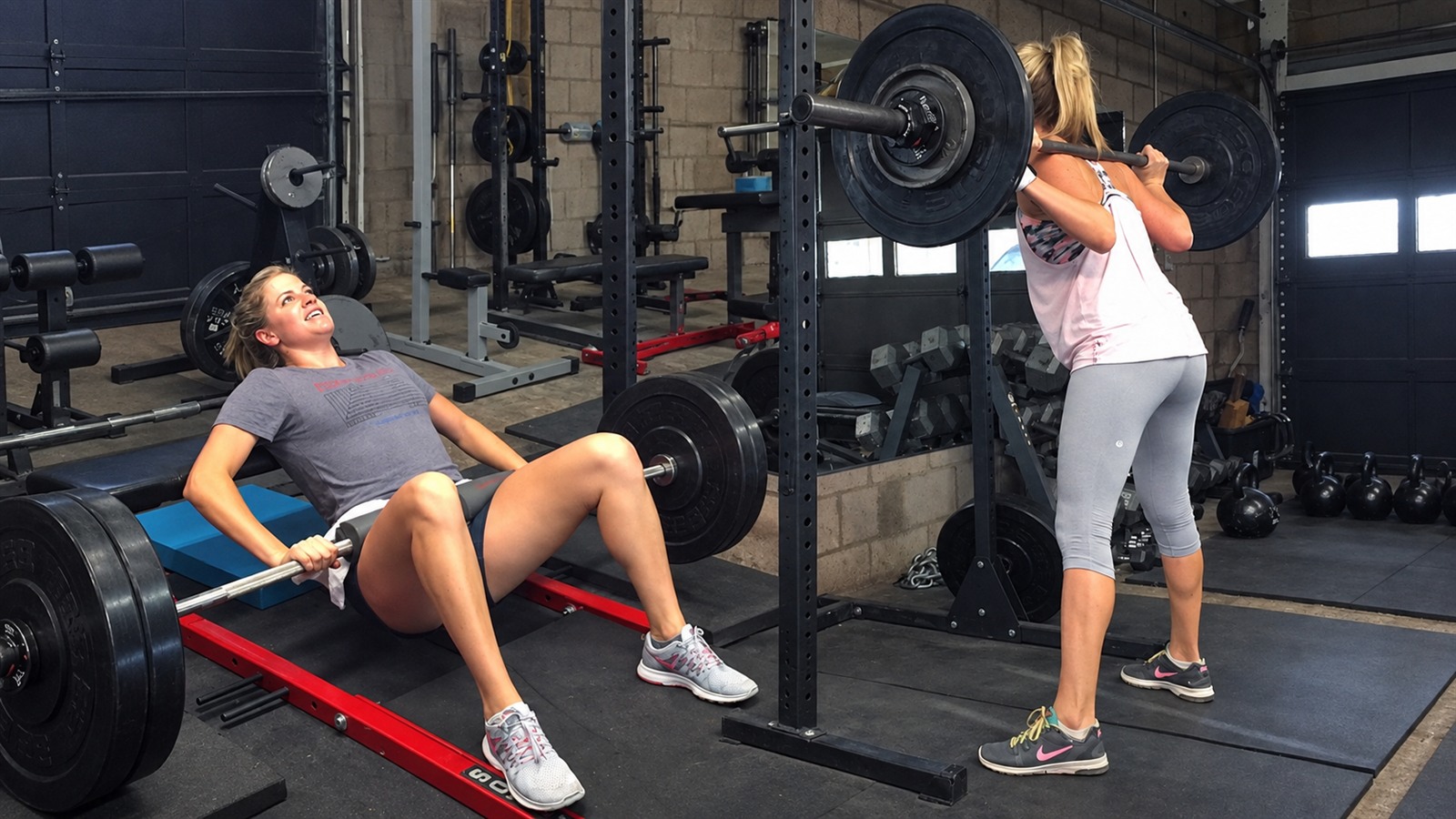

Two identical twins spent six weeks training their lower bodies three days a week.
One practiced back squats. The other practiced barbell hip thrusts. Their coach, Bret Contreras, measured strength, horizontal pushing force, and upper and lower glute muscle thickness before and after.
The results became an eye-catching comparison: both exercises worked, with the hip-thrust twin showing somewhat larger measured glute gains. But a pair of people is not enough to declare one lift universally superior.
Here is what happened, why the percentages in the original blog differ from the later thesis abstract, and how to use the experiment without treating it as a training guarantee.
How the six-week experiment worked
Contreras trained identical twin sisters who had exercised for years but had not previously followed progressive squat or hip-thrust programs.
One twin performed parallel back squats for the lower body; the other performed barbell hip thrusts. Each attended 18 sessions over six weeks.
The weekly plan used a medium day of four sets of 10 at roughly 75 percent of one-repetition maximum, a heavier day of five sets of six near 85 percent, and a lighter day of three sets of 15 near 65 percent.
The final set could continue for additional repetitions when possible. Both also performed comparable upper-body and abdominal work, with loads progressing week by week.
They were instructed to follow similar calorie and macronutrient plans, and their body weights changed little. Those details help interpret the comparison, but they do not make two separate people perfectly matched experimental units.
Even identical twins can differ in training history, technique, effort, recovery, and their response to a particular exercise. Neither was randomly assigned from a large group, and neither performed both programs in a crossover design.
That makes this a revealing small experiment, not a decisive trial of what everyone should do.
What happened to glute thickness
Contreras measured upper and lower gluteus maximus thickness with ultrasound. Thickness is one useful indicator of local muscle growth, though it is not the same thing as total muscle mass or a photograph of body shape.
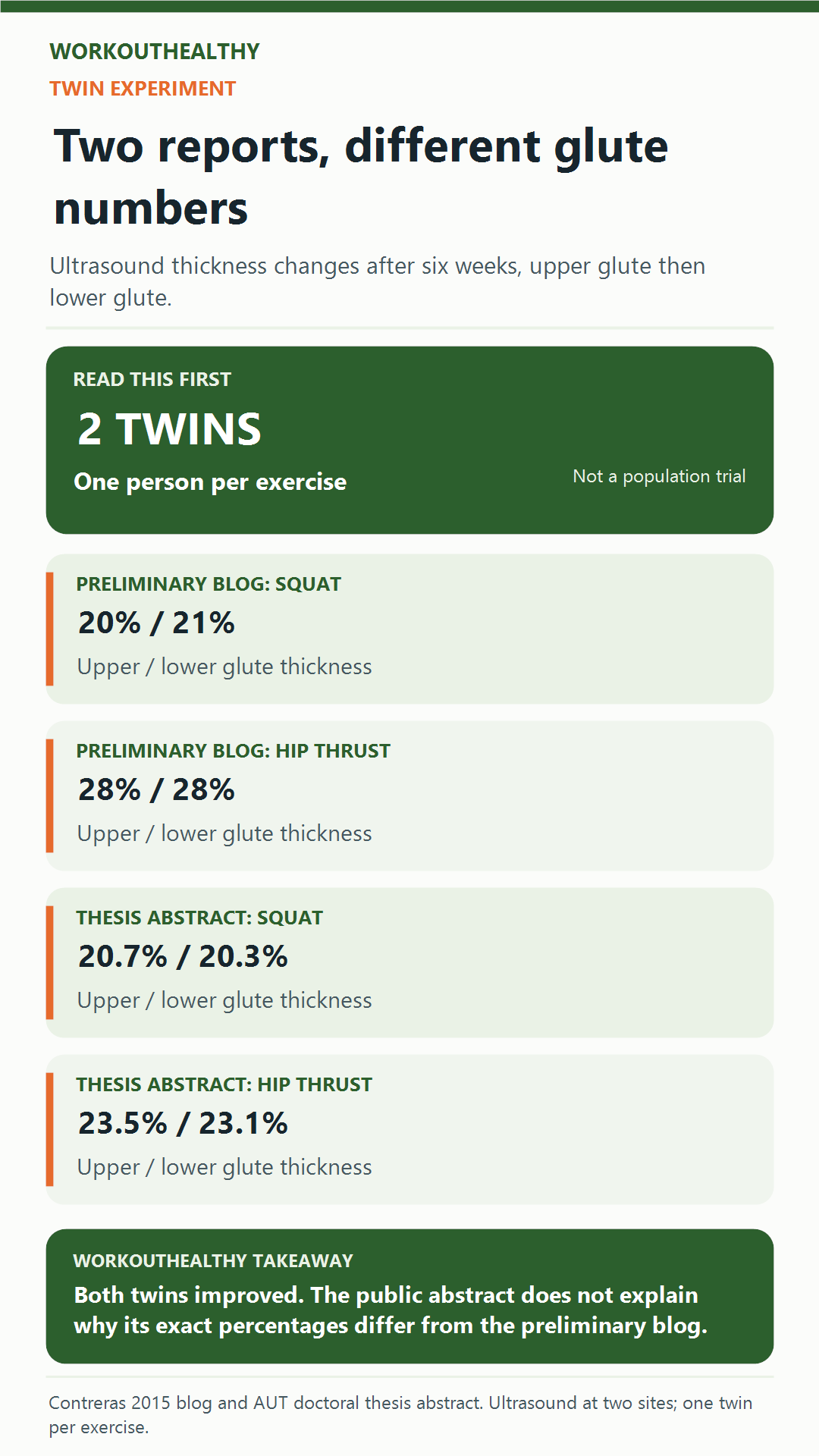
In the 2015 preliminary blog report, the squat twin’s upper and lower measurements rose by about 20 and 21 percent. The hip-thrust twin’s two measurements were described as rising by about 28 percent each.
Those are the figures quoted in the accompanying Facebook post. They reflect what Contreras published at that stage of the project.
Both twins therefore improved during a short period of consistent, progressive training. The direction of the difference favored the hip thrust for the particular glute measurements reported here.
It would be a mistake to convert those within-person changes into a promise that a reader will gain 20 or 28 percent glute size in six weeks. The twins had a specific background and a coached, tightly structured plan.
Ultrasound thickness at two locations also cannot tell us everything about glute shape, leg-muscle growth, or long-term results beyond six weeks.
The useful result is not that one lift won forever. It is that both twins got stronger and both grew measurable glute thickness.
Why the reported percentages differ
The later doctoral-thesis abstract reports a different set of exact percentages for the same single-subject twin study.
It lists upper-glute thickness changes of 20.7 percent for the squat twin and 23.5 percent for the hip-thrust twin. For lower glutes, it gives 20.3 and 23.1 percent, respectively.
The thesis still reports increases with both lifts and a small advantage for the hip-thrust twin in those measured sites. But its 23-percent figures are not the 28-percent preliminary figures in the original blog.
The public abstract does not explain the full reason for that numerical change. It may reflect a later analysis or reporting revision, but that is an inference, not a fact we can establish from the abstract alone.
For that reason, we present both sets with their provenance rather than silently treating the earlier blog figures as final. Readers using the social post should know the 28-percent values came from Contreras’s preliminary report.
Neither set permits a meaningful population-level ranking from only two participants. A few percentage points between twins can be interesting, but it cannot substitute for a larger controlled study.
Strength and horizontal-force results
The squat twin increased her one-repetition back squat from 95 to 155 pounds. Her hip thrust also rose, from 225 to 265 pounds, despite not practicing it as her main lower-body lift.
The hip-thrust twin increased her squat from 95 to 135 pounds. Her hip thrust rose from 195 to 315 pounds.
These results illustrate specificity: the person practicing squats improved her squat more, while the person practicing hip thrusts improved her hip thrust much more.
They also show carryover in both directions. Training the hips and legs through one movement can improve another movement, especially when neither had been trained progressively in that way before.
Contreras additionally tested maximum horizontal pushing force using a force plate and a wall push. His preliminary report described an increase from 309 to 370 newtons for the squat twin and from 320 to 422 newtons for the hip-thrust twin.
Those changes correspond to roughly 20 and 32 percent, respectively, matching the social post’s summary. This is a specific laboratory-style push test, not a direct measurement of sprint speed or sports performance.
Although a hip thrust loads the hips differently from a squat, force direction alone does not determine transfer to every sport. Technique, speed, range of motion, and an athlete’s existing training all matter.
What the experiment cannot prove
One twin per condition means there is no way to estimate how much ordinary individual variation shaped the observed difference. The word “identical” does not solve that statistical problem.
The two programs also differed in how much total weight was moved and how long each set lasted. In the preliminary report, squat repetitions produced much more total time under tension, while hip thrusts accumulated a much greater volume load.
That means the comparison is not a perfectly isolated test of exercise name alone. It compares two real training approaches with several simultaneous differences.
The study did not establish that every person will grow more glute muscle from hip thrusts, that squats are inferior for total leg development, or that one lift replaces the other.
It did not measure quadriceps growth in the twins. Its horizontal-force test also should not be described as proof that hip thrusts always improve sprinting more than squats.
Six weeks is long enough to see changes in this pair, but not long enough to know which strategy performs better after months or years of training.
Contreras himself called for an adequately powered randomized trial. That caution belongs alongside the striking figures, not hidden at the bottom of the story.
What later research adds
Contreras’s doctoral thesis examined more than this twin pair. Other chapters compared muscle activation, force characteristics, and training outcomes in different groups.
For example, a separate randomized training comparison in adolescent male athletes examined hip thrusts against front squats. It reported different patterns of improvement across sprint, jump, and strength tests.
That work is not a replication of the twin experiment. The participants, exercises, and measured outcomes were different, so its results should not be pasted onto the twins’ glute-growth percentages.
A muscle-activation reading during a repetition is also not the same as a long-term hypertrophy result. Higher electrical activity can suggest a muscle is working hard, but growth depends on training over time.
The broader conclusion is more modest and more useful: squat and hip-thrust patterns both have evidence for improving strength, while their different mechanics may favor different tasks or muscle regions.
For everyday training, combining movements can cover more bases than chasing a single winner. Our full-body dumbbell routine analysis explains the same principle in a practical session.
How to choose and combine the lifts
Choose a squat variation when your main goal is to get better at squatting, rising from a chair, or loading the knees and hips together through a controlled range.
Choose a hip-thrust or bridge variation when you want a direct hip-extension exercise that can be progressed without performing another squat set. It can be useful alongside, not instead of, a broader lower-body plan.
If both movements are comfortable, start with the one most important to your goal while you are fresh. Then use the second for a smaller amount of accessory work.
A person learning squat technique might begin with a bodyweight box squat and a light floor bridge. Someone already competent with both can add resistance gradually.
The surface supporting the upper back during a hip thrust should be stable. Keep the ribs from flaring and finish by extending the hips rather than arching the lower back.
For squats, use a stance and depth you can control without sharp pain. Allow the knees to travel naturally while keeping the feet planted and the movement balanced.
Both lifts are tools. The best version is one you can perform consistently, recover from, and progress with sound form.
For a broader view of how lower-body strength supports daily function, see our discussion of seven movement patterns for independence after 50.
A practical six-week starting plan
The twins’ program is a research example, not a prescription to copy its heavy percentages or all-out final sets. Beginners can start with two nonconsecutive lower-body sessions a week.
After a short warm-up, practice two or three sets of six to 10 controlled squats or sit-to-stands. Follow with two or three sets of eight to 12 bridges or hip thrusts.
Choose a version that leaves roughly two or three good repetitions in reserve. That gives you room to learn the movement without turning every set into a test.
Over the first two weeks, prioritize a comfortable range of motion and repeatable technique. Add a little resistance only when the same repetitions feel controlled across all sets.
In weeks three and four, progress one variable at a time: perhaps a small amount of load, one or two repetitions, or an additional set. Keep the rest of the program stable enough to notice how you respond.
In weeks five and six, reassess your technique and useful outcomes, such as the load you can control or how confidently you stand and climb. Do not judge success only from a tape measure or a single photograph.
Sharp joint pain, unusual back pain, or symptoms that persist after the session warrant stopping and getting individualized guidance. People recovering from injury should ask a clinician or physical therapist which variations fit their situation.
The sensible takeaway from the twins is not a magic exercise or a magic number. It is the value of progressive training, specific goals, and honest interpretation of a very small experiment.
Train for the movement you want to improve, and judge progress over months. Two twins cannot hand everyone the same winner.
Want more like this? Subscribe to WorkoutHealthy Insider for practical explanations behind popular fitness claims.
References
Contreras, B. (2015, August 10). Squats versus hip thrusts part II: The twin experiment. Bret Contreras. https://bretcontreras.com/squats-versus-hip-thrusts-part-ii-the-twin-experiment/
Contreras, B. (2015). Kinematics, kinetics, and electromyography of vertical and horizontal hip extension exercises and their transference to acceleration and power [Doctoral thesis, Auckland University of Technology]. AUT open repository.
This article is for general information only and is not medical advice. If you have an injury, ongoing pain, or a medical condition, talk to a doctor or physical therapist before you change how you train or eat.