Arthur Jones did not merely build exercise machines. He built an argument. In the 1970s, the Nautilus founder told lifters that training could be brief, controlled, brutally focused, and productive. Instead of spending hours collecting set after set, he favored a small number of exercises performed with strict form and high effort.
That message still has enormous appeal. It promises that a busy person can train hard, recover, and improve without living in the gym. But modern research gives the original idea a more useful shape: one hard set can work, while more weekly volume often produces greater muscle growth. Training to failure can be a tool, but it is not a requirement for every set.
Jones’s Big Idea Was Efficiency, Not Ease
Jones challenged the idea that progress required marathon workouts. His early Nautilus bulletins argued for brief sessions, a limited number of exercises, controlled repetitions, and enough effort to make those exercises count. The work was short because it was demanding, not because it was casual.
That distinction matters. A one-set program is not automatically efficient. If the resistance is too light, the range of motion is shortened, or the set ends long before it becomes challenging, the low volume may simply be too little training. The method depends on concentration, honest effort, and a progression plan.
The durable lesson: You do not need a crowded workout. You need a small number of movements performed well, tracked over time, and supported by recovery.
Jones was also writing in a particular historical setting. Bodybuilding culture often rewarded long, high-volume routines copied from advanced athletes. His system offered a useful correction: start by proving that the minimum effective dose has stopped working before adding more.
What One Hard Set Can Actually Do
One challenging working set per exercise can improve strength and build muscle, especially for beginners, people returning after a layoff, and anyone whose current routine is inconsistent. A concise session is easier to repeat, and consistency is a powerful advantage.
The important phrase is working set. Warm-up sets prepare the joints and nervous system; they are not counted the same way. The working set should use a load that makes the final repetitions meaningfully difficult while form remains stable. Depending on the exercise and the lifter, that might mean stopping with one to three good repetitions still available.
This approach also makes progression easy to see. Record the load, repetitions, and technique standard after each session. When you reach the top of your target repetition range with clean form, add a small amount of resistance next time. Our guide to keeping a useful training log explains the few numbers worth tracking.
Where More Volume Often Wins
The strongest challenge to a universal one-set prescription comes from research on training volume. James Krieger’s 2010 meta-analysis reported that multiple sets were associated with greater hypertrophy than a single set. Newer reviews generally support a dose-response relationship, although returns diminish and the ideal dose varies by person, muscle group, and training age.
This does not mean every exercise needs four or five sets. It means that one set can be productive without being the maximum-growth dose. If two people train with similar effort and technique, the person doing several recoverable sets across the week will often have more opportunity to stimulate growth.
The practical answer is to earn volume. Begin with one or two hard sets per exercise. Add a set only when progress stalls, recovery is good, and the extra work does not degrade technique. Volume is useful when you can adapt to it. Volume that wrecks the next session is just fatigue.
The Training to Failure Question
Jones is closely associated with taking sets to momentary muscular failure, the point at which another full repetition cannot be completed with proper form. Modern evidence suggests that failure is not necessary for strength or muscle gain when sets are otherwise challenging.
A 2022 meta-analysis by Jozo Grgic and colleagues reviewed 15 studies and found no significant overall advantage for failure training over non-failure training for strength or hypertrophy. When total work was not matched, some subgroup results favored non-failure training for strength. The sensible interpretation is not that failure is useless. It is that failure is optional.
For machines and low-risk isolation exercises, an occasional failure set can help calibrate effort. On heavy squats, deadlifts, presses, or movements where technique can break suddenly, stopping one or two repetitions short is often the better trade. You can learn to judge effort without turning every set into a test.
Use failure strategically: Safer exercises, final sets, and occasional effort checks are better places for it than every compound lift in every workout.
Machines, Control, and Exercise Quality
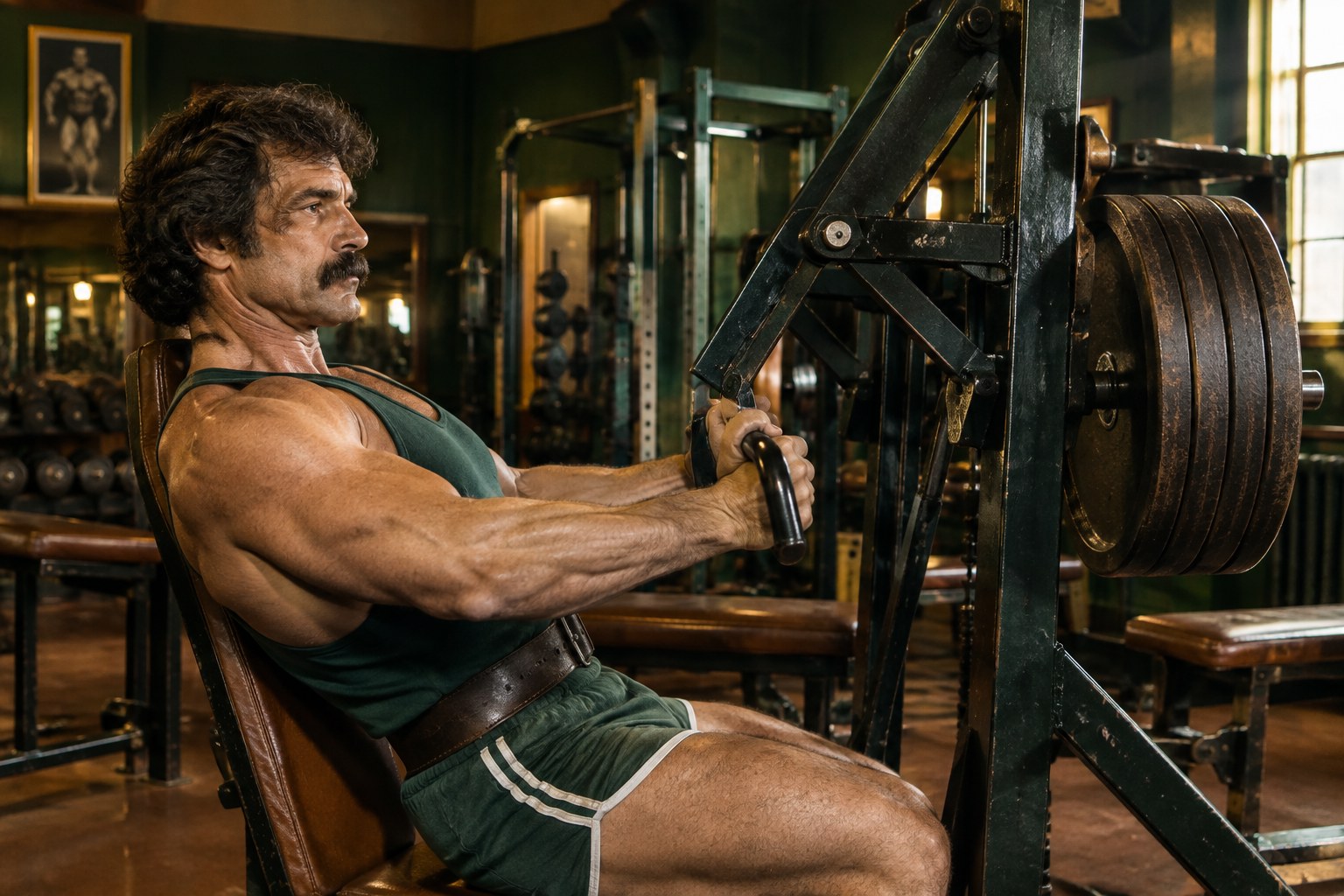
Nautilus machines were central to Jones’s system because they made exercises easier to standardize. The machine guided the path, reduced balance demands, and let a trainee focus on producing force through a controlled range of motion. That can be useful for beginners, older adults, and anyone training around a limitation.
Machines are not inherently superior to free weights, and free weights are not inherently more functional. The best choice is the one that trains the target movement safely, can be progressed, and fits the person. A leg press, chest press, row, pulldown, and leg curl can form a complete machine-based session. Squats, presses, rows, and hinges can do the same with free weights.
Jones’s emphasis on controlled repetitions still holds up. Slowing a repetition is not magic, but control makes the exercise repeatable. If every rep changes depth, tempo, or body position, the training log becomes difficult to interpret.
Recovery Is Part of the Dose
High effort creates fatigue as well as stimulus. Jones often promoted infrequent training because he believed recovery was commonly underestimated. The modern view is more flexible: frequency is mostly a way to distribute weekly work. Two or three full-body sessions can all work if the total workload is appropriate.
Watch performance rather than guessing. If repetitions or loads trend upward, soreness resolves, sleep is normal, and motivation is stable, recovery is probably adequate. If performance declines across several sessions, joints ache, and enthusiasm disappears, reduce volume or effort before adding more.
Age does not eliminate the ability to gain strength, but it can change the recovery budget. This is one reason a low-volume starting point is useful. It gives you room to add work based on results instead of beginning with more than you can sustain. Even short strength efforts can be valuable, much like the simple lower-body approach discussed in our article on whether a one-minute wall sit can improve health.
A Practical Jones Inspired Plan
Use this full-body template two or three nonconsecutive days per week. Perform warm-up sets as needed, then one challenging working set for each movement. Choose a load that allows roughly 6 to 12 controlled repetitions for most exercises and stop with one or two repetitions in reserve.
- Leg press or squat: one working set
- Chest press or push-up: one working set
- Row: one working set
- Hip hinge or leg curl: one working set
- Overhead press: one working set
- Pulldown or assisted pull-up: one working set
- Calf raise or loaded carry: one working set
Keep the same exercise menu for six to eight weeks. Add repetitions before load, and add load in small steps. If a muscle group stops progressing for two or three weeks while sleep and nutrition are solid, add a second set for that movement. That single change turns the philosophy into an adjustable system instead of a rigid rule.
Who Benefits Most From Low-Volume Training
A Jones inspired routine is especially useful for beginners, busy adults, people returning after time away, and lifters who have accumulated more fatigue than progress. It is also a strong fallback plan during travel or a stressful season.
More advanced bodybuilders may need more weekly sets to keep growing because they have adapted to lower doses. Competitive strength athletes also need practice with their specific lifts, which can require more sets than a general fitness plan. The one-set idea remains valuable as a baseline, but the sport decides the final prescription.
Health benefits do not require a bodybuilding volume. Regular resistance training supports function and may also benefit the brain. Our review of whether lifting weights can help keep the brain younger covers that broader case.
The Bottom Line
Arthur Jones was right that productive training can be brief, focused, and measurable. One hard set per exercise can produce real results, and it is often a better starting point than an ambitious routine that gets abandoned.
Research adds an important qualifier. One set is not always the best dose for maximum muscle growth. Multiple sets often provide an advantage when they are recoverable, and training to failure is not required. Start with the smallest program that works, measure performance, then add only what the evidence from your own training supports.
References
- Jones A. Nautilus Bulletin No. 1. Arthur Jones Exercise.
- Arthur Jones Collection. Biographical and historical materials.
- Krieger JW. Single vs. multiple sets of resistance exercise for muscle hypertrophy: a meta-analysis. Journal of Strength and Conditioning Research. 2010;24(4):1150-1159. doi:10.1519/JSC.0b013e3181d4d436.
- Grgic J, Schoenfeld BJ, Orazem J, Sabol F. Effects of resistance training performed to repetition failure or non-failure on muscular strength and hypertrophy: a systematic review and meta-analysis. Journal of Sport and Health Science. 2022;11(2):202-211. doi:10.1016/j.jshs.2021.01.007.
- Currier BS, et al. Resistance training prescription for muscle strength and hypertrophy in healthy adults: a systematic review and Bayesian network meta-analysis. British Journal of Sports Medicine. 2023.
This article is for educational purposes only and is not medical advice. If you have an injury, medical condition, or symptoms during exercise, consult a qualified healthcare professional before changing your training.