
Foot exercises for balance can include toe spreading, towel curls, heel raises and controlled sideways steps. These practice different skills: moving the toes, working the ankle and calf, and controlling your body while stepping.
The four-movement card below gives an independently exercising adult a concrete starting example, followed by an evidence table. It is not a treatment for unexplained imbalance, and stronger feet do not automatically mean fewer falls.
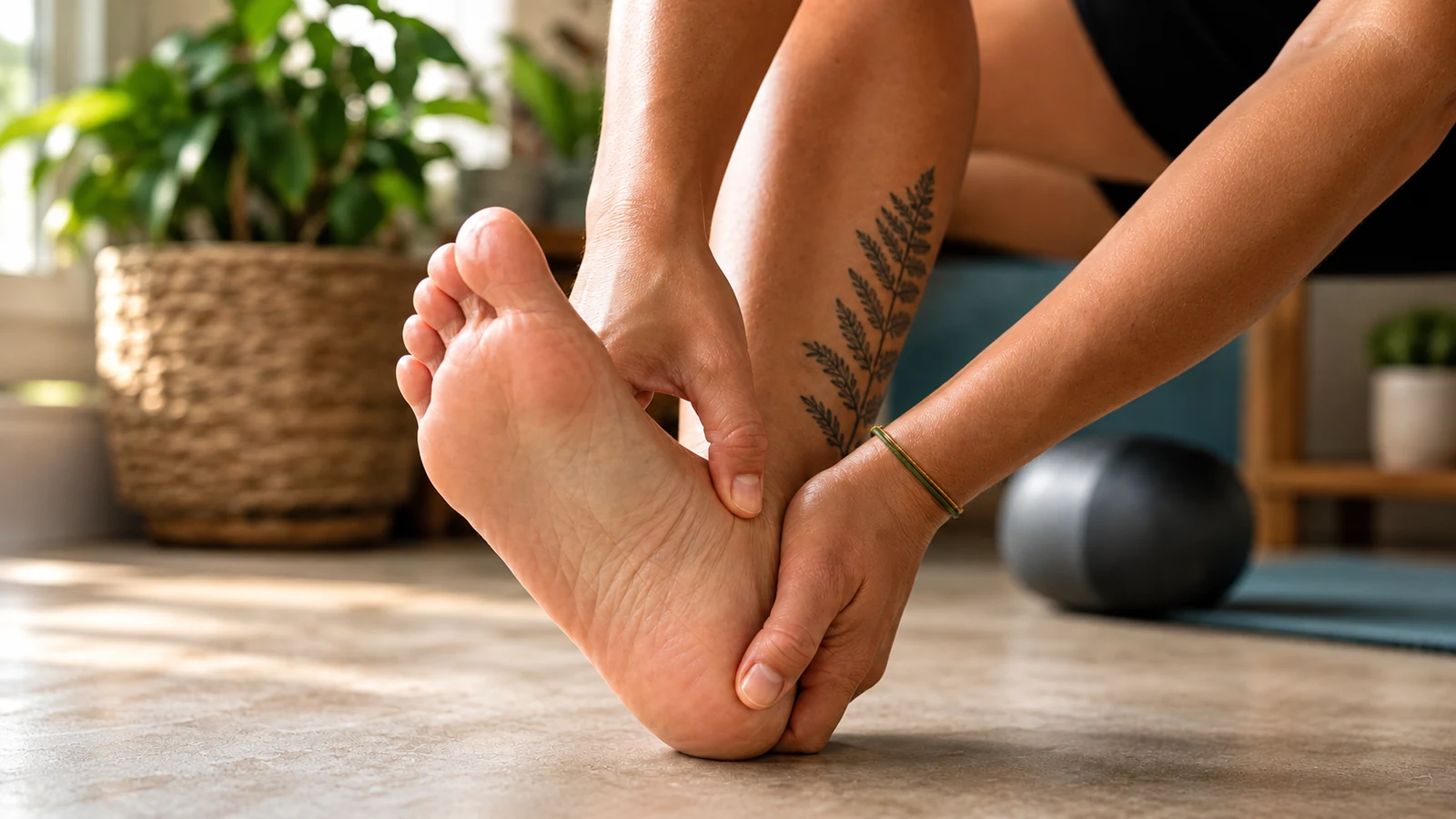
The opening image illustrates pressure applied to a seated person’s foot. That is the claim this article examines, not a demonstration of the exercises or evidence that arch pressure restores balance.
Choose support before choosing a harder exercise
Use a stable chair for the seated movements and a clear, nonslip area beside a fixed counter for standing work. Keep your eyes open and use support from the start rather than planning to catch yourself after losing balance.
The seated toe exercises assume healthy skin and intact sensation. If you have numbness, an ulcer, foot pain, a recent fall or new balance trouble, get personal advice before removing protective footwear or trying to make standing tasks harder.
There is no barefoot requirement for the standing movements. The Kent Community Health NHS foot-care guide explains why reduced sensation can allow an injury to go unnoticed and advises people with diabetes against walking barefoot.
Four foot exercises for balance practice
1. Seated toe spreading
- Sit upright with both feet resting on the floor.
- Spread your toes as comfortably as you can without forcing them.
- Relax, then repeat, working one foot at a time if that is easier to coordinate.
Cone Health’s original foot-exercise instructions include toe spreading and towel curls. Spreading the toes practices voluntary movement; performing it while seated is not itself a standing-balance task.
2. Towel curls
- Remain seated and place a small towel flat beneath the front of one foot.
- Use the toes to gather a little of the towel toward you, then release.
- Repeat with the other foot, without forcing a cramp or adding a weight to the towel.
Keep the towel clear of the standing area when you finish. The point is a controlled toe movement, not gripping as hard as possible or proving that an arch has been corrected.
3. Supported heel raises
- Stand upright with both feet planted and your hands on fixed support.
- Lift the heels smoothly while staying upright.
- Lower them under control, keeping your support rather than turning the set into a balance test.
The NHS strength page illustrates the supported calf raise. This works the calf and ankle movement, so it belongs in a broader foot-and-ankle plan rather than being described as an isolated arch exercise.
4. Small sideways steps
- Stand beside fixed support with enough clear space for a small step each way.
- Move one foot sideways, then bring the other foot toward it without crossing the feet.
- Reverse direction slowly, staying close enough to keep your support.
See the NHS sideways-walking illustrations for the basic step sequence. Crossing the feet, closing the eyes or narrowing into a tightrope stance are different challenges and are not part of this card.
A small practice card you can repeat
Start with one pass through the movements that fit your ability, pausing between them as needed. The numbers below are modest editorial examples to make a session recordable, not a research-tested dose or a fall-risk screening test.
| Movement | Example first pass | Record |
|---|---|---|
| Toe spreading | Five comfortable spread-and-relax repetitions | Each foot’s movement and any difficulty coordinating it |
| Towel curls | Five small gathers per foot | Completed repetitions, without extra resistance |
| Supported heel raise | Five controlled raises and lowers | Repetitions and the hand support used |
| Sideways steps | Up to five small steps in each direction, using a clear supported route | Actual steps and support, not just a completed-round tick |
Stop a movement if it causes pain, dizziness or feeling that you might fall. Completing only the seated part is a partial session, not evidence that the standing exercises are appropriate for you.
Repeat the same setup before deciding whether to add a repetition. You do not have to remove a hand, close your eyes or add an unstable surface to make the practice worthwhile.
Foot strength, standing balance, walking and falls are different outcomes
2025 systematic review by Liang and colleagues covered 16 papers involving 651 older adults.
| Question | What the research found | Limit |
|---|---|---|
| Can ankle and foot training change strength? | The review found an improvement in ankle plantarflexion strength | Varied training programs do not validate this exact four-movement card |
| Does standing balance improve? | Pooled eyes-open measures improved; eyes-closed results were not significant | Evidence quality was low or very low, depending on the outcome |
| Will walking become faster? | The review found no significant pooled gait-speed effect | A stronger foot or better standing score is not proof of faster walking |
| Are there fewer falls? | Two small studies reported no significant findings for the fall-related outcomes they assessed | Evidence is insufficient for promising fewer falls from a foot-only routine |
A separate Willemse trial involved 33 adults over 65 already attending functional exercise classes. It compared a supervised, progressive 12-week foot-muscle program with control, rather than testing a few unsupervised toe curls.
Maximum walking speed did not improve more than control, while concern about falling declined more in the training group. Foot-muscle capacity and strength increased within that group, but those changes were not linked to the other findings.
These findings do not establish a treatment for every balance problem. Seek individual guidance for falls or medical conditions.
Does pressing into the arch improve balance?
Neither training study tested thumb pressure, rubbing the sole or ball rolling. Their findings cannot validate those practices as balance treatments.
Feeling a different sensation in the foot is also a different outcome from standing more steadily, walking better or falling less often. More pressure is not a logical progression from a stronger sensation, especially when pain or reduced sensation is present.
- Skin and sensation: Do you need foot-care advice before trying a new drill?
- Comfort: Can you perform the movement without forcing pain or cramp?
- Support: Is the chair or counter stable, and are you using it before you feel unsteady?
- Actual task: Are you recording the movement performed, rather than treating a feeling in the arch as proof of better balance?
These are practical questions, not a diagnostic test or a clearance checklist. You do not need an arch-pressure exercise to use the movement card.
Keep the task the same when comparing sessions
Use this record: date / movement / footwear and support / repetitions or steps / comfort and control / next choice. A heel raise with two hands supported is different from an unsupported raise, even when both have the same repetition count.
Keep support and footwear consistent while comparing, and write down any change instead of counting it as automatic progress. A steadier supported movement is useful information even if the number of repetitions stays the same.
The CDC falls-prevention guidance also addresses wider risks, strength and balance activity, and professional assessment. Foot exercises can be a component of a plan; they do not replace investigating why balance or walking has changed.
If a foot problem or a recent fall changes how you walk, seek an appropriate clinician or podiatrist rather than waiting to finish a self-directed program. For general practice, prioritize a clear setup, controlled movement and an honest record over a more difficult stance.
Medical disclaimer: This article is general fitness information, not medical advice. If you have an injury, ongoing pain or a medical condition, talk to a doctor or physical therapist before changing how you train.