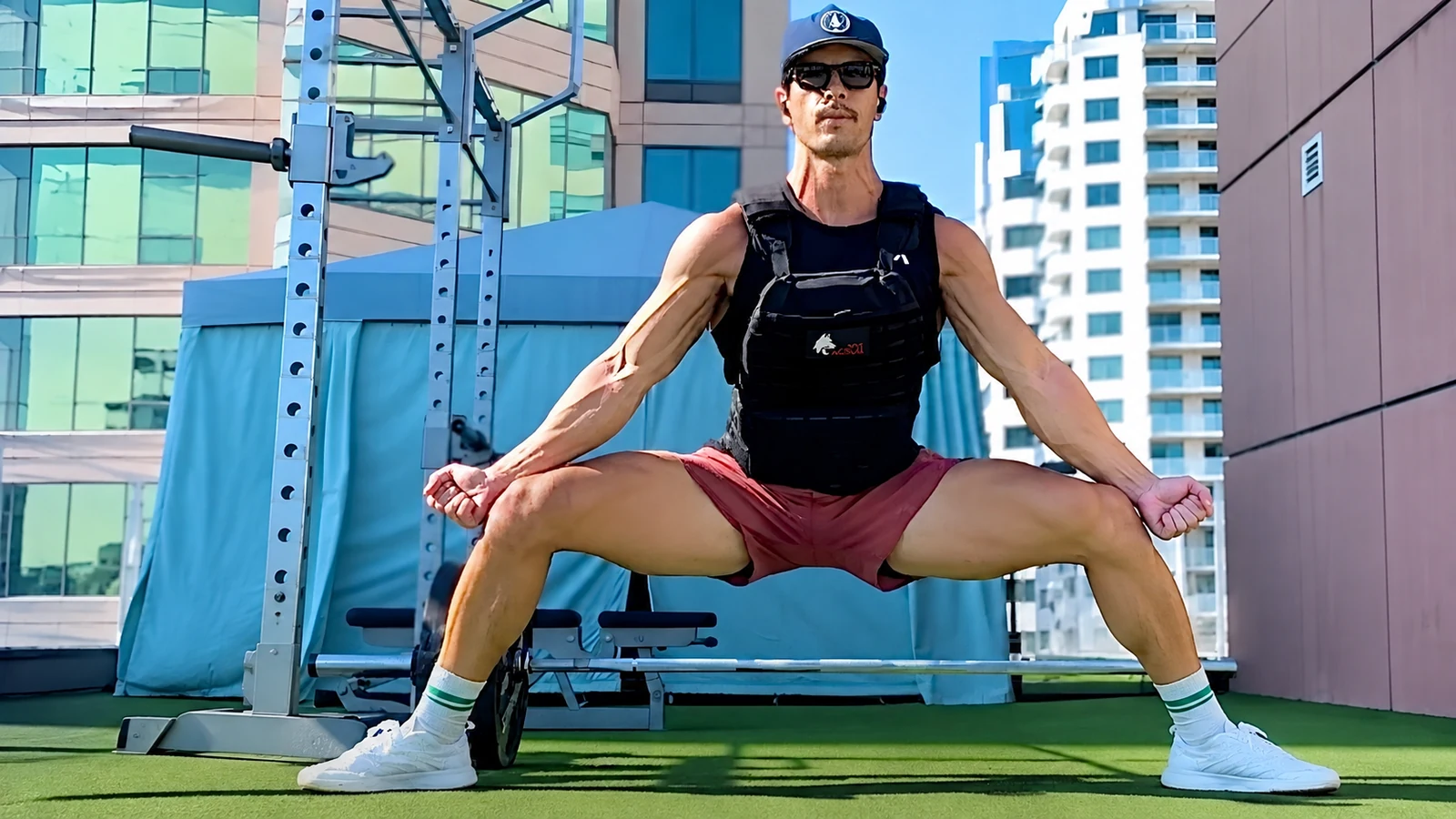

Exercise in your 40s can follow the same broad rules as any other adult decade: train major muscle groups regularly, include aerobic activity, and choose a workload you can repeat. This guide turns five familiar strength moves into a usable weekly plan, then fills the pulling and dynamic leg gaps the original list leaves.
Forty is not a switch that makes everyone fragile or imposes a universal 48-hour recovery clock. Training history, current ability, health conditions and how a session feels the next time you train matter more than the birthday.
What should exercise in your 40s include?
The CDC adult activity guide calls for 150 minutes of moderate aerobic activity per week and muscle strengthening on at least two days. The 2026 ACSM resistance training summary emphasizes regular participation, major muscle groups and individualization over a perfect exercise list.
| Part of the week | Practical choice | What to check |
|---|---|---|
| Strength | Two nonconsecutive full-body sessions can be a starting example. | Include a hinge, knee bend, push, pull and trunk work rather than only the five viral moves. |
| Aerobic activity | Walking, cycling, swimming or another activity you can sustain. | Build toward the weekly guideline at an effort that fits your ability. |
| Recovery | Allow enough time or reduce the next session when quality drops. | Track performance, pain and willingness to return, rather than a fixed age-based rule. |
A 2023 review of 66 studies in adults ages 40 to 60 found improvements in measured strength and balance with structured activity, but no included study measured falls. That evidence supports training, not a promise that one specific routine prevents injury or future falls.
Use the five moves as a starting menu
The original five are a plank, single-leg Romanian deadlift, push-up, horse stance and kettlebell swing. Use the scaled versions below to practice the pattern before choosing a more demanding version; the exact routine is an editorial example, not a tested clinical protocol.
| Pattern | Start here | Move on when | Common adjustment |
|---|---|---|---|
| Trunk brace | Wall or counter plank, breathing steadily. | You can hold your body position without sagging or holding your breath. | Use a higher support or a shorter hold. |
| Hip hinge and balance | Supported single-leg Romanian deadlift with one hand on a sturdy support. | The hip hinge stays controlled on both sides. | Keep the back toes on the floor in a kickstand stance. |
| Upper-body push | Incline push-up at a stable counter or bench. | You can repeat the same body position and comfortable hand placement. | Raise the hands to make the move easier. |
| Static knee bend | High horse stance at a comfortable depth. | You can hold a stable foot position without joint pain. | Stand higher or shorten the hold; a 90-degree bend is not required. |
| Dynamic hip hinge | Kettlebell deadlift before any swing. | You can hinge and stand repeatedly without the weight pulling you out of position. | Use a lighter load or stop at the deadlift; get instruction before adding swing speed. |
The swing is a power exercise, not a required milestone for people in their 40s. Research on kettlebell mass and joint kinetics shows that changing the load changes the movement demands, so choose a manageable weight and learn the hinge first.
Fill the two gaps: pulling and a moving knee bend
The five-move list has no true upper-body pull, and its horse stance holds still. A row and a chair squat make the plan more complete without pretending that these seven moves are the only valid options.
- Pull: Add a supported dumbbell row, a machine row or a band row with a secure anchor. Draw the elbow back without twisting the trunk; a qualified trainer can help you choose a setup that fits your space and equipment.
- Moving knee bend: Sit down to a stable chair and stand again with control, or use a comfortable squat. Adjust chair height or support rather than forcing a depth that changes your balance.
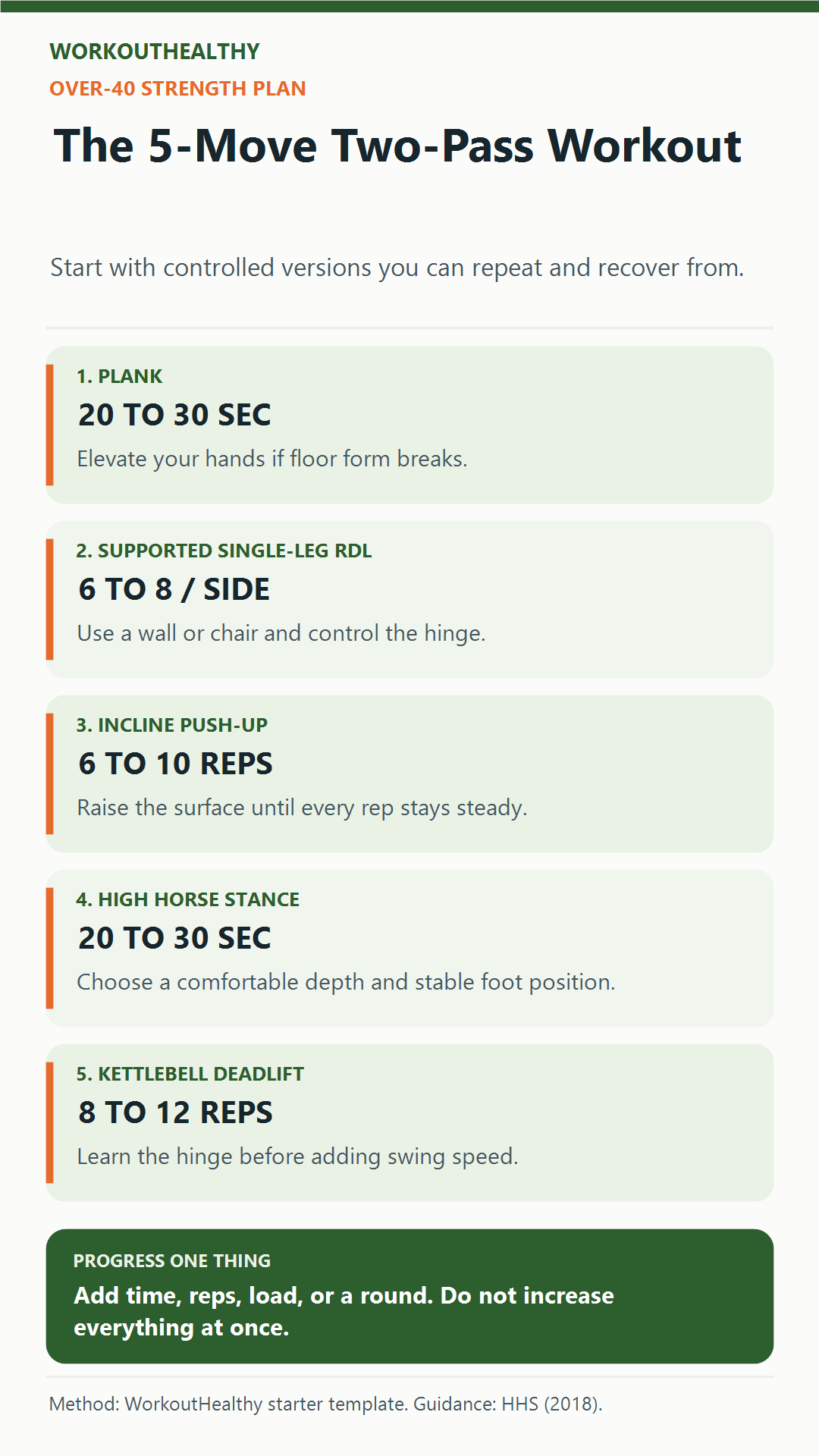
The existing five-move card remains a compact baseline, so its numbers are examples rather than minimums. Add the row and chair squat to your own log if you use the fuller seven-pattern version.
A two-pass week you can adjust
Use Monday and Thursday as example strength days, with aerobic activity on other days if your schedule allows. They are not mandatory days or a rule that everyone needs exactly 72 hours to recover.
| Day | Example | How to adapt it |
|---|---|---|
| Monday | Two controlled passes through the strength menu. | One pass is acceptable while learning the movements. |
| Tuesday or Wednesday | Comfortable or brisk walking. | Choose another aerobic activity or break it into shorter bouts. |
| Thursday | Repeat the strength menu and compare form with Monday. | Reduce a hold, load or pass if pain or performance is worse. |
| Weekend | More aerobic activity that suits your life. | Use the weekly guideline as a direction, not a test of one perfect week. |
For each strength pass, consider a short plank, a supported hinge on each side, an incline push-up, a comfortable horse-stance hold, a kettlebell deadlift, a row and a chair squat. The visual’s 20 to 30 second holds and six to 12 repetition examples are adjustable; rest long enough to keep the next set controlled.
Two passes on two days are an editorial starting example, not a dose proved optimal for all adults in their 40s. The Marques review compared one versus multiple sets mostly in women ages 58 to 70, so its modest lower-body strength advantage for multiple sets cannot dictate your personal starting volume at 40.
Use a response check instead of a rigid recovery rule
Write down the version, repetitions or hold time, load, effort and any pain after each session. Our training-log guide shows how those notes can inform the next workout.
| At the next session | Reasonable next step |
|---|---|
| Same form, similar effort, no concerning symptoms | Repeat the work or add one small change, such as a repetition or a little load. |
| Still learning a movement or noticeably tired | Keep the same version, use one pass or take more rest. |
| Sharp pain, swelling, loss of normal movement or worsening symptoms | Stop that move and seek appropriate clinical assessment before progressing it. |
Soreness is not proof of progress, and failure on every set is not required for general health training. ACSM’s 2026 review says consistency and a program you can sustain matter more than advanced methods for the average healthy adult; our rest-day guide explains how recovery fits into that plan.
Does the brain-age story prove this circuit works?
One result ranking for this broad search term reports a 12-month randomized aerobic-exercise trial in 130 healthy adults ages 26 to 58. Its outcome was an MRI-derived estimate of brain age, and only 81 participants had both baseline and follow-up MRI scans; it did not test this seven-pattern strength plan or a dementia outcome.
That news story reinforces why aerobic activity belongs in the week, while the strength menu answers a separate exercise-selection question. It cannot tell an individual how many months younger their brain would become from these workouts.
When to seek a more personal plan
Stop and seek urgent medical care for chest pain, fainting or severe or unusual breathlessness during exercise. Ask a clinician or physical therapist for an appropriate starting plan after surgery, with an unstable condition, or when pain or balance problems change how you move.
For everyone else, the strongest starting point is a plan you can repeat, record and adjust. The five original moves can stay, but a row, a moving squat and aerobic activity make the week more complete.
Want more practical training guidance? Subscribe to WorkoutHealthy Insider for evidence-aware routines you can adapt to real life.
References
- CDC. Adding Physical Activity as an Adult. Current aerobic and strengthening guidance.
- American College of Sports Medicine. 2026 resistance training guidelines summary. Consistency, major muscle groups and individualization.
- Adams M, et al. Effects of physical activity interventions on strength, balance and falls in middle-aged adults. 2023 systematic review.
- Marques DL, et al. Manipulating resistance training volume in middle-aged and older adults. 2023 meta-analysis.
- Levine NA, et al. Effects of kettlebell mass on lower-body joint kinetics during a swing. Published online 2020; 30 young recreationally active adults.
- Erickson KI, et al. Fitness and exercise effects on brain age. 12-month randomized aerobic trial.
Health note: This is general fitness information, not personal medical advice. A clinician or physical therapist can help adapt the plan when an injury, medical condition or persistent pain affects exercise.