

Circuit training gives you a real cardio stimulus and a modest strength stimulus inside one short session.
That efficiency is the actual selling point.
It is also a compromise.
Neither adaptation is as large as it would be if you trained cardio and strength separately with full rest.
That is not a reason to skip circuits. It is a reason to use them for the right job.
What counts as circuit training?
A circuit is a set of exercises done in sequence with little or no rest between stations, followed by a longer rest before you repeat the sequence.
That is the whole definition.
Circuit training is not a brand, a class, or a specific list of movements. It is a way of organizing whatever exercises you already have.
You can build a circuit out of barbells, machines, dumbbells, bands, a rower, or nothing but your own body weight.
The defining variable is rest, not equipment and not exercise choice.
Cut the rest between sets and a strength session starts behaving like conditioning. Add the rest back and it turns into a strength session again.
Everything interesting about circuits comes from that one dial.
This is worth saying because circuit training gets confused with the class formats and gym brands that happen to use it.
Those are products.
The circuit itself is just a scheduling decision you can apply to any equipment in any room.
What does the research actually show?
The largest pooled look at this is a 2021 meta-analysis of 45 studies covering roughly 1,370 people across training and control groups.
It reported average changes of about 4.3 percent lower fat mass, 1.9 percent higher muscle mass, and 6.3 percent higher VO2max after circuit based resistance training.
A separate 2017 meta-analysis of 16 studies in healthy adults found improvements in both VO2max and upper body one repetition maximum.
The bigger aerobic effects showed up in programs of roughly 14 to 30 sessions across 6 to 12 weeks, with sessions of at least 20 to 30 minutes.
Those are honest, useful numbers. They are also modest numbers.
| Outcome | Typical pooled change | How to read it |
|---|---|---|
| VO2max | About 6 percent higher | Real, but below what a dedicated aerobic block usually produces |
| Fat mass | About 4 percent lower | Consistent with starting any structured program |
| Muscle mass | About 2 percent higher | Small, and mostly in people new to lifting |
| Upper body 1RM | Improved | Strongest in untrained people and programs over 20 sessions |
One caveat matters more than any of the percentages.
Most of these studies used untrained or lightly trained people, and beginners improve at almost everything you ask them to do.
The better trained you already are, the smaller the circuit effect gets on both ends.
Does a circuit burn fat better than other training?
No. Nothing about the format gives it a special fat loss property.
Fat loss follows energy balance over weeks and months, and a workout is one input into that.
The 4 percent fat mass change in the pooled data is roughly what you would expect from anyone who starts training consistently and quietly cleans up their eating at the same time.
The afterburn effect is real but small, and it is routinely oversold.
Calorie estimates from machines and trackers are rough enough that the published burn ranges for a single activity can vary by hundreds per hour depending on body size and effort.
Where circuits genuinely help is the part nobody puts on a poster.
They compress a decent session into 25 or 30 minutes, which means you actually do them on a busy week.
Consistency, not metabolic magic, is the mechanism.
The other thing worth protecting during any fat loss phase is muscle, and that depends far more on protein intake and resistance training than on how fast you move between stations.
The best argument for circuit training has never been that it burns more fat. It is that a good 30 minute session you finish beats a great 75 minute session you skip.
Why is a circuit always a compromise?
Because the short rest that makes a circuit efficient is the same short rest that limits what you can lift.
A 2018 systematic review on rest intervals found that trained lifters generally need more than two minutes between sets to maximize strength gains.
Untrained lifters did fine with under 60 seconds to about two minutes.
Circuits live almost entirely in that short rest zone.
So a beginner loses very little by circuit training, and an experienced lifter loses quite a lot.
The cardio side has its own version of the same problem.
Station changes, grip fatigue, and setup time keep breaking the effort, so your heart rate sawtooths instead of holding a steady, high fraction of your capacity.
A continuous bike, row, or run holds that stimulus more cleanly.
You end up with two decent stimuli instead of one excellent one.
That is the trade, and it is worth naming out loud.
None of this makes the format bad. It makes it a general tool rather than a specialist one.
A general tool is exactly right when your goal is general, and exactly wrong when your goal is narrow.
How do exercise order and rest change what you get?
Order decides who gets your best effort, because whatever sits at station one gets a rested nervous system and everything after it does not.
If strength is the priority this block, put the heaviest and most technical lift first.
If conditioning is the priority, put a machine or a carry there and let the lifts absorb the fatigue.
Spacing matters just as much.
Alternating regions keeps local fatigue from stacking. A squat followed by a row lets your legs recover while your back works.
Stacking two lower body stations back to back does the opposite, and it pushes the whole circuit toward conditioning whether you wanted that or not.
Rest between stations is the dial you actually set.
| Rest between stations | What the session becomes | Best used for |
|---|---|---|
| 0 to 15 seconds | Mostly conditioning | Work capacity, short time budget |
| 20 to 40 seconds | Balanced, the classic circuit | General fitness, returning from a layoff |
| 45 to 75 seconds | Strength leaning | Holding real loads while still moving quickly |
| 2 minutes or more | No longer a circuit | Maximal strength work |
There is no correct row in that table. There is only the row that matches the goal you picked this month.
When is a circuit the right choice, and when is it not?
A circuit is a good fit when time is the binding constraint and general fitness is the goal.
It works well as a conditioning block between heavier training phases, as a re-entry format after a layoff, and in a busy gym where you can hold three or four stations at once.
It is also forgiving. You can scale any station up or down without redesigning the session.
A circuit is the wrong choice when maximal strength is the goal.
If you are trying to add weight to a squat, bench, or deadlift, you need the long rest that circuits are built to remove.
It is also a poor place to learn a heavy technical lift, because form degrades under fatigue and a circuit manufactures fatigue on purpose.
And if you want aerobic base with low joint stress, a circuit is a strange way to get it.
Steady walking builds that with far less wear, and the daily distance that produces most of the health benefit is lower than most people assume.
How do you build a circuit that is not just random?
Most circuits fail because they are assembled from whatever equipment was free, not from a decision.
Start by naming one priority for the block. Strength leaning or conditioning leaning, not both.
Then use five to eight stations.
Fewer than five and it is a superset. More than eight and the first station is cold before you return to it.
Alternate upper body, lower body, and a carry or machine so no single area fails early.

Use time for conditioning stations and reps for strength stations, since a rep target under fatigue quietly turns into a form target you will miss.
Keep loads submaximal enough that the last round looks like the first.
Then repeat the same circuit for four to six weeks and progress it, because a circuit you change every session cannot show you whether it worked.
Warm up properly before the first round, because the first station is where you are most likely to move badly at speed.
Five minutes of easy cardio plus a light set of the first two movements is usually enough.
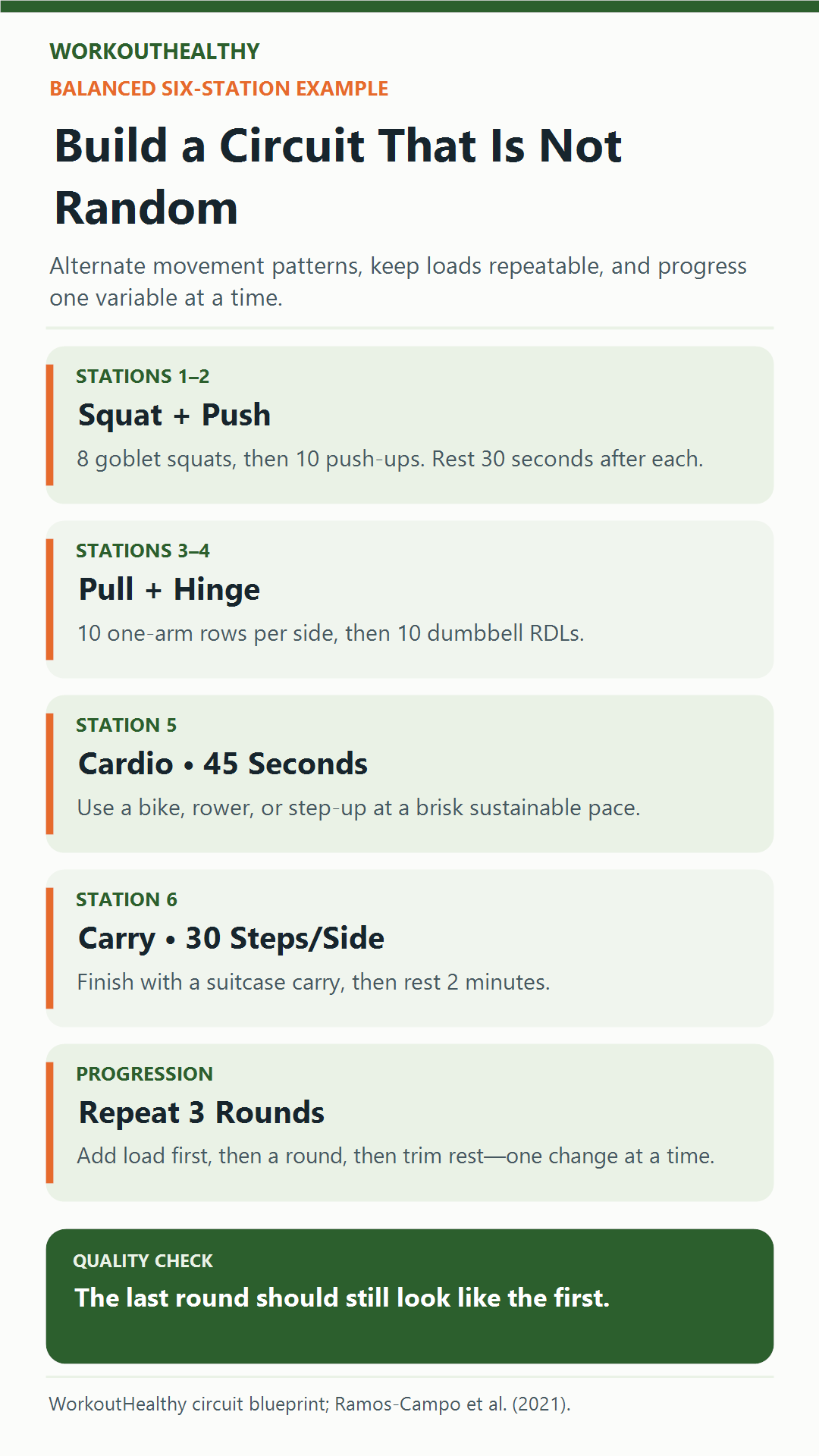
Here is a balanced example built on that logic.
| Station | Exercise | Work | Rest before next |
|---|---|---|---|
| 1 | Goblet squat | 8 reps | 30 seconds |
| 2 | Push-up or incline push-up | 10 reps | 30 seconds |
| 3 | One arm dumbbell row | 10 reps each side | 30 seconds |
| 4 | Dumbbell Romanian deadlift | 10 reps | 30 seconds |
| 5 | Bike, rower, or step-up | 45 seconds brisk | 30 seconds |
| 6 | Suitcase carry | 30 steps each side | Rest 2 minutes, then repeat |
Three rounds takes about 25 minutes including the warm-up.
Progress it by adding load at stations 1, 3, and 4 first, then by adding a fourth round, and only then by trimming the rest.
Change one variable at a time so you can tell what did the work.
Pick what the circuit is for before you pick the exercises. A session that tries to be strength work and conditioning at the same time usually ends up being neither.
What should you expect after eight weeks?
Expect to be noticeably fitter, mildly stronger, and better at recovering between hard efforts.
Expect the pooled numbers to hold roughly true if you were untrained when you started, and to shrink if you were not.
Expect body composition to move only if your eating supports it, because training does not override energy balance.
The most useful thing to track is not the scale.
Track the load you can hold at station one and how the last round compares to the first.
If both are climbing, the circuit is doing its job.
If the last round keeps collapsing, the rest is too short or the load is too high.
The honest summary is that circuit training buys you time and costs you specificity.
For a lot of people, most weeks, that is a trade worth making.
Get the next evidence check.
Five practical fitness stories worth your time, every Friday.
One email a week. No product pitches. Unsubscribe in one click.
References
- Ramos-Campo, D. J., Andreu Caravaca, L., Martínez-Rodríguez, A., & Rubio-Arias, J. Á. (2021). Effects of resistance circuit-based training on body composition, strength and cardiorespiratory fitness: A systematic review and meta-analysis. Biology, 10(5), 377. https://doi.org/10.3390/biology10050377
- Muñoz-Martínez, F. A., Rubio-Arias, J. Á., Ramos-Campo, D. J., & Alcaraz, P. E. (2017). Effectiveness of resistance circuit-based training for maximum oxygen uptake and upper-body one-repetition maximum improvements: A systematic review and meta-analysis. Sports Medicine, 47(12), 2553-2568. https://doi.org/10.1007/s40279-017-0773-4
- Grgic, J., Schoenfeld, B. J., Skrepnik, M., Davies, T. B., & Mikulic, P. (2018). Effects of rest interval duration in resistance training on measures of muscular strength: A systematic review. Sports Medicine, 48(1), 137-151. https://doi.org/10.1007/s40279-017-0788-x
Medical disclaimer: This article is for general information only and is not medical advice. If you have an injury, ongoing pain, or a medical condition, talk to a doctor or physical therapist before you change how you train or eat.