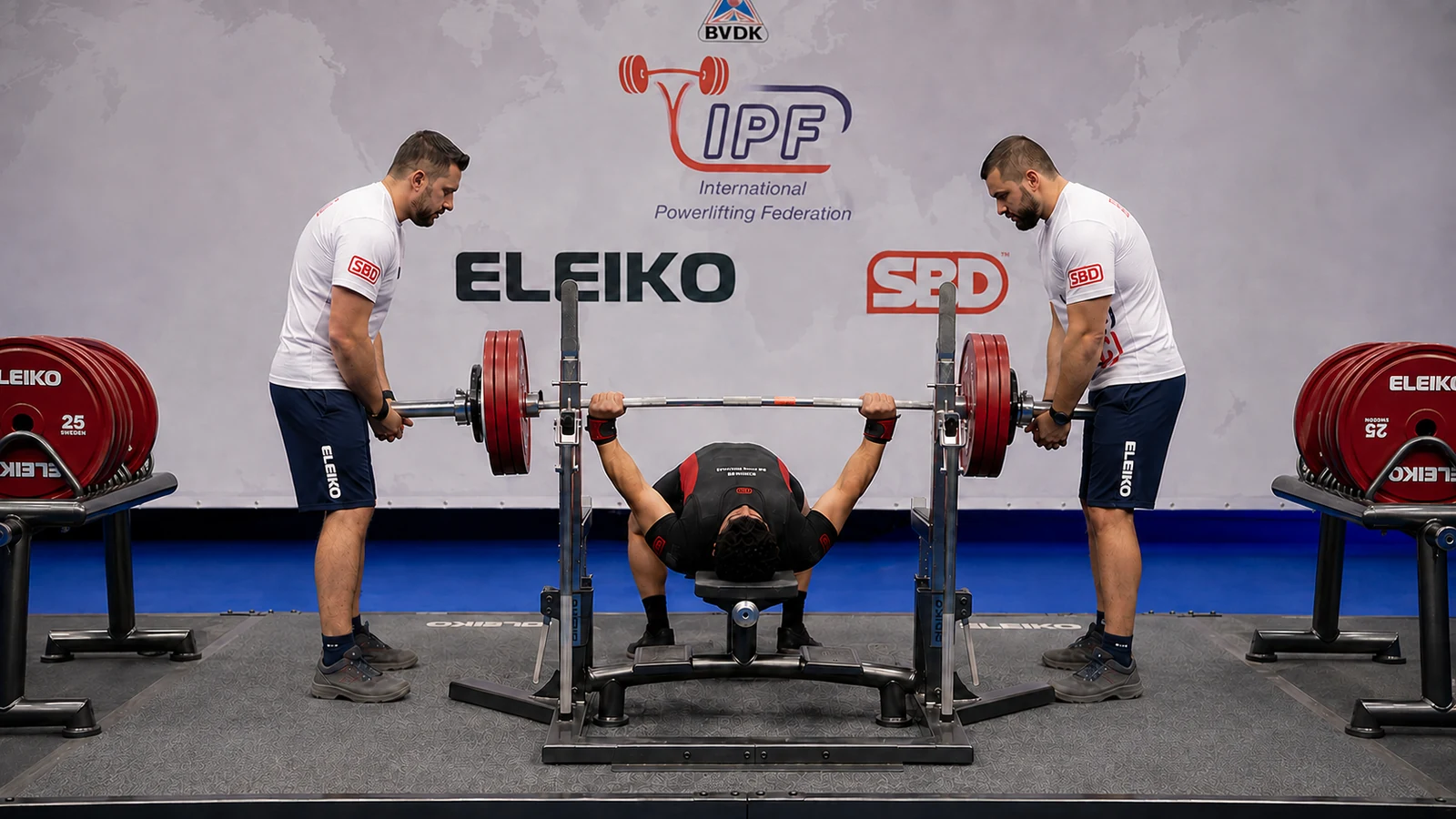

Ilyas Boughalem pressed 291.5 kilograms off his own chest in Sun City, South Africa.
That converts to 642.65 pounds.
It stands as the current raw bench press world record in powerlifting’s heaviest men’s class, 120 kilograms and up, sometimes called super heavyweight.
He set it in June 2022 at the International Powerlifting Federation’s World Men’s Classic Championships, wearing wrist wraps and a lifting belt, with no bench shirt.
More than four years later nobody has beaten it, including Boughalem himself.
The caption circulating with the video says he got there in four steps.
The IPF’s own results database says it took seven.
What Happened in Sun City
The meet was the IPF World Men’s Classic Championships, held in Sun City, South Africa, during the federation’s June 2022 championship window.
The footage comes from the International Powerlifting Federation’s own YouTube channel, titled plainly, “World Record Bench Press with 291.5 kg by Ilyas Boughalem ALG in 120+kg class.”
Boughalem, competing for Algeria, weighed in that day at 161.6 kilograms, about 356 pounds.
He was not a bench specialist showing up for one lift.
He squatted 360 kilograms and deadlifted 300 kilograms at the same meet, for a three-lift total of 951.5 kilograms, or about 2,098 pounds.
His bench press was the best in the entire 120+kg field that day.
His total was not, and he finished second overall in the class.
Nobody in the building out-benched him and he still did not win, which is a useful reminder that a single-lift world record and a competition win are two different things.
Eight Years, Seven Meets: The Real Progression
The caption behind this video lists three earlier marks on the way to 291.5 kilograms: 275 kilograms, 283 kilograms, and 290 kilograms.
Checking Boughalem’s competition history against the IPF’s own results archive turns up a real progression, but not that one.
No 283-kilogram result appears anywhere in his verified competition record.
| Year | Championship | Bench Press |
|---|---|---|
| 2014 | World Men’s Classic Championships | 240.0 kg |
| 2015 | World Men’s Classic Championships | 270.5 kg |
| 2016 | World Men’s Classic Championships | 275.0 kg |
| 2017 | 5th World Men’s Classic Championships | 277.5 kg |
| 2018 | 6th World Men’s Classic Championships | 281.5 kg |
| 2019 | 7th World Men’s Open Classic Championships | 290.0 kg |
| 2022 | World Men’s Classic Championships | 291.5 kg (current record) |
Seven world championships, eight years, and a gain of 51.5 kilograms in his competition bench press, most of it added a few kilograms at a time.
The gap between 2019 and 2022 is the IPF’s disrupted World Championships calendar across 2020 and 2021.
At the very top of a sport, records rarely move in big jumps. They move a kilogram or two at a time, year after year, at the same championship, against the same rivals, until one number finally holds long enough to be called a world record.
Not four steps, but seven, climbing steadily across nearly a decade before the current record finally stuck.
That same pattern of small, well-earned jumps shows up across other verified world records too, including the pacing behind DonnaJean Wilde’s push-up world record.
What “Raw” and “IPF World Record” Actually Mean
In powerlifting, raw does not mean equipment-free.
A raw lifter can still use a belt and wrist wraps, both of which Boughalem wore.
What raw excludes is the bench shirt, a rigid, multi-ply supportive garment that stores and returns energy through the bottom of the lift.
The equipped 120+kg world record, held separately by a different lifter, sits far higher at 425 kilograms according to the IPF’s own records database, for exactly that reason.
The International Powerlifting Federation is the largest and oldest international powerlifting federation, and the one most competitive lifters treat as the sport’s primary governing body, though it is not the sport’s only one.
Other federations such as the WRPF and USPA run their own meets and keep their own separate record books, which is why competing numbers turn up online for what sounds like the same record.
A record with “IPF” attached means something specific: a judged lift, made at a sanctioned IPF championship, under IPF drug-testing and technical rules, entered into the federation’s own results system.
Why the Heaviest Class Holds the Biggest Number
The 120+kg class exists because, past a certain point, added body mass keeps translating into more absolute pressing strength even though it stops translating into more strength relative to bodyweight.
A 1999 study in Medicine and Science in Sports and Exercise tested the IPF’s own Wilks formula, the standard method the federation uses to compare lifters of different bodyweights on a relative-strength basis (Vanderburgh & Batterham, 1999).
That research confirmed that absolute strength does not rise in a straight line with bodyweight, but rises quickly at first and then flattens.
A much heavier lifter is not automatically stronger pound for pound, but can still move more total weight than anyone lighter.
That is why the single heaviest raw bench in the sport belongs to the 120+kg class rather than a lighter one, and always has.
At 161.6 kilograms of bodyweight Boughalem carries enough mass to generate that force, and eight years of competition taught him to convert it into a judged world record rather than just a big number on a gym bench.
The Mechanics Behind a 291.5-Kilogram Press
Grip width changes where the bar tends to slow down or stall during the press, a point researchers call the sticking region.
A 2016 study in the Journal of Sports Sciences measured how grip width shifted the location and severity of that sticking region in trained lifters, confirming it as a real, measurable mechanical effect rather than just a coaching preference (Gomo & Van Den Tillaar, 2016).
Super heavyweight lifters like Boughalem tend to have longer arms and a wider frame to work with, which changes exactly where their own sticking region falls compared to a lighter lifter.
A 2025 biomechanics study modeled the shoulder and elbow as one linked chain rather than isolated joints, showing how the two interact to produce the bar path and the sticking region under heavy pressing loads (Evangelista et al., 2025).
Finding a setup, grip width, and bar path that hold up under 291.5 kilograms is where most of those eight years went, and readers curious how the lift changes once leg drive is removed entirely can see that tradeoff explained in our floor press versus bench press comparison.
Still Standing: Has Anyone Beaten It?
The most direct evidence comes from Boughalem himself.
He returned to IPF competition in 2023, at both the World Men’s Classic Open Championships and the IPF Arab Cup, benching 280 kilograms and 275 kilograms at those two meets.
In 2024, at the World Men’s Classic Bench Press Championships, a bench-only event, he lifted 282.5 kilograms.
None of those three results reached his own 2022 mark.
The IPF’s live records database, checked directly for this article, still lists Boughalem’s 291.5-kilogram lift as the current raw men’s 120+kg world record, with no newer entry from any other lifter shown as having surpassed it.
More than four years on, the record’s toughest challenger has been Boughalem’s own later attempts, and even those came up short.
What This Record Does Not Prove
It does not mean Boughalem is the strongest human alive in any general sense.
It is a single-lift record in one weight class, and his own second-place finish at that same 2022 meet makes the distinction concrete rather than abstract.
It also does not transfer to what a much smaller lifter could ever bench, which is exactly why powerlifting tracks separate records by weight class instead of ranking everyone on one scale.
And it is a competition record, made under a referee’s watch at a sanctioned meet, not a gym training number, a distinction that gets blurred online constantly and almost always in the direction of overstating an unofficial lift.
Watch the Original Video
Enjoy stories like this one? Subscribe to WorkoutHealthy Insider for practical explanations behind popular fitness claims.
References
Evangelista, P., Rum, L., Picerno, P., & Biscarini, A. (2025). Decoding the contribution of shoulder and elbow mechanics to barbell kinematics and the sticking region in bench and overhead press exercises: A link-chain model with single- and two-joint muscles. Journal of Functional Morphology and Kinesiology, 10(3), 322. https://doi.org/10.3390/jfmk10030322
Gomo, O., & Van Den Tillaar, R. (2016). The effects of grip width on sticking region in bench press. Journal of Sports Sciences, 34(3), 232 to 238. https://doi.org/10.1080/02640414.2015.1046395
Vanderburgh, P. M., & Batterham, A. M. (1999). Validation of the Wilks powerlifting formula. Medicine & Science in Sports & Exercise, 31(12), 1869 to 1875. https://doi.org/10.1097/00005768-199912000-00027
This article is for general information only and is not medical advice. If you have an injury, ongoing pain, or a medical condition, talk to a doctor or physical therapist before you change how you train or eat.