
Katy Perry’s Lifetimes Tour wrapped in December 2025 after grossing more than 134 million dollars across 91 shows.
Numbers like that describe a tour’s success. They do not describe what it actually takes to deliver two hours of full effort singing and dancing, night after night, for the better part of a year.
Perry, 41, has been a fixture of pop music since her 2008 album One of the Boys and the chart topping run that followed with Teenage Dream.
She has sold more than 151 million records worldwide and earned six diamond certifications. She spent years as a judge on American Idol. In 2025 she also flew to space aboard a Blue Origin flight, adding an unusual line to an already unusual career.
Her 2010 album, Teenage Dream, remains the only album by a female artist to produce five number one singles on the Billboard Hot 100.
She headlined the Super Bowl XLIX halftime show in 2015, watched by more than 118 million viewers in the United States alone, one of the most watched television broadcasts of that entire year.
That kind of career longevity does not happen by accident, and it does not happen without the body holding up to decades of physically demanding touring.
Through all of it, touring has stayed physically demanding in a way that rarely gets discussed directly.
A modern pop show is not just singing. It is hours of rehearsed choreography, quick costume changes, and full vocal output, repeated on a schedule that would be considered heavy training volume in almost any athletic context.
What Perry Has Said About Staying Ready for Tour
Perry has described leaning on a few specific habits to get through a demanding tour schedule.
She has pointed to espresso to help her get going, a simple and mostly whole food focused diet, and meditation to manage the stress of travel and performance.
She has also spoken about the sheer volume of choreography rehearsal that goes into preparing a tour, often putting in hours of practice before a single date is played live.
None of that reads like an elite athlete’s training log on paper. Put together, it describes a routine built around the same basic ideas that sports science uses for anyone doing repeated, demanding physical work: fuel, recovery, and consistent practice of the actual skill.
Rehearsal itself is a major part of that preparation. A modern pop tour typically spends weeks running full choreography before the first date, building both the muscle memory and the conditioning needed to perform it night after night without the movement falling apart under fatigue. That rehearsal period functions much like a preseason for an athlete, building capacity before the real demands of a long schedule begin.

The Science Behind Touring as a Physical Demand
Caffeine, Perry’s espresso habit included, has a well studied role in exercise and performance. A position stand from the International Society of Sports Nutrition reviewed the evidence on this. It concluded that moderate caffeine intake, roughly 3 to 6 milligrams per kilogram of body weight, can meaningfully improve endurance performance and, in some cases, power output for most healthy adults (Guest et al., 2021). That does not mean more caffeine is always better. The same review noted that higher doses mostly add side effects like jitteriness and disrupted sleep without much additional performance benefit.
Timing matters too. Caffeine has a half life of roughly five hours in most healthy adults, meaning half of a given dose is still active in the body five hours after it is consumed. A dose taken late in the day, even one meant to power through a demanding evening, can still be affecting sleep quality well after a show ends. That is a real tradeoff for any touring performer relying on caffeine to get through a physically demanding set.
Sleep and recovery matter just as much, maybe more, for someone touring at Perry’s pace.
A major review in Sports Medicine examined how sleep loss affects exercise performance. It found that inadequate sleep reliably reduces submaximal exercise performance, slows reaction time, and raises perceived effort during physical activity (Fullagar et al., 2015). For a performer doing two hours of vocal and physical output most nights, often across time zones, protecting sleep is not a luxury. It is closer to a performance requirement.
Meditation’s specific role is harder to measure directly in a touring context. Its general use for stress management is well supported in the broader research on recovery and performance. Chronic stress interferes with sleep quality and recovery, both directly tied to physical output, so a stress management habit used consistently can have a real, if indirect, effect on how someone performs night after night.
How Touring Compares to General Endurance Guidance
Most people will never sing and dance through a two hour show on a stage.
The underlying physical demand, sustained moderate to high intensity effort over an extended period, is not unlike what general cardiovascular fitness guidelines are built around.
The American Heart Association and similar bodies generally recommend at least 150 minutes of moderate intensity aerobic activity a week for general health, with more for anyone building real endurance capacity.
A touring performer puts in a version of that most days of the week. It just shows up as choreography and vocal performance instead of a treadmill session.
The lesson that carries over to an ordinary routine is less about the specific hours and more about the pattern.
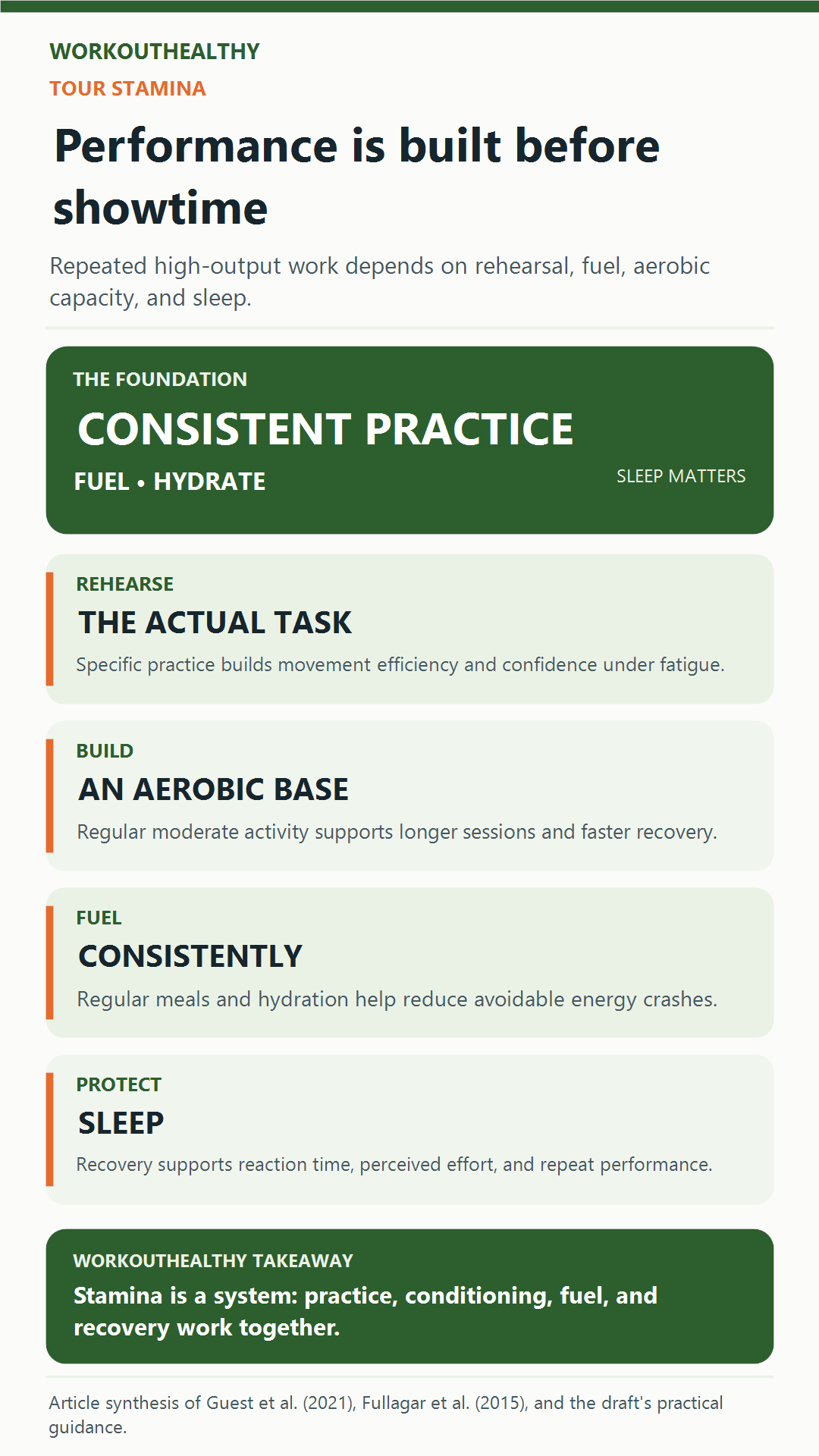
Consistent practice of the actual activity, attention to fuel and hydration, and real recovery time built in rather than treated as optional, that combination is what turns a demanding activity into something a person can sustain for months instead of days.
Common Mistakes People Make With Endurance and Recovery
A few patterns show up often in people trying to build the kind of stamina a demanding schedule requires, whether that is touring, a physical job, or a training block for an event.
One common mistake is relying on caffeine to make up for a genuine sleep deficit rather than treating sleep as the actual fix.
Caffeine can mask fatigue for a while. It does not replace the recovery that sleep actually provides, and over time that gap tends to catch up with a person.
Another is skipping meals or eating inconsistently during a demanding stretch, then wondering why energy crashes mid effort.
A simple, consistent eating pattern tends to outperform an inconsistent “good” diet when the goal is steady daily energy.
A third mistake is ignoring stress management entirely until it becomes a problem. Waiting until burnout hits to start managing stress is much harder than building a small, sustainable habit before it becomes necessary.
A fourth pattern, common among performers specifically, is skipping a proper warm up before demanding physical or vocal output.
Jumping straight into full intensity without preparing the body first raises the risk of strain, whether the activity is a two hour set or a hard training session at the gym.
A fifth mistake is treating rest days as wasted time rather than active parts of a training plan.
The body adapts and gets stronger during recovery, not during the effort itself, and skipping that recovery on a demanding schedule tends to catch up with a person eventually, whether that person is on tour or simply managing a busy week.
A Practical Way to Build Everyday Stamina
Building the kind of stamina that supports a demanding schedule does not require a tour bus or a stage crew.
It starts with the same three pieces Perry has described using: consistent practice, basic fuel, and real recovery.
For most people, that means building cardiovascular capacity gradually through regular aerobic activity. Walking, cycling, swimming, jumping rope, or a cardio machine all work, aiming for the widely recommended 150 minutes a week as a baseline and building from there if endurance is a specific goal.
On the fuel side, a simple pattern works better than a complicated one. Regular meals built around whole foods, protein, and enough carbohydrate to support activity level tend to hold up better over weeks and months than restrictive plans that are hard to sustain.
Caffeine, used deliberately rather than constantly, can be a reasonable tool. Keeping it earlier in the day protects sleep. Keeping the dose moderate avoids the jitteriness and crash that can come with overuse.
A short warm up before any demanding activity, five to ten minutes of light movement to raise heart rate and loosen the major joints, prepares the body for real effort and lowers injury risk.
A brief cool down afterward, even just a few minutes of slower movement and stretching, helps the body transition out of high effort mode rather than stopping cold.
Finally, a small daily stress management habit supports the sleep that everything else depends on.
Meditation, quiet breathing, or simply a consistent wind down routine before bed all work. None of this requires a stadium tour to matter. It applies just as much to anyone managing a demanding week at work or a busy training block.
References
Guest, N. S., VanDusseldorp, T. A., Nelson, M. T., Grgic, J., Schoenfeld, B. J., Jenkins, N. D. M., Arent, S. M., Antonio, J., Stout, J. R., Trexler, E. T., Smith-Ryan, A. E., Goldstein, E. R., Kalman, D. S., & Campbell, B. I. (2021). International society of sports nutrition position stand: Caffeine and exercise performance. Journal of the International Society of Sports Nutrition, 18(1), 1. https://doi.org/10.1186/s12970-020-00383-4
Fullagar, H. H. K., Skorski, S., Duffield, R., Hammes, D., Coutts, A. J., & Meyer, T. (2015). Sleep and athletic performance: The effects of sleep loss on exercise performance, and physiological and cognitive responses to exercise. Sports Medicine, 45(2), 161-186. https://doi.org/10.1007/s40279-014-0260-0
This article is for general information and is not personalized medical or nutrition advice. Caffeine affects individuals differently, and anyone with a heart condition, anxiety disorder, or sleep problems should talk to a doctor before making significant changes to caffeine intake. Talk to a doctor before starting any new exercise or diet routine.