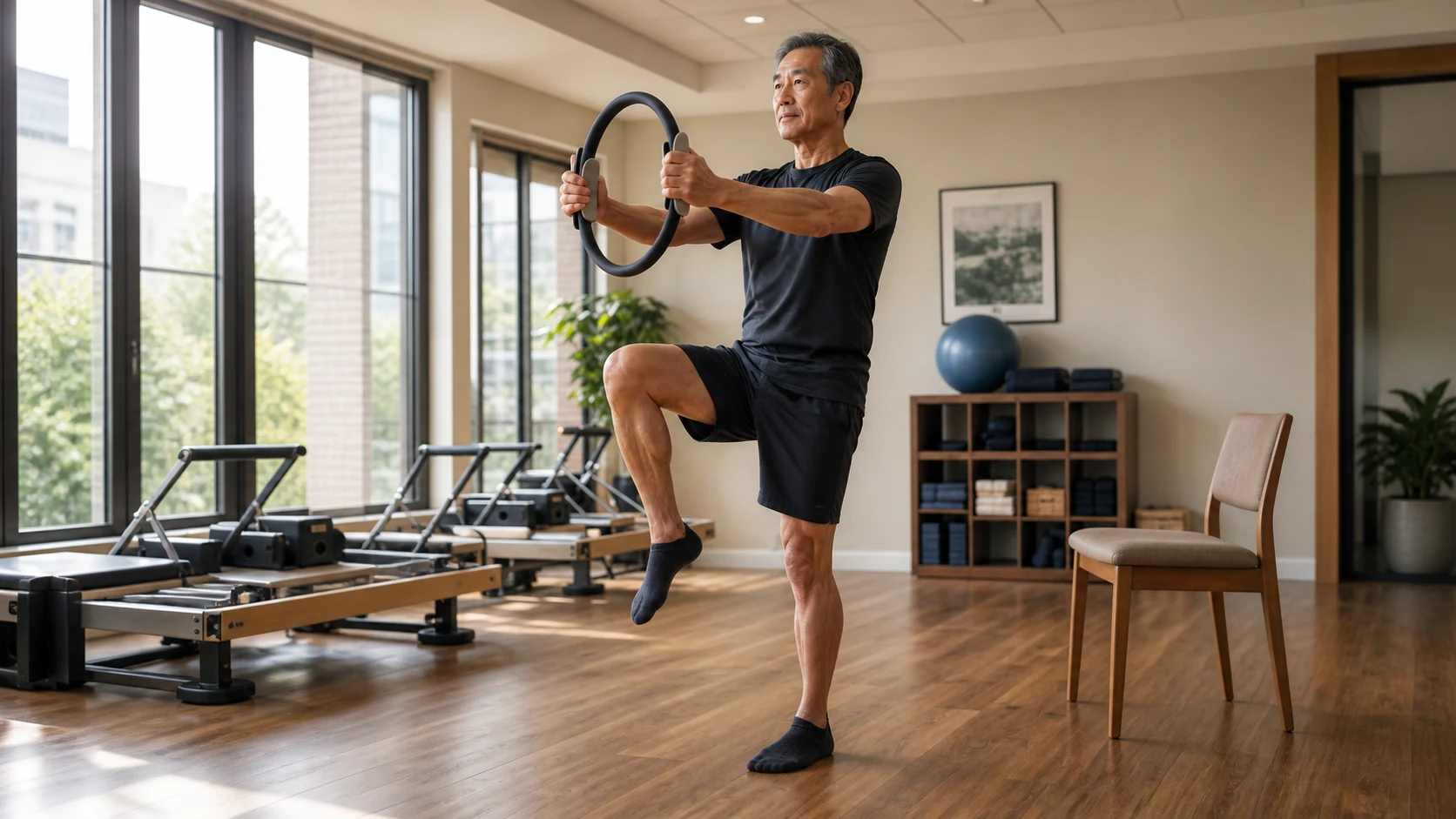

Pilates for seniors can be a useful way to practice strength, balance and controlled movement, but the right starting class depends on floor access, symptoms and medical history. Research supports several physical improvements in adults 60 and older; it does not show that any online sequence prevents falls for every older adult.
If you are comfortable moving to and from the floor, a beginner mat class may fit. If floor access or standing balance is difficult, ask about a chair, supported standing or equipment-based option before joining; recent falls, a fracture, osteoporosis concerns, surgery or significant pain deserve individual guidance.
Choose an entry point before choosing a class
“Senior Pilates” describes an audience, not a standardized program. Use this class-selection card to ask a qualified instructor how a session would be adapted, rather than treating a chair label as proof that every movement is safe for every condition.
| Starting situation | Class option to discuss | What to ask before starting |
|---|---|---|
| Floor entry and exit are comfortable | Beginner mat or equipment-based Pilates | How do you teach a slower version and stop a movement that causes pain? |
| Floor entry is difficult but seated movement is comfortable | Chair-based work with a stable chair and an instructor who can adapt positions | Which movements can stay seated, and which need standing support? |
| Standing balance is the main concern | Supported standing work beside a stable surface, with a clinician or instructor choosing the difficulty | Is someone close enough to assist, and can the task be made easier immediately? |
| Recent fall, fracture, surgery, marked pain, dizziness or known osteoporosis | Individual assessment before a general class | Does a clinician or physical therapist need to set movement limits or investigate symptoms first? |
A beginner class might use breathing, gentle trunk control and small limb movements before more demanding balance or resistance work. Those are examples of class elements, not a tested first-session protocol or a substitute for an instructor demonstrating the movements.
What did the 39-study Pilates review find?
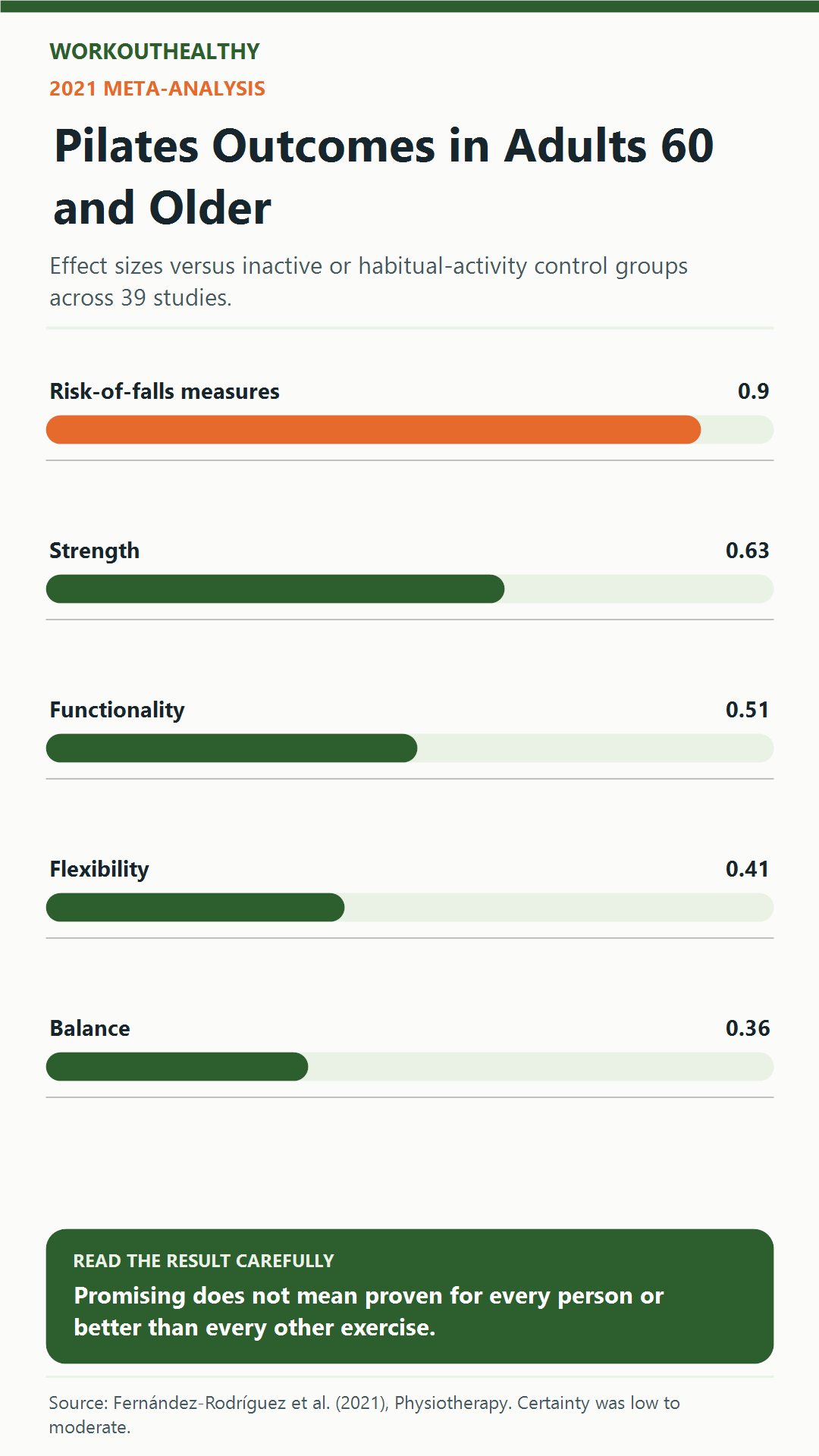
Fernández-Rodríguez and colleagues pooled 39 randomized trials involving adults 60 and older, comparing Pilates programs with habitual activity or nonexercise controls. Average standardized effects favored Pilates for balance (0.36), strength (0.63), flexibility (0.41), functionality (0.51) and measures the authors grouped as risk of falls (0.90).
Those standardized values combine different test scales; 0.90 does not mean 90% fewer falls. The review rated certainty low for balance, flexibility and functionality, and moderate for strength and fall-risk measures.
The programs differed in duration, equipment, supervision and the health of participants. A pooled average therefore cannot specify what one beginner should do, or show that Pilates beats another well-designed strength or balance program.
Does Pilates prevent actual falls?
Better balance-test performance is useful, but it is not the same endpoint as counting falls or injuries over time. A 2024 review of 39 studies and 1,770 participants found favorable postural-balance results but no evidence of reducing the number of falls or fear of falling.
A separate 2021 review focused on fall-risk factors reported too little fall-count data for a reliable incidence conclusion; only two included studies counted actual falls. This distinction matters most for people considering Pilates because they have already fallen.
Falls can involve vision, blood pressure, medication, footwear, home hazards and unexpected surfaces. If falls, fainting or new weakness are present, a clinician can assess causes that a class alone may not address.
Five questions for a first class
- Can I enter and leave each position? Ask how the instructor handles the floor, chair, standing and equipment transitions.
- Can the movement be scaled? Ask for a smaller range, stable support or another position when needed.
- What is the goal? Balance, general strength, mobility and social activity need different class emphasis.
- How does difficulty progress? Better control may come before more range, resistance or complex balance work.
- What symptoms change the plan? Sharp pain, new numbness, dizziness or worsening symptoms deserve stopping and individualized advice.
Use these questions before paying for a course, especially when a class calls itself “gentle” without explaining how it handles different abilities.
Where does Pilates fit in a weekly activity plan?
The CDC recommends aerobic, muscle-strengthening and balance activity each week for adults 65 and older. Pilates can contribute to the latter two depending on the actual class, but a gentle session should not automatically be counted as the week’s moderate aerobic activity or a complete strength plan.
Walking or another comfortable aerobic activity may fill a separate role, while progressive strength work can address muscles a class does not challenge enough. Our walking guide discusses how to choose time and effort without a universal mileage target.
The practical answer
For an older adult seeking a new class, Pilates is a reasonable option when the instructor can adapt it to current abilities and explain what the session is meant to improve. Select the starting position and support first, then judge the class by how well it progresses control and strength without worsening symptoms.
The available reviews support physical-function gains while leaving actual fall prevention uncertain. If you need precise movement instruction, choose a qualified instructor who can see and adapt how you move.
Sources
- Fernández-Rodríguez et al. 2021, 39-trial Pilates review.
- de Campos Júnior et al. 2024, postural-balance and fall-outcome review.
- 2021 review of Pilates and fall-risk factors.
- CDC older-adult physical activity guidance.
Get the next evidence check.
Five practical fitness stories worth your time, every Friday.
One email a week. No product pitches. Unsubscribe in one click.
This article is general fitness information, not medical advice or an individualized exercise prescription. Ask a qualified clinician or physical therapist about recent falls, fracture, surgery, major pain or a medical condition before choosing a class.