
A sprinter crosses the line in a personal best time, and coaches immediately want to know why.
A video from the channel NWU, North-West University, titled “Reverse Engineering in Sport: The Secret to Better Athletic Performance,” argues that studying a great performance backward can reveal how to build one.
North-West University is a real public university in South Africa, formed by a 2004 merger, with campuses in Potchefstroom, Mahikeng, and Vanderbijlpark.
Its Faculty of Health Sciences includes a Human Movement Science department, the kind of academic home this topic would actually come from.
“Reverse engineering” sounds like a term borrowed from engineering and applied to sport, so we checked whether it is a real approach in sport science or just a catchy label.
It turns out the idea has real roots in coaching and sport science research, even if the exact phrase shows up more in coaching texts than in journal titles.
Here is what the actual research on this backward looking approach supports, and where it runs out.
What the Video Claims
The video comes from NWU’s own channel and presents reverse engineering as a way to study elite performance and work backward to design training.
The general idea it describes is to look closely at what a top athlete’s body and technique are doing at the moment of success, then build a training plan aimed at producing those same qualities.
The specific examples in a short university explainer video are the presenter’s own choices for illustrating the concept.
Those exact examples are not something we can verify point by point against one published study.
What we can verify is the broader approach the video is describing.
That approach has a real name in the strength and conditioning field, and real research sits behind several of its pieces.
The video frames the idea as a fresh insight, but this way of thinking has a decades long history in sport science under a few different labels.
What Real Research Shows About Working Backward From Elite Performance
The clearest match for the video’s own term comes from strength and conditioning coaching, not from a lab study.
Strength and conditioning coach and academic Ian Jeffreys wrote a book chapter literally titled “Reverse Engineering the Path to Success” (Jeffreys, 2019).
In it, he describes starting with what a successful performance actually requires, then building a training program to develop those specific qualities.
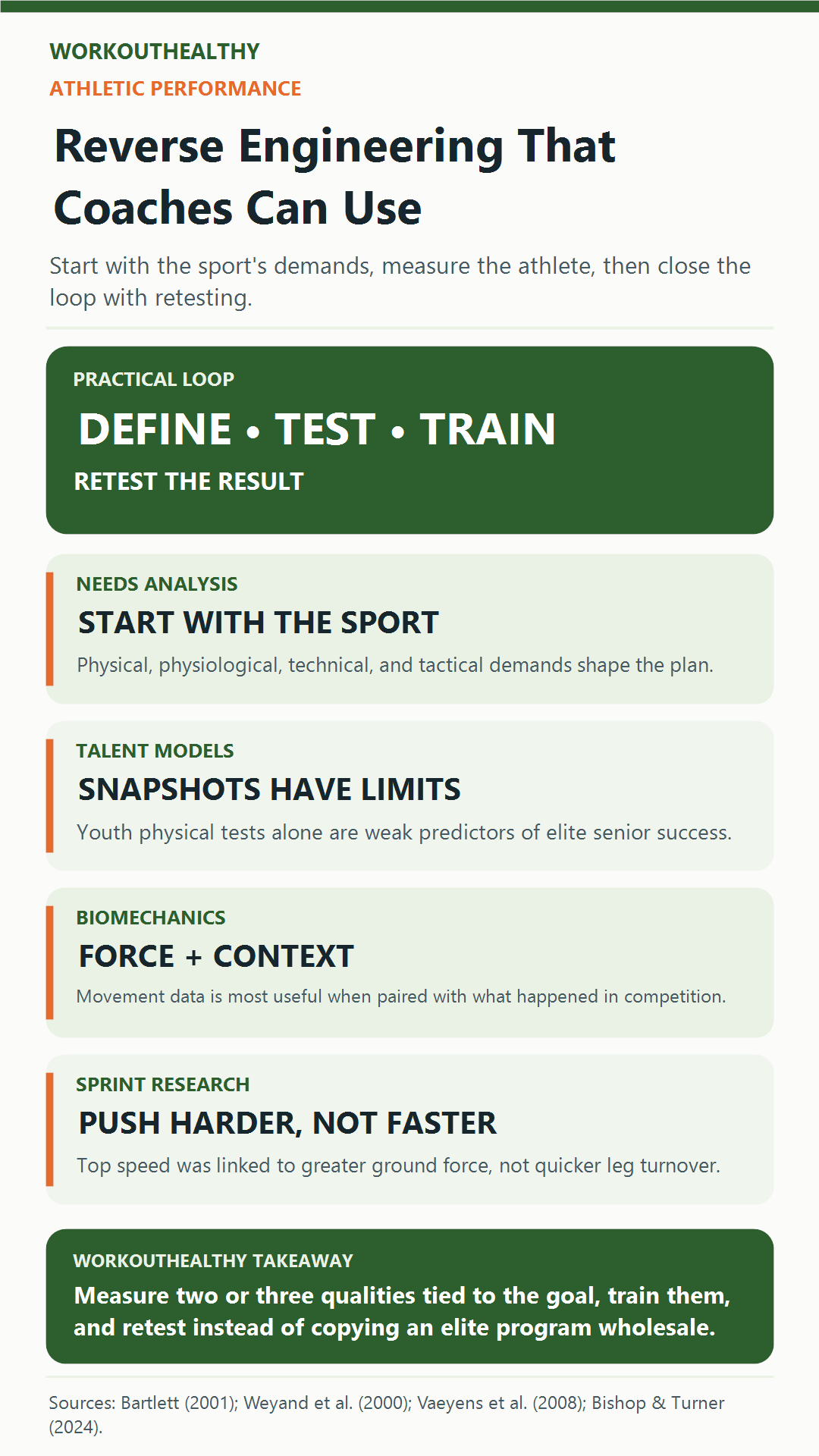
That is close to what sport scientists call a needs analysis, a formal step many coaches are trained to complete before writing a single workout (Bishop & Turner, 2024).
A needs analysis studies the demands of a sport and the traits of athletes who already perform it well, then works backward from there.
That includes the energy systems used, the joint forces involved, and the injuries most common in that particular sport.
Coaches have used some version of this backward planning for decades, with formal guidance on it appearing in strength and conditioning journals as early as the 1980s (Kraemer, 1984).
The idea is not new, but “reverse engineering” is simply a newer, catchier way to describe an old, well tested coaching habit.
What Real Research Shows About Talent Identification and Performance Modeling
Sport scientists have also tried to reverse engineer success on a much bigger scale, across whole groups of athletes rather than one training plan at a time.
This field is called talent identification, and it tries to find the traits that separate elite athletes from everyone else (Vaeyens et al., 2008).
Researchers measure things like sprint speed, jump height, and aerobic capacity in large groups of young athletes at different levels.
Then they look backward from who actually became elite to see which early traits actually predicted that outcome.
A major review of this research found some genuinely useful patterns, but also some hard limits (Vaeyens et al., 2008).
A major review of talent identification research found that physical testing in youth, on its own, is a weak predictor of who will go on to become an elite senior athlete.
Growth timing, coaching quality, and simple opportunity all mattered just as much as the physical traits researchers could measure.
That does not make physical testing useless, but it does mean treating a snapshot of elite traits as a full blueprint is a mistake.
Reverse engineering the finish line does not automatically reveal the entire path that got someone there.
What Real Research Shows About Biomechanical Analysis of Elite Technique
A more literal kind of reverse engineering happens in biomechanics labs, where researchers break down exactly what an elite athlete’s body is doing during a movement.
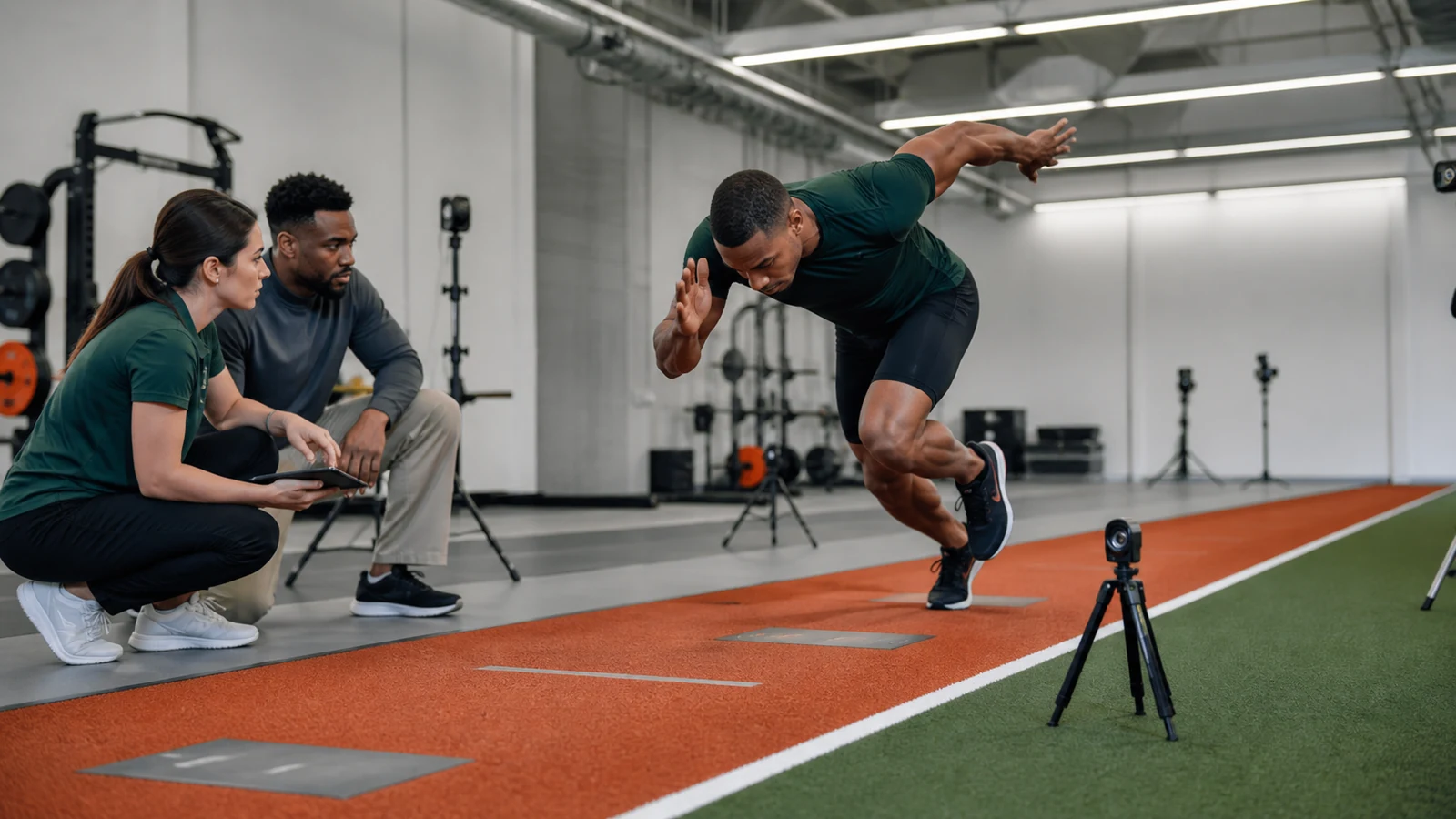
One influential paper argued that coaches get the most value when biomechanical data, meaning the forces and angles inside a movement, gets combined with notational analysis, meaning the record of what actually happened in competition (Bartlett, 2001).
Put together, those two data sources let researchers work backward from a result, like a win or a personal best, to the specific movement pattern behind it.
Notational analysis has its own detailed research base covering how to collect and interpret this kind of performance data reliably (Hughes, 2004).
A well known real world example comes from research on elite sprinters.
Researchers compared what actually separated faster sprinters from slower ones at the level of ground contact (Weyand et al., 2000).
The answer was not leg turnover speed, which is what many coaches at the time assumed mattered most.
Faster sprinters pushed harder into the ground with each stride instead of simply moving their legs faster.
That single finding reshaped how many sprint coaches train, shifting real attention toward force production rather than only leg speed drills.
This is reverse engineering in its most literal sense: start with the outcome, top speed in this case, and work backward to the specific mechanical cause.
Lower body power shows up the same way across several other sports, a pattern covered in our piece on whether box jumps build muscle.
The Mechanism
None of this works because reverse engineering is magic, and researchers have a fairly clear idea of why the approach actually helps.
Human movement follows the same physics for everyone, elite competitor or complete beginner.
The forces, angles, and timing found inside a great performance are not random, because they follow rules a body has to obey to move efficiently.
Studying an elite performance closely can reveal which of those rules matter most for one specific skill.
A needs analysis works the same way at the level of a whole program, using the demands of a sport to decide which qualities are worth training first (Bishop & Turner, 2024).
Strength is one of the most consistent qualities to show up across this kind of analysis, which is part of why resistance training earns a place in nearly every serious program, a benefit that reaches well beyond sport performance and is covered in our article on whether lifting weights keeps your brain young.
The mechanism only works, though, when the trait being studied is actually something training can change.
Some traits found in elite athletes, like limb length or certain genetic factors, cannot be trained into existence no matter how good the analysis is.
What This Evidence Does Not Prove
Finding a pattern inside elite athletes does not prove that pattern caused their success.
Elite athletes are already a selected group, since people with certain traits may simply be more likely to reach that level in the first place, not created by training alone.
A pattern found in elite athletes shows what winners tend to look like, not proof that copying it will make someone else a winner too.
The talent identification review was explicit that early physical testing carries weak predictive power on its own (Vaeyens et al., 2008).
A single biomechanical finding, like the sprint force research, describes what strong sprinters actually do, not a guarantee that training that one trait alone will produce an elite sprinter.
Case studies of one specific elite athlete’s habits carry that same limitation on a smaller scale.
Copying one person’s routine, diet, or technique cannot separate what genuinely mattered from what was incidental, a problem covered in detail in our breakdown of Jay Cutler’s 1993 diet and what the math behind it really says.
Reverse engineering is a good way to generate hypotheses about training, not a way to prove any single hypothesis is correct on its own.
Only a properly designed study, testing the trait in a new group of athletes, can actually do that.
Common Mistakes
The most common mistake is copying an elite athlete’s outcome without doing the actual needs analysis behind it.
A sprinter’s stride does not transfer directly to a swimmer or a weightlifter, because the underlying demands are completely different sports.
Another common mistake is treating one impressive case study as proof, rather than as a single data point among many.
A third mistake is ignoring the selection bias built into elite sport, since the athletes being studied already survived years of competition and injury.
A fourth mistake is skipping real measurement entirely and relying on eyeballing video instead of actual biomechanical or performance data.
A fifth mistake is applying an adult elite athlete’s training demands directly onto a younger or less experienced athlete without adjusting for training age.
A sixth mistake is treating reverse engineering as a single exercise done once, instead of an ongoing loop of testing, training, and retesting.
Who Should Be Extra Careful
Youth athletes are the clearest group who need caution here, since their bodies and training age look nothing like an elite adult’s.
Growth plates, coordination, and hormone levels are all still changing during adolescence, and copying an adult program can raise injury risk instead of raising performance.
Athletes returning from a significant injury should also be careful about reverse engineering an elite competitor’s current training load.
An injured athlete’s tissue capacity is not the same as a healthy elite competitor’s, even when their sport and position match exactly.
Recreational lifters and weekend athletes should be careful about copying an elite athlete’s training volume, since that volume assumes years of already built training capacity.
Anyone relying on a single video, article, or online personality as their only source of guidance should be cautious, since a real needs analysis usually draws on more than one source of evidence.
Coaches without access to real testing tools should stay honest about the limits of judging technique by eye alone.
Anyone with a current injury, joint pain, or a diagnosed medical condition should talk to a doctor or physical therapist before adopting a new training approach based on any online video.
A Practical Takeaway
Reverse engineering athletic performance is a legitimate approach, but it works best as a structured process, not a single insight pulled from one video.
Start with a clear, specific goal rather than something vague like “get better,” since a needs analysis only works when the target is precise (Bishop & Turner, 2024).
Identify two or three measurable qualities that real research actually links to that specific goal, instead of copying an entire program wholesale.
Test where those qualities currently stand, using real measurements where possible instead of guesswork.
Build a training plan around improving those specific qualities, using established, well tested methods rather than an exotic technique one elite athlete happened to use.
Retest periodically to confirm the plan is actually working, since the entire point of reverse engineering is closing the loop between outcome and cause.
Structured, deliberate training tends to beat unstructured effort here, a preference our own readers lean toward as well, covered in our piece on why 85 percent of readers favor weightlifting over running.
Whatever the goal, this approach rewards patience and measurement far more than it rewards chasing a single trick borrowed from one champion’s highlight reel.
Watch the video
Want more like this? Subscribe to WorkoutHealthy Insider for practical explanations behind popular fitness claims.
References
Bartlett, R. (2001). Performance analysis: Can bringing together biomechanics and notational analysis benefit coaches? International Journal of Performance Analysis in Sport, 1(1), 122 to 126. https://doi.org/10.1080/24748668.2001.11868254
Bishop, C., & Turner, A. (2024). Undertaking a needs analysis to inform fitness testing and program design. In Conditioning for Strength and Human Performance. Routledge. https://doi.org/10.4324/9781003366140-11
Hughes, M. (2004). Notational analysis: A mathematical perspective. International Journal of Performance Analysis in Sport, 4(2), 97 to 139. https://doi.org/10.1080/24748668.2004.11868308
Jeffreys, I. (2019). Reverse engineering the path to success. In Effective Coaching in Strength and Conditioning (pp. 170 to 182). Routledge. https://doi.org/10.4324/9780203794999-14
Kraemer, W. J. (1984). Program design: Exercise prescription: Needs analysis. National Strength & Conditioning Association Journal, 6(5), 47. https://doi.org/10.1519/0744-0049(1984)006%3C0047:epna%3E2.3.co;2
Vaeyens, R., Lenoir, M., Williams, A. M., & Philippaerts, R. M. (2008). Talent identification and development programmes in sport: Current models and future directions. Sports Medicine, 38(9), 703 to 714. https://doi.org/10.2165/00007256-200838090-00001
Weyand, P. G., Sternlight, D. B., Bellizzi, M. J., & Wright, S. (2000). Faster top running speeds are achieved with greater ground forces not more rapid leg movements. Journal of Applied Physiology, 89(5), 1991 to 1999. https://doi.org/10.1152/jappl.2000.89.5.1991
This article is for general information only and is not medical advice. If you have an injury, ongoing pain, or a medical condition, talk to a doctor or physical therapist before you change how you train or eat.