

A video from Jos McGee Sr makes a bold claim.
It says a new study found that muscle decline starts at 35, not 40.
That is a specific number, and specific numbers deserve a real check.
Age related muscle loss affects almost everyone eventually.
Knowing roughly when it starts helps people decide when to act.
What the Video Claims
The video’s title states the claim directly: muscle decline starts at 35, not 40.
It frames this as new research that overturns an older assumption.
The video does not name the study, the authors, or the journal behind it.
That makes the exact claim difficult to verify on its own.
We went looking for the actual science behind the age of onset question.
Real research in this area is more nuanced than a single birthday.
The honest picture depends heavily on what gets measured and how.
What Real Research Shows About Muscle Mass and Age
One of the most cited studies on this topic comes from Ian Janssen and colleagues.
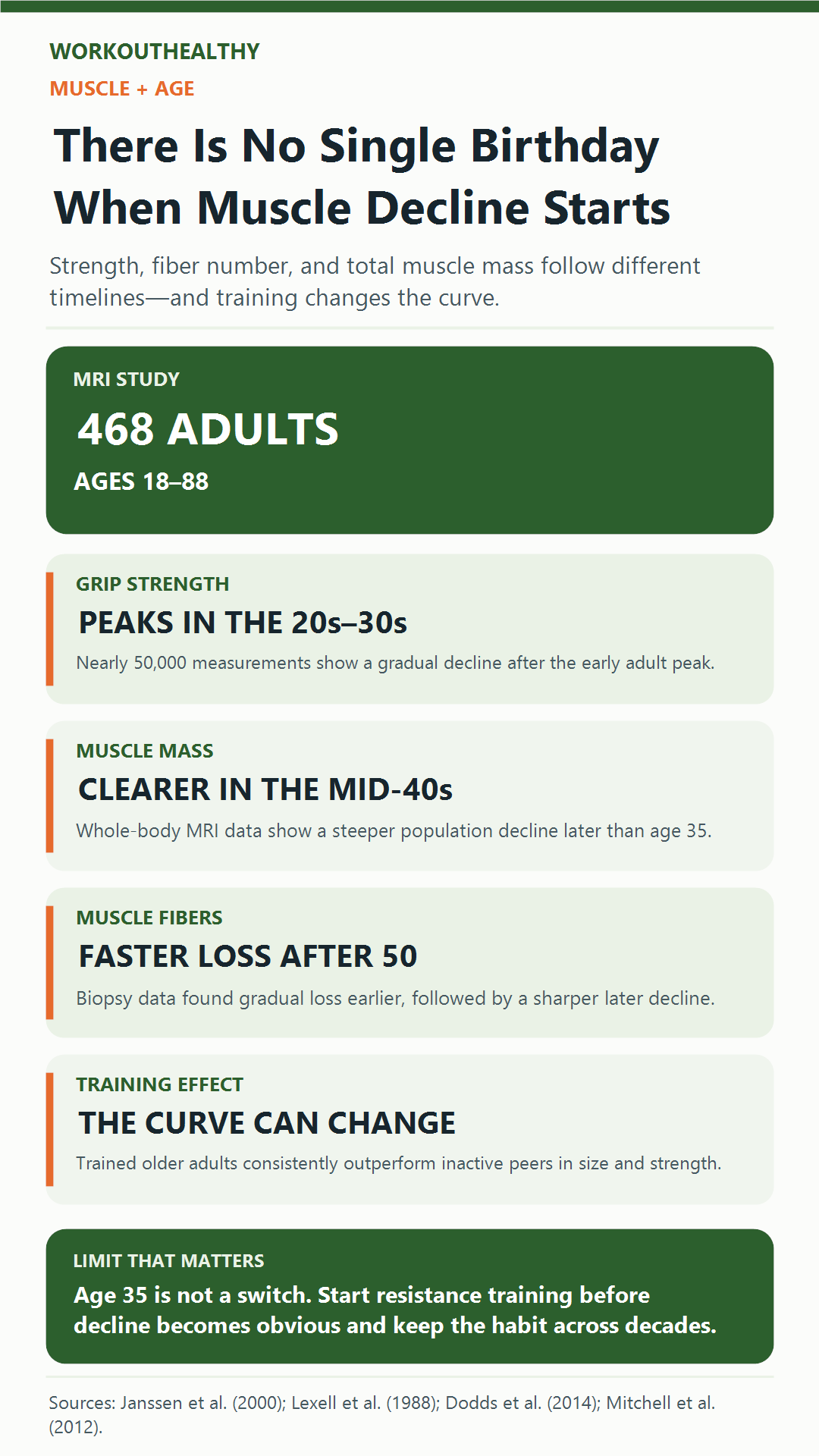
Their 2000 paper in the Journal of Applied Physiology studied 468 men and women.
Participants ranged in age from 18 to 88 years old.
The researchers used whole body MRI scans to measure skeletal muscle directly.
That is a far more precise method than estimating muscle from body weight alone.
Relative skeletal-muscle mass—the share of body mass made up of muscle—was lower beginning in the third decade. A noticeable decline in absolute muscle mass did not appear until about the end of the fifth decade, driven mainly by the lower body. This cross-sectional pattern does not identify a universal personal start date (Janssen et al., 2000).
This is one reason researchers have historically pointed to 40 or later as a marker.
A different kind of evidence comes from Jan Lexell and colleagues in 1988.
Their study examined actual muscle tissue instead of just overall size.
They analyzed whole cross sections of the vastus lateralis, a large thigh muscle.
Samples came from men aged 15 to 83.
The authors estimated that atrophy of this one thigh muscle begins around age 25 and then accelerates. Loss of fiber number explained more of the observed change than reduced fiber size; type 2 fibers showed more size reduction. Because the study examined autopsy samples from 43 men, it should not be turned into an exact onset age for every person (Lexell et al., 1988).
Neither study supports a clean, sudden shift at exactly age 35.
Both instead describe a long, gradual slope that steepens later in life.
What Real Research Shows About Strength and Age
Muscle mass is only part of the story.
Strength can start slipping before mass loss becomes visible on a scan.
A 2014 study by Richard Dodds and colleagues pooled data from 12 British studies.
Nearly 50,000 people had their grip strength measured across the adult lifespan.
That pooled sample is large enough to draw a fairly reliable curve.
Median grip strength peaked at ages 29–39 for men and 26–42 for women in these cross-sectional data. The authors described a period of maintenance through midlife, followed by decline. A peak range is not proof that each person’s strength starts declining immediately after age 35 (Dodds et al., 2014).
This means strength, in some measures, can start dropping earlier than muscle size does.
A 2012 review by Kyle Mitchell and colleagues backs up this pattern.
They combined findings from dozens of cross sectional and longitudinal studies.
Across older-adult studies, strength often declines faster than muscle mass. That distinction is sometimes described as dynapenia: age-related loss of strength that cannot be inferred from size alone. The review does not establish one universal age when strength or power decline begins (Mitchell et al., 2012).
So depending on what gets measured, an early decline is defensible.
But it is a shift in trend lines, not a hard switch at age 35.
Strength can start drifting downward years before muscle mass shows any visible change on a scan.
What Real Research Shows About Slowing the Decline
The same body of research that documents decline also documents what changes it.
Muscle tissue stays responsive to training across the entire adult lifespan.
Resistance-training trials in older adults show that muscle and strength remain trainable, with modest average improvements in physical performance. Inactivity can contribute to loss, but the reviewed evidence does not quantify how much of any individual’s decline is due to disuse rather than other age-related processes (Mitchell et al., 2012).
That distinction matters because it changes what a person can actually do about it.
The Mechanism
Muscle loss with age happens through a few overlapping processes.
Age-related changes in motor units and muscle fibers may contribute to loss of strength and size. Lexell’s study found fiber loss without a predominant loss of one fiber type, although type 2 fibers showed more size reduction. These mechanisms do not switch on at a specific birthday.
Protein synthesis, the process that rebuilds muscle after use, also slows with age.
Older muscle needs a stronger stimulus, like more protein or more effort, to trigger the same repair.
Researchers sometimes call this blunted response anabolic resistance.
Hormone levels tied to muscle maintenance shift gradually across adulthood too.
Low grade inflammation tends to rise slowly with age as well.
That background inflammation can interfere with normal muscle repair.
None of these processes switches on overnight at one specific birthday.
They build slowly, which is exactly why studies describe a range instead of one date.
What This Evidence Does Not Prove
This research does not prove the video’s specific “35, not 40” claim is false.
It also does not prove that exact claim is accurate as stated.
We could not trace it to one specific, verifiable peer reviewed study.
The honest answer is that onset age depends heavily on what gets measured.
Strength trends can shift earlier than muscle mass trends do.
Individual results also vary a lot based on activity level and genetics.
Someone who lifts weights regularly in their 30s may show little decline at all.
Someone who is mostly sedentary may show earlier changes than the averages suggest.
Population averages describe trends across large groups, not a guarantee for one person.
None of the studies above were designed to test a single video’s exact claim.
They describe broad patterns across thousands of people, not a verdict on one number.
Muscle aging does not arrive on a single birthday. It builds slowly, through several overlapping biological processes.
Common Mistakes
One common mistake is treating any single age as a hard deadline.
Bodies do not read research papers and switch tracks on schedule.
Another mistake is assuming nothing can be done once decline starts.
Resistance training measurably slows muscle and strength loss at almost any age.
A third mistake is confusing muscle loss with unrelated weight changes.
Not all weight loss is muscle loss, and the two need separate tracking.
Our guide on losing weight and muscle mass breaks down that difference.
A fourth mistake is waiting for a symptom before starting strength work.
Starting strength work before a major loss is practical, but older adults can still gain strength after a long break.
A fifth mistake is doing only cardio and skipping resistance work entirely.
Cardio supports the heart, but it does not target strength the same way.
A sixth mistake is chasing soreness as proof that a workout worked.
Consistent, moderate effort over months matters more than one brutal session.
Who Should Be Extra Careful
Anyone over 60 with a sudden drop in grip strength should mention it to a doctor.
Sudden strength loss, unlike gradual aging, can signal something else going on.

People recovering from illness, surgery, or a long sedentary stretch lose muscle faster.
That faster loss is sometimes called disuse atrophy.
Adults managing diabetes or thyroid conditions should also pay closer attention.
Those conditions can accelerate muscle and strength changes beyond typical aging.
Postmenopausal women face an added hormonal shift that can speed up muscle loss.
That shift makes resistance training especially useful during and after menopause.
People on long term steroid medication should also watch their strength closely.
Those drugs can weaken muscle tissue as a known side effect.
A simple way to check functional strength at home is the four flights stair test.
Anyone starting resistance training after a long break should start light and progress slowly.
A doctor or physical therapist can help tailor a plan around existing conditions.
A Practical Takeaway
The exact starting age matters less than the response to it.
Resistance training two to three times a week is well supported at any adult age.
It does not require heavy weights or an expensive gym membership.
Bodyweight squats, rows, and presses count as real resistance training too.
Protein intake spread across the day supports the muscle building process.
Daily movement matters too, and it does not need to be complicated.
Readers on this site consistently lean toward strength work over cardio.
A recent reader survey on this site backs that instinct up.
Age is not a wall against building or keeping muscle.
Edith Connor’s story shows how much room there still is to build strength later in life.
Consistency across years matters more than any single workout.
Strength training also carries benefits beyond muscle, including for brain health as people age.
Starting now, at whatever age that is, beats waiting for a cleaner number that may not exist.
Watch the video
Want more like this? Subscribe to WorkoutHealthy Insider for practical explanations behind popular fitness claims.
References
Janssen, I., Heymsfield, S. B., Wang, Z., & Ross, R. (2000). Skeletal muscle mass and distribution in 468 men and women aged 18 to 88 yr. Journal of Applied Physiology, 89(1), 81 to 88. https://doi.org/10.1152/jappl.2000.89.1.81
Lexell, J., Taylor, C. C., & Sjöström, M. (1988). What is the cause of the ageing atrophy? Total number, size and proportion of different fiber types studied in whole vastus lateralis muscle from 15 to 83 year old men. Journal of the Neurological Sciences, 84(2 to 3), 275 to 294. https://doi.org/10.1016/0022-510X(88)90132-3
Dodds, R. M., Syddall, H. E., Cooper, R., Benzeval, M., Deary, I. J., Dennison, E. M., Der, G., Gale, C. R., Inskip, H. M., Jagger, C., Kirkwood, T. B., Lawlor, D. A., Robinson, S. M., Starr, J. M., Steptoe, A., Tilling, K., Kuh, D., Cooper, C., & Sayer, A. A. (2014). Grip strength across the life course: Normative data from twelve British studies. PLOS ONE, 9(12), e113637. https://doi.org/10.1371/journal.pone.0113637
Mitchell, W. K., Williams, J., Atherton, P., Larvin, M., Lund, J., & Narici, M. (2012). Sarcopenia, dynapenia, and the impact of advancing age on human skeletal muscle size and strength; a quantitative review. Frontiers in Physiology, 3, Article 260. https://doi.org/10.3389/fphys.2012.00260
This article is for general information only and is not medical advice. If you have an injury, ongoing pain, or a medical condition, talk to a doctor or physical therapist before you change how you train or eat.