
Grip strength and longevity: what was measured, and what does the reported number mean? Start with those questions before treating a score as a personal forecast.
The floor-rise research adds another question: what does a different movement task reveal? Comparing the actual studies helps explain why neither test should become a survival score or a contest to find the single “best” health marker.
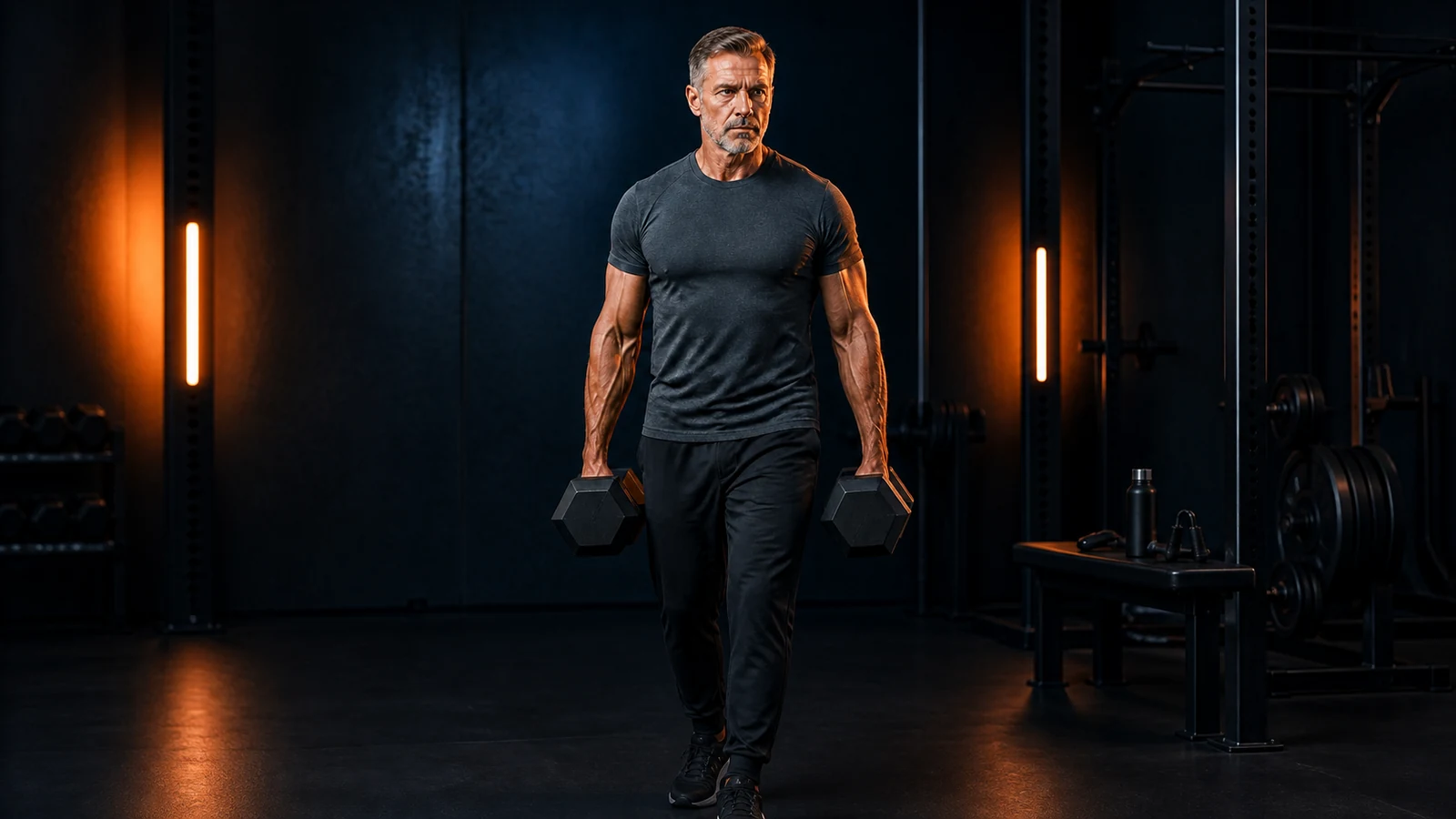
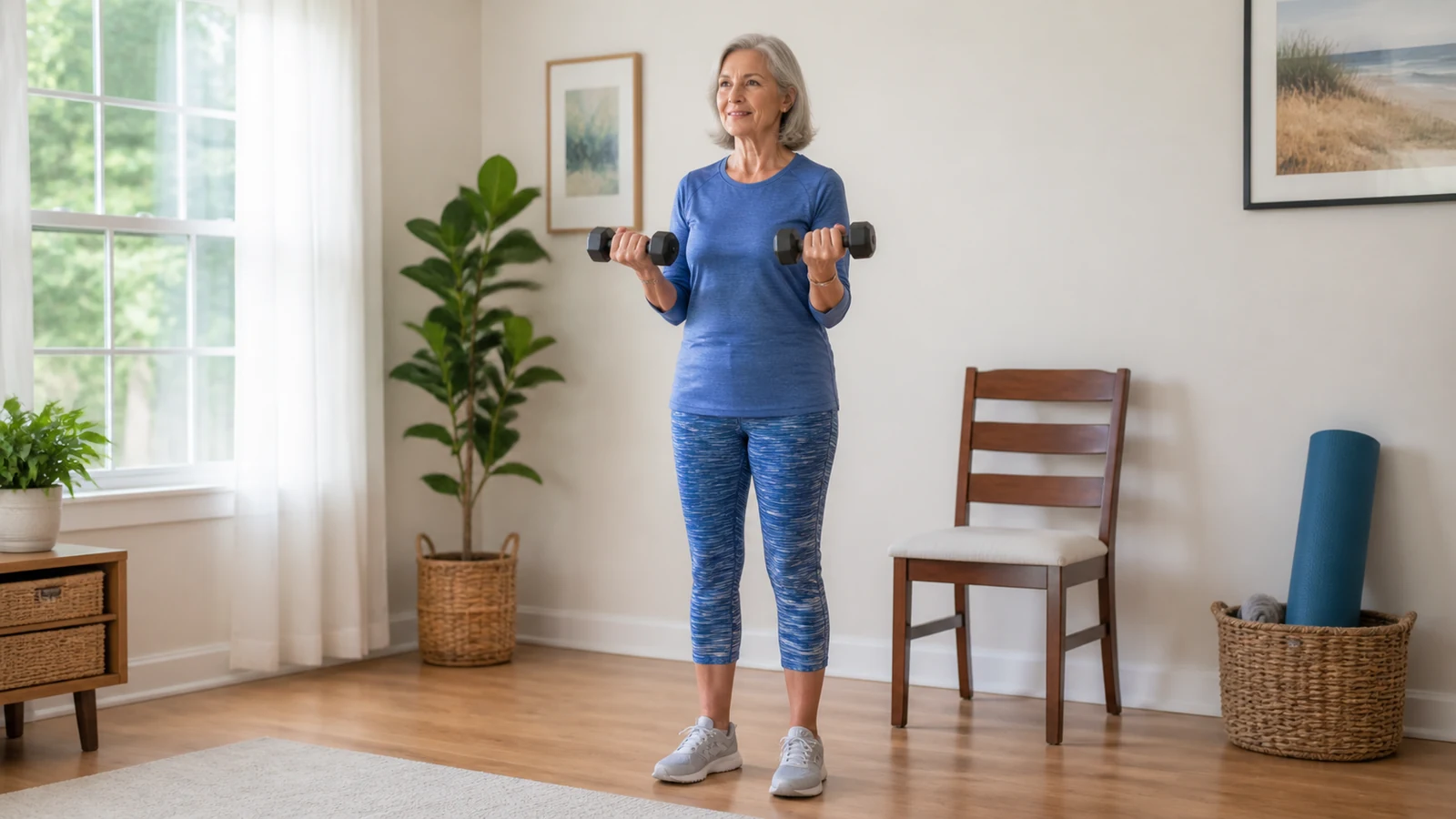
The pictured dumbbell hold is an exercise illustration, not the dynamometer test used in the grip study or a demonstration of the sitting-rising test. The people illustrated here are not identified research participants.
Read the grip paper
PURE analyzed 139,691 adults aged 35 to 70 with known vital status across 17 countries, using a Jamar dynamometer; median follow-up was four years. Per five-kilogram lower baseline grip, adjusted mortality hazard ratios were 1.16 for all causes (95% CI 1.13 to 1.20) and 1.17 for cardiovascular deaths.
Those are 16% and 17% higher relative hazards, not years lost or evidence that adding five kilograms reverses the associations.
Grip predicted mortality more strongly than systolic blood pressure within PURE; this does not establish a universal ranking or replace blood-pressure care.
CDC guidance explains that hypertension often has no symptoms and requires blood-pressure measurement to identify. A reassuring strength result does not replace recommended monitoring or treatment.
Compare the tasks
A dynamometer records squeezing force. A chair rise, timed squat and floor rise are different tasks; keep the actual measurement name attached to its result.
CLINIMEX followed 4,282 adults aged 46 to 75 at a private Brazilian clinic (median 12.3 years). Experienced physicians scored sitting and rising separately for support/unsteadiness; strength, balance and flexibility contribute, so difficulty does not identify one cause.
| Study feature | PURE grip cohort | CLINIMEX sitting-rising cohort |
|---|---|---|
| Participants | Who provided a valid grip measurement? | Who could complete the floor task? |
| Follow-up | Distinguish a median from a fixed risk window. | Check the time window behind the estimate. |
| Mortality outcome | Which causes of death were analyzed? | Which deaths were excluded? |
| Interpretation limit | Was training assigned? | Was practicing this task assigned? |
People with testing limitations were excluded; this was neither unselected home testing nor assigned practice. Natural/cardiovascular analyses excluded COVID-19/external deaths; online 2025, issue 2026.
Why Bigger Risk Numbers Do Not Identify a Better Test
Lowest versus perfect CLINIMEX scores: adjusted natural-mortality hazard ratio 3.84.
A fixed force difference and opposite ends of a movement-score scale are different comparisons. A larger headline number alone cannot settle which test is better.
Before comparing estimates, align the participants, follow-up, outcome and statistical adjustments. Write down each difference instead of ranking two numbers.
A proper comparison would need an appropriate design measuring both tests in the same population and assessing their added predictive information. Merely finding a statistically significant association for each is not that comparison.
Keep a mortality coefficient separate from a calculation of remaining years. An association and a personal prognosis answer different questions.
A Raw Percentage and an Adjusted Estimate Are Different
Scores 8 versus 10: 11.1% versus 3.7% observed natural deaths (CLINIMEX Table 2).
Fully adjusted hazard ratio: 1.51 (95% CI 0.92 to 2.66), including 1. No clear adjusted association for this pair.
A raw ratio and an adjusted model answer different questions. Reading the comparison label prevents a percentage from silently becoming a model result.
A median follow-up is not a fixed risk window for every participant. Do not relabel observed proportions as everyone’s “12-year risk.”
The practical lesson is to preserve the label attached to a number. Observed percentage, adjusted hazard ratio and an individual’s probability are different quantities.
Grip Is Useful Without Being a Complete Health Assessment
Bohannon’s 2019 narrative review summarizes grip associations with several health and functional outcomes. It also warns that grip does not always reflect overall strength and may be more informative alongside a lower-limb measure.
The review acknowledges inconsistent testing procedures and thresholds across studies. It is a broad narrative synthesis, not one standardized experiment proving that every outcome follows from hand strength.
Combined measurements have also been studied directly, but the details matter. A 2016 ELSA analysis examined grip, chair-rise speed and later survival among adults aged 60 to 85.
The investigators transformed measurements into a shared research metric to examine education-related differences in survival. That was not the CLINIMEX floor test, and it supplies no justification for adding a home grip number to a floor-rise score.
These findings support asking which abilities an assessment covers. They do not establish a universal home formula, a single healthy cutoff or a competition between hand and leg function.
Build a Better Receipt for a Longevity Claim
Before sharing a striking strength headline, retain the information needed to understand it. This short source receipt is a reading aid, not a medical screening score.
- Task: Was the measurement a dynamometer squeeze, chair rise, floor rise or a different exercise?
- Contrast: Did the estimate compare categories, a fixed force difference or changes over time?
- Outcome: Was it all-cause mortality, selected causes of death, physical function or something else?
- People and time: Who was eligible, who was excluded and how long were participants followed?
- Intervention: Did researchers actually assign training, or observe existing differences?
Try this headline check: would replacing “measured force” with “assigned training” change the exposure? Keep the original exposure rather than silently converting observation into an intervention.
For a floor-rise headline, retain the actual task and selection criteria. Rewriting it as “anyone who uses a hand is in danger” discards the research setting and overstates what an individual action establishes.
Keep the source available when discussing a claim with a health professional. A screenshot of a risk percentage without the comparison cannot carry the same information.
Use Functional Concerns to Ask Better Questions
You do not need to perform either test to read this research. Do not attempt an unsupported floor challenge when getting down or up could be unsafe, or force a painful hand test to obtain a score.
If everyday tasks have become harder, describe the actual change: opening containers, carrying familiar objects, getting out of a chair or moving safely. A clinician or physical therapist can choose a suitable assessment without requiring the task shown in a viral clip.
Useful questions include what the result measures, whether pain or another limitation affected it, and whether comparison with a previous assessment is appropriate. Ask which functional goal matters rather than how to earn a perfect survival score.
Sudden weakness is a different concern from an ordinary fitness trend. CDC stroke guidance says to call 911 right away for warning signs such as sudden weakness or numbness, especially on one side, or sudden trouble speaking.
If your separate question is how to record a dynamometer result, our home grip-strength measurement guide explains device instructions and comparable records. This article addresses the longevity interpretation, rather than creating another testing protocol.
Keep the Health Signal Without the Lifespan Promise
Keep the actual task, comparison and uncertainty with any strength-and-longevity claim. Use the source receipt to organize a discussion, rather than treating a score as a verdict about your future.
Health disclaimer: This article provides general fitness and research information, not medical advice, diagnosis or a personal prognosis. Ask a qualified healthcare professional about an appropriate assessment or exercise approach if pain, injury, a medical condition or a concerning change in function affects you.
References
Leong, D. P., et al. (2015). Prognostic value of grip strength: Findings from the Prospective Urban Rural Epidemiology (PURE) study. The Lancet, 386(9990), 266 to 273. Read the indexed abstract.
Araújo, C. G. S., et al. (2025; issue 2026). Sitting-rising test scores predict natural and cardiovascular causes of deaths in middle-aged and older men and women. European Journal of Preventive Cardiology, 33(12), 2170 to 2178. Read the original cohort paper.
Bohannon, R. W. (2019). Grip strength: An indispensable biomarker for older adults. Clinical Interventions in Aging, 14, 1681 to 1691. Read the narrative review.
Sanderson, W. C., et al. (2016). Combined measures of upper and lower body strength and subgroup differences in subsequent survival among the older population of England. Journal of Aging and Health, 28(7), 1178 to 1193. Read the indexed abstract.
Centers for Disease Control and Prevention. (2026). About high blood pressure; Signs and symptoms of stroke.