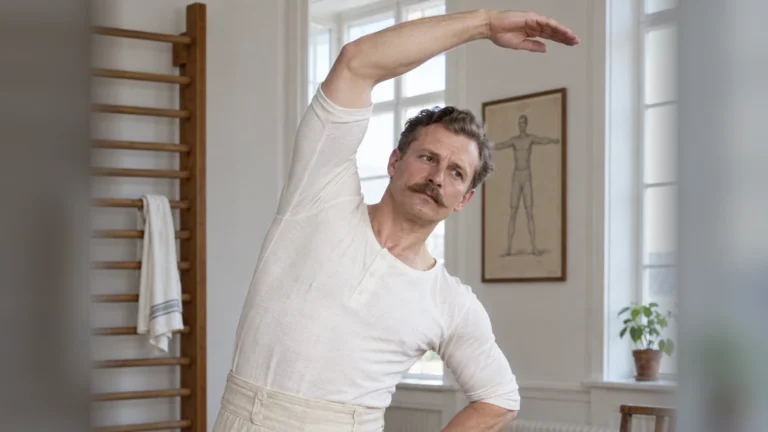

Low impact cardio for seniors can use ordinary marching, side steps and heel taps, with no jumping or floor exercises. The plan below has a 12-minute main block, plus a five-minute warm-up and five-minute cool-down, so allow at least 22 minutes altogether.
This is a general standing exercise example for adults who can move independently, not cardiac rehabilitation or a treatment for heart disease. The original Drew Hopper video remains below, separate from our timed plan and the research on short exercise bouts.
Choose the pace and space first
Clear a nonslip area where you can take a small step in either direction without crossing your feet or reaching around furniture. Wear suitable footwear and keep stable support within reach, while leaving enough room to move without pulling on it.
Keep the first attempt easy enough to speak comfortably. The CDC talk test describes moderate intensity as an effort where you can talk but cannot sing; low impact alone does not establish that intensity.
If you feel unsteady, have a new exercise restriction or need a seated program, get help selecting a suitable routine. Changing a standing movement into a seated one can change its effort and mechanics, so this clock does not prescribe a chair-based rehabilitation alternative.
Learn the movements before starting a timer
March in place
- Stand upright and lift one foot, then the other, in a comfortable rhythm.
- Keep foot lifts modest enough to remain steady.
- Let your arms swing comfortably, without forcing an overhead reach.
The NHS warm-up page shows marching and heel digs with illustrations. Use it to learn the movements; our timed card is a separate editorial arrangement, not the NHS routine.
Small side step
- Take a small step to your right, then bring the other foot toward it.
- Step back toward the left and bring the other foot across to its starting position.
- Keep the motion slow and controlled, without crossing one foot over the other.
The NHS sideways-walking illustrations show this basic step pattern. This is a modest side-to-side movement, not a narrow-stance balance test or an instruction to move away from needed support.
Alternating heel tap
- Place one heel a short distance in front of you, with that foot’s toes pointing upward.
- Bring the foot back, then tap the opposite heel forward.
- Keep a small bend in the supporting leg and use only a comfortable arm movement.
You do not need a deep step, a punch or a high knee lift to follow the card. If a movement does not feel controlled, leave it out rather than trying to keep up with the clock.
The complete clock: 12 main minutes, 22 total
The American Heart Association advises five to ten minutes of slower activity to warm up and a gradual cool-down of similar length. The example below uses five minutes for each; allow longer when needed or follow your own clinician’s preparation and recovery plan.
During each main minute, move for up to 45 seconds and use the remaining 15 seconds to slow down and change movements. Longer pauses are fine, but they extend the elapsed time and reduce the amount of movement completed.
| Elapsed clock | Movement | Purpose |
|---|---|---|
| 0:00 to 5:00 | Easy walking in place, gradually adding comfortable arm swings and rehearsing the steps | Warm up without rushing to a target pace |
| 5:00 to 6:00 | March | Main slot 1 |
| 6:00 to 7:00 | Small side steps | Main slot 2 |
| 7:00 to 8:00 | Alternating heel taps | Main slot 3 |
| 8:00 to 9:00 | March again | Main slot 4 and a familiar return before repeating |
| 9:00 to 13:00 | Repeat those four one-minute slots in the same order | Second round |
| 13:00 to 17:00 | Repeat the four slots once more | Third round |
| 17:00 to 22:00 | Gradually slow your walking in place and arm movement | Cool down rather than stopping abruptly |
There are three movement choices, with marching used twice in each four-minute round. The main block is twelve minutes on the clock, not twelve uninterrupted minutes at a proven exercise intensity.
For a shorter first try, complete one four-minute round between the warm-up and cool-down, making 14 minutes in this example. Two rounds make 18 minutes; completing all three rounds is optional.
Separate elapsed time from actual movement
Twelve slots of 45 seconds provide at most nine minutes of main movement, with three minutes allocated to transitions. Warm-up and cool-down add activity, but easy movement does not automatically count as moderate-intensity aerobic time.
| Record | What to write |
|---|---|
| Session length | Actual start and finish time, including longer pauses |
| Rounds | One, two or three completed main rounds |
| Changes | Which movement you skipped or replaced with familiar marching |
| Effort | Easy conversation, talk-but-not-sing effort, or too hard |
| Next choice | Repeat unchanged, shorten, or add one round when the current work is manageable |
Do not try to make up missed work by speeding through the next minute. Repeating a comfortable format makes it easier to decide whether more time or a slightly brisker pace fits, without changing both at once.
Stop if a movement causes pain, dizziness or feeling unwell. A heart or lung condition, recent surgery or new symptoms calls for individual guidance; this routine is not a substitute for an existing medical exercise plan.
Short bouts can count, but match the actual study
In a 2020 randomized trial, Magutah and colleagues studied 53 screened sedentary adults aged 50 and older in Kenya. Their average ages were about 54 to 55, so this was not specifically a trial in adults over 65.
The trial supports discussing accumulated activity, while its exercise intensity, screened participants and repeated schedule limit transfer to this article. It cannot establish a heart-health benefit from one gentle 12-minute routine.
For adults 65 and older, CDC guidance combines aerobic activity with muscle-strengthening on at least two days and balance activity. Its general aerobic target is 150 minutes of moderate effort weekly, with activity adapted to abilities and health conditions.
This example can help organize part of a week, while walking or another suitable activity supplies additional aerobic time. It does not replace the separate strength and balance work in that guidance.

Watch the original Drew Hopper video
The source video presents its own gentle movement sequence and is about twelve minutes long. Our march, step and heel-tap clock is a different session, and the original video is not evidence that either routine prevents disease.
Start with a format you can control, record the work you completed and repeat before adding more. A short session has value as a manageable habit without needing to carry a promise about your heart or lifespan.
Medical disclaimer: This article is general fitness information, not medical advice. If you have an injury, ongoing pain or a medical condition, talk to a doctor or physical therapist before changing how you train.