

A YouTube video titled “What Exercise Scientists Actually Agree On About Strength Training” has been making the rounds.
It comes from a channel called Huberman Explained.
That name sounds official.
It is not Andrew Huberman’s own channel.
We went straight to the peer reviewed research to check what exercise scientists actually agree on.
Here is what the evidence actually supports, and where real disagreement still exists.
What the Video Claims
The video comes from a channel called Huberman Explained, not from Andrew Huberman himself.
Andrew Huberman is a real Stanford neuroscientist who hosts the Huberman Lab podcast.
His own channel publishes long interviews and solo episodes about neuroscience and health.
Huberman Explained is a separate channel that summarizes or reacts to ideas associated with his name.
That distinction matters for anyone trying to judge how much to trust a claim.
A summary channel can simplify a nuanced point until it sounds more settled than it actually is.
We could not verify specific lines from this particular video against a primary Huberman source.
So this article does not attribute any quote to Andrew Huberman directly.
Instead, we researched the underlying question using peer reviewed studies.
That question is worth asking on its own merits.
What do exercise scientists actually agree on about strength training?
The honest answer has two halves.
There is real, broad consensus on a handful of core training principles.
There is also real, ongoing disagreement on several specific details.
Both halves matter, and we cover both below.
What Real Research Shows About Progressive Overload
If exercise scientists agree on one thing more than anything else, it is progressive overload.
Progressive overload means gradually increasing the demand placed on a muscle over time.
That can mean more weight, more reps, more sets, or better technique over months of training.
Without an appropriately challenging stimulus, progress can slow; the way to increase that challenge depends on the person and goal.
The American College of Sports Medicine reviewed the resistance training literature on this exact question (Ratamess et al., 2009).
Their formal position stand was direct about the conclusion.
Progressively increasing training demands over time is necessary for continued strength and muscle gains.
This is not a niche opinion inside exercise science.
It is a useful organizing principle, but it does not prescribe one weekly increase in weight, sets, or repetitions for everyone.
Progressive overload is not one option among many for building strength. It is closer to the mechanism that nearly every other training variable exists to support.
This is also why programs that never change intensity or volume tend to stall.
A fixed routine may eventually stop providing enough challenge for further progress.
That is not a flaw in the person doing the training.
It is exactly what the research predicts should happen over time.
What Real Research Shows About Training Close to Failure
A second point of real consensus concerns how close to muscular failure a set needs to go.
Failure means the point where another full rep cannot be completed with good form.
A 2023 systematic review pooled the available controlled trials on this exact question (Refalo et al., 2023).
The researchers compared several definitions of training to failure with non-failure training; the studies did not all use the same repetitions-in-reserve target.
Training close to failure produced hypertrophy results similar to training all the way to failure.
Grinding out the absolute last rep on every set is not required for muscle growth.
Stopping short of momentary failure can still build muscle; this review does not identify one exact repetitions-in-reserve target for every set.
That finding matters for anyone who worries an easier feeling workout is a wasted one.
The review measured hypertrophy, not long-term joint outcomes.
Avoiding unnecessary grinding may be a reasonable practical choice, but this meta-analysis does not establish a tendon- or joint-injury advantage.
What Real Research Shows About Periodization
Periodization is the practice of planning training in structured phases instead of repeating one workout forever.
A typical periodized plan rotates through phases of higher volume, higher intensity, and lighter recovery weeks.
A 2017 meta-analysis in Sports Medicine compared periodized training against non-periodized training (Williams et al., 2017).
Across 18 studies, periodized programs showed greater average one-repetition-maximum gains than non-periodized programs. The analysis did not establish that all comparisons matched total work exactly.
Training status influenced the results, with larger average gains among untrained participants; the result is not a guarantee for every experience level.
This does not mean a beginner needs a complicated twelve week spreadsheet on day one.
It suggests that planned variation can be useful for maximal strength, while a beginner can still make progress with a simple plan that gradually increases challenge.
What Real Research Shows About Recovery Between Sets
Recovery is not just about days off between workouts.
It also includes how long a lifter rests between individual sets.
A review in Sports Medicine looked specifically at rest interval length and its effects (de Salles et al., 2009).
Shorter rest periods of about one minute limited how much weight lifters could handle on later sets.
In the 2009 review, three to five minutes of rest generally allowed more repetitions across heavy sets and was associated with greater gains in absolute strength than very short rests.
Rest needs depend on the exercise and goal; the strongest conclusion from that review concerns maintaining performance and maximal-strength training, not one universally best hypertrophy interval.
Rushing between sets to save time can quietly reduce the total useful work a session accomplishes.
A short lifting session can still build strength if its sets, effort, and rest fit the goal; speed alone does not determine the adaptation.
What Real Research Shows About Protein and Muscle Building
No discussion of building muscle is complete without protein.
This is one area where the scientific consensus is genuinely broad, not just a bodybuilding opinion.
The International Society of Sports Nutrition published a formal position stand on the protein research (Jäger et al., 2017).
People doing regular resistance training benefit from protein intakes well above the bare minimum.
The position stand discusses distributing protein intake across the day, but adequate daily intake is better established than one mandatory meal pattern.
This matters even more during a calorie deficit, when the body is more likely to break down muscle for fuel.
Anyone actively trying to lose fat without losing muscle mass should treat protein and progressive overload as one combined plan, not two separate concerns.
The Mechanism
All of these findings connect to the same underlying biology.
Resistance training creates mechanical tension and signals adaptation; muscle damage may occur but is not a required driver of muscle growth.
Progressive overload increases mechanical tension over time, which is the main driver behind long-term growth.
Training near failure, though not always all the way to it, recruits a high share of a muscle’s available fibers.
Periodization organizes training stress and recovery across time, but the cited comparison does not prove that a particular schedule prevents burnout.
Adequate rest between sets protects the number of quality reps a lifter can perform.
Protein supplies the amino acids that muscle fibers actually use to rebuild larger and stronger.
None of these mechanisms works well in isolation.
They function as a system, which is part of why chasing one single variable rarely produces dramatic results alone.
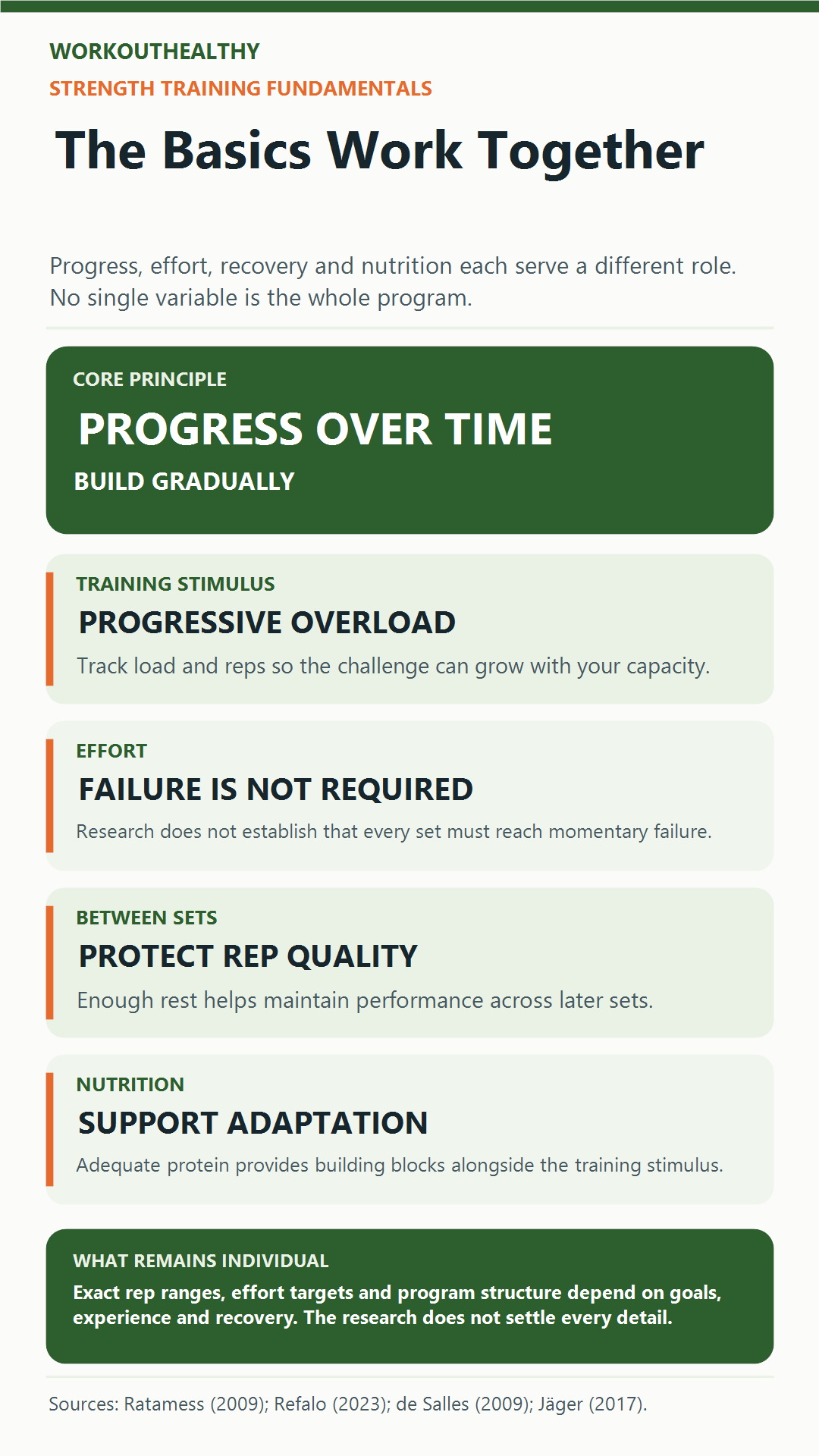
Training to momentary failure is not required for muscle growth in the pooled trials. The review did not establish a precise repetitions-in-reserve target or a joint-health advantage.
Strength training also has consequences that reach beyond the muscles being trained directly.
A large systematic review found that people who did resistance training had a lower risk of dying from any cause over the study periods (Saeidifard et al., 2019).
These observational associations do not prove that lifting itself caused the lower mortality risk; studies also differ in how they account for aerobic activity.
It is part of why strength training belongs in the same conversation as daily step counts and long term mortality risk, not as a separate, optional add on.
There is also growing evidence connecting resistance training to brain health outcomes later in life, though this is a newer and still developing research area.
What This Evidence Does Not Prove
None of this research settles every question about strength training.
Real, active scientific disagreement still exists in a few specific areas.
The exact ideal rep range for building muscle is one of them.
Studies show meaningful muscle growth across a wide range, from roughly six reps to thirty reps per set.
That happens as long as sets are taken reasonably close to failure.
Scientists do not fully agree on how much rep range itself matters once effort and volume are accounted for.
Whether every single set should approach failure, or only some sets in a session, is also unsettled.
The Refalo review found similar outcomes between the two approaches, but it pooled a modest number of trials.
Larger studies over longer timeframes would strengthen that conclusion in either direction.
Deload weeks, meaning planned lighter training weeks, are another gray area.
Coaches widely use them, but strong trial evidence on the ideal frequency is limited.
Genetics also plays a real role in how quickly two people respond to an identical program.
Researchers still cannot precisely predict an individual’s response to a program ahead of time.
Being honest about these gaps is part of taking the actual research seriously.
Common Mistakes
A common mistake is treating one single variable as the entire answer.
Some lifters obsess over an exact rep range while ignoring whether load or reps rise over time.
Others take every set to failure even when it is not needed for their goal; persistent joint pain deserves individual assessment rather than a single assumed cause.
Skipping rest between sets to finish a workout faster is another frequent error.
Very short rests can reduce repetitions or load on later heavy sets, which may undercut a maximal-strength goal.
Ignoring protein intake while chasing perfect programming is another common gap.
A lifter can have flawless set and rep numbers and still under recover without enough protein.
Copying an advanced periodization plan without the training history to need it is another trap.
A true beginner does not need the same complexity as someone with five years of hard training behind them.
A Practical Takeaway
Start with progressive overload as the backbone of any program.
Track your weights and reps so you actually know whether you are progressing.

Here are nine evidence-supported takeaways from the research reviewed above. This is our synthesis, not an official nine-point consensus statement or one universal workout prescription:
- Strength is trainable: resistance work can improve strength and function, including in later life.
- Progress gradually: add appropriate challenge over time instead of repeating an unchanged workload forever.
- Match training to the goal: a strength goal and an endurance goal do not require identical sessions.
- Do enough quality work: sustainable sets across weeks matter more than one heroic workout.
- Failure is optional: most sets can stop with a little capacity left.
- Rest supports performance: do not rush heavier sets merely to keep the clock moving.
- Protein supports adaptation: adequate daily intake matters, but exact meal timing is less settled.
- Recovery matters: allow enough time and resources to repeat productive training.
- Age is modifiable, not erasable: training can improve age-related strength loss, but cannot guarantee that sarcopenia fully reverses.
A meta-analysis of randomized trials in older adults with sarcopenia found substantial strength improvements with resistance training but smaller average changes in muscle mass. That distinction matters when interpreting the social post’s shorthand about reversal.
It also does not require youth.
A Guinness World Record holder for oldest female bodybuilder is living proof that age is not the barrier people assume it is.
Strength training has also become one of the more popular paths people choose for fitness.
A reader preference survey cannot establish the health effects of lifting; the controlled studies and reviews above are the relevant evidence for these claims.
Consistency with these basics, applied for months and years, is what the actual research supports.
Watch the video
Want more like this? Subscribe to WorkoutHealthy Insider for practical explanations behind popular fitness claims.
References
Sun, R., et al. (2025). Effectiveness of resistance training on body composition, muscle strength, and biomarker in sarcopenic older adults: A meta-analysis of randomized controlled trials. Archives of Gerontology and Geriatrics. PubMed 39191151.
de Salles, B. F., Simão, R., Miranda, F., Novaes, J. S., Lemos, A., & Willardson, J. M. (2009). Rest interval between sets in strength training. Sports Medicine, 39(9), 765 to 777. https://doi.org/10.2165/11315230-000000000-00000
Jäger, R., Kerksick, C. M., Campbell, B. I., Cribb, P. J., Wells, S. D., Skwiat, T. M., Purpura, M., Ziegenfuss, T. N., Ferrando, A. A., Arent, S. M., Smith-Ryan, A. E., Stout, J. R., Arciero, P. J., Ormsbee, M. J., Taylor, L. W., Wilborn, C. D., Kalman, D. S., Kreider, R. B., Willoughby, D. S., Hoffman, J. R., Krzykowski, J. L., & Antonio, J. (2017). International Society of Sports Nutrition position stand: Protein and exercise. Journal of the International Society of Sports Nutrition, 14, 20. https://doi.org/10.1186/s12970-017-0177-8
Ratamess, N. A., Alvar, B. A., Evetovich, T. K., Housh, T. J., Kibler, W. B., Kraemer, W. J., & Triplett, N. T. (2009). American College of Sports Medicine position stand: Progression models in resistance training for healthy adults. Medicine & Science in Sports & Exercise, 41(3), 687 to 708. https://doi.org/10.1249/MSS.0b013e3181915670
Refalo, M. C., Helms, E. R., Trexler, E. T., Hamilton, D. L., & Fyfe, J. J. (2023). Influence of resistance training proximity to failure on skeletal muscle hypertrophy: A systematic review with meta-analysis. Sports Medicine, 53(3), 649 to 665. https://doi.org/10.1007/s40279-022-01784-y
Saeidifard, F., Medina-Inojosa, J. R., West, C. P., Olson, T. P., Somers, V. K., Bonikowske, A. R., Prokop, L. J., Vinciguerra, M., & Lopez-Jimenez, F. (2019). The association of resistance training with mortality: A systematic review and meta-analysis. European Journal of Preventive Cardiology, 26(15), 1647 to 1665. https://doi.org/10.1177/2047487319850718
Williams, T. D., Tolusso, D. V., Fedewa, M. V., & Esco, M. R. (2017). Comparison of periodized and non-periodized resistance training on maximal strength: A meta-analysis. Sports Medicine, 47(10), 2083 to 2100. https://doi.org/10.1007/s40279-017-0734-y
This article is for general information only and is not medical advice. If you have an injury, ongoing pain, or a medical condition, talk to a doctor or physical therapist before you change how you train or eat.