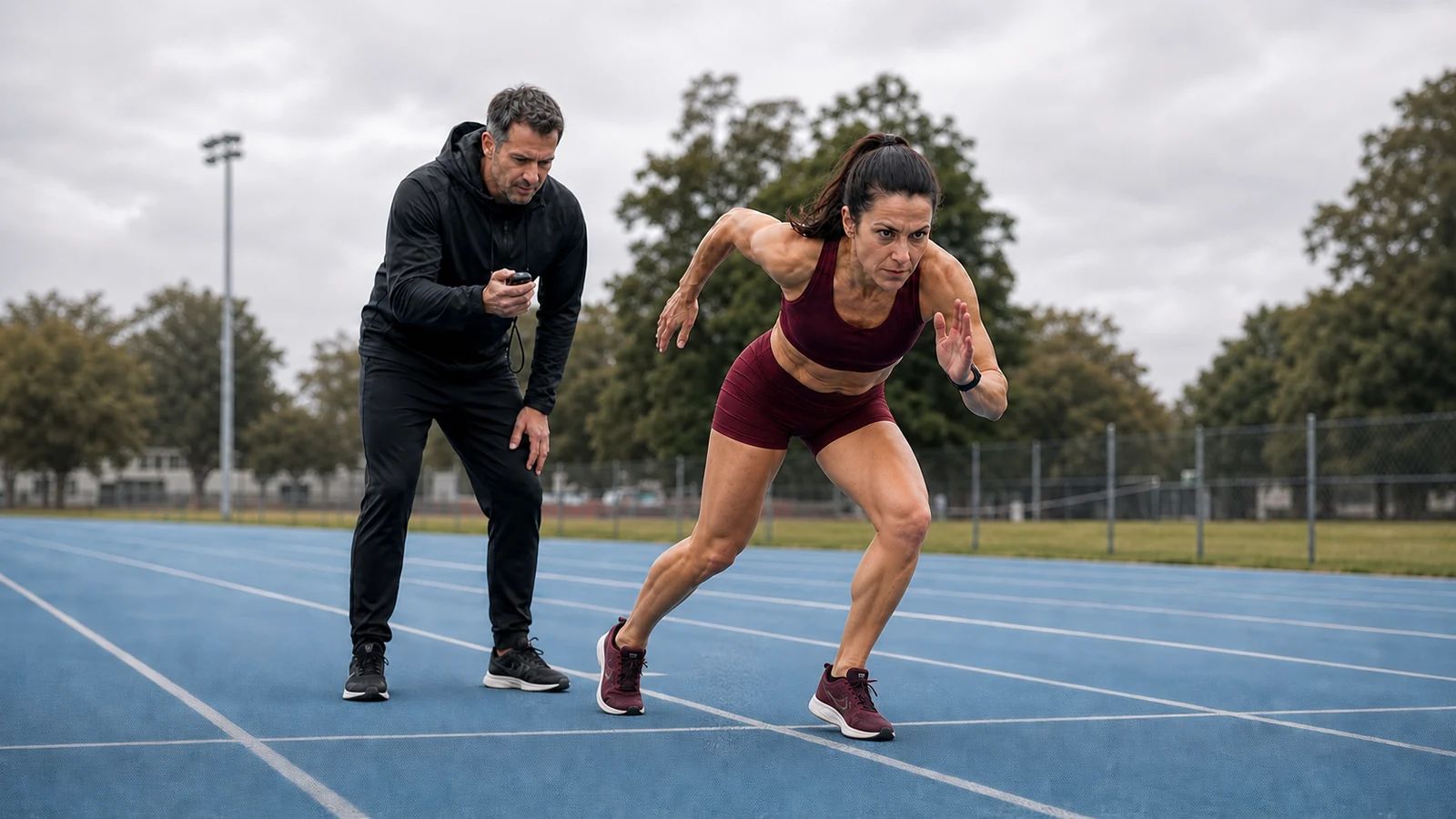

A YouTube video called “Athletic Performance Doesn’t Die at 35, Here’s My Proof” is getting attention right now.
The video comes from Jonathan Clark, a masters track and field athlete known online as JClarkTheJUMPER.
He argues that age 35 is not the finish line many people assume it is.
That claim is worth checking against the actual science, not just against one athlete’s story.
What the Video Claims
Clark’s video centers on his own results as a jumper who kept competing well past his mid thirties.
He frames his own numbers as proof that athletic decline is not locked to a fixed age.
We cannot independently verify his personal marks, so we are treating them as his own reported experience.
That is different from treating them as confirmed data, and it matters for how you read this article.
What we can check is the much larger body of research on aging athletes as a group.
That research does not depend on any single person’s claim, and it tells a nuanced story.
What Real Research Shows About Athletic Performance and Age
Scientists have studied masters athletes for decades because they offer a rare natural experiment.
These are people who kept training hard well into their thirties, forties, fifties, and beyond.
A 2010 study pooled record level data across six masters sports, from track to weightlifting (Baker & Tang, 2010).
It found that peak performance holds up fairly well through the thirties and forties.
The decline becomes steeper only after about age 70, not right after 35.
That general pattern held across very different sports, from swimming to weightlifting to distance running.
The researchers described the shape as fairly flat through midlife, followed by a much steeper drop after roughly age 70.
That trend line came from decades of official competition records, not from survey answers or self reports.
This is the kind of evidence base an individual claim like Clark’s cannot match, no matter how sincere it is.
Across sport after sport, performance does not fall off a cliff at 35. It fades slowly for decades before the real drop off begins.
A separate study focused only on power based events like sprinting and jumping (Rittweger et al., 2009).
Researchers compared world record power output to world record endurance output across every age group.
They found that power declines faster with age than aerobic endurance does.
This matters directly for a jumper like Clark, since jumping is a power event, not an endurance one.
In other words, his sport sits in the category research says ages the fastest, not the slowest.
Another study followed masters sprinters and measured exactly how their 100 meter times changed with age (Korhonen et al., 2003).
It found that slower times came mostly from a shorter stride, not from legs turning over more slowly.
That detail matters, because stride length depends heavily on how much force the legs can produce.
Less force production is exactly what you would expect if raw muscle power was fading.
The Mechanism: Why Power Fades, and Why Training Still Matters
The biology behind this pattern centers on a process called sarcopenia (Doherty, 2003).
Sarcopenia is the gradual loss of muscle mass and strength that comes with getting older.
It does not affect every type of muscle fiber equally.
Fast-twitch fibers, the ones built for quick, powerful movements, tend to shrink and disappear first.
Slow-twitch fibers, the ones built for steady endurance work, tend to hold up longer.
That is one reason sprinting and jumping ability often fades before easy paced endurance ability does.
Motor neurons that control fast-twitch fibers are also lost at a higher rate with age (Doherty, 2003).
Fewer motor neurons means fewer muscle fibers can fire together at the same moment.
Fewer fibers firing together means less force produced in a short amount of time.
Less force in a short amount of time is the exact definition of lower power output.
Tendons also get stiffer and less springy with age, which changes how a jump or sprint uses stored elastic energy.
That stiffness shift adds to the muscle changes above, rather than replacing them.
We covered this same muscle loss process in more detail in our article on losing weight and muscle mass.
None of this means training is pointless after 35.
A separate line of research draws a sharp line between two different kinds of aging (Tanaka & Seals, 2003).
One is called primary aging, the decline that happens from biology alone, no matter what you do.
The other is called secondary aging, the extra decline that comes from simply not training anymore.
Much of the drop off seen in typical adults comes from secondary aging, not primary aging.
Trained masters athletes still decline with age, but they decline from a much higher starting point.
A well trained sprinter in their fifties is nowhere near an untrained person’s speed at that same age.
This is the piece of research that lines up most closely with what Clark is describing in his own case.
Consistent training appears to preserve a large amount of capacity, even though some decline still happens.
Studies on trained older lifters and jumpers point to the same lever again and again, which is keeping some heavy, fast, forceful work in the plan.
Steady, moderate paced cardio alone does not seem to protect power output the same way strength and jump training does.
Trained masters athletes do not escape aging. They experience a much gentler version of it than people who stop training.
A 2017 review made a related point using the phrase “the trajectory of healthy human ageing” (Lazarus & Harridge, 2017).
Even elite masters athletes, people who train seriously their entire lives, still lose performance as they age.
The researchers argue that this decline may be a basic feature of being human, not simply a training gap.
That is a more honest framing than either extreme.
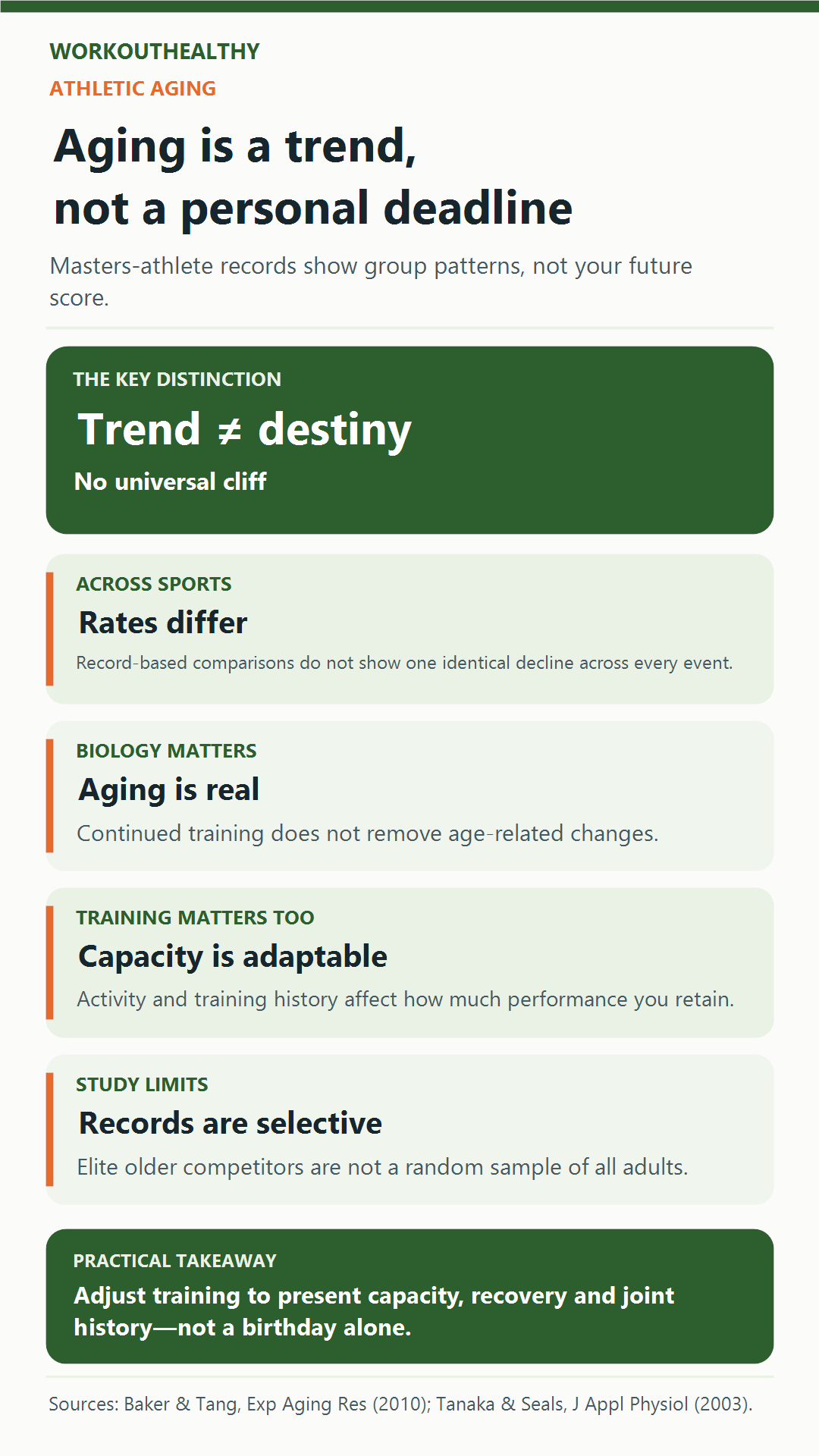
Decline is not optional, but its size and its timing are not fixed either.
For a documented example of building serious physical capacity later in life, see our coverage of Edith Connor’s Guinness World Record, set decades past Clark’s current age range.
Staying active later in life also pays off in ways that have nothing to do with a stopwatch.
Our piece on whether lifting weights keeps your brain young covers what the research found for cognitive function.
What This Evidence Does Not Prove
This research does not prove that any specific person can match their twenties performance at 40.
Group level data describes averages and trends, not a guarantee for one individual.
Genetics, injury history, sport choice, and training background all shape how any one athlete ages.
The research also does not verify Clark’s own specific numbers, because we have no independent record of them.
It supports his general point that decline is gradual and trainable, not his exact personal statistics.
It also does not prove that everyone should train like a competitive masters athlete.
Elite masters athletes are a self-selected group who tolerate high training loads unusually well.
Their experience does not automatically apply to someone with joint pain, past injuries, or a sedentary background.
Common Mistakes People Make After 35
One common mistake is assuming decline is inevitable and quitting hard training altogether.
The research above suggests that choice accelerates the very decline people are trying to avoid.
A second mistake is doing the opposite, training exactly like a 25 year old with no adjustment.
Recovery generally slows with age, and ignoring that raises injury risk without adding much benefit.
A third mistake is dropping power and speed work entirely in favor of only steady cardio.
Since power qualities fade first, they are also the ones that benefit most from direct, ongoing practice.
A fourth mistake is skipping a proper warm up before explosive movements like jumps or sprints.
Tendons and connective tissue also change with age, and they need more preparation time than they used to.
A fifth mistake is skipping medical clearance when it actually matters.
Anyone with a joint replacement, an uncontrolled heart condition, or a recent injury should check with a doctor before resuming jumping or sprinting.
That caution applies at any age, but it matters more as impact forces and joint stress rise with explosive training.
A Practical Takeaway
The research supports a specific, moderate message rather than either extreme in this debate.
Athletic performance does decline with age, and pretending otherwise is not supported by the evidence.
That decline is also not a cliff at 35, and it is not fixed or automatic either.
Consistent strength and power work appears to be the biggest lever most people actually control.
That means keeping some jumping, sprinting, or explosive movement in a routine, not just walking or light cardio.
Our article on whether box jumps build muscle covers one accessible way to keep training power safely.
Anyone returning to explosive training after a long break should start light and progress slowly.
A physical therapist or qualified coach can help build a plan that fits an individual’s joint history.

Clark’s underlying message, that 35 is not an ending, holds up reasonably well against the research.
His personal proof is his own story to tell, and it is not something this article can confirm or deny.
Watch the video
Want more like this? Subscribe to WorkoutHealthy Insider for practical explanations behind popular fitness claims.
References
Baker, A. B., & Tang, Y. Q. (2010). Aging performance for masters records in athletics, swimming, rowing, cycling, triathlon, and weightlifting. Experimental Aging Research, 36(4), 453 to 477. https://doi.org/10.1080/0361073X.2010.507433
Doherty, T. J. (2003). Invited review: Aging and sarcopenia. Journal of Applied Physiology, 95(4), 1717 to 1727. https://doi.org/10.1152/japplphysiol.00347.2003
Korhonen, M. T., Mero, A., & Suominen, H. (2003). Age-related differences in 100-m sprint performance in male and female master runners. Medicine and Science in Sports and Exercise, 35(8), 1419 to 1428. https://doi.org/10.1249/01.mss.0000079080.15333.ca
Lazarus, N. R., & Harridge, S. D. R. (2017). Declining performance of master athletes: silhouettes of the trajectory of healthy human ageing? The Journal of Physiology, 595(9), 2941 to 2948. https://doi.org/10.1113/JP272443
Rittweger, J., di Prampero, P. E., Maffulli, N., & Narici, M. V. (2009). Sprint and endurance power and ageing: an analysis of master athletic world records. Proceedings of the Royal Society B: Biological Sciences, 276(1657), 683 to 689. https://doi.org/10.1098/rspb.2008.1319
Tanaka, H., & Seals, D. R. (2003). Invited review: Dynamic exercise performance in Masters athletes: insight into the effects of primary human aging on physiological functional capacity. Journal of Applied Physiology, 95(5), 2152 to 2162. https://doi.org/10.1152/japplphysiol.00320.2003
This article is for general information only and is not medical advice. If you have an injury, ongoing pain, or a medical condition, talk to a doctor or physical therapist before you change how you train or eat.