

Did a study show that 10 squats every 45 minutes blunt a blood sugar spike? No.
The 2024 trial tested ten three-minute squat breaks, not ten repetitions.
For a movement reminder, record both repetitions and time; do not use the labels interchangeably.
Study comparison
Eighteen young men with overweight or obesity completed four randomized crossover conditions over 8.5-hour laboratory days.
| Condition | Protocol | Glucose-area summary |
|---|---|---|
| Sitting | No activity break | 10.2 |
| One walk | One 30-minute walk | 9.2 |
| Walking breaks | Ten three-minute walks, every 45 minutes | 7.9 |
| Squatting breaks | Ten three-minute squat breaks, every 45 minutes | 7.9 |
These net incremental glucose-area values summarize the laboratory day, not personal glucose readings or targets. They do not establish the effect of ten quick repetitions.
Both repeated-break conditions had the same summary value; squats were not uniquely necessary.

A habit prompt
Choose whether your reminder asks for a duration or a repetition count. Write the choice down so you can repeat the same task.
A repetition challenge is a different task from a timed block. Label a personal reminder as a habit prompt rather than a measured glucose intervention.
Choose a comfortable movement for your setting, such as walking or supported chair stands. Use the care guidance below when a medical condition or symptom affects that choice.
What the experiment cannot prove
This acute study was neither a months-long intervention nor a trial in people with diabetes. It did not establish diabetes prevention, exercise replacement or predictable control of an individual post-meal spike.
A different crossover study in 12 normal-weight young adults used three-minute bodyweight-exercise breaks every 30 minutes and found higher post-meal glucose than sitting. Different populations and protocols prevent treating the studies as a direct replication or a universal squat prescription.
The ADA’s 2026 guidance includes sitting breaks within individualized care and regular aerobic and resistance exercise, not as a complete replacement program.
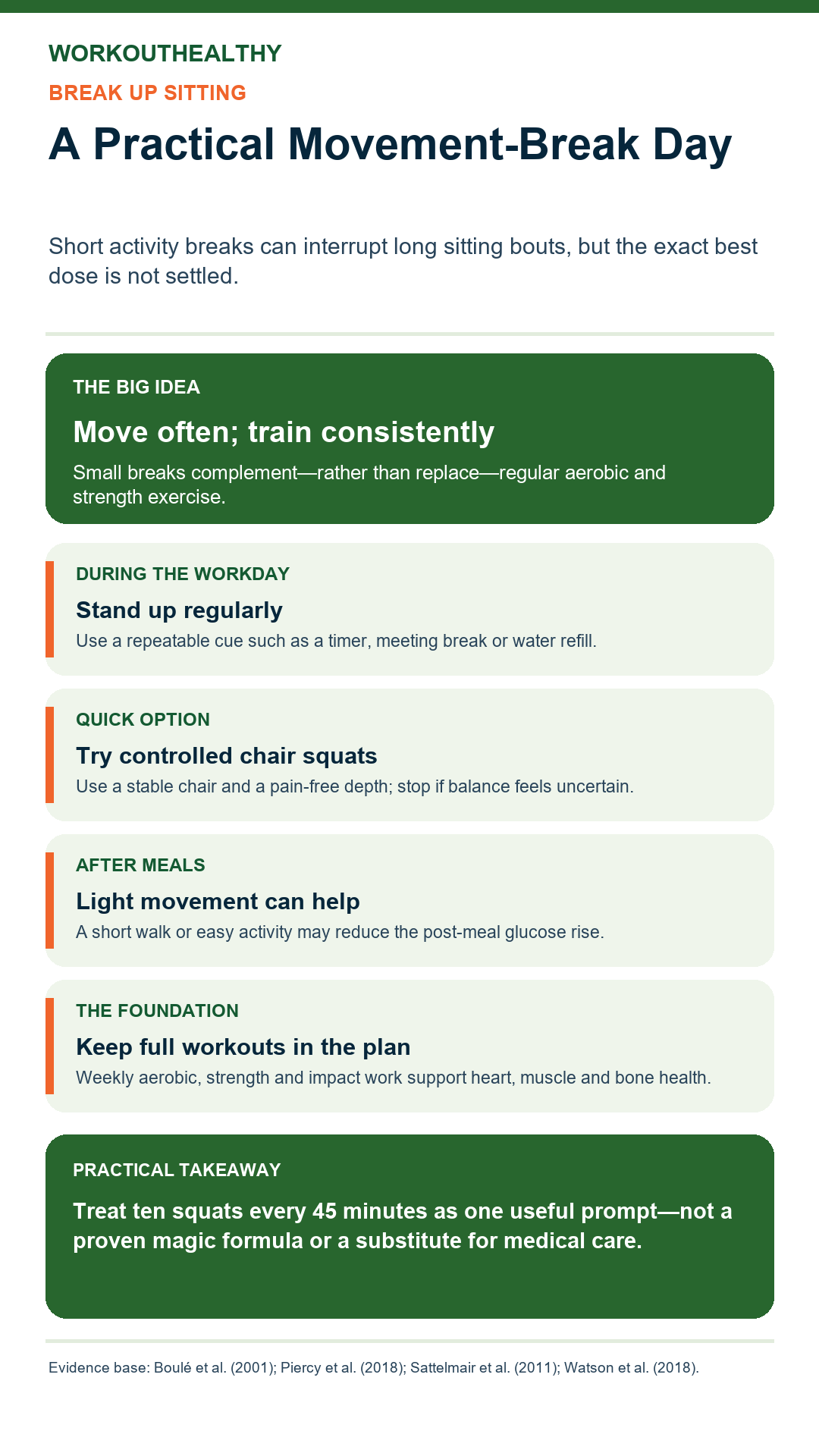
A workable movement-break choice
- Notice when a long sitting block is coming, such as desk work or a lengthy meeting.
- Choose a movement you can do safely in that setting, such as a short walk or supported sit-to-stands.
- Set a reminder if it helps, but do not treat 45 minutes or 10 repetitions as a medically required interval.
- Keep a separate plan for aerobic and strength activity that fits your health and schedule.
Use this checklist to plan a reminder, not a medical glucose-control protocol. Our guide to movement after long sitting offers more positioning options when floor or hanging exercises do not fit.
If you take insulin or another medicine that can cause low glucose, ask your care team how activity affects your monitoring and medication plan. People with joint pain, balance concerns, or cardiovascular symptoms should adapt the movement with a qualified clinician rather than copying a timed squat challenge.
Where the original video fits
The original APRC Health & Physiotherapy video is offered as additional context. The written study comparison above addresses a different, tightly defined question.
Sources
- Gao et al. (2024), four-arm interrupted-sitting crossover study.
- Charlett et al. (2021), bodyweight-exercise break crossover study.
- American Diabetes Association, Standards of Care in Diabetes 2026: physical activity and sitting breaks.
This article is general fitness and health information, not a diagnosis or personal glucose-management plan. Ask a clinician about movement and monitoring if you have diabetes, use glucose-lowering medication, or have another medical condition.