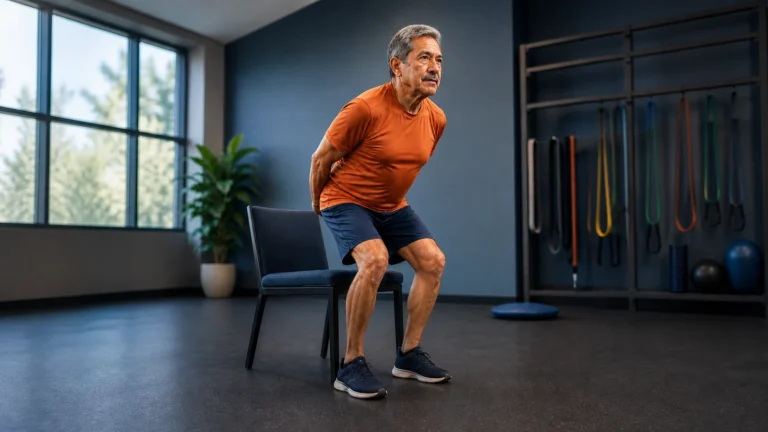

A fitness channel called Body Kind Fitness posted a 30 minute power walk workout.
The whole session stays standing, with no equipment and no floor work.
The pitch is simple.
Walk briskly in place for 30 minutes and get a real cardio workout.
Power walking sounds almost too easy to count as serious exercise.
No running, no jumping, and no gym membership required.
But a large body of research has actually studied brisk walking as its own form of cardio.
Some of it even compares power walking directly against running.
Here is what that research says, and where the video’s pitch holds up.
What the Video Claims
The video comes from a channel called Body Kind Fitness.
It runs 30 minutes and stays entirely standing.
The format is an all standing power walk, meant to be done at home.
No jogging, no jumping, and no equipment are required.
The promise is a real cardio workout built entirely around a brisk walking pace.
Viewers are told they can raise their heart rate and burn real calories without ever leaving the spot they are standing in.
That is a specific, testable claim.
Can walking briskly in place actually deliver meaningful cardio benefit, the kind researchers can measure?
That question has a real answer, and it comes from decades of walking research.
What Real Research Shows About Power Walking
Power walking is not just walking done faster for no reason.
Researchers use a specific measure called cadence, or steps per minute, to gauge how hard a walk actually is.
A major review pulled together decades of walking research to answer one practical question (Tudor-Locke et al., 2018).
How fast do you actually need to walk before it counts as moderate intensity exercise?
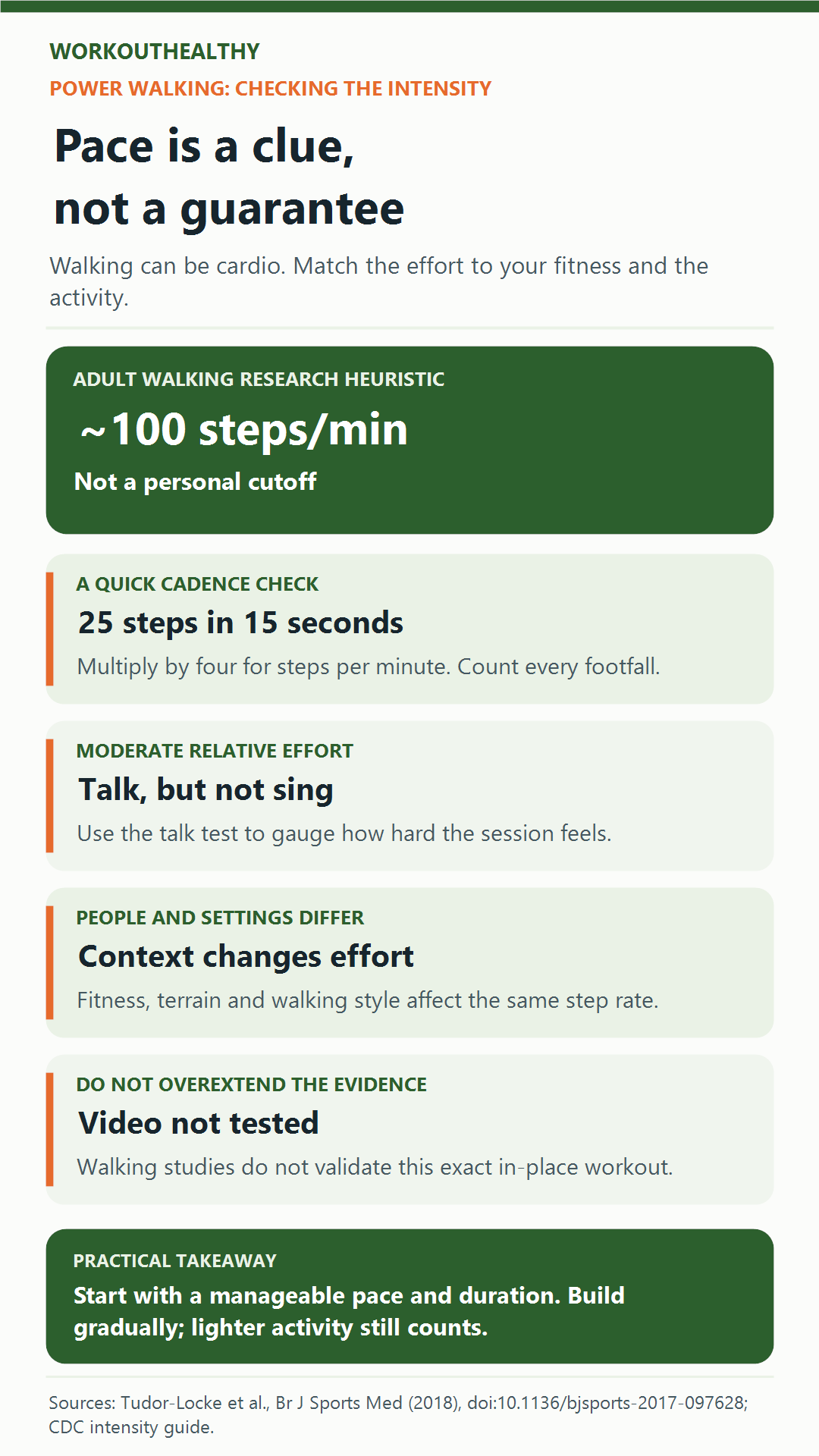
The review concluded that roughly 100 steps per minute is a reasonable floor for moderate intensity walking in most adults (Tudor-Locke et al., 2018).
That works out to about three steps every two seconds, a noticeably brisk pace.
Below that cadence, walking tends to sit closer to light activity than real cardio.
At or above it, heart rate and breathing typically climb into a moderate intensity training zone.
Roughly 100 steps a minute marks the point where an ordinary walk starts to count as real cardio.
This matters because power walking is defined by pace, not just by distance covered.
A slow stroll and a brisk power walk can cover the same mile.
They still do very different things to your heart rate along the way.
The cadence research gives people a simple, practical target they can feel without a lab or a heart rate monitor.
If you can comfortably talk but could not sing along to a song, you are usually in that moderate intensity range.
Walking at this pace for extended time has real cardiovascular payoff, not just a faster mile split on paper.
Distance still matters too, and our guide on how many miles you should walk a day covers that part of the picture.
Total daily steps have also been linked to lower long term mortality risk, which we cover in our piece on daily steps and mortality.
A natural question follows the pace research.
If walking briskly enough counts as real cardio, how does it actually compare to running?
One large study followed tens of thousands of walkers and runners over several years (Williams & Thompson, 2013).
Researchers matched the two groups by total energy expended, not by minutes exercised.
People who walked off a certain number of calories showed similar health improvements as people who ran off that same number of calories (Williams & Thompson, 2013).
Both groups saw comparable drops in blood pressure, cholesterol, and diabetes risk (Williams & Thompson, 2013).
The intensity of the exercise mattered less than the total energy spent doing it (Williams & Thompson, 2013).
That is a meaningful finding for anyone who cannot or does not want to run.
Power walking can reach similar cardiovascular payoff to running.
It usually just takes more time to burn the same calories running would burn faster.
That tradeoff is worth knowing, since a 30 minute power walk and a 30 minute run are not calorie equivalent.
Our breakdown of reader opinions in why most readers favor weightlifting over running shows how divisive the running debate already is among our own audience.
None of this means running has no advantage at all.
Running simply reaches a given calorie total faster, since it costs more energy per minute than walking does.
For someone with limited time, that speed advantage is real.
For someone with joint concerns or a preference for lower impact movement, power walking offers a genuine path to the same measured outcomes.
Pace and Total Steps Are Not Opponents
The social claim says a dedicated brisk walk matters more than all the steps accumulated across the day. Current evidence does not support that either-or conclusion.
A meta-analysis of 15 cohorts found progressively lower mortality risk as daily steps increased, with the association leveling off around 6,000 to 8,000 steps for adults 60 and older and 8,000 to 10,000 for younger adults (Paluch et al., 2022).
After researchers adjusted for total steps, time spent at 100 steps per minute or faster was not independently associated with lower mortality in that analysis. Peak cadence still showed an association, but observational data cannot prove that walking faster caused the difference.
A separate U.S. cohort of 4,840 adults also found that total step count was associated with mortality while step intensity was not significant after accounting for total steps (Saint-Maurice et al., 2020).
The practical answer is to keep both levers. Accumulate movement across the day, then include brisk sessions when your joints, fitness, and schedule allow.
Heart-rate zones can help describe effort, but watch estimates and age-based formulas are imperfect. The talk test is often simpler: moderate effort usually allows conversation but not singing, while vigorous effort makes more than a few words at a time difficult.
The Mechanism: Why Picking Up the Pace Changes the Math
Calorie burn during walking does not rise in a straight line as you speed up.
Researchers measured the actual oxygen cost of walking and running across a range of speeds in a lab (Hall et al., 2004).
At slow to moderate paces, walking stayed fairly efficient, close to how it feels during daily life.
Once walking speed climbed toward a brisk, power walking pace, the energy cost rose faster than expected (Hall et al., 2004).
Existing prediction formulas actually underestimated how much energy fast walking really burns (Hall et al., 2004).
That is the biomechanical reason power walking feels harder than a stroll, even over the exact same distance.
Your stride shortens as your pace climbs toward the top of a comfortable walking speed.
Your hips and ankles have to work harder to keep that quick turnover going without breaking into a jog.
Near the top end of walking speed, that added inefficiency becomes part of the workout, not a flaw in it.
It is part of why some research treats very fast walking as metabolically similar to slow jogging (Hall et al., 2004).
That holds even though your feet never technically leave the ground during a power walk.
Arm drive adds to this effect too.
Swinging your arms with real force recruits your shoulders and upper back into the effort.
That extra muscle work raises your heart rate beyond what leg movement alone would produce.
A power walk video built around active arm movement is using this mechanism directly.
For comparison, our look at calories burned jumping rope shows just how far intensity can push the calorie math in a different cardio style.
Fast walking is not simply an easier version of jogging. Past a certain pace, it becomes its own metabolic demand.
What This Evidence Does Not Prove
None of the studies above tested this exact video or its specific routine.
The cadence review analyzed walking in general, not one 30 minute standing session (Tudor-Locke et al., 2018).
The running comparison study tracked outdoor walkers and runners over years, not an indoor, standing style power walk (Williams & Thompson, 2013).
The lab study on energy cost used a treadmill, not free movement in a living room (Hall et al., 2004).
A structured, in place power walk video may burn somewhat less than open ground walking at the exact same cadence.
Arm movement, terrain, and how strictly someone follows the target pace can all shift the real number up or down.
None of this research proves that one 30 minute session will produce dramatic weight loss on its own.
Every study cited here looked at sustained activity across weeks or years, not a single workout.
Any specific calorie number the video itself might claim was not independently tested by these studies.
The running comparison study was also observational, following people rather than randomly assigning them to walk or run.
That design is strong for spotting patterns, but it cannot prove cause and effect the way a controlled trial can.
Common Mistakes People Make With Power Walking
The most common mistake is walking too slowly to hit real cardio intensity.
A relaxed stroll rarely reaches the 100 steps per minute range that counts as moderate intensity (Tudor-Locke et al., 2018).
Another mistake is keeping your arms still while your legs do all the work.
Driving your arms actively raises your heart rate and adds real effort to the pace.
Some people round their shoulders forward to move faster.
That posture can strain the neck and lower back over a long session.
Staying upright with a tall posture protects your spine while you push the pace.
Skipping a warm up before jumping straight into a brisk pace is another common shortcut.
A few minutes of slower walking first gives your joints and heart rate time to adjust.
Comparing your results directly to a runner’s calorie burn, minute for minute, sets up an unfair comparison (Hall et al., 2004; Williams & Thompson, 2013).
Wearing worn out shoes during a long power walk session can add unnecessary strain on your feet and knees.
Anyone with a diagnosed heart condition, joint injury, or balance issue should check with a doctor before starting a new brisk walking routine.
A Practical Way to Power Walk for Real Cardio Benefit
Aim for a pace where talking stays possible but singing does not.
That effort level usually lines up with the moderate intensity cadence research described above (Tudor-Locke et al., 2018).
If you want a concrete number, count your steps for 15 seconds and multiply by four.
A result near 25 steps in that window puts you close to the 100 steps per minute mark.
Three to five sessions a week is a reasonable starting frequency for most healthy adults.
Start with 15 to 20 minutes if a full 30 feels like too much at first.
Add a few extra minutes each week instead of overhauling the whole routine at once.
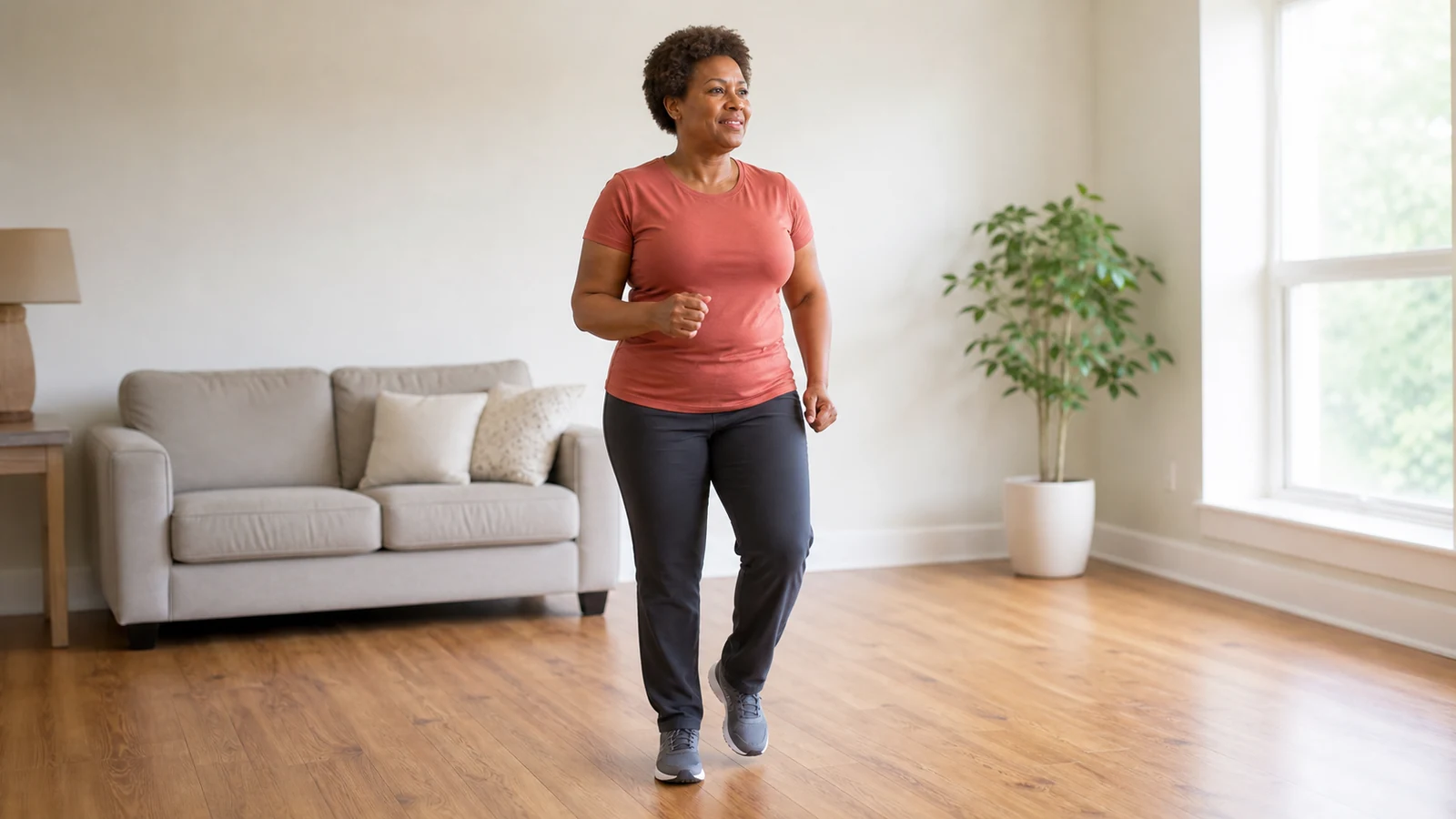
Swing your arms with real intent, since that alone raises the effort without adding any impact.
Keep a slight bend in your knees rather than locking them straight with every step.
Rate of perceived exertion is a simple guide, aim to feel like you are working around a five or six out of ten.
Pair power walking sessions with basic strength work when you can, since cardio alone does not protect muscle the same way.
Give any new routine at least four to six weeks before judging whether it is actually working for you.
Watch the video
Get the next evidence check.
Five practical fitness stories worth your time, every Friday.
One email a week. No product pitches. Unsubscribe in one click.
References
Hall, C., Figueroa, A., Fernhall, B., & Kanaley, J. A. (2004). Energy expenditure of walking and running: Comparison with prediction equations. Medicine & Science in Sports & Exercise, 36(12), 2128 to 2134. https://doi.org/10.1249/01.mss.0000147584.87788.0e
Tudor-Locke, C., Han, H., Aguiar, E. J., Barreira, T. V., Schuna, J. M., Jr., Kang, M., & Rowe, D. A. (2018). How fast is fast enough? Walking cadence (steps/min) as a practical estimate of intensity in adults: A narrative review. British Journal of Sports Medicine, 52(12), 776 to 788. https://doi.org/10.1136/bjsports-2017-097628
Williams, P. T., & Thompson, P. D. (2013). Walking versus running for hypertension, cholesterol, and diabetes mellitus risk reduction. Arteriosclerosis, Thrombosis, and Vascular Biology, 33(5), 1085 to 1091. https://doi.org/10.1161/ATVBAHA.112.300878
Paluch, A. E., et al. (2022). Daily steps and all-cause mortality: a meta-analysis of 15 international cohorts. The Lancet Public Health, 7(3), e219 to e228. https://pubmed.ncbi.nlm.nih.gov/35247352/
Saint-Maurice, P. F., et al. (2020). Association of daily step count and step intensity with mortality among US adults. JAMA, 323(12), 1151 to 1160. https://pubmed.ncbi.nlm.nih.gov/32207799/
Medical disclaimer: This article is for general information only and is not medical advice. If you have an injury, ongoing pain, or a medical condition, talk to a doctor or physical therapist before you change how you train or eat.