

A new video from The Proof with Simon Hill promises a masterclass in metabolic flexibility.
The channel is run by Simon Hill, a registered dietitian and podcast host known for explaining nutrition science to a general audience.
A full transcript of this specific video was not available for this article.
So instead of guessing at exact claims or quotes, this article looks at the real research instead.
It focuses on two ideas from the video’s title: metabolic flexibility and lactate as an early warning sign.
Both concepts come up often in conversations about metabolic health, but they rarely get explained with the actual studies behind them.
What the Video Title Promises
The title says the video will explain how your body burns fuel.
That phrase, metabolic flexibility, is a real concept in exercise and nutrition science.
It is not a marketing term invented for online content.
Researchers have studied it for more than two decades, mostly in the context of diabetes and obesity risk.
One widely cited review traces the modern use of the term back to work on insulin resistance in muscle tissue (Galgani, Moro, & Ravussin, 2008).
The video’s framing around lactate as a warning sign is newer territory for a general fitness audience.
But lactate research itself is decades old and comes from serious exercise physiology labs.
This article treats both ideas separately, starting with what metabolic flexibility actually means.
Podcasters and content creators sometimes simplify complicated physiology to fit a short video format.
That is not automatically wrong, but it is worth checking the underlying science before repeating a claim as fact.
What Metabolic Flexibility Actually Means
In simple terms, metabolic flexibility is your body’s ability to switch fuels.
A metabolically flexible body leans on fat for energy when you are fasting or resting.
It shifts toward carbohydrate right after a carb heavy meal or during hard exercise.
A landmark review in Cell Metabolism describes this switching ability as central to overall metabolic health (Goodpaster & Sparks, 2017).
People with insulin resistance often lose some of this switching ability.
Their muscles keep burning a similar fuel mix no matter what they just ate or how active they were.
Researchers call this pattern metabolic inflexibility (Galgani, Moro, & Ravussin, 2008).
It shows up in lab tests as a blunted rise in fat burning during fasting, and a blunted rise in carb burning after a meal.
A blunted fuel-switching response can be seen with insulin resistance, but it is not an established clinical early-warning test.
Researchers usually measure it in a lab using indirect calorimetry, a method that tracks the gases you breathe out to estimate which fuel your body is burning.
That kind of testing is not available at a typical gym or doctor’s office, which is part of why the concept stays mostly inside research papers.
Metabolic flexibility is not about which diet you follow. It is about whether your body can adjust its fuel choice at all.
Why Researchers Are Studying Resting Lactate
Lactate is a molecule your muscles make constantly, not just during hard exercise.
For decades, most people treated lactate as a waste product from anaerobic effort.
That view is outdated.
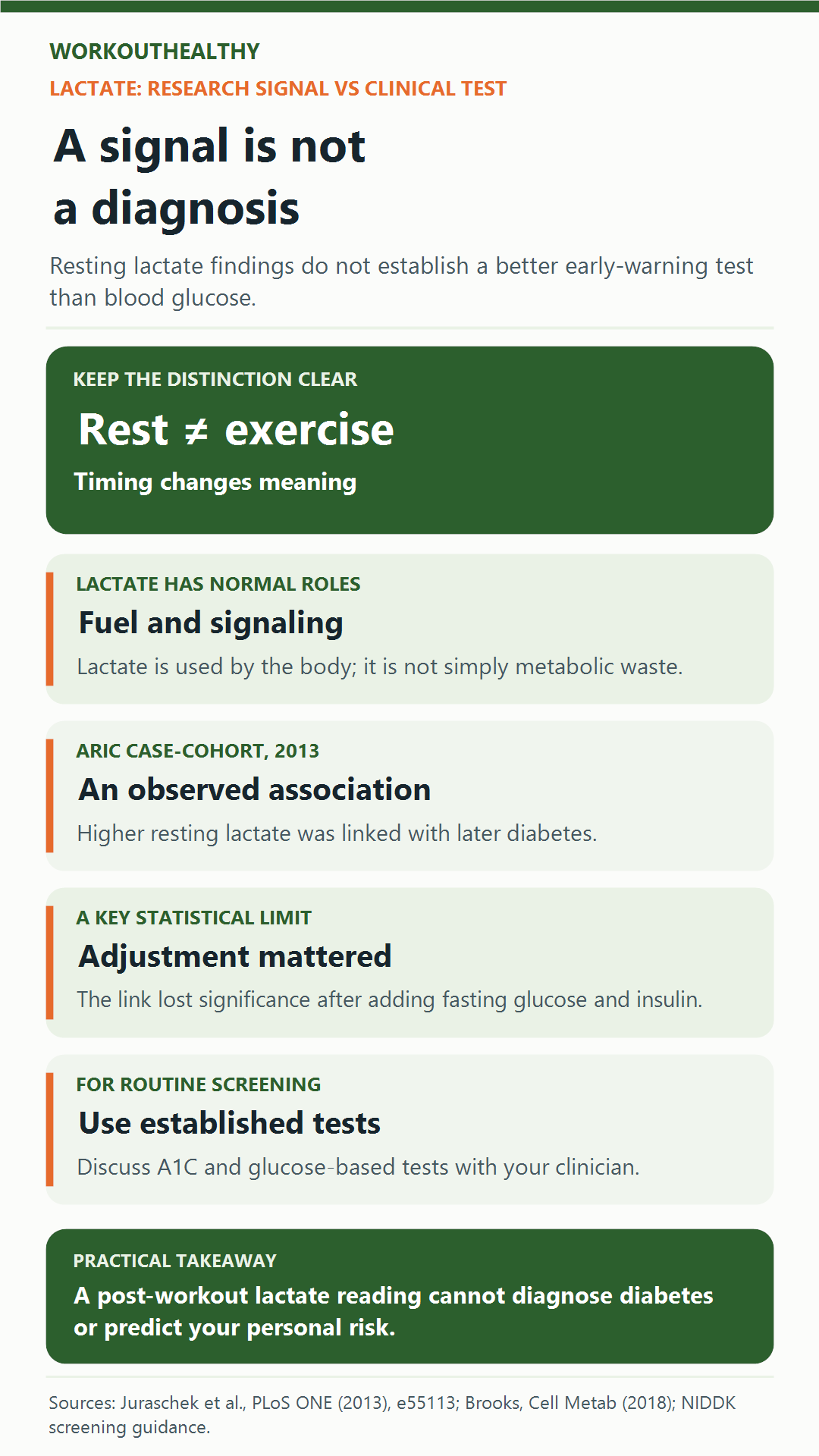
A major review in Cell Metabolism shows lactate acts as a fuel source and a signaling molecule throughout the body (Brooks, 2018).
Your liver, heart, and even your brain can use lactate for energy.
Because lactate production is tied closely to how your body handles glucose, resting lactate levels can reflect underlying metabolic health.
A large study followed more than 8,000 adults for close to nine years (Juraschek et al., 2013).
People with higher resting lactate levels at the start of the study had a meaningfully higher risk of developing type 2 diabetes later on.
The association weakened and was no longer statistically significant after fasting glucose and insulin were included in the model.
That makes resting lactate a research signal worth studying, not a validated screening replacement for blood glucose or A1C.
Muscle handles a large share of glucose disposal in the body.
Losing muscle mass can therefore affect how well you manage blood sugar, a link explored in our piece on losing weight and muscle mass.
The Mechanism: How Fuel Switching Breaks Down
Muscle cells contain the machinery for burning both fat and carbohydrate.
Mitochondria are the small structures inside cells that turn fuel into usable energy.
When mitochondria work well, they adjust their output based on which fuel is most available.
In insulin resistant muscle, that adjustment slows down (Goodpaster & Sparks, 2017).
Fat can build up inside and around muscle fibers instead of being burned efficiently.
This buildup can worsen insulin resistance further.
That creates a cycle that is genuinely hard to break through diet changes alone.
Exercise is the intervention with the most consistent evidence for interrupting that cycle, because contracting muscle pulls glucose out of the blood even without extra insulin.
Over time, regular training also increases the number and quality of mitochondria inside muscle cells.
Insulin normally signals muscle cells to open glucose transporters called GLUT4, letting sugar move out of the blood and into the muscle.
When insulin resistance sets in, that signal gets weaker, so both the glucose uptake and the fuel switching response suffer together.
How This Compares to a Standard Blood Sugar Test
A routine physical often includes a fasting glucose test or an A1C test.
Both of those measure blood sugar directly, either at one moment or averaged over a few months.
Metabolic flexibility measures something different: how well your body adapts when the fuel supply changes.
Research suggests fuel switching problems can appear before fasting glucose moves outside the normal range (Galgani, Moro, & Ravussin, 2008).
That is part of why some researchers are interested in metabolic flexibility and lactate as earlier signals.
Neither one currently replaces a standard blood panel, and neither is recommended as a routine screening tool in most clinical guidelines.
Who Should Pay Closer Attention
A family history of type 2 diabetes raises the relevance of these markers.
So does a sedentary job, a prior gestational diabetes diagnosis, or an earlier prediabetes diagnosis.
People with a larger waist circumference tend to show more pronounced metabolic inflexibility in lab studies (Goodpaster & Sparks, 2017).
None of this means you should panic over a single number.
It means these are reasonable topics to raise at your next checkup, especially if you already carry one of these risk factors.
A doctor can order standard blood work and interpret it inside your full health picture, which a video or a home test kit cannot do.
What This Evidence Does Not Prove
None of this research proves that one high lactate reading, by itself, causes diabetes.
The ARIC study found an association between resting lactate and diabetes risk, not a guaranteed cause and effect relationship (Juraschek et al., 2013).
Lactate levels can shift with hydration, recent meals, caffeine, and even stress.
A single reading from a fingertip test sold by a wellness company is not the same as a controlled lab measurement taken under standard conditions.
Most of the strongest metabolic flexibility research also comes from tightly controlled lab settings, not everyday routines.
Wearable devices that claim to estimate metabolic flexibility have not been validated against the lab methods used in these studies.
A YouTube video, even one built on real science, can frame a slow moving research field as more settled or more dramatic than it actually is.
Common Mistakes People Make
One common mistake is chasing a single number instead of watching a pattern.
Lactate, glucose, and insulin all shift throughout the day for normal reasons.
A single test tells you far less than a trend measured over several weeks.
Another mistake is assuming one diet trick can fix metabolic flexibility overnight.
No single meal, fast, or supplement has been shown to reliably restore fuel switching in a day.
A third mistake is skipping physical activity, which has the strongest evidence behind it of anything discussed here.
Consistent movement, more than any specific eating window, remains the best supported lever for improving these markers.
A fourth mistake is over relying on consumer continuous glucose monitors marketed to people without diabetes.
These devices were built and validated for people managing an existing diagnosis, not for interpreting day to day fuel switching in a healthy adult.
A Practical Takeaway
You do not need a lab or a wearable to start building better metabolic flexibility.
Regular movement is the most consistently supported tool researchers point to.
Daily walking is linked to lower long term health risks in large population studies, and our breakdown of daily steps and mortality covers what that research actually supports.
If you want a simple daily target to start with, our guide on how many miles you should walk a day breaks it down in plain terms.
Strength training matters too, since active muscle tissue is what pulls glucose out of the bloodstream.
Preserving muscle as you age or lose weight is part of that same picture, which our article on losing weight and muscle mass explains in more depth.
Breaking up long stretches of sitting also helps, since muscle contraction pulls glucose out of the blood even in short bursts.

Sleep matters as well, because even a few nights of short sleep can measurably reduce insulin sensitivity in healthy adults.
None of these habits require special equipment or a subscription.
The most reliable path to better metabolic flexibility is boring. It is consistent movement, not a single test result.
Do not build your whole self assessment around one lactate number from a home test kit.
Talk to a doctor before making major changes to your diet or training based on any single biomarker.
Watch the video
Want more like this? Subscribe to WorkoutHealthy Insider for practical explanations behind popular fitness claims.
References
Brooks, G. A. (2018). The science and translation of lactate shuttle theory. Cell Metabolism, 27(4), 757 to 785. https://doi.org/10.1016/j.cmet.2018.03.008
Galgani, J. E., Moro, C., & Ravussin, E. (2008). Metabolic flexibility and insulin resistance. American Journal of Physiology-Endocrinology and Metabolism, 295(5), E1009 to E1017. https://doi.org/10.1152/ajpendo.90558.2008
Goodpaster, B. H., & Sparks, L. M. (2017). Metabolic flexibility in health and disease. Cell Metabolism, 25(5), 1027 to 1036. https://doi.org/10.1016/j.cmet.2017.04.015
Juraschek, S. P., Shantha, G. P. S., Chu, A. Y., Miller, E. R., Guallar, E., Hoogeveen, R. C., Ballantyne, C. M., Brancati, F. L., Schmidt, M. I., Pankow, J. S., & Young, J. H. (2013). Lactate and risk of incident diabetes in a case-cohort of the Atherosclerosis Risk in Communities (ARIC) Study. PLoS ONE, 8(1), e55113. https://doi.org/10.1371/journal.pone.0055113
This article is for general information only and is not medical advice. If you have an injury, ongoing pain, or a medical condition, talk to a doctor or physical therapist before you change how you train or eat.