

A video from Kristen Sparrow, MD calls the metformin longevity trend a myth.
The title promises to show what new studies actually found.
Millions of people already take metformin every day for type 2 diabetes.
A smaller, newer group takes it off label, hoping it slows aging itself.
That anti-aging use is not an approved use, and it remains a real scientific debate.
Here is what the current, verifiable research actually supports, and what it still does not.
What the Video Claims
Dr. Kristen Sparrow is a physician who reviews popular health claims on YouTube.
Her video title calls the metformin anti-aging idea a myth.
It frames new studies as the reason that myth fell apart.
We could not independently verify every specific claim made inside the video itself.
So this article checks the underlying science directly, using published, citable research on metformin and aging.
Where a claim traces back to the video’s own framing rather than a source we could confirm, that is noted plainly below.
Where the Metformin Longevity Idea Came From
The metformin anti-aging idea has two main roots.
One root is animal research.
A 2013 study found that metformin extended lifespan in mice at a specific, carefully chosen dose (Martin-Montalvo et al., 2013).
That same study linked metformin to better health markers in the mice, not just a longer life span on its own.
The other root is population data collected in people who already had diabetes.
A 2014 study compared people newly started on metformin to a matched group of people without diabetes at all (Bannister et al., 2014).
The metformin group lived about as long, or slightly longer, than the non-diabetic comparison group.
That surprising result helped launch much bigger ambitions for the drug.
Researchers led by endocrinologist Dr. Nir Barzilai proposed a large human trial called TAME, short for Targeting Aging with Metformin.
The FDA agreed in 2015 to let researchers study aging itself as a trial outcome, a first for any drug at the time.
TAME has faced years of funding delays since then.
As of this writing, it has not produced a completed, published result on metformin and lifespan in healthy, non-diabetic older adults.
The Mechanism: Why Researchers Thought Metformin Might Help
Metformin does not work like most other diabetes drugs.
It lowers blood sugar mainly by telling the liver to produce less glucose.
Inside individual cells, metformin also activates an enzyme called AMPK.
AMPK acts like an energy sensor for the cell.
When AMPK switches on, cells tend to shift toward more efficient energy use and less growth signaling.
Some of those same pathways show up in animals that naturally live unusually long lives.
Metformin also mildly blocks a part of the mitochondria called complex I.
That mild block appears to trigger some of the same stress-adaptation responses seen with calorie restriction.
Researchers hoped these overlapping pathways meant metformin could mimic parts of calorie restriction, without requiring anyone to actually eat less.
AMPK activation also tends to dial down a separate growth pathway called mTOR.
mTOR is the same pathway targeted by rapamycin, a drug with a much stronger longevity track record in lab animals.
Some cell studies also link metformin to lower markers of cellular senescence, a process where old, damaged cells build up and stop dividing properly.
Every one of these findings comes from cells in a dish or animals in a lab, not from a completed human aging trial.
That gap between cell biology and a confirmed human outcome is exactly what the newer 2025 research set out to address.
Metformin’s anti-aging promise traces back to a diabetes drug being asked to do a job it was never designed, tested, or approved for in people who do not have diabetes.
What the New 2025 Studies Actually Found
Two studies published in 2025 directly challenge the anti-aging narrative around metformin.
The first is a large meta-analysis published in the journal Aging Cell (Ivimey-Cook et al., 2025).
The researchers pooled 911 separate effect sizes from 167 papers covering eight different vertebrate species.
They compared metformin, rapamycin, and calorie restriction against each other, head to head.
Rapamycin closely matched the lifespan pattern seen with calorie restriction across species.
Metformin did not.
The authors described metformin’s lifespan effect across the pooled data as inconsistent, and, in their own words, inconclusive.
The second study is a formal review published in Ageing Research Reviews (Keys et al., 2025).
One of its authors, Richard Miller, spent decades helping lead a federally funded program that tests candidate longevity drugs in mice.
The review looked hard at the original observational data linking metformin to longer life in diabetics.
It flagged known weaknesses in that kind of data, including something researchers call healthy user bias.
Healthy user bias means people who fill prescriptions and keep regular doctor visits tend to be healthier to begin with, for reasons unrelated to the drug itself.
The review’s own conclusion was direct.
Developments generally illustrate an emerging uncertainty in the anti-aging potential of metformin.
That line comes directly from the Keys et al. review, not from our own summary.
Together, these two 2025 papers are likely close to what the video means when it references new studies.
What This Evidence Does Not Prove
None of this means metformin is dangerous for the people it is actually prescribed to.
Metformin remains a first-line, FDA-approved treatment for type 2 diabetes.
It carries decades of real safety data in that specific population.
What the newer research shows is narrower and more specific than a blanket verdict.
It does not prove that metformin extends lifespan in people without diabetes.
It does not prove that metformin slows biological aging in otherwise healthy adults.
The original observational studies could not fully rule out healthy user bias.
Animal lifespan data does not automatically translate into a human result.
The one human trial designed to test this question directly, TAME, still has not delivered a completed result.
TAME was designed to measure something called compressed morbidity, meaning fewer years spent sick before death, not simply a longer number on the calendar.
Even a positive TAME result years from now would need to be weighed against everyday side effects and long-term monitoring, in people who do not currently need the drug at all.
Until that changes, using metformin for anti-aging stays an unapproved, unproven use, not a confirmed benefit.
Common Mistakes People Make About Metformin and Aging
The biggest mistake is treating “some diabetics on metformin live long lives” as proof the drug caused it.
Association is not the same thing as causation, especially inside observational data like this.
A second mistake is assuming a mouse lifespan study transfers directly to human biology.
Mice are not small humans, and dosing, metabolism, and lifespan mechanics all differ in real, meaningful ways.
A third mistake is treating “off label” as a synonym for “harmless to try casually.”
Off label simply means a use the FDA has not formally evaluated or approved.
A fourth mistake matters a lot for anyone who also lifts weights.
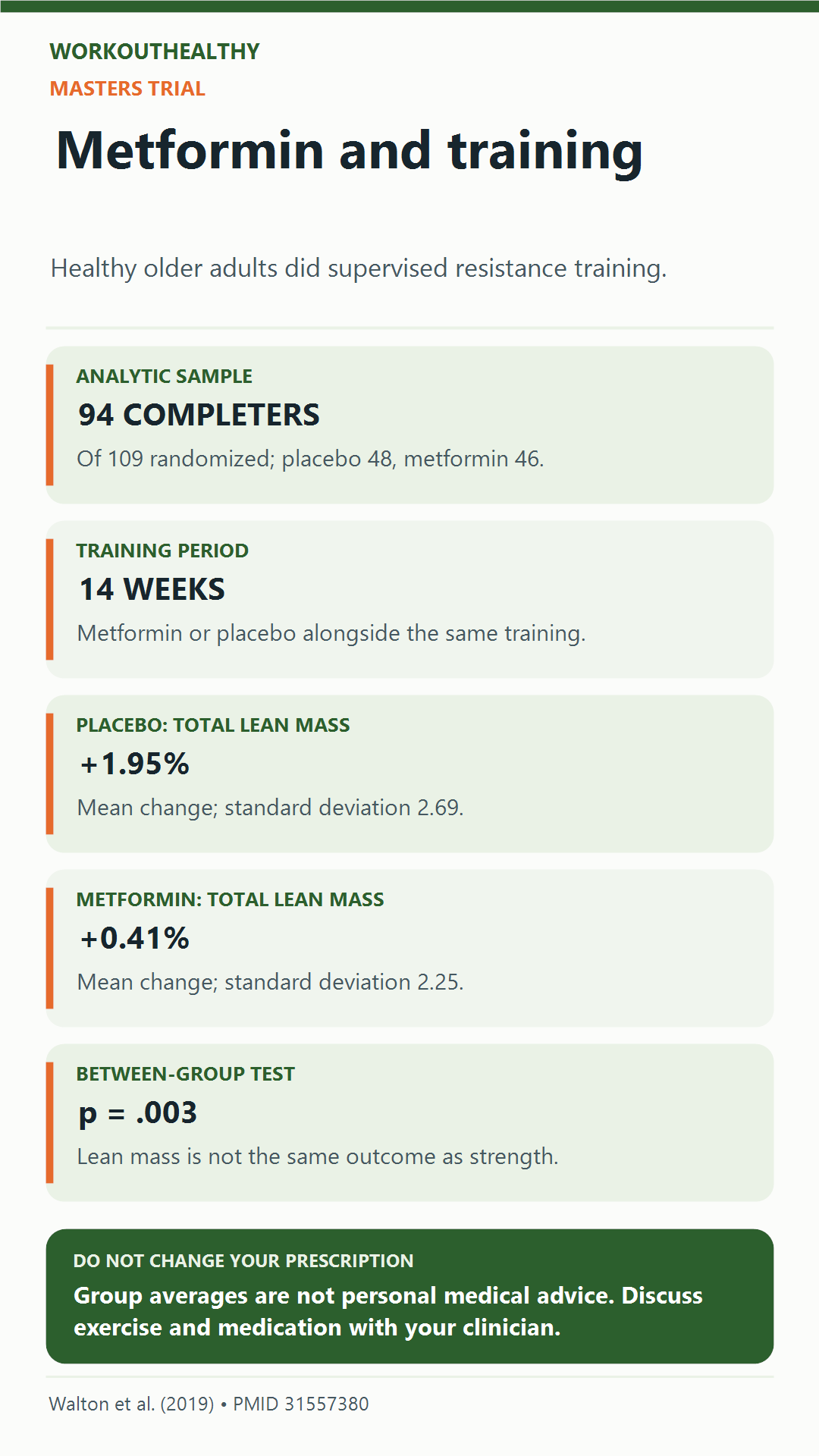
A randomized, placebo-controlled trial in older adults found that metformin blunted the muscle-building response to progressive resistance training, compared to a placebo group (Walton et al., 2019).
That does not mean metformin and strength training cannot coexist for someone who genuinely needs the drug.
It does mean the two are not simply additive, and anyone taking metformin should know that going in.
Who Should Talk to a Doctor First
Metformin is a prescription medication, not a supplement you can casually add to a routine.
A doctor needs to prescribe it, monitor it, and check on you while you take it.
People with reduced kidney function face real added risk from metformin, including a rare but serious condition called lactic acidosis.
People with significant liver disease, heavy alcohol use, or certain heart and lung conditions carry extra risk too.
Older adults taking several medications at once need a doctor to check for interactions.
Even in people who are correctly prescribed metformin, common side effects include stomach upset, diarrhea, and a metallic taste, especially early on.
Long-term use can lower vitamin B12 levels in some people, which is another reason routine bloodwork matters.
None of that makes metformin a bad drug for the job it is approved to do.
It does mean casual, unsupervised use is a genuinely different risk calculation than a doctor-managed diabetes prescription.
Anyone already prescribed metformin for diabetes should keep taking it exactly as directed.
Bring aging-related questions to that same doctor, rather than adjusting the dose or the reason for taking it on your own.

Anyone without diabetes who is curious about metformin for longevity should not obtain it informally or use a leftover prescription.
This article is not encouraging that use, and the current evidence does not support it either.
If you want to explore this with a doctor, bring the actual research, not a headline, and let a professional weigh your personal risk.
A Practical, Evidence-Based Path to Healthy Aging
The encouraging part is that some of the best-supported longevity tools do not need a prescription at all.
Regular movement remains one of the most reliably supported habits for healthy aging.
Large studies tie daily step counts to lower mortality risk.
You do not need an extreme step total to see a real benefit.
We break that research down in our piece on daily steps and mortality.
Strength training deserves its own place in that plan, and not only for the muscles.
A randomized trial found real cognitive benefits from resistance training in older adults.
We cover that study in does lifting weights keep your brain young.
Heat exposure through sauna use has its own growing evidence base for heart health.
You can read that research in our piece on sauna and heart health.
None of these tools are magic, and none of them replace real medical care for an existing condition.
But they share something the anti-aging use of metformin still does not have, which is real evidence gathered in the exact population trying to use them.
For a look at what sustainable healthy-aging habits can look like in practice, see how one public figure’s actual midlife routine held up to scrutiny in Gabrielle Union’s fitness routine at 53.
Build the boring, well-supported habits first.
Add anything else only with a doctor involved, not a headline.
Watch the Original Video
Want more like this? Subscribe to WorkoutHealthy Insider for practical explanations behind popular fitness claims.
References
Bannister, C. A., Holden, S. E., Jenkins-Jones, S., Morgan, C. Ll., Halcox, J. P., Schernthaner, G., Mukherjee, J., & Currie, C. J. (2014). Can people with type 2 diabetes live longer than those without? A comparison of mortality in people initiated with metformin or sulphonylurea monotherapy and matched, non-diabetic controls. Diabetes, Obesity and Metabolism, 16(11), 1165 to 1173. https://doi.org/10.1111/dom.12354
Ivimey-Cook, E. R., Sultanova, Z., & Maklakov, A. A. (2025). Rapamycin, not metformin, mirrors dietary restriction-driven lifespan extension in vertebrates: A meta-analysis. Aging Cell, 24(9), e70131. https://doi.org/10.1111/acel.70131
Keys, M. T., Hallas, J., Miller, R. A., Suissa, S., & Christensen, K. (2025). Emerging uncertainty on the anti-aging potential of metformin. Ageing Research Reviews, 111, 102817. https://doi.org/10.1016/j.arr.2025.102817
Martin-Montalvo, A., Mercken, E. M., Mitchell, S. J., Palacios, H. H., Mote, P. L., Scheibye-Knudsen, M., Gomes, A. P., Ward, T. M., Minor, R. K., Blouin, M. J., Schwab, M., Pollak, M., Zhang, Y., Yu, Y., Becker, K. G., Bohr, V. A., Ingram, D. K., Sinclair, D. A., Wolf, N. S., Spindler, S. R., Bernier, M., & de Cabo, R. (2013). Metformin improves healthspan and lifespan in mice. Nature Communications, 4, 2192. https://doi.org/10.1038/ncomms3192
Walton, R. G., Dungan, C. M., Long, D. E., Tuggle, S. C., Kosmac, K., Peck, B. D., Bush, H. M., Villasante Tezanos, A. G., McGwin, G., Windham, S. T., Ovalle, F., Bamman, M. M., Kern, P. A., & Peterson, C. A. (2019). Metformin blunts muscle hypertrophy in response to progressive resistance exercise training in older adults: A randomized, double-blind, placebo-controlled, multicenter trial: The MASTERS trial. Aging Cell, 18(6), e13039. https://doi.org/10.1111/acel.13039
This article is for general information only and is not medical advice. If you have an injury, ongoing pain, or a medical condition, talk to a doctor or physical therapist before you change how you train or eat.