
A YouTube video is making a bold claim about your handshake.
It says your grip strength can hint at how well you are aging, and maybe even how long you will live.
The video comes from a channel called Huberman Explained.
This channel is not run by Andrew Huberman himself, but it covers ideas from that same world of exercise science, explained for a general audience.
We wanted to know if the grip strength claim actually holds up against real, peer-reviewed research.
What the Video Claims
The video argues that strength training is the single biggest lever for long-term health.
It frames grip strength as a simple, low-cost way to check on that strength.
The claim is that a weak grip does not just mean weak hands.
It may point to weaker muscles everywhere, plus a higher risk of health problems later on.
That is a big claim to hang on one simple test.
The video also suggests that most people underestimate how much strength training protects long-term health compared to cardio alone.
It frames a grip test as a quick way to check your trajectory, not a single verdict.
So we went looking for the studies behind it.
What the Real Research Shows on Grip Strength
Grip strength as a health marker is not a new idea.
Researchers have studied it for decades.
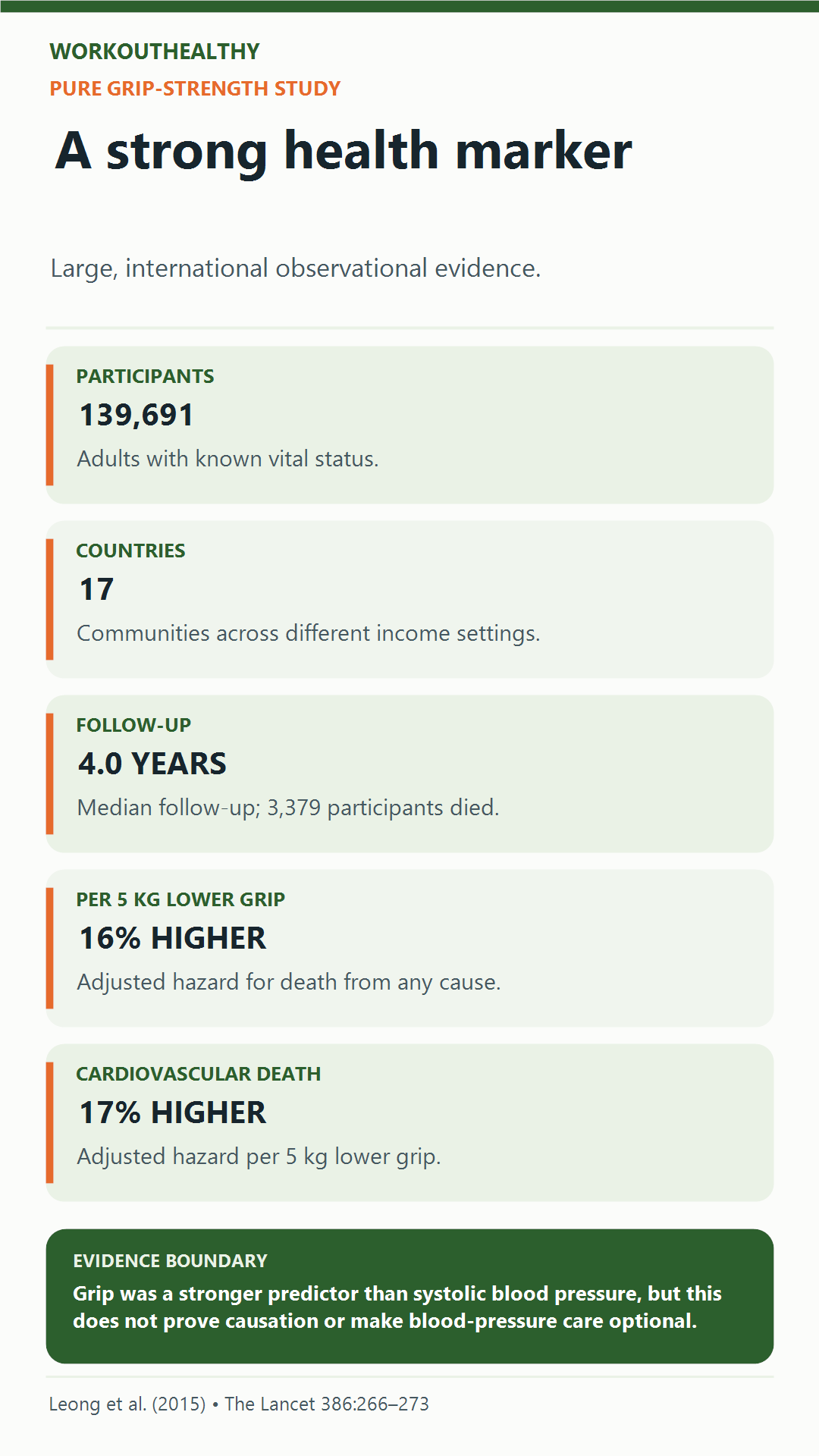
One of the largest studies came from the Prospective Urban Rural Epidemiology project, known as PURE.
Researchers tracked grip strength in nearly 140,000 adults across 17 countries and followed them for years (Leong et al., 2015).
The study included people from high-income, middle-income, and low-income countries alike.
That wide range makes the pattern harder to explain away as just wealth or access to healthcare.
Researchers followed participants for several years afterward to track who died and from what cause.
Lower grip strength was linked to a higher risk of dying during the follow up period, even after adjusting for age, smoking, and other health conditions (Leong et al., 2015).
Grip strength predicted death from any cause, and it also predicted death from heart disease.
In the PURE study, grip strength predicted death from any cause even more strongly than systolic blood pressure did.
That comparison is what made the PURE study stand out when it was published.
A simple squeeze test outperformed a measurement doctors check at nearly every visit.
A separate review backs up the general pattern.
Researchers pooled data from multiple long-term studies on physical capability and mortality (Cooper et al., 2010).
Grip strength was one of several measures included, along with walking speed and chair rising ability.
People with weaker grip strength showed a higher risk of death across nearly all the studies reviewed.
How Grip Strength Is Actually Measured
Most of these studies use a tool called a hand dynamometer.
You squeeze it as hard as you can, and it reads out a number in kilograms or pounds.
Researchers usually take the best of a few tries on each hand.
They also compare your result to normal ranges for your age and sex.
A gym grip tester or a smart luggage scale is not the same as a calibrated research dynamometer.
That is one reason a single home test should not be treated as a medical result.
The trend over months and years matters more than any single number.
Why Grip Strength Might Predict So Much
Grip strength is not magic.
Your hands are not what actually protects your health.
Researchers believe grip strength works as a stand in for something bigger, which is your overall muscle quality and function.
Muscle is not just for lifting things.
It plays a role in blood sugar control, immune function, and how your body handles illness or surgery.
A stronger grip tends to reflect a stronger, more resilient body overall.
Weaker muscles are also linked to slower nerve signaling and lower overall physical activity.
Both of those are markers of poorer health on their own, not just poor hand strength.
Grip strength also correlates with grip endurance and hand coordination, both of which decline with disuse.
Older adults who stay physically active tend to preserve nerve-to-muscle connections better than those who do not.
Fewer active connections mean fewer muscle fibers firing at full strength, and that often shows up first in smaller muscles like the hands.
So grip strength works less like a cause of a longer life, and more like a quick snapshot of your whole muscular and nervous system.
The Bigger Picture: Strength Training and Longevity
Grip strength is just one piece of a larger pattern in the research.
Muscular strength in general, not just hand strength, is tied to a lower risk of early death.
A large systematic review pooled data from studies covering almost 2 million men and women (García-Hermoso et al., 2018).
People with higher muscular strength had a meaningfully lower risk of dying from any cause during those studies.
A review covering data from nearly two million people found that stronger adults had a meaningfully lower risk of dying from any cause.
The same review also found lower cancer mortality risk among the stronger participants.
Another large analysis looked specifically at muscle strengthening activities, like resistance training (Momma et al., 2022).
People who did regular strength training had a lower risk of dying from any cause.
They also showed lower rates of heart disease, type 2 diabetes, and some cancers.
The benefit showed up even at fairly modest amounts of training, well short of an intense lifting schedule.
Researchers found the biggest drop in risk when comparing people who did some strength training to people who did none at all.
Doing more than that minimum still helped, but the added benefit got smaller past a certain point.
That pattern shows up often in exercise research, and it is good news for anyone short on time.
This lines up with what we found when we looked at whether lifting weights keeps your brain young.
Strength training keeps showing up as one of the most consistent predictors of healthy aging across very different research areas.
What This Evidence Does Not Prove
None of this means a weak grip causes an early death.
These are observational studies, which track people over time without controlling every variable in their lives.
People with health problems already underway often lose strength before anyone notices the illness itself.
That means part of the link could run backward, with illness causing weakness rather than the other way around.
Researchers call this reverse causation, and it is a real limitation in this kind of study.
Study participants also were not randomly assigned to be strong or weak.
People who are already active and healthy tend to test stronger in the first place.
Genetics, income, and access to good food and safe places to exercise all play a role too.
Researchers try to adjust for these factors statistically, but no adjustment is perfect.
The studies also cannot prove that training your grip specifically, like squeezing a hand gripper, will extend your life.
Grip strength works as a marker of overall muscle health, not a target to train in isolation.
Squeezing a stress ball more often is not the actual takeaway here.
Common Mistakes People Make
One common mistake is treating a single test result like a diagnosis.
A weak grip on one test does not mean something is seriously wrong.
Fatigue, hand injuries, and even the type of dynamometer used can change the number.
Another mistake is chasing grip strength directly instead of training the whole body.
A few minutes a day on a hand gripper will not replace real resistance training.
A third mistake is skipping strength work and relying only on walking or step counts for long-term health.
Walking has real value, but the research above suggests strength training adds something walking alone does not.
People also tend to wait too long to start strength training, often after strength has already begun declining with age.
Some people also compare their grip strength number to an average that does not match their age or sex.
Normal ranges shift quite a bit across the lifespan, so context matters more than a single cutoff.
Another mistake is doing the same strength workout for months without ever progressing it.
Muscles adapt fast, so lifting the exact same weight forever eventually stops driving much change.
Who Should Check With a Doctor First
Most healthy adults can start basic strength training safely on their own.
Some people should talk to a doctor or physical therapist before starting.
That includes anyone with uncontrolled high blood pressure or a recent heart event.
It also includes anyone with joint pain, a recent surgery, or an unhealed injury.
Older adults with a history of falls should get guidance before adding new resistance exercises.
People with osteoporosis or low bone density need a plan built around their bone health.
People on blood thinners should check in before starting heavy carries or grip-intensive lifts.
Pregnant women should get personalized guidance on which strength exercises fit each stage of pregnancy.
A sudden, one-sided drop in grip strength is worth mentioning to a doctor too.
That kind of change can point to a nerve or joint issue rather than general aging.
A Practical Way to Use This Information
You do not need a dynamometer to benefit from this research.
The real takeaway is to build and keep general muscular strength as you age.
Start with two to three strength sessions per week, using full-body movements.
Basic moves like squats, rows, presses, and carries hit most major muscle groups at once.
A simple weekly plan might include one lower body day, one upper body day, and one full-body day.
Aim for two to three sets of each exercise, in a range of about eight to twelve reps.
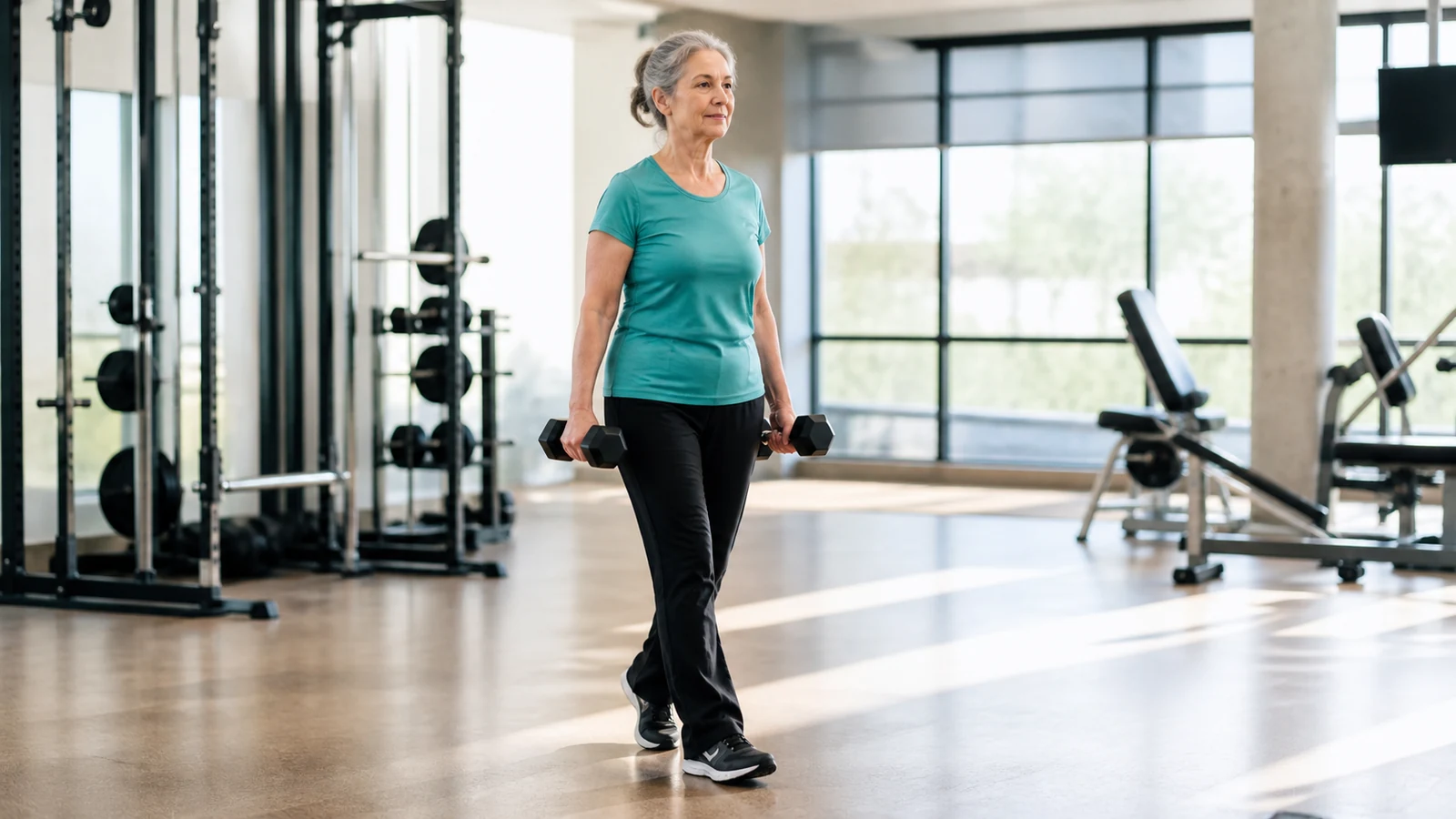
Farmer carries, suitcase carries, and dead hangs from a bar all challenge grip strength directly, alongside the rest of the body.
Rest at least one day between sessions that train the same muscle groups.
Carries in particular also challenge your grip along the way.
Progress slowly by adding small amounts of weight or a few more reps over time.
Sleep and enough protein both support the muscle building process, so they matter almost as much as the workouts themselves.
Consistency matters more than intensity, especially when you are just starting out.
If you want a simple way to track functional strength, try the four flights stair test alongside your training.
It is a low-cost way to see real-world progress, not just numbers on a chart.
Older lifters are proof that strength training keeps working at almost any age, including Edith Connor, who kept training well into her nineties.
Her story will not match everyone’s goals, but it shows the body keeps responding to training later in life than most people expect.
Watch the Original Video
Want more like this? Subscribe to WorkoutHealthy Insider for practical explanations behind popular fitness claims.
References
Cooper, R., Kuh, D., Hardy, R., & Mortality Review Group. (2010). Objectively measured physical capability levels and mortality: Systematic review and meta-analysis. BMJ, 341, c4467. https://doi.org/10.1136/bmj.c4467
García-Hermoso, A., Cavero-Redondo, I., Ramírez-Vélez, R., Ruiz, J. R., Ortega, F. B., Lee, D., & Martínez-Vizcaíno, V. (2018). Muscular strength as a predictor of all-cause mortality in an apparently healthy population: A systematic review and meta-analysis of data from approximately 2 million men and women. Archives of Physical Medicine and Rehabilitation, 99(10), 2100 to 2113. https://doi.org/10.1016/j.apmr.2018.01.008
Leong, D. P., Teo, K. K., Rangarajan, S., Lopez-Jaramillo, P., Avezum, A., Orlandini, A., Seron, P., Ahmed, S. H., Rosengren, A., Kelishadi, R., Rahman, O., Swaminathan, S., Iqbal, R., Gupta, R., Lear, S. A., Oguz, A., Yusoff, K., Zatonska, K., Chifamba, J., … Yusuf, S. (2015). Prognostic value of grip strength: Findings from the Prospective Urban Rural Epidemiology (PURE) study. The Lancet, 386(9990), 266 to 273. https://doi.org/10.1016/S0140-6736(14)62000-6
Momma, H., Kawakami, R., Honda, T., & Sawada, S. S. (2022). Muscle strengthening activities are associated with lower risk and mortality in major non-communicable diseases: A systematic review and meta-analysis of cohort studies. British Journal of Sports Medicine, 56, 755 to 763. https://doi.org/10.1136/bjsports-2021-105061
This article is for general information only and is not medical advice. If you have an injury, ongoing pain, or a medical condition, talk to a doctor or physical therapist before you change how you train or eat.