
A video making the rounds online promises something every athlete wants.
It claims a special kind of water can unlock peak athletic performance.
The video comes from a company that sells hydrogen water, a bottled product infused with extra hydrogen gas.
That detail matters a lot once you start looking at the actual science.
What the Video Claims
The video comes from Echo Hydrogen Water, a brand that makes and sells hydrogen infused water.
Its message is simple.
Drink this specific water and your athletic performance will improve.
That is a marketing claim from a company that profits when people believe it.
That does not automatically make the claim false, but it does mean the claim deserves a closer look.
The real question here is actually two separate questions.
First, does hydration in general affect athletic performance? Second, does hydrogen enriched water specifically add anything beyond normal water?
The answers to those two questions are very different, and mixing them together is where a lot of the confusion starts.
What Dehydration Actually Does to Performance
Hydration status is one of the most studied topics in sports science.
Researchers have measured it for decades using sweat testing, body weight changes, and lab based endurance trials.
The findings are remarkably consistent.
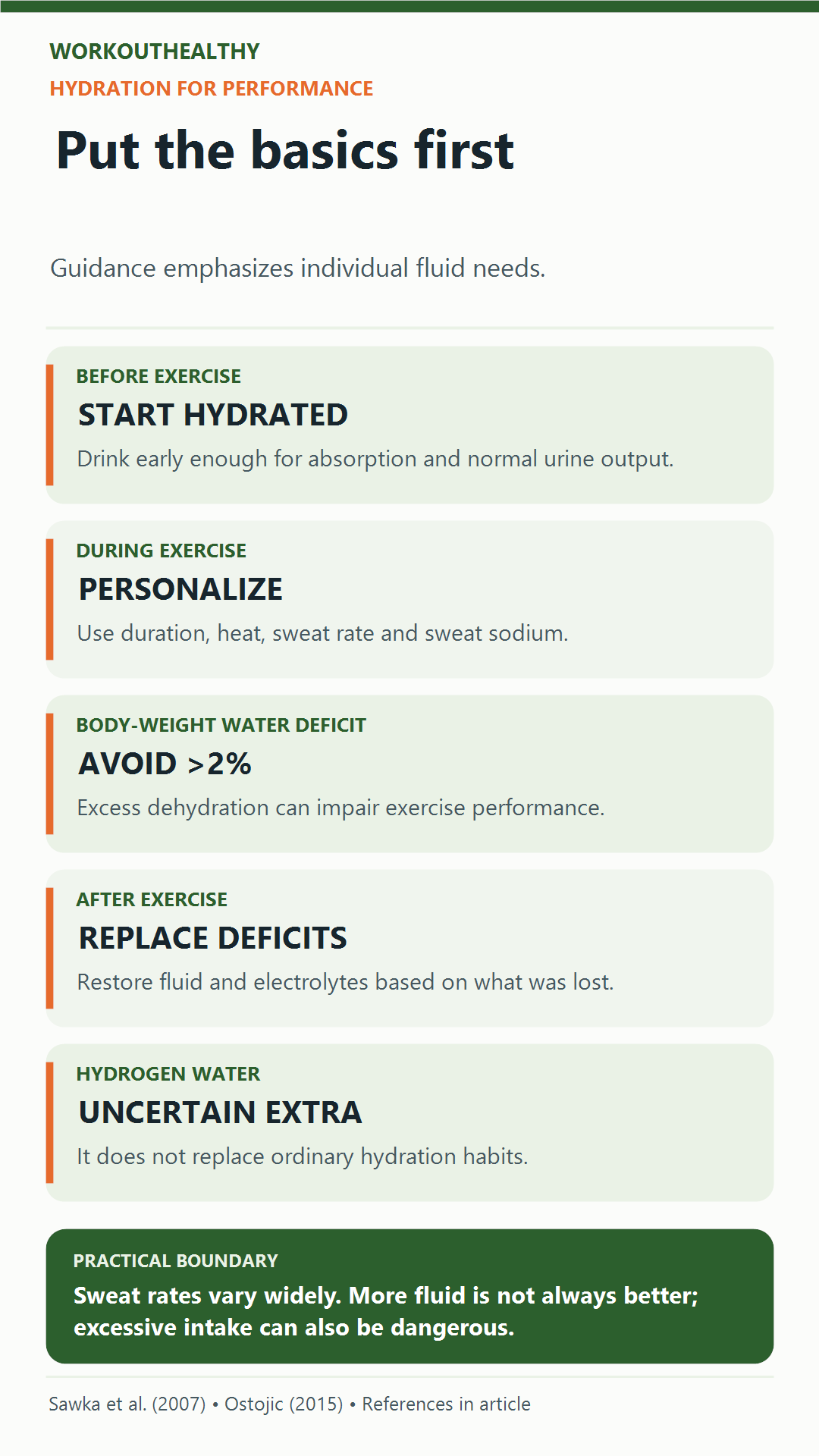
Losing as little as two percent of body weight in fluid can measurably hurt performance (Sawka et al., 2007).
Losing just two percent of body weight in sweat can start to slow you down, long before you ever feel truly thirsty.
Two percent sounds small.
For a person who weighs 170 pounds, that is only about three and a half pounds of sweat.
An hour of hard exercise in the heat can easily produce that much fluid loss.
A detailed review in the journal Comprehensive Physiology walked through decades of dehydration research and performance testing (Cheuvront and Kenefick, 2014).
That review found dehydration reduces endurance capacity most clearly during exercise lasting longer than about thirty minutes.
Shorter, more explosive efforts are affected too, just less dramatically.
In practical terms, that means a runner or cyclist going longer than half an hour is the person most likely to feel a real drop off from fluid loss.
The effect also gets worse as the heat and humidity go up.
A dehydrated athlete working out in hot weather faces two problems at once, less fluid to work with and a harder time cooling down.
Why Fluid Loss Hurts Endurance and Strength
The mechanism behind this is not mysterious.
When you sweat, your blood volume drops.
Lower blood volume means your heart has to work harder to push the same amount of blood around your body.
That raises your heart rate at any given pace, which makes exercise feel harder than it should.
Dehydration also blunts your body’s ability to send blood to your skin for cooling.
Your core temperature climbs faster as a result.
Heat is a major part of this story, and it is not unique to endurance sports.
The same cooling systems that struggle during a dehydrated run are also stressed during heat exposure like sauna use, which is why sauna and heart health research pays close attention to fluid status too.
A review focused specifically on strength, power, and high intensity endurance looked at how fluid loss affects muscular performance, not just endurance running (Judelson et al., 2007).
That review found dehydration of more than about two percent of body weight can reduce muscular strength and power output too.
The effect on strength was smaller and less consistent than the effect on endurance.
Still, it showed up in several of the studies the researchers reviewed.
This matters for anyone who lifts weights, not just runners and cyclists.
Electrolytes and Why Plain Water Is Not Always Enough
Sweat is not just water.
It carries sodium, potassium, and other electrolytes out of your body.
During long or hot workouts, that loss adds up.
Replacing fluid without replacing any electrolytes can leave your blood sodium diluted, a condition called hyponatremia.
Sports medicine guidelines recommend matching fluid intake to your sweat rate and including sodium for longer sessions (Sawka et al., 2007).
This matters most for exercise lasting more than an hour, or anything done in hot and humid conditions.
Electrolyte needs are not just about marathon distances either.
Athletes who do short, hard efforts like high intensity jump rope intervals can sweat heavily in a very short time.
Sweat sodium concentration also varies a lot between individuals.
Some people are naturally “salty sweaters” and lose more sodium per liter of sweat than others.
That is one reason generic hydration advice does not fit everyone equally well.
Athletes who train hard in the heat regularly may benefit from testing their own sweat rate rather than guessing.
What About Hydrogen Water?
This brings us back to the product behind the video.
Hydrogen water is regular water with extra molecular hydrogen gas dissolved into it.
The theory is that hydrogen gas acts as an antioxidant and reduces exercise related oxidative stress.
That is a real biological idea, and a small number of published studies have tested it.
A 2015 review in the International Journal of Sports Medicine summarized the early research on molecular hydrogen in sports settings (Ostojic, 2015).
The review described the field as promising but early.
Most of the underlying studies were small, short, and inconsistent in their results.
Some small trials reported modest reductions in blood lactate or perceived fatigue.
Other trials found no meaningful difference compared to plain water.
The evidence for hydrogen water is thin, mixed, and mostly limited to small, short term studies, nothing close to the mountain of research behind plain hydration.
None of the available research comes close to the size or consistency of the evidence behind basic hydration and electrolyte balance.
In plain terms, hydrogen water has not been shown to reliably outperform normal water for athletic performance.
If a hydrogen water product makes a workout feel better, it may simply be because a person is drinking enough fluid in the first place.
That would be a hydration effect, not a hydrogen effect.
What This Evidence Does Not Prove
It is worth being precise about what the hydration research actually shows.
It shows that dehydration hurts performance, and that correcting it helps.
It does not show that drinking extra water beyond what you lose gives you an added performance boost.
More is not automatically better.
Overdrinking carries its own risks, including the hyponatremia mentioned earlier.
The research also does not prove that any single branded water product outperforms tap water or a basic sports drink for most people.
Individual sweat rates vary a lot, so a hydration plan that works for one athlete may not fit another.
Common Hydration Mistakes People Make
Waiting until you feel thirsty is one of the biggest mistakes.
Thirst usually shows up after you are already somewhat dehydrated.
Drinking only plain water during very long or very hot sessions is another common mistake.
That approach skips electrolyte replacement entirely.
Some people go the opposite direction and drink far more than they need.
That habit can dilute blood sodium and cause its own problems.
Skipping hydration the day before a big event is another mistake.
Starting a workout already low on fluid makes everything harder from the first minute.
Relying on a specialty water product instead of a consistent hydration habit is also a mistake, especially if it replaces attention to actual sweat losses.
Heavy caffeine or alcohol intake right before a workout is another overlooked mistake.
Both can increase fluid loss through urination, working against your hydration goals.
Who Should Check With a Doctor First
Most healthy adults can follow general hydration guidance safely.
Some people should talk to a doctor before changing their fluid or electrolyte intake.
That includes anyone with kidney disease, heart failure, or a history of hyponatremia.
People on blood pressure medications or diuretics should also check first.
Those drugs directly affect fluid balance in the body.
Endurance athletes training for very long events, like ultramarathons, should get individualized guidance rather than relying on general rules.
Anyone with a history of heat illness should be extra cautious about both hydration and heat exposure.
How to Actually Hydrate for Performance
Start by drinking normally throughout the day, not just before a workout.
A simple check is your urine color. Pale yellow usually means you are reasonably hydrated.
Weigh yourself before and after a hard training session to estimate your personal sweat rate.
For sessions under an hour, plain water is usually enough for most people.
For sessions over an hour, or anything hot and humid, add electrolytes, especially sodium.
Drink consistently during exercise rather than trying to catch up afterward.
This matters just as much for daily movement as it does for formal training sessions.
That is part of why how far you walk each day can affect your day to day fluid needs too.
After exercise, aim to rehydrate with roughly one and a half times the fluid you lost.

Some of that fluid will be lost again through normal urination, so the extra margin helps you catch up fully.
If a hydrogen water product fits your budget and you enjoy it, there is no strong evidence it will hurt you.
Just do not expect it to replace good basic hydration habits.
Timing matters too.
Drinking around 16 to 20 ounces of fluid two to three hours before exercise gives your body time to absorb it and clear the excess.
A smaller amount 20 to 30 minutes before starting can top you off without leaving you feeling sloshy.
Watch the Original Video
Want more like this? Subscribe to WorkoutHealthy Insider for practical explanations behind popular fitness claims.
References
Cheuvront, S. N., and Kenefick, R. W. (2014). Dehydration: physiology, assessment, and performance effects. Comprehensive Physiology, 4(1), 257 to 285. https://doi.org/10.1002/cphy.c130017
Judelson, D. A., Maresh, C. M., Anderson, J. M., Armstrong, L. E., Casa, D. J., Kraemer, W. J., and Volek, J. S. (2007). Hydration and muscular performance: does fluid balance affect strength, power and high intensity endurance? Sports Medicine, 37(10), 907 to 921. https://doi.org/10.2165/00007256-200737100-00006
Ostojic, S. M. (2015). Molecular hydrogen in sports medicine: new therapeutic perspectives. International Journal of Sports Medicine, 36(4), 273 to 279. https://doi.org/10.1055/s-0034-1395509
Sawka, M. N., Burke, L. M., Eichner, E. R., Maughan, R. J., Montain, S. J., and Stachenfeld, N. S. (2007). American College of Sports Medicine position stand: exercise and fluid replacement. Medicine and Science in Sports and Exercise, 39(2), 377 to 390. https://doi.org/10.1249/mss.0b013e31802ca597
This article is for general information only and is not medical advice. If you have an injury, ongoing pain, or a medical condition, talk to a doctor or physical therapist before you change how you train or eat.