
A recent CNN-News18 segment says most men over 40 can boost their health with a few simple lifestyle changes.
The video points to sleep, exercise, and diet as the biggest levers.
That is a reasonable claim on its face.
But “simple lifestyle changes” can mean almost anything, so we decided to check what the actual research says about the specific changes that matter most for men in this age group.
What the Video Claims
The video frames men’s health after 40 as a turning point.
It suggests that hormone levels, muscle mass, and energy naturally start to shift around this age.
The general advice includes moving more, sleeping better, and eating with more intention.
None of that is wrong as a broad direction.
The problem is that broad directions do not tell you which specific habit gives you the most benefit for the effort you put in.
We looked at three areas the video touches on that have real, peer-reviewed research behind them.
Those areas are hormone changes with age, sleep’s effect on hormones, and exercise’s effect on muscle and lifespan.
What Happens to Testosterone After 40
Testosterone does decline with age, and this part of the video’s framing holds up.
A landmark study from the Baltimore Longitudinal Study of Aging tracked hundreds of men over several decades.
Researchers found a slow, steady drop in both total and free testosterone as men got older (Harman et al., 2001).
By their 60s, roughly one in five men in the study had testosterone low enough to meet clinical criteria for low testosterone.
That number rose to about three in ten men in their 70s.
And it reached roughly half of all men in their 80s.
This decline is gradual.
It is not a cliff that happens the day someone turns 40.
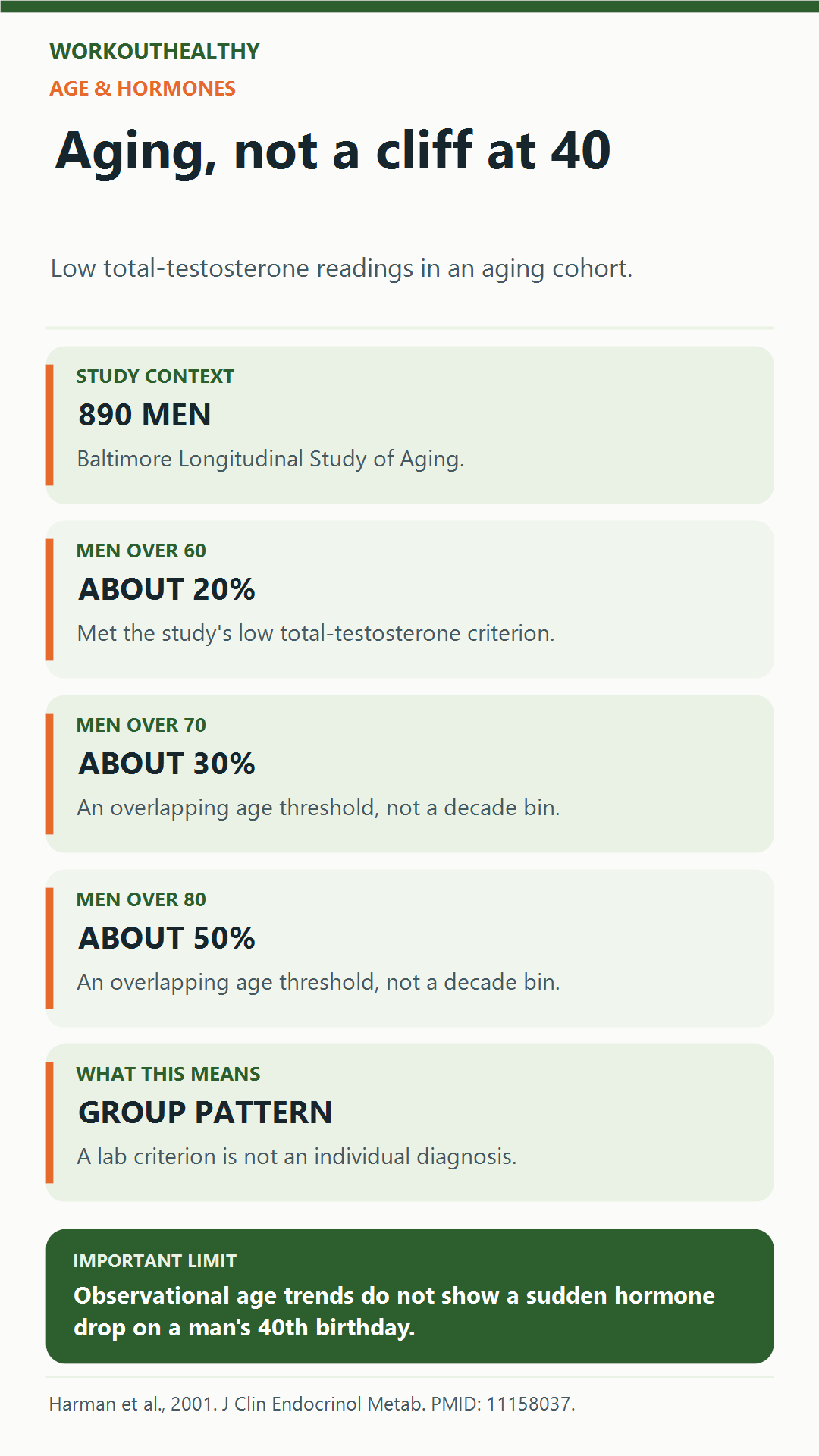
Testosterone does decline with age, but the drop is gradual, not a switch that flips on a fortieth birthday.
Why Sleep Matters More Than Men Think
Sleep is one habit that gets overlooked in most men’s health conversations.
A study out of the University of Chicago put young, healthy men through one week of restricted sleep.
The men slept only five hours a night for that week.
Their testosterone levels dropped compared to when they were well rested (Leproult & Van Cauter, 2011).
The drop was modest in absolute terms.
But researchers noted it was similar in size to the natural decline seen over roughly ten to fifteen years of normal aging.
That is a striking comparison.
A single week of short sleep produced a hormone shift that otherwise takes over a decade to happen naturally.
This particular study was done on younger men, not men specifically over 40.
Still, it shows that sleep is not a minor detail.
It is a lever that can move hormone levels in either direction.
Men already dealing with an age-related decline have less room to lose.
The researchers measured testosterone with blood draws taken across the day, not just one morning sample.
That method matters because testosterone naturally rises and falls in a daily rhythm.
The sleep-restricted men showed lower levels across nearly the entire daytime window, not just at one point.
What Resistance Training Actually Does (and Does Not Do)
The video suggests strength training as one of the key changes for men over 40.
The research on this is more nuanced than most headlines suggest.
A 2021 systematic review pooled 14 randomized controlled trials on resistance training in older adults with sarcopenia, the age-related loss of muscle (Chen et al., 2021).
Resistance training clearly improved grip strength, leg strength, walking speed, and functional mobility tests.
It also helped reduce body fat in several of the pooled trials.
But the same review found no significant increase in overall skeletal muscle mass across those trials.
That is a real and important caveat.
The researchers suggested that early strength gains often come from the nervous system learning to recruit muscle fibers more efficiently, not from muscle tissue actually growing bigger.
In plain terms, you can get noticeably stronger without a big change on the scale or in the mirror.
For most men over 40, that is still a real win.
Strength and function predict independence and injury risk better than muscle size alone.
Our article on why losing weight can sometimes cost you muscle too digs deeper into that tradeoff.
Resistance training may also support brain health as men age.
We cover that separate but related question in our breakdown of lifting weights and cognitive health.
Cardio, Walking, and the Longevity Connection
Cardiovascular exercise is the piece of the video’s advice with the strongest evidence behind it.
A massive pooled analysis combined data from more than 660,000 adults across six separate studies (Arem et al., 2015).
Researchers measured how much leisure time physical activity people reported and tracked who died over years of follow up.
People who met the standard guideline of about 150 minutes of moderate activity per week had a meaningfully lower risk of death than inactive people.
Going beyond that minimum still helped, up to a point.
The biggest jump in benefit came from going from doing nothing to doing something.
The biggest jump in benefit came from going from doing nothing to doing something.
Even modest walking counted toward this benefit in the data.
That lines up with what we found when we looked at daily step counts and mortality risk in a separate article.
It also connects to the practical question of how many miles you actually need to walk each day to get a real benefit.
The takeaway for men over 40 is simple.
You do not need to become a marathon runner to lower your risk.
You need to move consistently, most days, at a pace that gets your heart rate up.
What This Research Does Not Prove
None of these studies prove that lifestyle changes alone will add a specific number of years to your life.
The testosterone studies show a link with age and with short-term sleep loss.
They do not show permanent damage from a single bad week of sleep.
The resistance training review found no muscle mass increase, but it only pooled 561 people across 14 trials.
That is a modest sample size for a topic this broad.
The physical activity study is observational.
It cannot prove that exercise directly causes a longer life in every individual case.
People who exercise regularly may also eat better, smoke less, or have better access to healthcare.
Those factors can blur the picture.
Researchers try to adjust for this statistically, but it is never a perfect fix.
None of this means the video’s advice is wrong.
It means the advice describes a probability, not a guarantee for any one person.
Common Mistakes Men Make After 40
One common mistake is treating testosterone as the whole story.
Hormones matter, but sleep, stress, and body composition all interact with them.
Another mistake is jumping straight to supplements or testosterone therapy before trying the basics.
Exercise, sleep, and diet are cheaper, safer, and far better studied as a starting point.
A third mistake is chasing muscle size instead of strength and function.
As the sarcopenia research showed, strength can improve even when the mirror does not change much.
A fourth mistake is treating cardio and strength training as competing choices.
The research supports doing both, not picking just one.
A fifth mistake is expecting fast results.
Hormone shifts, strength gains, and longevity benefits build up over months and years, not days.
A sixth mistake is skipping recovery days entirely.
Muscle repair happens during rest, not just during the workout itself.
Training the same muscle groups hard every single day tends to backfire through fatigue, poor sleep, and a higher injury risk.
Who Should Check With a Doctor First
Men with symptoms of low testosterone should talk to a doctor before assuming lifestyle changes alone will fix it.
Those symptoms include persistent fatigue, low sex drive, or unexplained muscle loss.
A blood test can confirm whether testosterone is actually low.
Men with heart disease, uncontrolled high blood pressure, or a recent cardiac event should get medical clearance first.
This applies before starting any new cardio or strength program.
Anyone with sleep apnea or another diagnosed sleep disorder should treat that condition directly.
General sleep hygiene tips are not a substitute for treating a real sleep disorder.
Men over 40 with joint pain or a past injury should check with a doctor or physical therapist before starting heavier resistance training.
A Practical Plan You Can Actually Follow
Start with sleep, since it is free and it affects everything else on this list.
Aim for seven to nine hours a night on most nights.
Keep a consistent wake-up time, even on weekends.

Add resistance training two to three times a week.
Focus on the major muscle groups: legs, back, chest, and shoulders.
Progress slowly by adding small amounts of weight or a few more reps over time.
Add cardio on the days you are not lifting.
Walking briskly, cycling, or swimming all count toward this goal.
Aim for the 150-minute weekly target the research points to.
Track your daily steps if that helps you stay consistent.
Even a daily walk adds up meaningfully over a year.
Eat enough protein to support muscle repair, especially on training days.
Cut back on late-night screen time and alcohol, since both can hurt sleep quality.
Give any new routine at least eight to twelve weeks before judging whether it is working.
That is roughly how long it takes for measurable strength and sleep improvements to show up in most people.
Build in at least one full rest day between hard training sessions for the same muscle group.
Stay hydrated and pay attention to how caffeine timing affects your sleep, especially later in the day.
Schedule an annual checkup that includes basic bloodwork, since that is the easiest way to catch a hormone or metabolic issue early.
Small, consistent habits tend to outperform occasional intense pushes for men managing a busy schedule.
Watch the Original Video
Want more like this? Subscribe to WorkoutHealthy Insider for practical explanations behind popular fitness claims.
References
Arem, H., Moore, S. C., Patel, A., Hartge, P., Berrington de Gonzalez, A., Visvanathan, K., Campbell, P. T., Freedman, M., Weiderpass, E., Adami, H. O., Linet, M. S., Lee, I. M., & Matthews, C. E. (2015). Leisure time physical activity and mortality: A detailed pooled analysis of the dose-response relationship. JAMA Internal Medicine, 175(6), 959 to 967. https://doi.org/10.1001/jamainternmed.2015.0533
Chen, N., He, X., Feng, Y., Ainsworth, B. E., & Liu, Y. (2021). Effects of resistance training in healthy older people with sarcopenia: A systematic review and meta-analysis of randomized controlled trials. European Review of Aging and Physical Activity, 18, Article 23. https://doi.org/10.1186/s11556-021-00277-7
Harman, S. M., Metter, E. J., Tobin, J. D., Pearson, J., & Blackman, M. R. (2001). Longitudinal effects of aging on serum total and free testosterone levels in healthy men: Baltimore Longitudinal Study of Aging. The Journal of Clinical Endocrinology & Metabolism, 86(2), 724 to 731. https://doi.org/10.1210/jcem.86.2.7219
Leproult, R., & Van Cauter, E. (2011). Effect of 1 week of sleep restriction on testosterone levels in young healthy men. JAMA, 305(21), 2173 to 2174. https://doi.org/10.1001/jama.2011.710
This article is for general information only and is not medical advice. If you have an injury, ongoing pain, or a medical condition, talk to a doctor or physical therapist before you change how you train or eat.